

When Are Flights Cheapest and Can Kiwi.com Help You Find Them?
The quest for affordable airfare is a perennial challenge for travelers worldwide. In an era where travel costs can quickly escalate, understanding the dynamics of flight pricing and leveraging the right tools is paramount. Many travelers constantly ask, 'when are flights cheapest?', and the answer is rarely simple, involving a complex interplay of seasonal demand, booking windows, day-of-week trends, and even the specific algorithms employed by airlines and online travel agencies (OTAs). This comprehensive guide delves deep into these factors, providing actionable insights to help you secure the best possible deals for your next adventure in 2026 and beyond. We will uncover general truths about flight pricing, explore advanced search strategies, and critically examine the role of platforms like Kiwi.com in this intricate landscape, evaluating their unique offerings and potential trade-offs.
By the end of this article, you will not only possess a robust understanding of flight pricing mechanisms but also gain practical strategies for identifying and booking the most economical flights. We will dissect the nuances of using OTAs, specifically focusing on Kiwi.com's innovative features such as virtual interlining and its self-transfer guarantee. Furthermore, we will equip you with the knowledge to weigh the benefits of cost savings against potential risks, empowering you to make informed decisions that align with your travel style and budget. Whether you are a seasoned globetrotter or planning your first international trip, mastering the art of finding cheap flights is a skill that pays dividends, and this guide is your essential roadmap to achieving that.
When are Flights Cheapest? Unpacking the Seasonal, Day-of-Week, and Time-of-Day Factors
Flights are cheapest during off-peak seasons, typically mid-week (Tuesdays, Wednesdays) and often for early morning or late-night departures, avoiding major holidays and school breaks. These patterns are driven by demand, with airlines adjusting prices dynamically to fill seats.
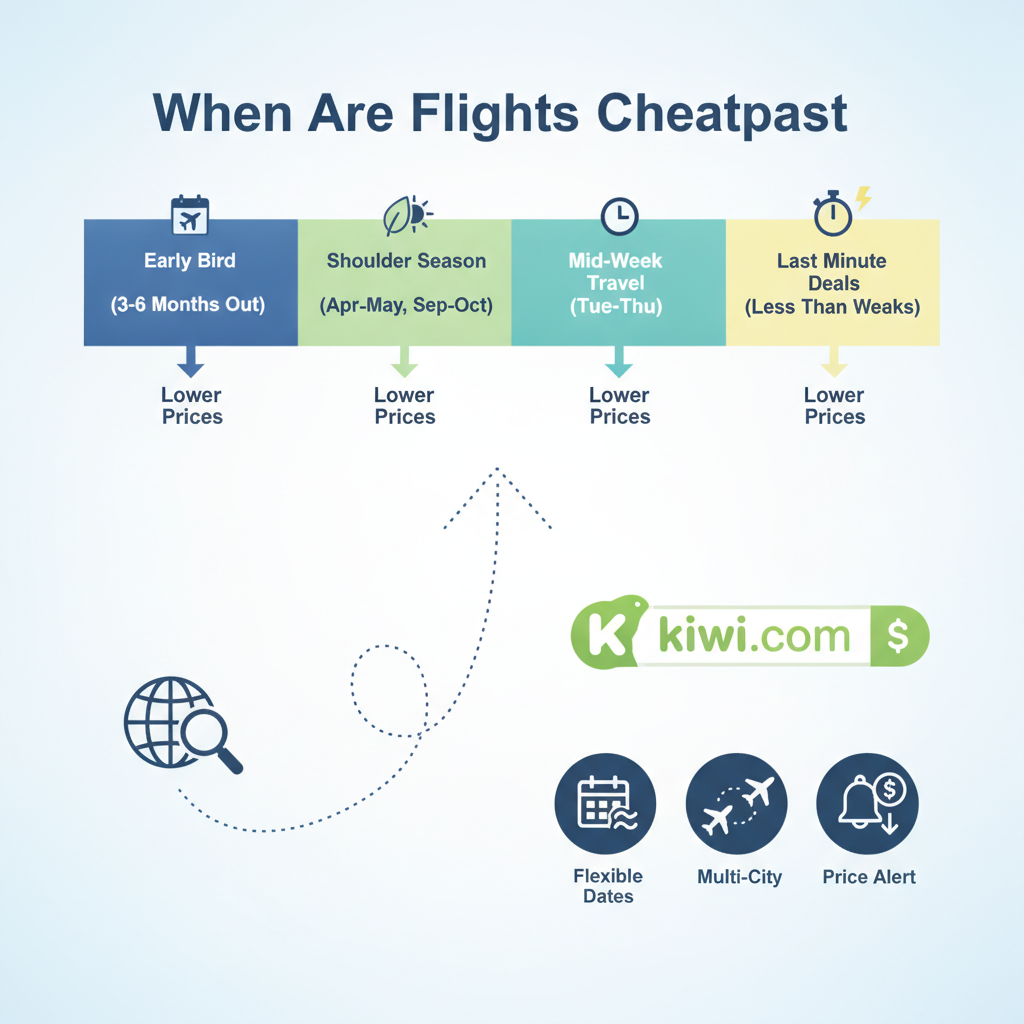
Understanding the cyclical nature of flight pricing is fundamental to securing the best deals. Seasonality plays the most significant role. Generally, flights are more expensive during peak travel seasons, such as summer (June to August in the Northern Hemisphere), major holidays like Christmas, New Year's, Easter, Thanksgiving, and school vacation periods. During these times, demand surges, allowing airlines to command higher prices. Conversely, the shoulder seasons (spring and fall) and the depths of winter (excluding holiday spikes) often present the cheapest opportunities. For example, traveling to Europe in February or November can be significantly more affordable than in July or August, even accounting for colder weather or fewer daylight hours. A traveler planning a European city break might find flights in late January for half the price of a similar trip in mid-June.
Beyond the broader seasons, the day of the week you choose to fly can also impact your fare. Data consistently shows that Tuesdays, Wednesdays, and sometimes Saturdays are typically the cheapest days to fly. Business travelers often depart on Mondays and return on Fridays, driving up demand and prices on those days. Weekends, particularly Sundays, also see higher prices due as leisure travelers return home. Flying out on a Tuesday and returning on a Wednesday of the following week often yields the lowest fares. For instance, a flight from New York to Miami might cost $250 on a Friday, but drop to $180 if you depart on a Tuesday.
The time of day is another crucial, though often overlooked, factor. Early morning flights (before 8 AM) and late-night flights (after 9 PM) are frequently less expensive. These inconvenient times are less popular, especially for leisure travelers, giving airlines an incentive to lower prices to fill seats. While it might mean an early alarm or a late arrival, choosing a 6 AM departure instead of a 10 AM flight could save you a significant percentage on your ticket. This strategy is particularly effective for shorter routes where the inconvenience is minimal. A family traveling with young children, however, might weigh the cost savings against the practical challenges of a very early start.
Comparing these factors, a trip planned for mid-week in the off-season, departing early in the morning, stands the best chance of offering the lowest possible price. For example, a solo traveler looking to visit Denver from Chicago might find the cheapest option by flying out on a Wednesday at 6 AM in October, rather than a Friday afternoon in July. This integrated approach, combining seasonal, day-of-week, and time-of-day considerations, provides a powerful framework for strategic flight booking.
How Far in Advance Should You Book Flights for the Best Deals?
The optimal booking window for domestic flights is typically 1-4 months in advance, while international flights often yield the best prices 2-8 months out. Booking too early or too late can result in higher fares due to airline pricing algorithms.
Determining the ideal booking window is a delicate balance, as airlines constantly adjust their pricing based on demand, remaining inventory, and competitor activity. Understanding this window is key to knowing when are flights cheapest for your specific journey. For domestic flights within countries like the United States or Canada, the "sweet spot" generally falls between one to four months before your departure date. During this period, airlines begin to release promotional fares and adjust prices based on initial booking trends. Booking much earlier than four months might mean you miss out on these future sales, while booking within a month of departure often means you are paying premium prices for the remaining seats.
Consider a scenario: a traveler planning a domestic trip from Los Angeles to Seattle. If they book five months in advance, they might see prices that are relatively high because the airline hasn't yet started its dynamic pricing adjustments for that far-out date. Waiting until three months before departure, however, could reveal a 20% price drop as the airline tries to stimulate demand. Conversely, attempting to book the same flight two weeks before departure will likely result in significantly higher prices, as only the most expensive fare classes remain.
For international flights, the booking window tends to be longer, typically ranging from two to eight months in advance. The increased complexity of international routes, higher operating costs, and diverse passenger segments (business, leisure, connecting traffic) contribute to this extended period. Airlines need more time to gauge demand for long-haul flights and manage their yield. Booking an international flight within two months of departure, especially to popular destinations, often means paying a substantial premium. A family planning a summer trip to Rome from New York, for instance, would ideally start monitoring prices in late fall or early winter of the preceding year to capture the best fares for their peak-season travel.
There are exceptions, of course. Last-minute deals can sometimes emerge, particularly for less popular routes or during off-peak times, but these are rare and highly unpredictable. Relying on a last-minute miracle deal for a critical trip is a high-risk strategy. On the other end of the spectrum, booking more than eight months out for international flights can also be suboptimal. Airlines may not have fully optimized their pricing for those distant dates, and better sales could appear closer to the optimal window. The key takeaway is to start monitoring prices early, identify the general booking window for your desired route, and be ready to book when prices dip, rather than waiting indefinitely or booking impulsively.
What Role Do Flexibility and Travel Dates Play in Finding Cheaper Airfare?
Flexibility with travel dates and destinations is arguably the single most powerful tool for finding cheaper airfare, allowing travelers to capitalize on dynamic pricing fluctuations and avoid peak demand periods.
A rigid travel schedule is the enemy of budget travel. When you are confined to specific departure and return dates, you severely limit your options and become highly susceptible to the airline's pricing algorithm for those exact days. Airlines use sophisticated revenue management systems that adjust prices based on anticipated demand for specific flights. If your desired dates fall during a popular period, such as a long weekend, school holiday, or a major event at your destination, prices will inevitably be higher. For example, a traveler who must fly from London to Edinburgh on the first Friday of August and return on the following Sunday will almost certainly pay a premium compared to someone who can shift their trip by a few days or weeks.
The power of flexibility becomes evident when you can adjust your travel by even a day or two. As discussed earlier, flying mid-week (Tuesday, Wednesday) is often cheaper than flying at the beginning or end of the week. If you can depart on a Tuesday instead of a Friday, or return on a Wednesday instead of a Sunday, the savings can be substantial. Many flight search engines, including Google Flights and Kiwi.com, offer flexible date search tools (e.g., +/- 3 days, or entire month views) that visually highlight these price differences. A comparison might show a flight from Berlin to Lisbon costing €300 on a Thursday-Sunday itinerary, but only €200 for a Tuesday-Tuesday trip, simply by shifting the travel days.
Even greater savings can be unlocked by being flexible with your travel month or season. If your travel plans aren't tied to specific events or school calendars, consider traveling during the shoulder seasons (spring and fall) or the off-peak winter months. For instance, a beach vacation to the Caribbean in September (hurricane season, but often beautiful weather) can be significantly cheaper than the same trip in March. This requires a willingness to adapt your expectations for weather or local events, but the financial reward can be immense. A couple hoping to visit Japan might find that October offers beautiful autumn foliage and far cheaper flights than the cherry blossom season in April.
Furthermore, flexibility with your destination can yield incredible savings. Instead of fixating on a single city, consider searching for flights to "anywhere" or exploring multiple nearby airports. Many budget airlines fly into smaller, less congested airports that often have lower landing fees, which translates to cheaper tickets for passengers. For example, flying into London Stansted or Luton might be cheaper than Heathrow or Gatwick. Similarly, if your primary goal is a beach vacation, searching for flights to a general region like "Southeast Asia" or "Mediterranean" and then comparing prices to various cities within that region can uncover hidden gems and significantly cheaper airfare. This approach effectively turns the entire world into a potential destination, allowing the best deals to dictate your next adventure.
Beyond the Calendar: Exploring Advanced Flight Search Strategies and Tools
Advanced flight search strategies involve leveraging powerful tools like price alerts, multi-city searches, exploring nearby airports, and utilizing "everywhere" or "Nomad" search functions to uncover non-obvious, cheaper routes and dates.
While understanding seasonal and day-of-week trends is crucial, modern travelers can go further by employing sophisticated search techniques. One of the most effective strategies is to set up price alerts. Almost all major flight search engines and OTAs, including Google Flights, Skyscanner, and Kiwi.com, offer this feature. By monitoring a specific route, you receive notifications when the price drops, allowing you to pounce on a deal without constantly checking manually. For example, a business traveler needing to fly from Chicago to Dallas regularly can set an alert for their preferred dates and book only when the price falls below a certain threshold, ensuring they never overpay.
Multi-city searches are another powerful tool, especially for those planning complex itineraries or seeking to combine destinations. Instead of booking two separate round-trip tickets, a multi-city search allows you to construct a single itinerary with multiple legs, often at a lower cumulative cost. This is particularly useful for international travel where you might fly into one city (e.g., Paris), travel overland, and then depart from another (e.g., Rome). Many search engines allow you to specify up to six or more segments, optimizing the overall route. A backpacker exploring Southeast Asia could fly into Bangkok, then fly from Hanoi to Ho Chi Minh City, and finally depart from Singapore, all as part of a single, more economical booking.
Exploring nearby airports is a strategy that capitalizes on varying airport fees and airline competition. Major cities often have multiple airports, and sometimes flying into or out of a smaller, less popular one can result in significant savings. For instance, traveling to New York City, you might consider Newark (EWR) or LaGuardia (LGA) instead of JFK, or for London, Stansted (STN) or Luton (LTN) instead of Heathrow (LHR) or Gatwick (LGW). While this might add a bit of ground transportation time, the savings on airfare can easily offset it, especially for a family of four. Always check the cost and time of ground transport before committing to a distant airport.
Finally, "everywhere" or "Nomad" search functions, pioneered by platforms like Skyscanner and Kiwi.com, are game-changers for truly flexible travelers. If you know you want to travel but aren't tied to a specific destination, these tools allow you to input your departure city and dates (or flexible date ranges) and then display the cheapest destinations worldwide. This is perfect for spontaneous adventures or those on a strict budget who let the cheapest flight dictate their next trip. Kiwi.com's Nomad search, for example, allows you to input multiple destinations in any order, and it will find the cheapest combination of flights to connect them all, effectively creating a custom round-the-world ticket at a fraction of the cost of traditional multi-stop fares. This strategy transforms the entire flight search process from finding a flight to a destination into finding a destination based on the best flight deals.
How Do Online Travel Agencies (OTAs) Like Kiwi.com Find Such Low Prices?
Online Travel Agencies (OTAs) like Kiwi.com find low prices by aggregating vast amounts of flight data, utilizing advanced algorithms to combine flights from different airlines (including low-cost carriers), and offering unique features like virtual interlining and self-transfer routes that traditional airlines don't.
OTAs operate on a different model than booking directly with a single airline. Their primary strength lies in their ability to scan and compare millions of flight segments from a multitude of airlines, including full-service carriers, budget airlines, and regional operators. This comprehensive data aggregation allows them to identify pricing inefficiencies and unique routing opportunities that might not be visible on an individual airline's website or even on traditional metasearch engines that primarily focus on single-airline itineraries. They are essentially digital travel agents with super-powered search capabilities.
One of the most significant ways platforms like Kiwi.com achieve remarkably low prices is through a technique called virtual interlining. This involves combining flights from different, often unrelated, airlines onto a single itinerary, even if those airlines do not have formal codeshare or interline agreements. For example, Kiwi.com might combine a flight on a major carrier like Lufthansa with a segment on a budget airline like Ryanair or Wizz Air, creating a route that is significantly cheaper than flying solely on a full-service carrier. Traditional airlines generally only show flights within their own network or with their alliance partners, limiting the scope of potential savings. Kiwi.com, however, stitches together these disparate flights, effectively creating new, more affordable routes.
This virtual interlining often results in "self-transfer" itineraries, where the traveler is responsible for collecting their luggage, clearing customs (if necessary), and checking in again for the next flight, sometimes at a different terminal or even a different airport. While this adds a layer of complexity and risk, it is a key driver of the lower prices. Kiwi.com mitigates some of this risk with its Kiwi.com Guarantee, which promises to rebook or refund travelers in case of a missed connection due to delays or cancellations by the airlines involved. This protection is a crucial differentiator, as booking self-transfer flights independently would leave the traveler fully exposed to such risks.
Furthermore, OTAs like Kiwi.com often leverage their sheer volume of bookings to negotiate preferential rates or access to specific fare classes from airlines. They also benefit from dynamic pricing algorithms that constantly monitor the market for price drops and offer bundles (flight + hotel, or flight + car) that might not be available elsewhere. Their business model is built around finding the absolute cheapest way to get from point A to point B, even if it means sacrificing some of the convenience or traditional protections associated with single-airline bookings. This aggressive approach to price optimization is what sets them apart in the highly competitive travel booking market.
Can Kiwi.com Truly Help You Find the Absolute Cheapest Flights?
Yes, Kiwi.com can often help you find some of the absolute cheapest flights, especially for complex or multi-stop itineraries, due to its unique virtual interlining technology and ability to combine carriers that other search engines don't, but this often comes with trade-offs in convenience and risk.
Kiwi.com's reputation for finding incredibly low fares is well-earned, primarily stemming from its innovative approach to flight search. Unlike many traditional online travel agencies or metasearch engines that stick to established airline partnerships and direct routes, Kiwi.com specializes in what it calls virtual interlining. This means it can stitch together flight segments from completely different airlines, including budget carriers, that don't typically cooperate. For instance, it might combine a long-haul flight on a major flag carrier with a short-haul connection on a low-cost airline like Spirit or Ryanair, resulting in a significantly lower overall price than booking with a single airline or alliance. A traveler looking to go from Toronto to Athens might find a Kiwi.com itinerary that routes them through London on Air Canada and then to Athens on EasyJet, a combination unlikely to appear on other platforms.
This capability is particularly powerful for multi-city trips or when traveling to less accessible destinations where direct flights are expensive or non-existent. Kiwi.com's "Nomad" search feature exemplifies this, allowing users to input a list of cities they wish to visit in any order, and the algorithm calculates the cheapest possible route to connect them all. This can lead to massive savings for backpackers or digital nomads planning extensive travel across continents. For example, a three-month trip through Europe visiting five cities could be thousands of dollars cheaper through a Nomad search than booking individual legs or traditional multi-stop tickets.
However, the "absolute cheapest" often comes with a caveat. These ultra-low prices frequently involve self-transfer itineraries, meaning you, the traveler, are responsible for re-checking baggage, passing through immigration/customs, and re-checking in for your next flight. This requires sufficient layover time and vigilance. While Kiwi.com offers its "Kiwi.com Guarantee" to cover missed connections due to airline delays or cancellations, the process of claiming this guarantee and the potential for disruption can be more involved than with a traditional single-airline booking. This means that while the sticker price might be the lowest, the overall "cost" in terms of potential stress or time investment needs to be factored in. A budget-conscious solo traveler with minimal luggage and a flexible attitude might find this an excellent deal, whereas a family with multiple checked bags and tight schedules might prefer a more straightforward, albeit pricier, option.
Therefore, while Kiwi.com is an exceptional tool for uncovering the lowest possible fares through its unique aggregation and virtual interlining, travelers must be aware of the implications. It is best suited for those who prioritize price savings above all else, are comfortable with potentially complex itineraries, and understand the self-transfer process. For travelers seeking maximum convenience, direct airline support, or simple, low-risk journeys, the "absolute cheapest" might not equate to the "best value" overall.

What are the Unique Benefits and Potential Drawbacks of Booking with Kiwi.com?
Kiwi.com's unique benefits include unparalleled price discovery through virtual interlining, a powerful Nomad search for multi-city trips, and the Kiwi.com Guarantee for self-transfer connections. However, potential drawbacks involve increased complexity for self-transfers, reliance on third-party customer support, and less flexibility compared to direct airline bookings.
Unique Benefits of Kiwi.com
Unparalleled Price Discovery and Virtual Interlining: Kiwi.com's standout feature is its ability to combine flights from airlines that do not typically cooperate. This "virtual interlining" means it can create itineraries that are often significantly cheaper than those found on traditional search engines or airline websites. It accesses a vast inventory of low-cost carriers and major airlines, stitching together the cheapest possible route, even if it involves multiple carriers and self-transfers. This is a game-changer for budget-conscious travelers seeking the absolute lowest fare. For example, a route from Dublin to Bangkok might involve a flight on Ryanair to Frankfurt and then a separate flight on Thai Airways to Bangkok, a combination that a standard search would not yield.
Nomad Search for Multi-City Trips: For travelers planning complex, multi-destination journeys, the Nomad search tool is invaluable. Instead of manually searching for individual legs, users can input a list of cities they want to visit, and Kiwi.com's algorithm finds the cheapest sequence of flights to connect them all. This saves immense time and often uncovers itineraries that are far more economical than booking separate one-way tickets. It's ideal for backpackers, gap-year travelers, or anyone exploring a region with multiple stops.
Kiwi.com Guarantee: One of the biggest concerns with self-transfer itineraries is the risk of missing a connection due to delays or cancellations. Kiwi.com addresses this with its unique guarantee. If an airline change causes you to miss a subsequent flight on a virtual interlined itinerary, Kiwi.com promises to rebook you on the next available flight or provide a full refund. This provides a crucial safety net that you wouldn't get if you booked separate tickets yourself, offering peace of mind for an otherwise risky booking strategy. This guarantee can be a deciding factor for many budget travelers.
Potential Drawbacks of Booking with Kiwi.com
Complexity of Self-Transfers: While the virtual interlining leads to lower prices, it often results in itineraries requiring self-transfers. This means travelers must collect their luggage, clear customs (if international), and re-check in for their next flight, sometimes at a different terminal or airport. This adds a layer of stress, requires sufficient layover time (Kiwi.com usually suggests this, but travelers should verify), and can be particularly challenging for travelers with limited mobility, young children, or extensive luggage. A family of five with three checked bags attempting a self-transfer with a tight two-hour layover could find the experience overwhelming.
Customer Support Experience: As a third-party booking platform, Kiwi.com acts as an intermediary between you and the airlines. This can complicate customer support, especially during disruptions. While the Kiwi.com Guarantee is helpful, resolving issues might involve communicating with Kiwi.com first, rather than directly with the airline. This multi-layered support can sometimes lead to longer resolution times compared to booking directly with an airline, where you have a direct relationship with the carrier responsible for your flight. Traveler reviews often highlight this as a potential pain point during urgent situations.
Less Flexibility for Changes and Cancellations: Cheaper fares, especially those involving multiple budget airlines, often come with strict change and cancellation policies. While Kiwi.com may offer its own flexible ticket options at an additional cost, the underlying airline tickets themselves are frequently non-refundable or incur high change fees. This means if your plans change, you might lose a significant portion, or even all, of your ticket cost. Comparing this to booking a flexible economy fare directly with a major airline, which might allow changes for a fee or even free, highlights a trade-off between upfront savings and post-booking adaptability.
Navigating Kiwi.com's Self-Transfer Guarantee and Understanding Its Implications
Kiwi.com's Self-Transfer Guarantee offers protection for missed connections on virtual interlined itineraries, promising rebooking or refund if an airline delay or cancellation causes a missed subsequent flight. However, travelers must understand its limitations, such as needing to contact Kiwi.com first and potential delays in resolution, and ensure ample layover time.
The Kiwi.com Guarantee is a critical feature that differentiates it from simply booking separate tickets yourself. When you book a self-transfer itinerary through Kiwi.com, you are essentially purchasing multiple individual flight tickets that are not officially connected by the airlines. Without the guarantee, if your first flight is delayed and you miss your second, you would be solely responsible for buying a new ticket. The guarantee acts as a safety net, promising to cover the cost of a new flight or provide a refund if a missed connection occurs due to an unexpected schedule change, delay, or cancellation by any of the carriers on your itinerary.
For instance, imagine you book a flight from Madrid to Rome via Paris through Kiwi.com, with the Madrid-Paris leg on Vueling and the Paris-Rome leg on Air France. If the Vueling flight is delayed by two hours, causing you to miss your Air France connection, the Kiwi.com Guarantee would kick in. You would contact Kiwi.com, and they would either rebook you on the next available flight to Rome or offer a refund for the unused portion of your journey. This protection is invaluable, especially when dealing with the inherent unreliability of budget airlines or complex multi-segment travel.
However, understanding the implications and potential limitations of this guarantee is crucial. Firstly, you must contact Kiwi.com's customer support immediately upon realizing a disruption. Do not try to resolve the issue directly with the airline, as this could invalidate your guarantee claim. The process involves reaching out to Kiwi.com via phone or their app, explaining the situation, and following their instructions. While the guarantee aims to provide a swift resolution, the actual time taken to rebook or process a refund can vary, especially during peak travel periods or widespread disruptions. This means you might experience some waiting time or temporary inconvenience while a solution is being arranged.
Secondly, while the guarantee covers the cost of rebooking, it doesn't always cover incidental expenses like meals, accommodation, or ground transportation during a lengthy delay, unless explicitly stated or required by specific passenger rights regulations (e.g., EU261, which may or may not apply depending on the airline and route). Travelers should also ensure they allow ample layover time for self-transfers. While Kiwi.com's algorithm suggests optimal layover durations, factors like immigration queues, baggage claim times, and terminal transfers can be unpredictable. A recommended minimum of 3-4 hours for international self-transfers is a wise precaution, giving you a buffer even with the guarantee in place. The guarantee is a robust safety feature for budget travelers, but it's not a magic wand that eliminates all travel uncertainties.
Kiwi.com Alternatives: How Do Other Flight Search Engines Compare?
Kiwi.com's unique virtual interlining sets it apart, but other flight search engines like Google Flights, Skyscanner, and Kayak offer strong alternatives, excelling in price alerts, direct airline links, and overall search usability, catering to different traveler preferences and risk tolerances.
While Kiwi.com is a powerful tool for finding the absolute cheapest, often complex, itineraries, it's essential to compare its offerings with other leading flight search engines. Each platform has its strengths and caters to different types of travelers. Understanding these alternatives helps you choose the best tool for your specific travel needs.
Google Flights: Often considered the gold standard for its user-friendly interface and robust features, Google Flights excels in its flexible date calendar, price graph, and ability to track prices for specific routes. It's excellent for price research, showing you the cheapest days to fly over several months. It primarily focuses on direct airline bookings or established OTA partnerships, making it a low-risk option. Its strength lies in its transparency about fare classes and its ability to quickly direct users to book directly with airlines or major OTAs. However, it typically doesn't offer virtual interlining, meaning it won't combine unrelated low-cost carriers in the same way Kiwi.com does, potentially missing some ultra-low fares. A traveler prioritizing simplicity and direct airline support would find Google Flights ideal.
Skyscanner: Similar to Kiwi.com in its broad coverage of airlines, including many low-cost carriers, Skyscanner is a strong contender for budget travelers. It offers a popular "Everywhere" search function, allowing users to find the cheapest destinations from their origin. It also shows a mix of direct airline bookings and OTA options. While it does occasionally suggest self-transfer combinations, its primary focus is often on individual legs rather than the complex, guaranteed itineraries of Kiwi.com. It's excellent for discovering cheap destinations and comparing prices across many providers. A comparison might show Skyscanner offering a slightly higher price for a complex route than Kiwi.com, but with more straightforward connections.
Kayak: Kayak operates as a metasearch engine, pulling results from hundreds of travel sites at once. It's strong on filters, allowing users to refine searches by airline, stops, departure times, and even aircraft type. Kayak also offers price alerts and a "Hacker Fares" feature that sometimes combines one-way tickets from different airlines to create a cheaper round trip, similar in concept to virtual interlining but often without a comprehensive guarantee like Kiwi.com's. It's a solid all-rounder for comparing prices across a wide array of providers, but its Hacker Fares may require travelers to manage separate bookings themselves. For a traveler needing advanced filtering and a broad overview of options, Kayak is a powerful tool.
Other OTAs (Expedia, Booking.com, Trip.com): These larger OTAs often focus on package deals (flight + hotel) and direct airline bookings. They offer strong customer support for their own bookings and loyalty programs. While they might not find the niche, ultra-cheap virtual interlined routes of Kiwi.com, they often provide competitive pricing for standard itineraries and a more traditional, less risky booking experience. For families or business travelers prioritizing convenience, bundled deals, and robust support, these platforms are often preferred. The choice between Kiwi.com and these alternatives ultimately depends on your priority: maximum savings with potential complexity (Kiwi.com) versus convenience, comprehensive support, and established itineraries (Google Flights, traditional OTAs).
| Feature | Kiwi.com | Google Flights | Skyscanner | Kayak |
|---|---|---|---|---|
| Primary Focus | Virtual Interlining, Cheapest Combinations | Price Research, Direct Bookings | Global Coverage, "Everywhere" Search | Metasearch, Hacker Fares |
| Virtual Interlining | Yes (Core Feature) | No (Limited to established partnerships) | Limited (Shows separate tickets, no guarantee) | Limited ("Hacker Fares" for one-ways) |
| Self-Transfer Guarantee | Yes (Kiwi.com Guarantee) | No | No | No |
| Flexible Date Search | Good (Month View) | Excellent (Calendar, Graph) | Good (Month View, "Cheapest Month") | Good (Flexible Dates +/-) |
| Multi-City/Nomad Search | Excellent (Nomad Tool) | Good | Good ("Multi-city") | Good ("Multi-city") |
| Price Alerts | Yes | Excellent | Yes | Yes |
| Customer Support | Third-party intermediary (via Guarantee) | Direct to airline/OTA | Direct to airline/OTA | Direct to airline/OTA |
| Risk Level (Complexity) | Medium to High (Self-transfer) | Low | Low to Medium (separate tickets possible) | Low to Medium (Hacker Fares can be complex) |
| Best For | Budget travelers, complex itineraries, "anywhere" travel | Price tracking, simple itineraries, direct booking | Destination discovery, broad price comparison | Advanced filters, broad comparison |
| Where to Buy | View Deal |

Essential Tips for Securing the Lowest Airfare and Maximizing Your Travel Budget
Securing the lowest airfare involves a combination of strategic timing, flexible planning, smart search techniques, and understanding the trade-offs of different booking platforms. Maximizing your travel budget means looking beyond the ticket price to consider total trip cost.
The journey to finding cheap flights is multifaceted, but by consolidating the best practices, you can significantly increase your chances of saving money. Firstly, be flexible with your travel dates and times. As highlighted, flying mid-week, during off-peak seasons, and at inconvenient hours (early morning or late night) almost always yields lower prices. Use flexible date calendars on search engines like Google Flights or Skyscanner to visualize the cheapest days. If you're tied to specific dates, start monitoring prices within the optimal booking window (1-4 months for domestic, 2-8 months for international) and set price alerts.
Secondly, consider flying into or out of alternative airports. Major cities often have smaller, less congested airports that budget airlines utilize, leading to cheaper fares. Always weigh the cost of ground transportation to the main city against the airfare savings. For example, a flight into Milan Bergamo (BGY) might be cheaper than Milan Malpensa (MXP), but ensure the transfer cost and time don't negate your savings. Similarly, don't be afraid to explore alternative destinations if your primary goal is simply to travel cheaply. Tools like Kiwi.com's Nomad or Skyscanner's "Everywhere" feature can inspire budget-friendly trips you hadn't considered.
Thirdly, leverage the power of flight search engines and OTAs strategically. Use metasearch engines like Google Flights or Kayak for initial price research and to compare direct airline options. Then, for potentially deeper savings, especially on complex or multi-stop itineraries, explore platforms like Kiwi.com that specialize in virtual interlining. Always cross-reference prices across multiple platforms before booking. Remember that the cheapest option might come with trade-offs in terms of convenience or support, so choose the platform that aligns with your comfort level and travel style.
Beyond the ticket price, maximizing your travel budget means considering the total cost of your trip. This includes baggage fees (especially critical with budget airlines and self-transfers), seat selection fees, travel insurance, ground transportation from the airport, and accommodation. A seemingly cheap flight can quickly become expensive if you add multiple ancillary fees. Always read the fine print regarding baggage allowances and check-in procedures, particularly when booking with low-cost carriers or through platforms that combine them. For instance, a basic economy fare might seem cheap, but if it doesn't include a carry-on and you need one, the added fee could make it more expensive than a standard fare on another airline.
Finally, be informed about risks and protections. If opting for self-transfer itineraries, understand the implications of the Kiwi.com Guarantee or consider purchasing comprehensive travel insurance that covers missed connections and travel disruptions. While travel insurance is an added upfront cost, it can save you significantly more in the event of unforeseen circumstances like flight cancellations, medical emergencies, or lost luggage. By integrating these strategies, you move beyond simply finding a cheap ticket to truly mastering the art of budget-conscious travel, ensuring your adventures are both affordable and enjoyable.
How Do Hidden Costs and Fees Impact the 'Cheapest' Flight Price?
Hidden costs and fees significantly impact the 'cheapest' flight price by adding charges for baggage, seat selection, priority boarding, and payment processing, often making a low advertised fare more expensive than a higher-priced ticket that includes these essentials.
The concept of a "cheap flight" is often a mirage, particularly with budget airlines and some online travel agencies. What appears to be an incredibly low base fare can quickly escalate once mandatory or near-mandatory add-ons are included. These hidden costs are a primary strategy for airlines, especially low-cost carriers (LCCs), to keep advertised prices appealing while generating additional revenue. Travelers must meticulously review the final checkout summary before payment to understand the true cost of their journey.
The most common hidden cost is baggage fees. Many budget airlines and basic economy fares from full-service carriers only include a small personal item that fits under the seat. Checking a bag or even bringing a standard carry-on (overhead bin size) can incur significant charges, sometimes exceeding the initial ticket price. For example, a €20 flight might become a €70 flight if you add a checked bag. If you're comparing a €20 budget flight with a €50 full-service flight, and the latter includes a carry-on, the full-service option might actually be cheaper in practice. Always factor in your luggage needs when comparing prices.
Seat selection fees are another frequent add-on. While many airlines will assign you a seat for free at check-in, if you want to choose a specific seat (window, aisle, extra legroom, or even just sit with your travel companions), you'll often have to pay. For a family traveling together, paying to ensure they sit next to each other can add a substantial amount to the total. This is particularly prevalent on LCCs and basic economy fares. A family of four might add $80-$100 just to guarantee adjacent seats.
Other common fees include: priority boarding (allowing you to board earlier and secure overhead bin space), payment processing fees (a small percentage charged for credit card use, though less common now due to regulations in some regions), and even printing boarding passes at the airport for some budget airlines. For self-transfer itineraries booked through OTAs like Kiwi.com, while the Kiwi.com Guarantee covers rebooking, you might still incur costs for additional visa requirements if your layover country requires one, or unexpected ground transportation if you need to switch airports during a self-transfer.
To truly understand when are flights cheapest, you need to calculate the "all-in" price. This means going through the booking process, selecting all the necessary add-ons (baggage, specific seats, etc.), and reaching the final payment page to see the total. Compare this total across different airlines and OTAs. Often, a slightly more expensive upfront ticket from a full-service carrier that includes baggage and seat selection can be cheaper than a budget airline's base fare once all the extras are accounted for. Being vigilant about these hidden costs is a critical step in becoming a savvy, budget-conscious traveler.
How Does Travel Insurance Integrate with Cheap Flight Bookings, Especially Self-Transfers?
Travel insurance integrates with cheap flight bookings by providing a crucial safety net against unforeseen disruptions, particularly vital for self-transfer itineraries and non-refundable tickets where airline liability is limited. It covers risks like trip cancellation, medical emergencies, and baggage issues that budget fares often don't.
When you opt for the cheapest flight options, especially those involving multiple low-cost carriers or self-transfer itineraries, you often forgo many of the built-in protections offered by full-service airlines. This is where travel insurance becomes not just an option, but a near-essential component of your travel budget. It acts as a financial safeguard against a wide range of potential problems that could otherwise turn a cheap trip into a costly nightmare.
For self-transfer itineraries, like those often found on Kiwi.com, travel insurance can complement the Kiwi.com Guarantee. While the Guarantee covers rebooking or refund for missed connections due to airline issues, a good travel insurance policy offers broader protection. For example, if you miss a connection due to a personal emergency, severe weather not directly causing an airline delay, or if you simply need to cancel your entire trip due to illness, the Kiwi.com Guarantee would not apply. A comprehensive travel insurance policy, however, could cover the non-refundable costs of your flights and other pre-paid expenses in such scenarios. This is a critical distinction for travelers who want to mitigate risk beyond just airline-caused disruptions.
Furthermore, cheap flights often come with strict, non-refundable terms. If you book a basic economy fare and then need to cancel for any reason, you typically lose the entire ticket cost. Travel insurance with trip cancellation coverage can reimburse you for these non-refundable expenses if you cancel for a covered reason (e.g., unexpected illness, job loss, death in the family). This adds a layer of flexibility to otherwise rigid, low-cost bookings. A traveler who books a non-refundable flight to a wedding, for instance, might find peace of mind knowing that if an unforeseen emergency prevents them from attending, their financial loss is minimized.
Beyond flight-specific issues, travel insurance provides coverage for general travel risks that are equally relevant to cheap and expensive flights. This includes emergency medical expenses, which can be astronomically high in foreign countries, especially the USA. It also covers baggage loss, damage, or delay, providing reimbursement for essential items if your luggage doesn't arrive with you. For a budget traveler who might not have extensive credit card travel benefits, a standalone travel insurance policy is often the most cost-effective way to protect against major financial losses and health emergencies abroad. When comparing policies, always check the coverage limits, deductibles, and exclusions to ensure it aligns with your specific needs and the risks associated with your chosen cheap flight itinerary.
What are the Best Practices for Using Flexible Dates and Destinations for Maximum Savings?
The best practices for using flexible dates and destinations for maximum savings involve utilizing "cheapest month" and "everywhere" search tools, adjusting travel by a few days to target mid-week flights, considering alternative airports, and being open to less popular destinations or shoulder seasons.
Embracing flexibility is the cornerstone of finding truly cheap flights. It empowers you to outmaneuver airline pricing algorithms that prey on rigid travel plans. The first best practice is to always use flexible date search tools. Instead of entering exact dates, opt for options like "cheapest month" or "flexible dates +/- 3 days" available on platforms like Google Flights, Skyscanner, and Kiwi.com. These tools visually display price variations across a range of dates, immediately highlighting the most economical days to fly. For example, a search for a flight from New York to Paris might reveal that departing on a Tuesday in November is $300 cheaper than a Friday in October, even if both are shoulder season months.
Secondly, target mid-week travel for both departure and return. As discussed, Tuesdays, Wednesdays, and sometimes Saturdays are historically the cheapest days to fly due to lower business and weekend leisure travel demand. If your schedule allows, shifting your travel by just one or two days can unlock significant savings. A four-day trip from Thursday to Sunday will almost always be more expensive than a Tuesday to Friday trip, even for the same destination and airline. This simple adjustment can often save you 10-20% on your fare.
Thirdly, be open to alternative airports near your desired destination. Many major cities are served by multiple airports, and budget airlines often operate from smaller, less central hubs due to lower landing fees. For example, flying into Paris Beauvais (BVA) might be significantly cheaper than Charles de Gaulle (CDG) or Orly (ORY), although it will require additional time and cost for ground transportation into the city center. Always calculate the total cost and time for the entire journey, including transfers, before deciding. A traveler heading to Rome might find a cheaper flight into Rome Ciampino (CIA) than Fiumicino (FCO), but should ensure the bus transfer from Ciampino is convenient.
Finally, and perhaps most impactful for budget travelers, is to embrace destination flexibility. If you don't have a fixed destination in mind, use tools like Skyscanner's "Everywhere" search or Kiwi.com's "Nomad" feature. These allow you to input your origin and preferred dates (or date range) and then show you the cheapest destinations globally. This approach lets the deals dictate your adventure, often leading to discovering incredible places you hadn't considered, at prices you wouldn't believe. For instance, a search from London to "Everywhere" in January might reveal incredibly cheap flights to Morocco or Poland, redirecting your travel plans from a more expensive European city. Similarly, consider traveling during shoulder seasons (late spring, early autumn) or off-peak winter months to popular destinations. While the weather might be cooler or less predictable, the crowds are smaller and the prices are substantially lower.
How Do Flight Price Prediction Tools and Alerts Enhance Your Search for Cheaper Fares?
Flight price prediction tools and alerts enhance your search for cheaper fares by analyzing historical data and market trends to advise on whether to book now or wait, and by notifying you instantly when prices drop for your desired routes, automating the monitoring process.
In the dynamic world of flight pricing, trying to manually track price fluctuations for your desired routes can be a full-time job. This is where flight price prediction tools and alerts become invaluable assets, transforming a tedious task into an automated, data-driven strategy. These tools leverage sophisticated algorithms, often powered by artificial intelligence and machine learning, to analyze vast datasets of historical flight prices, booking patterns, and current market conditions.
Price prediction tools, such as those integrated into Google Flights or Kayak, offer insights into future price movements. When you search for a flight, these tools might provide a recommendation: "prices are low, book now" or "prices are likely to drop, wait to book." This guidance is based on their analysis of whether the current price for that specific route and date range is higher or lower than historical averages, and what future trends are anticipated. For instance, if you're looking at a flight for next month and the tool indicates that prices are historically high for that period, it might suggest waiting a week or two, or conversely, if prices are unusually low, it will urge you to book immediately. This takes some of the guesswork out of timing your purchase, giving you a data-backed edge.
Price alerts are another crucial feature. Once you've identified a route and potential dates, you can set an alert to be notified via email or push notification whenever the price for that specific flight or route changes. This eliminates the need for constant manual checking. Platforms like Google Flights, Skyscanner, Kayak, and even Kiwi.com offer robust price alert systems. For example, a student planning a trip home for the holidays might set an alert for a flight from their university city to their hometown. When the price drops from $350 to $280, they receive an instant notification, allowing them to book before the fare increases again. This is particularly effective during the optimal booking window when prices tend to fluctuate more frequently.
The effectiveness of these tools lies in their ability to process information far more rapidly and comprehensively than any human could. They monitor millions of fare changes daily, identifying patterns and anomalies that signal potential deals. While no prediction tool is 100% accurate, they significantly improve your chances of booking at a lower price point than if you were relying solely on intuition or infrequent manual checks. They empower travelers to be proactive rather than reactive in their flight search.
Comparing these tools, Google Flights is often praised for the accuracy of its predictions and the clarity of its price graphs. Skyscanner is excellent for its "cheapest month" view and broad reach of budget airlines in its alerts. Kayak's "Price Forecast" also provides useful insights. For complex itineraries, setting multiple alerts across different platforms might be beneficial. By integrating these prediction and alert systems into your flight search strategy, you can automate the process of finding cheaper fares, making your travel planning more efficient and budget-friendly.
What Role Do Loyalty Programs and Credit Card Perks Play in Reducing Flight Costs?
Loyalty programs and credit card perks can significantly reduce flight costs by offering free flights, upgrades, lounge access, and travel insurance benefits through earned points, miles, or sign-up bonuses, turning regular spending into valuable travel savings.
Beyond finding the lowest cash price, savvy travelers often leverage loyalty programs and credit card perks to dramatically reduce their overall flight costs. These strategies transform everyday spending into opportunities for free travel, upgrades, and enhanced travel experiences, effectively making your flights "cheaper" by offsetting their monetary value.
Airline Loyalty Programs: Most major airlines offer loyalty programs (e.g., AAdvantage, MileagePlus, SkyMiles) where you earn miles or points for flying with them or their partners. These accumulated points can then be redeemed for free flights, known as award travel, or for upgrades to premium cabins. The key is to concentrate your flying with one or two airline alliances to maximize your earning potential. For example, a business traveler who frequently flies Star Alliance airlines can quickly accumulate enough MileagePlus miles with United to book a free international flight or upgrade their economy ticket to business class. While the cash price of the flight might be high, the out-of-pocket cost becomes zero or minimal when redeemed with points.
Credit Card Travel Rewards: Travel rewards credit cards are perhaps the most accessible way for many to reduce flight costs. These cards offer substantial sign-up bonuses (often 50,000-100,000 points or miles) after meeting a minimum spending requirement, which can be enough for one or more free flights. Furthermore, they offer accelerated earning rates on travel-related purchases or everyday spending categories. Many co-branded airline credit cards provide perks like free checked bags, priority boarding, and discounted in-flight purchases, directly reducing ancillary fees that often inflate the "cheap" flight price. For instance, a family of four flying a domestic round trip could save $240-$320 on checked bag fees alone with a credit card that offers a free first checked bag for the cardholder and up to three companions.
Beyond direct flight redemptions, some premium travel credit cards offer flexible points that can be transferred to multiple airline partners, providing versatility. They also often include valuable travel insurance benefits, such as trip delay/cancellation coverage, lost luggage protection, and rental car insurance. These benefits can act as a substitute for purchasing separate travel insurance policies for simpler trips, further reducing the overall cost and risk of your flight booking. A traveler who experiences a flight delay of six hours might be reimbursed for meals and hotel accommodation through their credit card's travel delay insurance, a benefit that wouldn't be included with a basic economy ticket.
However, it's crucial to use credit cards responsibly and pay off balances in full to avoid interest charges that would negate any travel savings. Understanding the redemption value of points and miles is also key, as some programs offer better value than others. While these strategies require some planning and commitment, for those who travel frequently or spend consistently, loyalty programs and credit card perks represent a powerful, often overlooked, method for significantly reducing the financial burden of air travel and maximizing their travel budget.
Conclusion: Navigating the Complexities of Cheap Flights with Kiwi.com and Beyond
Finding the cheapest flights in 2026 is a nuanced endeavor that extends far beyond simple luck; it requires a strategic blend of timing, flexibility, and leveraging the right search tools. We've explored how seasonal demand, the day of the week, and even the time of day significantly influence airfare, with off-peak periods and mid-week travel generally offering the best value. The optimal booking window, typically 1-4 months for domestic and 2-8 months for international flights, serves as a crucial guideline, emphasizing the need to monitor prices proactively rather than impulsively.
Flexibility emerged as the most potent weapon in a budget traveler's arsenal, allowing for significant savings by adjusting travel dates, exploring alternative airports, and being open to diverse destinations. Advanced search strategies, including price alerts, multi-city itineraries, and "everywhere" or "Nomad" searches, further empower travelers to uncover non-obvious deals that traditional booking methods might miss. Platforms like Kiwi.com, with their innovative virtual interlining and the reassuring Kiwi.com Guarantee for self-transfer itineraries, have carved out a unique niche, providing access to ultra-low fares that other search engines simply cannot match. However, this often comes with trade-offs in terms of itinerary complexity and potential reliance on third-party support during disruptions.
While Kiwi.com is an exceptional tool for those prioritizing price and comfortable with self-transfers, alternatives like Google Flights, Skyscanner, and Kayak offer robust features for price research, direct bookings, and destination discovery, catering to travelers who may prefer simpler, lower-risk itineraries. Crucially, we highlighted the impact of hidden costs and fees, underscoring the importance of calculating the "all-in" price to avoid false economies. Integrating travel insurance, especially for complex or non-refundable bookings, provides an essential layer of protection against unforeseen circumstances, transforming a cheap flight into a secure investment. Finally, leveraging loyalty programs and credit card perks can further reduce out-of-pocket expenses, turning everyday spending into valuable travel rewards.
Ultimately, the decision of when are flights cheapest and how to book them, and whether to utilize a platform like Kiwi.com, hinges on your individual priorities. Do you value the absolute lowest price above all else, even if it means navigating self-transfers and relying on an OTA's guarantee? Or do you prioritize convenience, direct airline support, and lower risk, even if it means paying a slightly higher fare? By understanding these dynamics and employing the comprehensive strategies outlined in this guide, you are well-equipped to make informed choices, maximize your travel budget, and embark on your next adventure with confidence in 2026.
Frequently Asked Questions
Yes, Kiwi.com is a legitimate online travel agency that has been operating since 2012. It is safe to book with, particularly due to its unique Kiwi.com Guarantee which offers protection for self-transfer itineraries. However, as with any third-party booking platform, travelers should be aware of the terms and conditions. The safety largely depends on understanding its virtual interlining model, which can involve more complex itineraries than direct airline bookings. Always ensure you have sufficient layover time and understand the self-transfer process, including potential visa requirements for transit countries. Based on official policies and review patterns, it's a trusted platform for those who understand its unique model.
Kiwi.com can often be significantly cheaper than booking direct with individual airlines, especially for complex routes or itineraries involving multiple low-cost carriers. Its virtual interlining technology allows it to combine flights from airlines that do not typically partner, creating unique, lower-priced routes. However, this often involves self-transfer connections and may not include baggage or seat selection, which can add to the final cost. Always compare the total 'all-in' price, including any necessary add-ons, to determine if it's truly cheaper than a direct booking that might include more perks upfront. For simple, direct flights, booking direct might offer more straightforward support.
If your self-transfer flight booked through Kiwi.com is delayed or cancelled, causing you to miss a subsequent connection, the Kiwi.com Guarantee should apply. You must contact Kiwi.com's customer support immediately, rather than the airlines directly. They will then work to rebook you on the next available flight to your destination or offer a refund for the unused portion of your journey. While this guarantee provides crucial protection, the resolution process might take some time, and it generally does not cover incidental expenses like meals or accommodation during the delay. Always ensure you have ample layover time to minimize stress.
While the best day to book flights can fluctuate, data consistently suggests that Tuesdays, Wednesdays, and sometimes Saturdays are often the cheapest days to purchase tickets. This is because business travelers typically book at the beginning and end of the week, driving up demand. Airlines often release new deals or adjust prices mid-week to fill remaining seats. However, the day you book is less impactful than the day you actually fly. Flying on Tuesdays, Wednesdays, and Saturdays usually yields lower prices than flying on peak travel days like Fridays or Sundays. Always cross-reference prices across multiple days using flexible date search tools.
For international flights, the optimal booking window to secure the best deals is generally between two to eight months in advance of your departure date. Booking too early (e.g., more than eight months out) might mean you miss out on future sales, as airlines haven't fully optimized their pricing. Conversely, booking within two months of an international trip, especially to popular destinations, often results in significantly higher prices as cheaper fare classes sell out. This longer window allows airlines to gauge demand and manage yields, while giving travelers ample time to monitor price fluctuations and set up price alerts.
Like many online travel agencies and especially when combining budget airlines, Kiwi.com's initial advertised prices may not include all potential costs. Common hidden fees or add-ons that can increase the final price include baggage fees (for checked bags and sometimes even carry-ons), seat selection fees, and priority boarding. These are typically airline-specific charges. Kiwi.com generally displays these options during the booking flow, allowing you to add them. It's crucial to proceed to the final payment summary to see the total 'all-in' price after selecting all necessary extras. Always read the fine print regarding baggage allowances and check-in procedures to avoid surprises.
Travelers who prioritize maximum convenience, direct airline support, and simple, low-risk itineraries might want to avoid booking with Kiwi.com. It is not ideal for those who are uncomfortable with self-transfer processes, have extensive luggage, or are traveling with young children or individuals with limited mobility, as self-transfers can be physically demanding and time-consuming. Additionally, travelers who need highly flexible tickets for changes or cancellations, or who prefer direct communication with airlines for any disruptions, might find Kiwi.com's intermediary role less ideal. It's best suited for experienced, budget-conscious travelers who are flexible and understand the trade-offs of complex itineraries.