How To Plan a Multi-Country European Trip: Flights, Trains, and Ferries Combined
Dreaming of a grand European adventure that seamlessly blends Parisian boulevards with Roman ruins, Swiss peaks with Greek islands? The allure of a multi-country trip is undeniable, but the logistics can feel daunting. The secret to unlocking a smooth, efficient, and unforgettable journey isn't choosing one mode of transport; it's mastering the art of combining them. A hybrid strategy using flights, trains, and ferries is the most effective way to conquer Europe's diverse geography.
When you plan a multi-country European trip, success involves strategically choosing the right transport for each leg of your journey. You'll leverage budget flights for long distances, enjoy scenic high-speed trains for regional connections, and embrace relaxing ferries for coastal and island hopping. This approach maximizes your time, stretches your budget, and enriches your travel experience by turning the journey itself into part of the adventure.
This comprehensive guide will walk you through every step of the process. You will learn how to build a logical itinerary that avoids backtracking, identify when to fly versus when to take the train, and discover how ferries can unlock unique destinations. We will dive into the best booking platforms, provide actionable budgeting advice, and highlight common pitfalls to avoid. By the end, you'll have the confidence and knowledge to build a complex, multi-modal European itinerary that feels effortless.
How Do You Start Planning a Multi-Country European Itinerary?
The first step to plan a multi-country European trip is to define your core interests, setting a realistic pace, and establishing a rough geographical focus. Before you even look at a map or a booking website, you need to answer the fundamental question: "What kind of trip do I want to have?" This foundational step dictates every subsequent decision.
First, pinpoint your passions. Are you an art aficionado dreaming of the Louvre, the Uffizi Gallery, and the Prado? Or perhaps a history buff wanting to trace the path of Roman legions from Italy to Germany? Maybe you're a nature lover who craves the fjords of Norway, the Alps of Switzerland, and the beaches of Portugal. Listing your must-see sights and must-do experiences creates a thematic anchor for your trip. This prevents your itinerary from becoming a random collection of cities and helps ensure a more fulfilling experience. Don't try to see everything; focus on what truly excites you.
Next, determine your travel pace. A common mistake is trying to cram too many destinations into a short period. A whirlwind tour of ten countries in three weeks will lead to burnout and leave you with only a superficial impression of each place. A good rule of thumb is to allocate at least three nights per major city and two nights for smaller towns. This allows for one or two full days of exploration without feeling constantly rushed. Remember to factor in travel days; a four-hour train ride, including check-out, station transfers, and check-in, can easily consume the better part of a day.
Finally, establish a broad geographical scope. Europe is vast, and trying to combine Lisbon, Stockholm, and Istanbul in a two-week trip is logistically impractical and expensive. Instead, focus on a specific region. Consider a Western Europe loop (e.g., France, Spain, Portugal), a Central Europe circuit (e.g., Germany, Czech Republic, Austria, Hungary), a Mediterranean exploration (e.g., Italy, Croatia, Greece), or a Scandinavian adventure. Grouping countries logically minimizes travel time and costs, allowing you to immerse yourself more deeply in the regional culture.
Real-World Example: Planning a 'History & Cuisine' Trip
Imagine a couple planning a three-week trip focused on ancient history and food. Their interests point towards Italy and Greece. Instead of adding a random outlier like Amsterdam, they decide to focus their itinerary exclusively on this Mediterranean region. They set a pace of 3-4 nights per location to allow for both sightseeing and culinary experiences. Their initial list includes Rome, Florence, and Athens. This focused approach immediately makes planning the transport logistics much simpler and more coherent.
Actionable Insight: The 'Must-See' vs. 'Nice-to-See' List
Create two columns: "Must-See" and "Nice-to-See." Your itinerary should be built around the absolute must-sees. The nice-to-sees are flexible options you can add if time and budget permit, or save for a future trip. This prioritization is crucial for making tough decisions when you realize you can't fit everything in. It's the most effective tool for preventing an overstuffed, stressful itinerary.

What Is the Best Way to Map Your European Route Geographically?
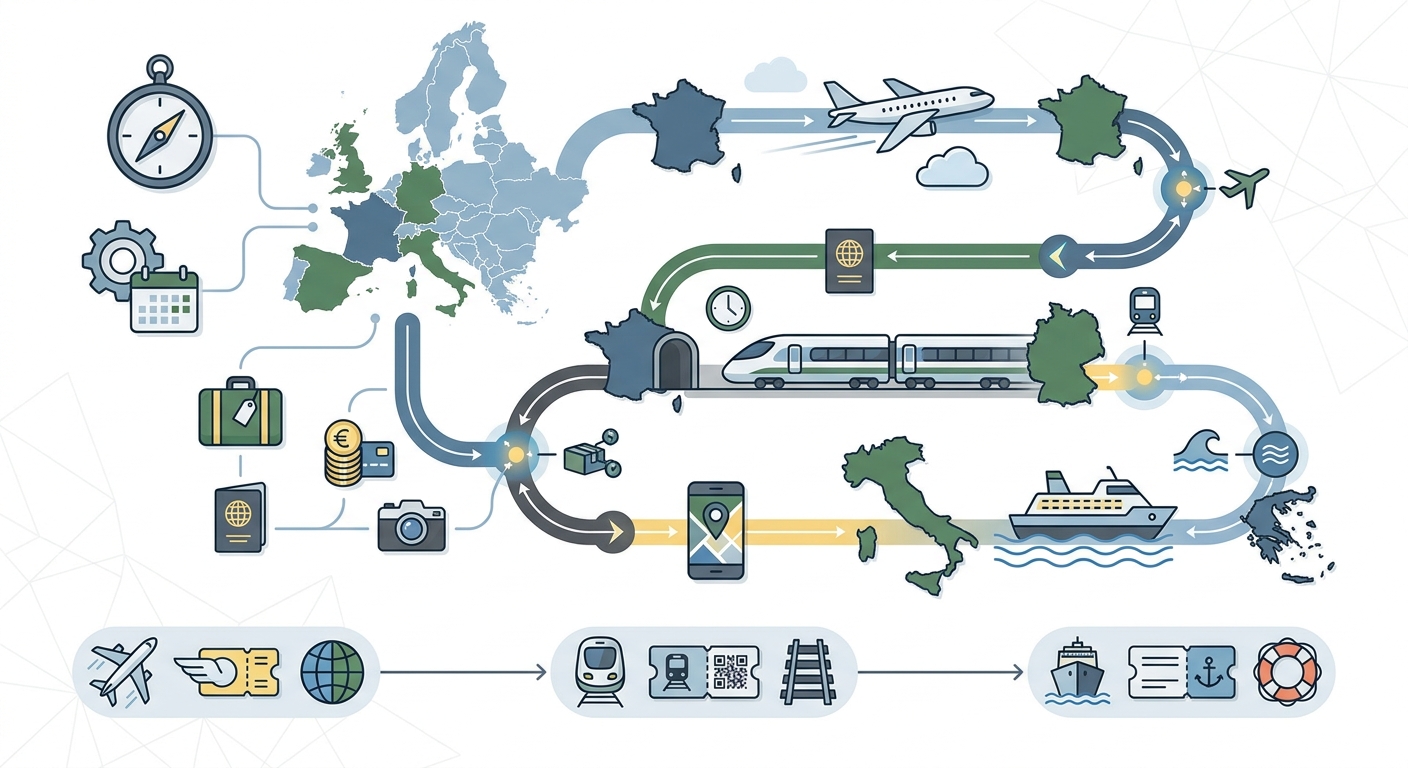
The best way to map your European route is to create a logical, flowing path that minimizes backtracking and maximizes efficiency. Think of your itinerary as a dot-to-dot puzzle; you want to connect the points in the most sensible order. This involves choosing a starting and ending point strategically and arranging the destinations in between to form a continuous line or a circular loop.
A powerful technique for this is using "open-jaw" or "multi-city" flights. Instead of booking a simple round-trip ticket in and out of the same city (e.g., London-Paris-London), you fly into your first destination and out of your last (e.g., London-Paris and then Rome-London). This immediately eliminates the need to waste a day and money traveling back to your starting point. Almost all major airline websites and flight search engines like Google Flights or Skyscanner offer a "multi-city" search option that makes booking these tickets simple. Often, the cost is comparable to a standard round-trip.
Once you have your potential start and end points, use a tool like Google Maps to visualize the route. Plot your must-see cities and look at the geography. Does it make sense to travel from west to east? North to south? A common and effective strategy is to create a loop or a semi-circle. For instance, a Central Europe trip could start in Berlin, move south through Prague and Vienna to Budapest, and then you fly home from there. This linear progression is far more efficient than zig-zagging across the continent, which wastes precious vacation time on trains and in airports.
Consider the natural flow of transportation networks. Major European cities are connected by high-speed rail lines that often follow historical trade routes. Planning your journey along these main arteries is usually faster and cheaper than creating a convoluted route between less-connected towns. Look at a high-speed rail map of Europe; it will give you a clear idea of which city-to-city connections are the most direct and frequent.
Scenario: Optimizing a Western Europe Itinerary
Let's say a traveler wants to visit Amsterdam, Paris, Barcelona, and Lisbon in 15 days. A poorly planned route would be flying into Paris, taking a train to Amsterdam, then flying to Lisbon, and finally flying to Barcelona before returning to Paris to fly home. This involves significant backtracking.
A geographically logical route would be:
- Fly into Amsterdam (Start).
- Take the high-speed Thalys train from Amsterdam to Paris (3.5 hours).
- Take an overnight train or a budget flight from Paris to Barcelona.
- Fly from Barcelona to Lisbon (End).
- Fly home from Lisbon.
This north-to-south progression is linear, efficient, and saves at least one full day of travel. The open-jaw flight (into Amsterdam, out of Lisbon) is the key that unlocks this efficiency.
Actionable Insight: Use a Visual Planning Tool
Don't just write a list of cities. Use an interactive map tool. Google Maps' "My Maps" feature is perfect for this. Drop pins on your desired locations, and you can instantly see the geographical relationships. You can even draw lines between them to visualize your potential route. This visual feedback makes it immediately obvious if your plan involves inefficient backtracking.

When Should You Choose Flights Over Trains in Europe?
You should choose flights over trains in Europe for long distances, non-direct routes, or when crossing significant geographical barriers like seas or mountain ranges. While Europe's train network is exceptional, flying is often the more practical choice when the train journey would exceed six to seven hours. The key is to calculate the total door-to-door travel time, not just the flight duration.
The primary advantage of flying is speed over long distances. A journey from Lisbon to Rome, for example, would take well over 24 hours by train with multiple changes. A direct flight takes about three hours. Even when you factor in getting to the airport two hours early and travel to/from the city centers, flying is still significantly faster. Budget airlines like Ryanair, EasyJet, and Wizz Air have made these long-haul European flights incredibly affordable, often cheaper than a last-minute train ticket for the same route.
Flying is also necessary for island hopping (e.g., reaching the Greek Islands from mainland Europe or traveling between the Balearic Islands) or for crossing bodies of water like the English Channel or the Adriatic Sea, where train options are non-existent or ferry options are too slow for your schedule. Similarly, if your itinerary involves jumping from one corner of the continent to another - say, from Scandinavia to Southern Spain - a flight is the only logical option.
However, the headline flight time can be deceptive. For shorter distances, the train is often the winner. A flight from Paris to Brussels might only be one hour in the air, but the total journey looks like this: 1 hour to get to CDG airport, 2 hours for check-in/security, 1-hour flight, 30 minutes to deplane/collect bags, and 30 minutes to get to Brussels city center. That's a total of 5 hours. The high-speed Thalys train travels from city center to city center in just 1.5 hours. Always compare the total travel time before making a decision.
Comparison Table: Barcelona to Paris
This is a classic route where the choice isn't immediately obvious. Let's break it down.
| Factor | High-Speed Train (Renfe-SNCF) | Budget Airline (e.g., Vueling) |
|---|---|---|
| Travel Time | ~6.5 hours (city center to city center) | ~90-minute flight + ~4 hours airport logistics = ~5.5-6 hours total |
| Cost (Booked in Advance) | €60 - €120 | €40 - €100 + baggage fees (€30-€50) + airport transfer costs (€20-€30) |
| Comfort & Experience | Spacious seats, ability to walk around, large windows with scenic views, no luggage weight limits (within reason), cafe car. | Cramped seating, strict baggage limits, potential delays, stressful airport experience. |
| Baggage | Generous allowance included in ticket price. | Base fare includes only a small personal item. Checked bags and carry-ons cost extra. |
| Verdict | Often more comfortable and relaxing, with a comparable total travel time. Cost can be higher if not booked far in advance. | Can be cheaper on the base fare, but extra fees can add up. Slightly faster in the best-case scenario. |
Actionable Insight: The Six-Hour Rule
Use the "Six-Hour Rule" as a general guideline. If a train journey between two city centers is six hours or less, the train is almost always the better option. The experience will be more comfortable, less stressful, and the total travel time will likely be similar to or even less than flying. If the train journey is longer than six hours, it's time to seriously investigate flights.
How Can You Maximize High-Speed Trains for Cross-Border Travel?
You can maximize high-speed trains for cross-border travel by focusing on major, well-connected corridors and booking tickets directly with national rail operators well in advance. Europe's high-speed network is a marvel of engineering, turning what were once full-day journeys into comfortable half-day trips. Understanding how to leverage this system is key to efficient regional travel.
First, identify the core high-speed routes that align with your itinerary. Key international lines include the Eurostar (linking London with Paris, Brussels, and Amsterdam), the Thalys (connecting Paris, Brussels, Amsterdam, and Cologne), the TGV (radiating from France into Spain, Italy, Switzerland, and Germany), and the ICE (connecting major German cities with neighboring countries). Planning your trip along these established routes ensures frequent service, modern trains, and the fastest travel times. For example, linking Paris, Geneva, and Milan via high-speed rail is a seamless and scenic experience.
Second, the golden rule of European train travel is to book in advance, especially for international high-speed journeys. Tickets are sold in pricing tiers, much like airline tickets. The cheapest fares are released 90 to 180 days before the date of travel. As the date approaches and the cheap tickets sell out, the price can increase dramatically. Booking a Paris to Amsterdam Thalys ticket three months out might cost €35; booking it the week before could cost €135 or more. Use national railway websites (like Germany's Deutsche Bahn, France's SNCF Connect, or Italy's Trenitalia) or trusted resellers like Trainline for booking.
You must also decide between point-to-point tickets and a rail pass like the Eurail Pass. A Eurail Pass offers flexibility, allowing you to travel on many trains across a set number of days. However, it's not always the most economical choice. For high-speed and overnight trains, you still need to pay an additional seat reservation fee, which can range from €10 to over €30 per journey. A pass is generally cost-effective if you plan to take many long, spontaneous journeys. If you have a fixed itinerary and can book in advance, point-to-point tickets are almost always cheaper.
Real-World Scenario: Rail Pass vs. Point-to-Point Tickets
Consider a traveler with a fixed 10-day itinerary: Berlin -> Prague -> Vienna.
- Point-to-Point (Booked 2 months ahead):
- Berlin to Prague (Deutsche Bahn): ~€30
- Prague to Vienna (RegioJet/ÖBB): ~€20
- Total Cost: ~€50
- Eurail Pass (e.g., 4 days in 1 month pass):
- Pass Cost: ~€250
- Seat Reservations (optional but recommended on busy routes): ~€5 x 2 = €10
- Total Cost: ~€260
In this scenario, with a planned itinerary, point-to-point tickets are vastly cheaper. The Eurail Pass would only make sense if the traveler planned to add several more long-distance, expensive, last-minute train journeys within their travel days.
Actionable Insight: Use The Man in Seat 61
For unparalleled, in-depth information on European train travel, the website The Man in Seat 61 is an indispensable resource. It provides detailed guides on the best routes, how to book the cheapest tickets on the correct national railway websites, and what to expect on board specific trains. Before booking any major train journey, consulting this site can save you time, money, and headaches.

Where Do Ferries Fit Into a Multi-Country European Trip?
Ferries fit into a multi-country European trip primarily for island hopping, coastal routes where land travel is circuitous, and as a relaxing, often scenic alternative to short-haul flights. They are an essential mode of transport in regions like the Mediterranean and Scandinavia, and can even double as overnight accommodation, saving you time and the cost of a hotel.
The most common use for ferries is connecting mainland countries to their islands. If your itinerary includes the Greek Islands, Croatia's Dalmatian Coast, or Italy's Sardinia and Sicily, ferries are unavoidable and a core part of the experience. Major hubs like Piraeus (for Athens), Split, and Naples offer extensive networks serving dozens of islands. These range from slow, traditional boats to high-speed catamarans. For island-hopping adventures, ferries provide a flexible and often breathtakingly beautiful way to travel.
Ferries are also invaluable for connecting countries separated by sea where flying would be inefficient or driving would be impossible or slow. Key routes include connecting Spain to Morocco, Italy to Croatia across the Adriatic, the UK to France, Ireland, and Spain, and linking Germany and Poland with the Scandinavian countries of Denmark, Sweden, and Finland. These routes are often served by large, cruise-like ferries equipped with restaurants, cabins, and entertainment, turning the journey into a mini-cruise.
Consider the overnight ferry as a strategic travel tool. An overnight ferry from, for example, Bari (Italy) to Dubrovnik (Croatia) or from Stockholm (Sweden) to Helsinki (Finland) allows you to cover a significant distance while you sleep. You board in the evening, book a private cabin, and wake up the next morning in a new country, refreshed and ready to explore. This saves you an entire travel day and the cost of one night's accommodation, making it a highly efficient and cost-effective option for specific routes.
Example Itinerary: An Italy-Croatia Hybrid Trip
A traveler wants to combine the historical sights of Italy with the coastal beauty of Croatia. A highly effective itinerary would be:
- Fly into Rome and explore Italy, traveling south by train to Naples and then Bari.
- Take an overnight ferry from Bari across the Adriatic Sea to Dubrovnik, Croatia. This saves a full day of travel that would otherwise be spent on convoluted flights or long bus journeys around the sea.
- Explore Dubrovnik, then use Croatia's local ferry network (Jadrolinija) to hop up the coast to islands like Hvar or Korčula, eventually ending in Split.
- Fly home from Split.
In this plan, the train is used for efficient land travel within Italy, the long-haul ferry acts as a time-saving bridge between countries, and local ferries enable exploration of the Croatian archipelago.
Actionable Insight: Check Vehicle vs. Foot Passenger Prices
When booking ferries, especially larger ones, recognize that they are priced for vehicles and foot passengers differently. If you are traveling without a car, your ticket will be significantly cheaper. Also, be aware of the difference between slow car ferries and fast catamarans (often for passengers only). The fast boats are more expensive but can cut travel time in half, which might be worth the premium on shorter island-hopping routes.
What Are the Best Tools and Apps for Booking Combined Transport?
The best tools and apps for booking combined transport are third-party aggregators like Omio and Trainline, which allow you to compare and book trains, buses, and flights in a single search. For more complex itineraries, a multi-pronged approach using aggregators for initial research and booking directly with transport providers for the best prices is often the most effective strategy.
Aggregator platforms are the ideal starting point. Omio (formerly GoEuro) is particularly powerful for European travel as it integrates rail, bus, and flight schedules from hundreds of providers across the continent. You can enter a route like "Prague to Budapest," and it will show you the train options (with travel time and price), bus options, and flight options on one screen. This makes it incredibly easy to see at a glance whether the train's convenience outweighs the bus's low cost or the flight's speed. Trainline is another excellent resource, focusing primarily on rail travel with extensive coverage and an easy-to-use interface for buying tickets across different national systems.
For flights, Google Flights and Skyscanner remain the top-tier tools. Their key features for multi-country planning are the "multi-city" search function and the flexible destination search. With Google Flights' "Explore" map, you can enter your departure city and a date range and see flight prices to dozens of cities across Europe, helping you find the cheapest entry point for your trip. Skyscanner allows you to search from a specific airport to "Everywhere" to uncover surprisingly cheap flight routes you may not have considered.
While aggregators are fantastic for research and convenience, it is sometimes cheaper or more advantageous to book directly with the service provider. This is especially true for trains. After finding a suitable train on Omio, it's worth checking the price on the official website of the national railway (e.g., Deutsche Bahn for Germany). You might find slightly lower prices, a wider selection of fares, or an easier process for selecting your seat. For ferries, a dedicated platform like Ferryhopper is invaluable, especially for complex island-hopping in Greece, as it shows you all the direct and indirect connections between islands, which is something a general aggregator can't do.
Mini Case Study: Booking a Berlin to Paris Leg
A planner is looking for the best way to get from Berlin to Paris.
- Initial Research on Omio: They search "Berlin to Paris." Omio shows:
- Flights: 1.5-hour flight, but total time is ~5 hours with airport logistics. Price: ~€80 on EasyJet (with fees).
- Trains: A high-speed train with one change (e.g., in Frankfurt) takes ~8.5 hours. Price: ~€150.
- Buses: A direct FlixBus takes ~12 hours. Price: ~€40.
- Decision & Deep Dive: The 8.5-hour train seems too long. The flight is the fastest. They then use Google Flights to confirm the EasyJet price and check other airlines, finding a similar deal on Transavia. They also check the baggage fees directly on the airline's website.
- Booking: They decide to book the flight. To ensure they get the best deal on luggage, they book directly on the EasyJet website rather than through a third party, as it's easier to manage add-ons.
This workflow uses an aggregator for a broad comparison and then a specialized tool and direct booking for optimization and purchase.
Actionable Insight: The 'Book Direct' Rule for Airlines
While using search engines like Google Flights is essential for finding the best options, always try to book your flight directly with the airline itself. If there are cancellations, delays, or any issues with your booking, it is infinitely easier to resolve the problem with the airline than it is to go through a third-party booking agent, who may have poor customer service and act as a frustrating middleman.
How Do You Create a Realistic Budget for a Hybrid European Trip?
When you plan a multi-country European trip, you must create a realistic budget by breaking down costs into major categories - transport, accommodation, food, and activities - and researching the average price for each leg of your journey. A common mistake is only budgeting for the big-ticket items like transatlantic flights, while underestimating the cumulative cost of inter-city transport, which can significantly impact your total spend.
First, tackle your transportation budget with a detailed, leg-by-leg approach. Don't just allocate a generic "€500 for transport." Instead, create a spreadsheet and list every planned journey. Research each one individually using tools like Omio, Skyscanner, and national rail websites to get real-time price estimates. Getting good at this is key, and you can learn more in our guide on how to find cheap flights and hotels. Remember to be comprehensive. For a flight, the cost isn't just the ticket; it's the ticket + checked bag fee + seat selection fee + cost of the train/bus to and from the airport. For a train, it's the ticket + any potential seat reservation fee. Summing these detailed estimates will give you a much more accurate figure than a rough guess.
Booking horizons are critical for managing this budget. As a general rule:
- Long-haul international flights: Book 3-6 months in advance for the best prices.
- Intra-Europe budget flights: Book 6-8 weeks in advance. Prices are often higher further out and then spike in the last few weeks.
- High-speed international trains: Book as soon as tickets are released, typically 90-180 days in advance, to secure the cheapest promotional fares.
- Ferries: Booking a few months in advance is wise for popular summer routes, especially if you need a cabin.
Beyond transport, estimate your daily costs for accommodation, food, and activities. These vary wildly by country. A day in Switzerland or Norway will be far more expensive than a day in Portugal or Poland. Use resources like Numbeo or Price of Travel to find a per-diem estimate for each city on your list. For accommodation, check prices on Booking.com or Hostelworld for your travel dates to get a realistic idea. Multiply the estimated daily cost by the number of days in each location and add it to your spreadsheet.
Sample Budget Breakdown: 5-Day Paris to Geneva Leg
Let's create a mini-budget for a traveler spending 2 days in Paris and 3 in Geneva.
| Category | Details | Estimated Cost (€) |
|---|---|---|
| Transport | High-speed TGV Lyria train (Paris-Geneva), booked 3 months out. | €55 |
| Paris Metro passes (2 days). | €20 | |
| Geneva public transport pass (often free with hotel stay). | €0 | |
| Accommodation | Mid-range hotel in Paris (2 nights @ €150/night). | €300 |
| Mid-range hotel in Geneva (3 nights @ €180/night). | €540 | |
| Food & Drink | Paris (2 days @ €70/day - mix of cafes, bakeries, one nice meal). | €140 |
| Geneva (3 days @ €90/day - notoriously expensive). | €270 | |
| Activities | Louvre Museum, Eiffel Tower climb. | €50 |
| Lake Geneva boat trip, museum entrance. | €60 | |
| Subtotal | €1435 |
This detailed breakdown shows how quickly costs add up and highlights the importance of researching each destination's specific price level.
Actionable Insight: Create a 'Contingency Fund'
No matter how well you plan, unexpected costs will arise. A train strike might force you to book a last-minute flight, you might stumble upon a must-do tour, or you might simply miss a connection. A smart budget includes a contingency fund of 10-15% of your total estimated trip cost. This buffer provides peace of mind and ensures that a minor setback doesn't derail your entire trip financially.
What Are the Biggest Mistakes to Avoid When Combining Flights, Trains, and Ferries?
The biggest mistakes to avoid when combining different modes of transport are scheduling connections that are too tight, underestimating total travel and transfer times, and overlooking disparate luggage restrictions. These logistical errors can derail your attempt to plan a multi-country European trip and turn a dream trip into a frantic scramble.
Booking connections too closely is a classic pitfall. It's tempting to book a flight that lands at 1:00 PM and a train that departs from the city center at 3:00 PM, but this is a recipe for disaster. You must account for potential flight delays, time to deplane, immigration, baggage claim, and the journey from the airport to the train station, which can often take an hour or more. A safe rule of time is to allow at least four to five hours between a flight's scheduled landing time and a departing train from a city center station. This buffer is your insurance against common travel delays.
Another common error is failing to account for the "last mile" logistics. Travelers often focus on the main flight or train journey but forget about the transfers at each end. How are you getting from your hotel to the train station? How are you getting from the destination airport - which might be 50km outside the city - to your accommodation? Research these transfers in advance. Know whether a train, bus, or taxi is the best option and how much it costs and how long it takes. These small journeys add up in both time and money and can be stressful to figure out on the spot with all your luggage.
Finally, inconsistent luggage policies can create major problems. The generous two-suitcase allowance on your transatlantic flight does not apply to the European budget airline you're taking from Rome to Athens. Ryanair and EasyJet are notoriously strict about the size and weight of cabin bags, and their checked baggage fees can be exorbitant if paid at the airport. Similarly, while trains are very liberal with luggage, you still have to be able to carry it yourself up and down stairs in stations. Traveling with a single, easy-to-manage suitcase and a personal item is the best strategy for a multi-modal trip, ensuring you comply with the strictest baggage rules you'll face (usually the budget airlines) and making transfers much easier.
Mini Case Study: A Connection Gone Wrong
A traveler books a flight from London to Milan Linate Airport, landing at 11:00 AM. They also book a high-speed train from Milano Centrale station to Florence, departing at 12:30 PM. They assume 90 minutes is plenty of time. Their flight is delayed by 30 minutes. It takes 20 minutes to deplane. Baggage claim takes another 30 minutes. The bus from Linate to Milano Centrale takes 30 minutes in traffic. They arrive at the train station at 12:50 PM, 20 minutes after their non-refundable, high-priced train has departed. They are forced to buy a new, last-minute ticket for a later train at a much higher price, adding stress and a significant unexpected cost to their day.
Actionable Insight: Never Book a Same-Day, Unprotected Connection
If possible, avoid arriving by one mode of transport and departing on another on the same day. A much safer and more enjoyable strategy is to arrive in a city in the afternoon, stay the night, and depart the next morning. This completely eliminates the risk of a missed connection due to delays and allows you to enjoy an evening in a new city. If you absolutely must connect on the same day, make it a late afternoon or evening departure to give yourself the largest possible buffer.
How Should You Handle Luggage and Transfers Between Different Modes of Transport?
The best way to handle luggage and transfers on a multi-modal trip is to pack light and use a single, mobile piece of luggage. Navigating airport terminals, train station stairs, and ferry gangways becomes exponentially more difficult with heavy, bulky bags. A minimalist packing strategy is not just a suggestion; it's a prerequisite for a smooth and enjoyable journey.
Aim to travel with one carry-on sized suitcase or backpack and a smaller personal item (like a daypack). This approach has several key advantages. First, you can often avoid checked baggage fees on budget airlines, saving a significant amount of money over the course of a multi-leg trip. Second, you eliminate the time wasted waiting at the baggage carousel and the risk of the airline losing your luggage. Third, and most importantly, you will be more mobile. You can easily navigate crowded public transport, walk a few blocks from the station to your hotel, and manage your belongings without assistance. Test-pack before you go and be ruthless about what you truly need.
When planning transfers, research your options meticulously. For airport-to-train-station transfers, many major European cities have direct rail or express bus links. For example, Frankfurt Airport has a dedicated long-distance train station (Fernbahnhof) right in the terminal, making connections incredibly easy. In contrast, Paris has multiple airports and train stations, so you need to know exactly how to get from Charles de Gaulle (CDG) to Gare de Lyon, for example (the RER B to Châtelet-Les Halles, then RER A is a common route). Look up these specific routes in advance and save the directions to your phone.
Utilize station luggage lockers for awkward gaps in your schedule. If you arrive in a city by train in the morning but can't check into your accommodation until the afternoon, leaving your bags in a locker at the station is a perfect solution. This frees you up to explore the city for a few hours unencumbered. Most major train stations in Europe have secure, automated luggage storage facilities available for a small fee. This simple service can make your travel days far more productive and enjoyable.
Example Transfer Plan: Rome Fiumicino Airport to Termini Station
A traveler lands at Rome's Fiumicino Airport (FCO) and needs to get to the main train station, Roma Termini, to catch a high-speed train to Florence.
- Option 1 (Fastest): The Leonardo Express train. It leaves directly from the airport terminal and arrives at Roma Termini in 32 minutes with no stops. It's the most expensive option (~€14) but is reliable and stress-free.
- Option 2 (Cheaper): Regional FL1 train. It also leaves from the airport but goes to other Rome stations like Trastevere or Tiburtina, requiring a change to the Metro to reach Termini. It's cheaper (~€8) but takes longer and involves a transfer.
- Option 3 (Budget): Terravision or SIT Bus Shuttle. These buses go directly from the airport to Termini. They are the cheapest option (~€6) but are subject to traffic and can take over an hour.
By researching this in advance, the traveler can choose the option that best fits their budget and schedule, avoiding confusion upon arrival.
Actionable Insight: Pack a 'Transfer Kit'
Keep a small, accessible 'transfer kit' in your personal item. This should include your passport/ID, printed or digital copies of your next ticket, a portable charger, a bottle of water, and some local currency or a contactless credit card. When you're rushing to make a connection, the last thing you want to do is dig through your main suitcase to find your train ticket or money for the bus.
How Far in Advance Should You Book European Flights, Trains, and Ferries?
As a general rule, you should book high-speed trains and international flights the furthest in advance (2-4 months) to secure the best prices, while regional transport and some ferries can be booked closer to your travel date. Each mode of transport has a unique booking window and pricing structure, and understanding these is crucial for optimizing your travel budget.
For high-speed and long-distance trains (e.g., Eurostar, TGV, ICE), booking as soon as the sales window opens is paramount. This is typically 90 to 180 days before travel, though it varies by country and company. These trains use a dynamic pricing model, just like airlines. The initial batch of tickets released is the cheapest, and as these "super saver" fares sell out, the price climbs steadily. Waiting to book a major international train route until the week of travel can result in paying three or four times the advance-purchase price. Local and regional trains, however, often have fixed prices and do not need to be booked far in advance.
Intra-European flights on budget airlines have a slightly different sweet spot. Booking too far in advance (6+ months) can sometimes be more expensive. The optimal window is typically 6 to 10 weeks before your flight. This is when airlines have a good sense of demand and adjust prices to fill seats. Use a tool like Google Flights or Skyscanner to set up price alerts for your desired routes. This will notify you when the price drops, allowing you to book at the most opportune moment. Be prepared to act quickly when you see a good fare.
Ferry booking windows depend heavily on the route and season. For popular summer routes in high-demand areas like the Greek Islands or the Croatian coast, it's wise to book 2-3 months in advance, especially if you need to book a vehicle spot or a private cabin on an overnight journey. These can sell out quickly. For less popular routes or travel during the shoulder seasons (spring and autumn), you often have more flexibility and can book a few weeks or even days ahead. However, booking earlier rarely hurts and provides peace of mind.
Booking Window Summary Table
| Transport Mode | Ideal Booking Window | Reasoning | Example |
|---|---|---|---|
| High-Speed International Train | 90-180 days in advance | Dynamic pricing; cheapest fares sell out first. | Paris to Amsterdam on Thalys |
| Intra-Europe Budget Flight | 6-10 weeks in advance | Price sweet spot before last-minute spikes. | Barcelona to Rome on Ryanair |
| Overnight or Popular Ferry | 2-3 months in advance (for summer) | Cabins and vehicle spots sell out on popular routes. | Athens to Santorini in July |
| Regional Train | 1 day to 2 weeks in advance | Often fixed prices; little to no benefit from early booking. | Florence to Pisa |
| Long-Haul International Flight | 3-6 months in advance | Best balance of price and availability for flights to/from Europe. | New York to London |
Actionable Insight: Create a Booking Calendar
Once your itinerary is set, create a booking calendar. For each major leg of your journey, work backward from the travel date to identify the ideal booking window. For a trip in July, note down to start checking train prices in February or March and flight prices in May. Set reminders on your phone or digital calendar. This proactive approach prevents you from missing the best deals and turns the potentially stressful task of booking into a manageable, step-by-step process.
Planning a multi-country European trip is a deeply rewarding endeavor, and mastering the interplay of flights, trains, and ferries is the key to an efficient, affordable, and enjoyable adventure. The core principle is not to be a loyalist to any single mode of transport, but to be a strategist, selecting the perfect tool for each specific leg of the journey. This hybrid approach transforms travel from a mere necessity into an integral and exciting part of your European experience.
Remember the foundational steps: start with your passions to build a coherent itinerary, map your route logically to eliminate backtracking with open-jaw flights, and apply the six-hour rule to decide between planes and trains. Leverage high-speed rail for scenic and comfortable regional travel, and embrace ferries to unlock Europe's stunning coastlines and islands. By booking in advance using a combination of aggregator sites for research and direct providers for purchasing, you can take firm control of your budget.
Ultimately, the perfect European trip is a puzzle where each piece - each city, each journey - fits together smoothly. The challenges of logistics are easily overcome with diligent research and smart planning. By avoiding common pitfalls like tight connections and overpacking, you free yourself to focus on the magic of the continent: the art, the history, the food, and the diverse cultures. So, start sketching that route, create your booking calendar, and get ready to embark on the multi-country European adventure you've always dreamed of when you set out to plan a multi-country European trip.
Frequently Asked Questions
A Eurail Pass is worth it if you prioritize flexibility and plan to take multiple long-distance train journeys, often on short notice. However, if you have a fixed itinerary and can book your train tickets 2-3 months in advance, point-to-point tickets are almost always cheaper. Remember that for most high-speed and overnight trains, a Eurail Pass requires you to pay an additional seat reservation fee. To make the right decision, create a sample itinerary, calculate the total cost of individual tickets, and compare it to the price of the appropriate Eurail Pass plus reservation fees.
When booking transport online, use a credit card that has no foreign transaction fees, as you will often be charged in the local currency (e.g., Euros, Swiss Francs, Czech Koruna). For payments on the ground, a mix of methods is best. Most places in Europe widely accept contactless payments via credit cards or mobile apps like Apple Pay. However, it's always wise to carry a small amount of local cash for smaller purchases, ticket machines that might not accept foreign cards, or in case of technological issues. Inform your bank of your travel dates to avoid your cards being frozen for suspicious activity.
The best way varies by city, but most major European airports have excellent public transport links. The fastest and most reliable option is often a dedicated airport express train, such as the Heathrow Express in London or the Leonardo Express in Rome. These go directly to a main city station. A cheaper alternative is usually a regional train or a designated airport bus service. Taxis and ride-sharing services are the most expensive and can be slow during rush hour. Research the specific airport's transport options online before you land to find the best balance of cost, speed, and convenience for your needs.
Yes, overnight trains can be a fantastic way to save both time and money on specific routes. They combine your transport and accommodation costs for one night into a single ticket price. You cover a long distance while you sleep, arriving in a new city in the morning ready to explore, effectively saving a valuable vacation day. Popular routes are operated by companies like ÖBB's Nightjet. For the best experience, book a couchette or a sleeper cabin. While a simple seat is the cheapest option, it won't provide a comfortable night's sleep. Book well in advance as sleeper compartments sell out quickly.
While there isn't one single app that perfectly books everything, some come very close. Omio is one of the best for this, as it aggregates and allows booking for trains, buses, and flights across Europe within its app. The Trainline is excellent for comprehensive train bookings. However, for ferries, you'll often need a specialized app like Ferryhopper, especially for complex island routes in the Mediterranean. A realistic strategy is to use one main app like Omio for initial research and most train bookings, supplemented by Skyscanner for flights and a ferry-specific app where needed.
First, stay calm and immediately contact the airline or railway company. For flights within the EU, Regulation EC 261/2004 provides strong passenger rights, entitling you to re-routing, care (food and drink), and potentially compensation depending on the length of the delay and reason for cancellation. For trains, passenger rights also ensure re-routing or a refund. It's crucial to have travel insurance, as it can cover non-refundable costs like hotels or tours that you might miss due to a cancellation. Keep all receipts for any extra expenses you incur. Having the transport provider's app on your phone often gives you the fastest notifications and re-booking options.