

How to Find Cheap Flights for International Travel: The Ultimate 2026 Guide
The dream of exploring ancient ruins in Rome, bustling markets in Marrakech, or serene beaches in Thailand often feels just out of reach, tethered to the daunting cost of international airfare. It's a common belief that overseas travel is an expensive luxury reserved for the few. But what if the biggest barrier - the flight ticket - could be dramatically reduced? What if there were proven strategies and tools that could consistently unlock fares hundreds, or even thousands, of dollars cheaper than what most people pay? The good news is, there are. This guide on how to find cheap international flights shows it isn't about luck; it's about strategy, timing, and knowing where and how to look.
The single best way to find cheap flights for international travel is to combine flexibility with the right search tools. This means being open to adjusting your travel dates, considering nearby airports, and using powerful flight comparison engines to scan billions of data points for the lowest possible price. It's a multi-layered approach that moves beyond a simple search for a specific destination on a specific date. It involves understanding the rhythm of airline pricing, leveraging technology, and occasionally using unconventional tactics to your advantage. This isn't a secret art form; it's a learnable skill that can transform your travel budget and open up a world of possibilities.
In this comprehensive guide, we will deconstruct the entire process of finding and booking the cheapest international flights. You will learn the optimal time to book your tickets, how to master flight search engines, and why flexibility is your greatest asset. We will explore the pros and cons of budget airlines, dive into advanced techniques like using a VPN, and even touch on high-risk strategies like hidden-city ticketing. By the end, you will be equipped with a complete toolkit of actionable insights to make your next international adventure more affordable than you ever thought possible.
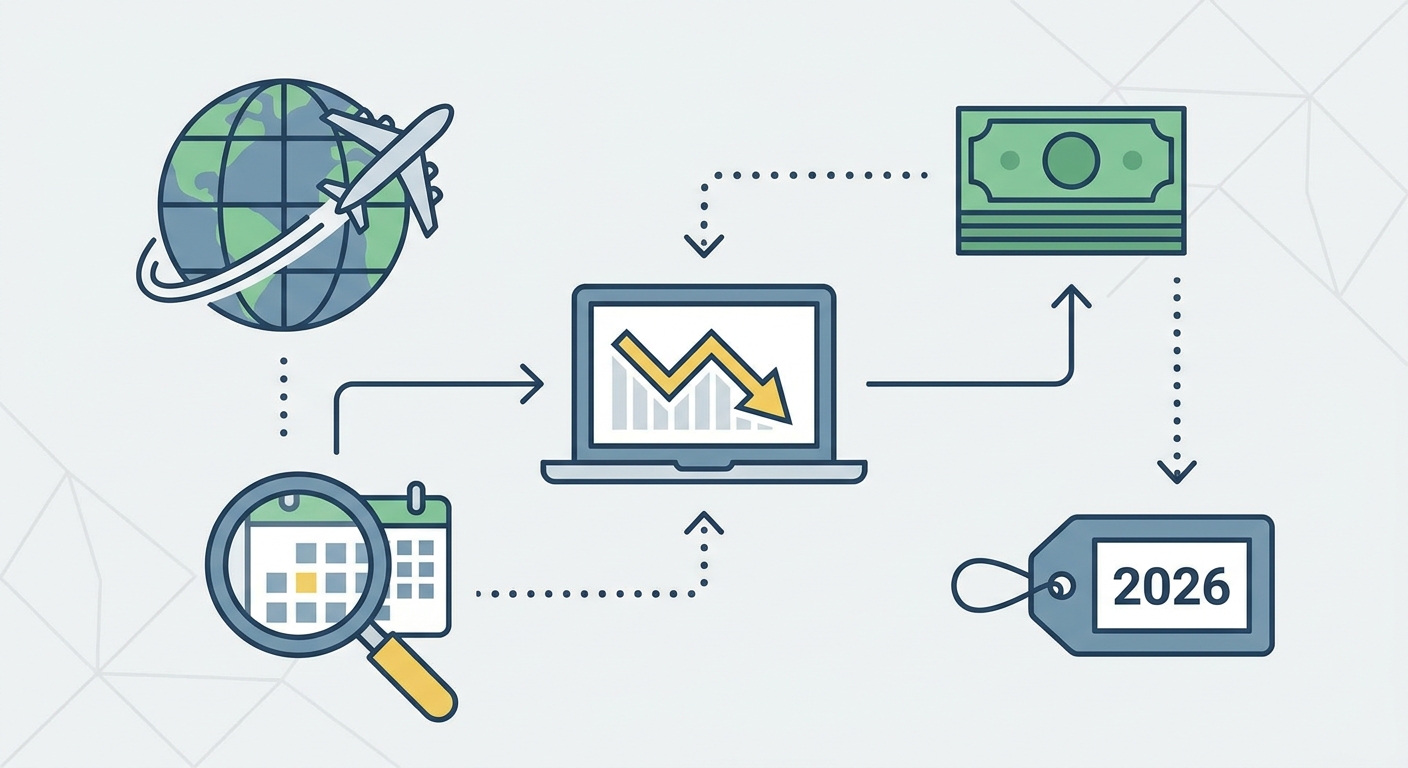
When Is the Best Time to Book International Flights for the Lowest Prices?
The best time to book international flights for the lowest prices is typically within a 'Goldilocks' window of two to eight months before your departure date. Booking too far in advance (over a year) or too close to your travel date (within 60 days) usually results in paying a premium, as airlines have not yet released their cheapest fare classes or are capitalizing on last-minute demand.
Understanding this booking window is crucial for anyone learning how to find cheap international flights. When airlines first release schedules, about 11 to 12 months out, the prices are often set at a high, standard rate. They are not yet incentivized to offer discounts. As time progresses, they use complex algorithms to manage their inventory, releasing different fare 'buckets' based on projected demand. The sweet spot, from two to eight months out, is when they are actively trying to fill seats and competition is at its peak, leading to more reasonable prices. For peak season travel, such as summer holidays to Europe or Christmas in Southeast Asia, you should aim for the earlier side of this window, around six to eight months in advance. For off-season or shoulder season trips, you can often find great deals closer to the two-month mark.
Real-World Example: Imagine a family planning a trip from Chicago to Paris in July 2026. If they start looking in June 2025 (13 months out), they might see round-trip fares at $1,500 per person. This is a placeholder price. If they wait until December 2025 or January 2026 (6-7 months out), they will likely see those fares drop to a more competitive $900-$1,100 as airlines compete for summer travelers. However, if they delay booking until May 2026 (2 months out), demand will have surged, and the remaining seats could easily climb back up to $1,600 or more.
This contrasts significantly with booking domestic flights, where the ideal window is much shorter, often just one to three months in advance. International routes are more complex, involve less competition on specific routes, and have more predictable demand cycles, allowing airlines to plan their pricing strategy further out. The key mistake travelers make is applying domestic booking habits to international travel, either by waiting too long or booking impulsively the moment flights are released.
Actionable Insight: Start your flight search around eight to ten months before your desired travel period. Use a tool like Google Flights or Skyscanner to set up price alerts for your preferred route. This allows you to monitor the price fluctuations without needing to check daily. When you see a price that drops into your target budget within that two-to-eight-month window, be prepared to book it. Don't wait for a mythical last-minute deal for international travel; they are exceedingly rare and not a reliable strategy.

How Can Flexibility with Your Destination and Dates Save You Money?
Being flexible with your travel dates and destination is the single most powerful strategy for saving money on international flights. By shifting your travel days by just a few days, or by choosing a less-trafficked airport, you can often cut your airfare costs by 50% or more. This is a core part of how to find cheap international flights, as airline pricing is entirely based on supply and demand, which fluctuates dramatically day by day and route by route.
The two main types of flexibility are date flexibility and destination flexibility. Date flexibility means avoiding peak travel times. Flying on a Tuesday or Wednesday is almost always cheaper than flying on a Friday or Sunday. Similarly, traveling during the 'shoulder season' - the months just before or after the peak season (like April/May or September/October for Europe) - offers a sweet spot of pleasant weather and significantly lower flight and accommodation costs. Destination flexibility means being open to where you go. Instead of setting your heart on one specific city, you can choose a region and let the deals guide you. Tools like Google Flights Explore and Skyscanner's 'Everywhere' search are designed for this, showing you the cheapest places to fly from your home airport during a given time frame.
Real-World Example: Let's say a traveler in New York wants to go to Italy for two weeks in July. A direct search for NYC to Rome from July 12th to July 26th might yield a fare of $1,400. Using date flexibility, they check the price for the same trip in September and find it for $850. That's an instant saving of $550. Now, let's add destination flexibility. Using Google Flights Explore for a two-week trip to Europe in September, they might discover that flights to Dublin are only $500, while flights to Lisbon are $550. From there, they can book a cheap intra-European flight on a budget airline like Ryanair to Italy for under $100, bringing their total flight cost down to around $600-$650 - less than half the original price.
The alternative is having a fixed mindset, where you must travel to a specific city on exact dates. This locks you into the prevailing market rate, whatever it may be. While sometimes unavoidable for events like weddings or business meetings, this rigidity is the primary reason many people overpay for flights. By viewing your destination and dates as variables rather than constants, you fundamentally change the booking equation in your favor.
Actionable Insight: Reframe your trip planning. Instead of saying, "I want to go to Paris from June 7th to June 14th," try thinking, "I want to go to Western Europe for a week in late spring or early fall." Use search engines' flexible date features (e.g., searching for a 'one-week trip in May') and 'explore' maps to see what's affordable. Let the data guide your decision, and you'll uncover incredible deals you would have otherwise missed.

Which Flight Comparison Engines and OTAs Are Best for Finding Deals?
The best tools for finding cheap international flights are flight comparison engines (also called aggregators) like Google Flights, Skyscanner, and Momondo. These platforms don't sell flights themselves; instead, they scan hundreds of airline and Online Travel Agency (OTA) websites simultaneously to show you all available options, allowing you to easily compare prices and find the lowest fare.
While there are many options, a few stand out for their unique features. Google Flights is renowned for its incredible speed and powerful, user-friendly interface. Its calendar view and date grid instantly show you the cheapest days to fly over a two-month period, while its 'Explore Map' is perfect for destination flexibility. Skyscanner is excellent for its broad search capabilities, often including smaller budget airlines and OTAs that other search engines miss. Its signature 'Search Everywhere' feature is a fantastic tool for travelers who are open to discovering the cheapest possible destination from their home airport. Momondo operates similarly to Skyscanner but is particularly strong at finding 'hacker fares' - itineraries that combine separate one-way tickets on different airlines to create a cheaper round trip.
Real-World Example: A user wants to find the cheapest flight from Los Angeles to Bangkok in November. They start with Google Flights. The date grid immediately shows that flying out on Tuesday, November 5th and returning on Wednesday, November 20th is $150 cheaper than flying on the weekends. They find a flight on EVA Air for $950. Before booking, they run the same search on Skyscanner. Skyscanner uncovers an option on a lesser-known OTA for $920. It also shows a slightly longer itinerary on a different airline, Philippine Airlines, for $880. Finally, they check Momondo, which confirms the Philippine Airlines price but doesn't find anything cheaper. In this case, by cross-referencing three engines, the user identified the cheapest dates and found a fare $70 cheaper than their initial search.
Comparison of Top Flight Search Engines
| Feature | Google Flights | Skyscanner | Momondo |
|---|---|---|---|
| Best For | Speed, user interface, flexible date search | Broad search (including budget carriers), 'Everywhere' tool | Price comparison graphs, finding 'hacker fares' |
| Unique Feature | Date Grid & Explore Map | Search 'Everywhere' | Mix & Match Fares |
| Includes OTAs? | Yes | Yes (extensive list) | Yes |
| Price Alerts | Yes, very robust | Yes | Yes |
Actionable Insight: Adopt a 'triage' approach to your flight search. Start with Google Flights for its speed and date flexibility tools to identify the cheapest travel window and primary airline options. Then, take those specific dates and run the search again on Skyscanner and Momondo to ensure no cheaper carriers or OTA deals were missed. Never rely on a single search engine, as their coverage and pricing can vary.

Should You Book Directly with an Airline or Through a Third-Party Site?
After finding a deal on a search engine, you should generally book directly with the airline, even if a third-party Online Travel Agency (OTA) offers a slightly cheaper price. Booking direct provides significantly better customer service, greater flexibility for changes or cancellations, and a more straightforward process for earning loyalty points. The small savings from an OTA are often not worth the potential hassle if something goes wrong, which is a key lesson in how to find cheap international flights.
When you book through an OTA, you introduce a middleman into the transaction. If you need to change your flight, request a refund, or deal with a cancellation, you must go through the OTA's customer service, not the airline's. As we've covered before, booking flights and hotels through an OTA has its own set of challenges. Many smaller OTAs are notorious for having unresponsive support, imposing hefty change fees beyond what the airline charges, and making the refund process incredibly difficult. Booking directly with the airline streamlines this entire process. You are their customer, and you have direct access to their support team and self-service tools on their website or app. Furthermore, any elite status benefits or co-branded credit card perks (like free checked bags) are more likely to be applied correctly when booking direct.
Real-World Example: Consider two passengers, Sarah and Tom, who both booked a flight from New York to London. Sarah booked her British Airways ticket directly on their website for $750. Tom used a comparison site and found the same flight on a little-known OTA called 'SuperFlyDeals' for $720, and he booked it to save $30. A week before the trip, an unforeseen event requires them to change their return date. Sarah logs into her British Airways account, pays the airline's standard $150 change fee, and rebooks her flight in under ten minutes. Tom, however, must contact SuperFlyDeals. After a long wait on hold, the agent informs him that their company policy adds a $200 processing fee on top of the airline's $150 change fee, costing him $350. His initial $30 savings has now cost him an extra $170 and a major headache.
There are, however, a few scenarios where booking with an OTA makes sense. Major, reputable OTAs like Expedia or Orbitz can sometimes offer package deals (flight + hotel) that provide genuine savings. Additionally, for complex multi-airline itineraries (a 'hacker fare' found on Momondo, for instance), booking through the OTA that packaged it is your only option. But for standard round-trip flights, the direct-to-airline route is almost always the safer and smarter choice.
Actionable Insight: Always perform this two-step process. First, use flight aggregators like Google Flights and Skyscanner to find the cheapest flight. Second, before you click 'book' on the OTA's site, open a new tab and go directly to the airline's website. If the price is the same or even slightly more (e.g., $20-$40 difference), book direct. The peace of mind and superior customer service are well worth the minor price difference.

How Do Budget Airlines Work for International Travel and Are They Worth It?
Budget airlines offer cheap base fares for international travel by 'unbundling' their services, meaning you pay extra for everything from checked luggage and carry-on bags to seat selection and onboard meals. They are worth it only if the final, all-inclusive price is still significantly lower than a full-service carrier's fare, and you are comfortable with a no-frills travel experience.
The business model of long-haul, low-cost carriers (LCCs) like Norse Atlantic, PLAY, or LEVEL is built on cost reduction. They typically fly single-aisle, fuel-efficient aircraft, operate out of secondary, less expensive airports (e.g., London Gatwick instead of Heathrow), and maximize revenue through ancillary fees. The advertised price you see is just for the seat itself. Everything else is an add-on. This à la carte pricing model allows them to lure customers with eye-poppingly low headline fares, but the final cost can quickly escalate if you're not careful. It's essential to meticulously calculate the total cost, including all the extras you need, before making a booking decision.
Real-World Example: A traveler sees a one-way flight from New York (JFK) to Berlin (BER) on Norse Atlantic for an incredible $199. At the same time, Lufthansa, a full-service carrier, is offering the same route for $450. The Norse flight seems like a steal. However, let's break down the ancillary fees for the Norse flight:
- Carry-on bag (more than a small personal item): $70
- One checked bag: $75
- Standard seat selection (to sit with a partner): $45
- Onboard meal and drink: $30
However, for a minimalist traveler who can fit everything into a small personal item and is happy to forgo meals and seat selection, that $199 fare remains a fantastic deal. The value proposition of budget airlines is entirely dependent on your travel style and needs. They are not inherently good or bad; they are a tool that can provide huge savings for the right type of traveler.
Actionable Insight: Before booking a flight on a budget airline, go through the entire booking process up to the payment page. Add every single ancillary item you will realistically need - bags, seats, and even food if it's a long flight. Only then should you compare that final, total price to the fare offered by a full-service carrier. Often, the price gap narrows significantly, making the traditional airline the better value.
Can Using a VPN Actually Help You Find Cheaper Flights?
Yes, using a Virtual Private Network (VPN) can sometimes help you find cheaper international flights, although it is not a guaranteed method. A VPN works by masking your IP address and making it appear as if you are browsing from a different country. This can unlock lower prices because airlines often practice price discrimination, setting different fares for the same flight based on the customer's point of sale.
This pricing disparity happens for several reasons. Airlines might offer lower fares to the local population in the country of departure, where average incomes may be lower. Currency fluctuations can also create pricing anomalies; a fare priced in a foreign currency might convert to a lower price in your home currency. By using a VPN, you can digitally transport yourself to that country and access the local pricing. For example, if you are in the United States booking a flight from Colombia to Spain, the airline's website might show you a higher price than it shows to someone searching from within Colombia. By setting your VPN server to Bogota, you can access the locally-marketed fare, which could be substantially cheaper.
Real-World Example: A traveler in the UK wants to book a one-way flight from Ho Chi Minh City, Vietnam, to Singapore. Searching from their UK IP address, the flight on Singapore Airlines costs £120. Suspecting they might find a better deal by searching from a local point of sale, they use a VPN and set their server location to Vietnam. They clear their browser cookies and search again on the airline's Vietnamese website. The price now appears in Vietnamese Dong (VND), listed as 2,500,000 VND. When they convert this back to British Pounds, it comes out to approximately £80. By using a VPN, they saved £40, or 33%, on the exact same flight. They can then book using a credit card with no foreign transaction fees to lock in the savings.
It's important to note that this technique doesn't always work. It is most effective for flights originating in lower-income countries and for travel on foreign-based airlines. For domestic US flights or flights between major Western hubs (like London to New York), it's less likely to yield significant savings. As an alternative to a VPN, you can sometimes achieve the same result by simply going to the airline's website and manually changing the country/region setting at the top or bottom of the page, though some sites may redirect you based on your IP address.
Actionable Insight: After you've found the best flight through standard search methods, take an extra five minutes to test this strategy. Connect to a VPN server in the country of departure (and sometimes the destination country) and search again. Also, try searching from a nearby, lower-income country. Clear your browser cache and cookies between searches. It's a low-effort, high-potential-reward tactic that can occasionally lead to substantial savings.
What Are Mistake Fares and How Can You Find Them?
Mistake fares are exceptionally low flight prices that occur due to human or technological error. These are not standard sales; they are glitches, such as a misplaced decimal, a currency conversion error, or the accidental omission of fuel surcharges. Finding and booking a mistake fare can result in savings of 90% or more, but they are rare, unpredictable, and require immediate action.
These errors can originate from various sources. A data entry clerk might type '$150' instead of '$1500' for a business class ticket. A new route's fares might be loaded into the system incorrectly. Most commonly, the complex process of calculating the final ticket price, which includes the base fare, taxes, and carrier-imposed surcharges, can fail. If the hefty fuel surcharge is accidentally dropped from the calculation, a $1,200 transatlantic flight might suddenly be available for $250. Because these are errors that cost the airline significant money, they are usually corrected within hours, if not minutes, of being discovered. This makes speed the most critical factor in successfully booking one.
Real-World Example: One of the most legendary mistake fares occurred in 2019 when Cathay Pacific accidentally sold first and business class tickets from Vietnam to various US cities for as little as $675 round-trip. The normal price for these tickets was well over $16,000. Travelers who saw the deal and booked immediately secured a once-in-a-lifetime travel experience for the price of a standard economy ticket. To its credit, Cathay Pacific publicly announced that it would honor the tickets, creating immense goodwill. However, it's important to know that airlines are not always obligated to honor mistake fares and can cancel them, which is why the golden rule is to wait at least a week or two for your ticket to be officially confirmed before making any non-refundable hotel or activity bookings.
You won't find these fares on Google Flights. The best way to catch them is by following specialized deal-finding websites and newsletters like Going (formerly Scott's Cheap Flights), Secret Flying, and The Flight Deal. These services have teams and technology dedicated to scouring the web for these anomalies and will alert their subscribers immediately via email or social media. When an alert comes through, you must be prepared to drop everything and book within minutes.
Actionable Insight: Subscribe to the free newsletters of several mistake fare-finding services. Set up mobile alerts for their social media accounts. Have your passport information and credit card details saved in your browser's autofill to expedite the checkout process. When you book, use a credit card, as the consumer protections are stronger. And remember the cardinal rule: after booking a potential mistake fare, do not call the airline. This only draws attention to the error and increases the chances of it being cancelled for everyone.
How Can Airline Alliances and Loyalty Programs Reduce International Flight Costs?
Leveraging airline alliances and their associated loyalty programs is a powerful, long-term strategy to significantly reduce the cash cost of international flights, often allowing you to fly for free by only paying taxes and fees. By strategically earning points and miles - through flying and, more importantly, through credit card rewards - you can redeem them for high-value international tickets, especially in premium cabins.
The aviation world is dominated by three major global alliances: Star Alliance (including United, Lufthansa, Singapore Airlines, ANA), oneworld (including American Airlines, British Airways, Cathay Pacific, JAL), and SkyTeam (including Delta, Air France, KLM, Korean Air). The core benefit of these alliances is reciprocity. You can earn miles with one airline's loyalty program (e.g., United MileagePlus) and redeem those miles for a flight on any partner airline within the same alliance (e.g., on Lufthansa). This opens up a vast global network of destinations and award seat availability. The key is to consolidate your points-earning into one or two primary programs within each alliance to build up a usable balance faster.
Real-World Example: A traveler wants to fly business class from Chicago to Tokyo, a ticket that often costs over $5,000. Instead of paying cash, they use points. Over the past year, they've been using a Chase Sapphire Preferred credit card for all their daily spending, earning valuable Chase Ultimate Rewards points. They also received a large sign-up bonus when they first got the card. Chase points are 'transferable,' meaning they can be sent to various airline partners. The traveler finds award seat availability on All Nippon Airways (ANA), a Star Alliance member known for its excellent business class. They transfer 95,000 Chase points to the Virgin Atlantic Flying Club program (a quirky but valuable partner), and book the round-trip ANA business class flight through Virgin Atlantic's website, paying only about $250 in taxes. They have effectively traded their credit card points for a $5,000+ travel experience.
While earning miles from flying is slow, the real power comes from credit card welcome bonuses and strategic spending. A single sign-up bonus on a premium travel card can often yield 60,000 to 100,000 points - enough for a round-trip international economy ticket or a one-way business class ticket. This approach, often called 'travel hacking,' shifts the focus from finding cheap cash fares to accumulating points to eliminate the cash fare altogether.
Actionable Insight: Start by signing up for the loyalty programs of the major US airlines (American, Delta, United), as they anchor the three big alliances. Then, research and consider a travel rewards credit card that earns transferable points, such as Chase Ultimate Rewards, American Express Membership Rewards, or Capital One Miles. These flexible point currencies give you the most options when it comes to redeeming for flights across all three major alliances, protecting you from devaluations within a single airline program.
What Are "Hidden City" and "Throwaway" Ticketing Strategies?
"Hidden city" and "throwaway" ticketing are advanced, high-risk strategies used by some savvy travelers to exploit airline pricing inefficiencies. A hidden-city ticket involves booking an itinerary where your actual destination is the layover city, and you simply disembark there and forfeit the final leg of the flight. A throwaway ticket involves booking a cheaper round-trip fare when you only intend to fly one-way, and you discard the return portion.
These tactics work because airline pricing doesn't correlate with distance flown. It's based on market demand. It can be cheaper to fly from New York (A) to Cleveland (C) with a layover in Chicago (B) than it is to fly directly from New York (A) to Chicago (B), especially if Chicago is a major, competitive hub. A traveler wanting to go to Chicago could book the A-B-C ticket and simply walk out of the airport at layover B. This is known as hidden-city or skiplagging. Similarly, one-way international flights are often disproportionately expensive, sometimes costing nearly as much as a round-trip ticket. A traveler needing to fly one-way can book the cheaper round-trip and just not show up for the return flight.
Real-World Example (Hidden City): A passenger needs a last-minute flight from Atlanta to Orlando. A direct, one-way flight on Delta costs $350. They use a specialty search tool like Skiplagged and find a flight from Atlanta to Fort Lauderdale with a layover in Orlando on the same day for only $180. They book this flight. They fly the first leg from Atlanta to Orlando, and upon arrival, they collect their carry-on bag and leave the airport, skipping the connecting flight to Fort Lauderdale. They've saved $170.
However, these strategies come with significant risks and rules. First and foremost, you can only bring a carry-on bag. Any checked luggage will be tagged to the final destination on your ticket (Fort Lauderdale in our example), not your layover city. Second, this is a direct violation of the 'contract of carriage' you agree to when you buy a ticket from an airline. If an airline catches you, potential consequences include the cancellation of the remainder of your itinerary, forfeiture of your frequent flyer miles, a ban from the airline, or even being charged the fare difference for the route you actually flew. These tactics should never be used on a round-trip ticket's outbound journey, as the airline will cancel your entire return trip once you miss a segment.
Actionable Insight: These are expert-level, high-risk maneuvers. They should only be considered for one-way journeys where you have no checked luggage and are not concerned about your status with the airline. For most travelers, the potential savings are not worth the risk of being caught and facing penalties. Mainstream strategies like date flexibility and using proper search tools are far safer and more reliable ways to save money.
The journey to becoming a savvy international traveler begins with a single, powerful shift in mindset: moving from a passive ticket buyer to an active deal hunter. It's about understanding that airfare is not a fixed price but a dynamic, fluid number that you have the power to influence. By arming yourself with the right knowledge and tools, you can consistently position yourself to find the best possible price for your journey. This isn't about finding a single glitch or a magic bullet, but about applying a layered strategy of timing, flexibility, and technological leverage. It's the art of knowing when to look, where to look, and how to recognize a great deal when you see it.
The core tenets are simple but profound. Plan ahead, but book within the two-to-eight-month 'Goldilocks' window to avoid paying the premium for being too early or too late. Embrace flexibility as your greatest superpower; letting the deals guide your dates and even your destination can unlock savings that a rigid plan never could. Master the trinity of flight search engines - Google Flights, Skyscanner, and Momondo - using them in concert to cross-reference and leave no stone unturned. And when you find that deal, book directly with the airline whenever possible to protect yourself from the customer service nightmares that can accompany third-party bookings.
As you become more advanced, you can layer in more sophisticated techniques, from calculating the true cost of a budget airline ticket to exploring the world of points and miles. While expert-level tactics like VPNs or mistake fares can offer thrilling wins, the foundation of cheap travel is built on the consistent application of these fundamental principles. The ultimate goal is to make travel more accessible, to turn distant dreams on a map into tangible plans on your calendar. With the strategies outlined in this guide on how to find cheap international flights, you are no longer at the mercy of the airlines' pricing algorithms. You are in control, equipped to explore the world more affordably and more often than ever before.
Frequently Asked Questions
For international travel, it is almost always significantly cheaper to buy a round-trip ticket rather than two separate one-way tickets. Major airlines often price one-way international fares at a premium, sometimes costing 70-80% of a full round-trip fare. This is because they cater to business travelers who need flexibility and are less price-sensitive. If you only need to travel one way, you should still search for a round-trip ticket and simply discard the return portion (a strategy known as 'throwaway ticketing'), as this is often a cheaper option. Always compare prices, but expect the round-trip to provide better value.
The myth that booking a flight on a Tuesday is cheapest is outdated. While airlines historically released sales on Tuesdays, modern dynamic pricing means prices change constantly. However, it is often cheaper to *fly* on a Tuesday or Wednesday. These mid-week days have lower travel demand compared to weekends (Friday/Sunday) or Mondays, so airlines price the seats on these flights lower to fill them. Therefore, focus on the day of departure, not the day of booking. Use a fare calendar tool, like the one on Google Flights, to see a full month's view and easily spot the cheapest days to travel.
No, searching for flights in incognito mode does not directly make them cheaper. Airlines and travel sites do not typically raise prices based on your individual search history or cookies. The belief that they do is a persistent myth. Prices change due to dynamic pricing algorithms that adjust based on real-time demand, seat availability, and competitor prices, not because you've searched a route multiple times. While clearing cookies or using incognito won't hurt, it's not a reliable strategy for finding lower fares. Your time is better spent using flight comparison engines and being flexible with your dates.
Booking more than 10-11 months in advance is generally too early for an international flight. When airlines first release their schedules, the prices are often set at a standard, high rate as a placeholder. They haven't yet analyzed demand for that specific period or released their cheaper promotional fare classes. By booking this far out, you risk paying more than you need to. The optimal booking window, or 'Goldilocks zone,' for international travel is typically between 2 and 8 months before departure. Waiting for this period allows you to capitalize on competitive pricing as airlines actively manage their inventory to fill the plane.
The cheapest months to fly internationally are typically during the 'off-season' or 'shoulder season' for your chosen destination, which generally means avoiding major holidays and summer months. Globally, months like January (after the New Year's rush), February, September, and October tend to have lower demand and thus cheaper fares. For example, traveling to Europe in October is far cheaper than in July. Conversely, peak season in Southeast Asia might be during the winter months, making summer a cheaper time to visit. The key is to identify the low season for your specific destination to find the lowest prices.