

What Should You Know Before Booking Flights and Hotels Through an OTA?
The allure is undeniable. With just a few clicks, an Online Travel Agency (OTA) like Expedia, Booking.com, or Kayak presents a world of travel options on a single screen. Flights, hotels, and rental cars are all bundled into what looks like an unbeatable deal. This convenience and the promise of deep discounts have made OTAs a go-to starting point for millions of travelers planning their next getaway. They have revolutionized the way we research and book travel, transforming a once-complex process into a streamlined digital experience.
But behind the slick interface and eye-catching prices lies a critical trade-off that every traveler must understand. Booking through an OTA means inserting a third-party intermediary between you and the actual travel provider - the airline or the hotel. While this can lead to savings and simplicity, it can also create a tangled web of complications when plans change or something goes wrong. The lowest price on the screen is not always the best value once you factor in the potential for customer service headaches, lost loyalty perks, and restrictive terms and conditions.
This comprehensive guide will pull back the curtain on the world of Online Travel Agencies and the specifics of booking flights and hotels through an OTA. We will explore precisely how they work, dissect the truth about their pricing, and reveal what happens when your 'perfectly planned' trip hits a snag. You will learn about the impact on your loyalty status, the challenges of cancellations and changes, and who to call when you're stranded at a check-in desk. By the end, you'll be equipped with the knowledge to decide when using an OTA is a smart move and when booking direct is the far safer bet, ensuring your next trip is memorable for all the right reasons.
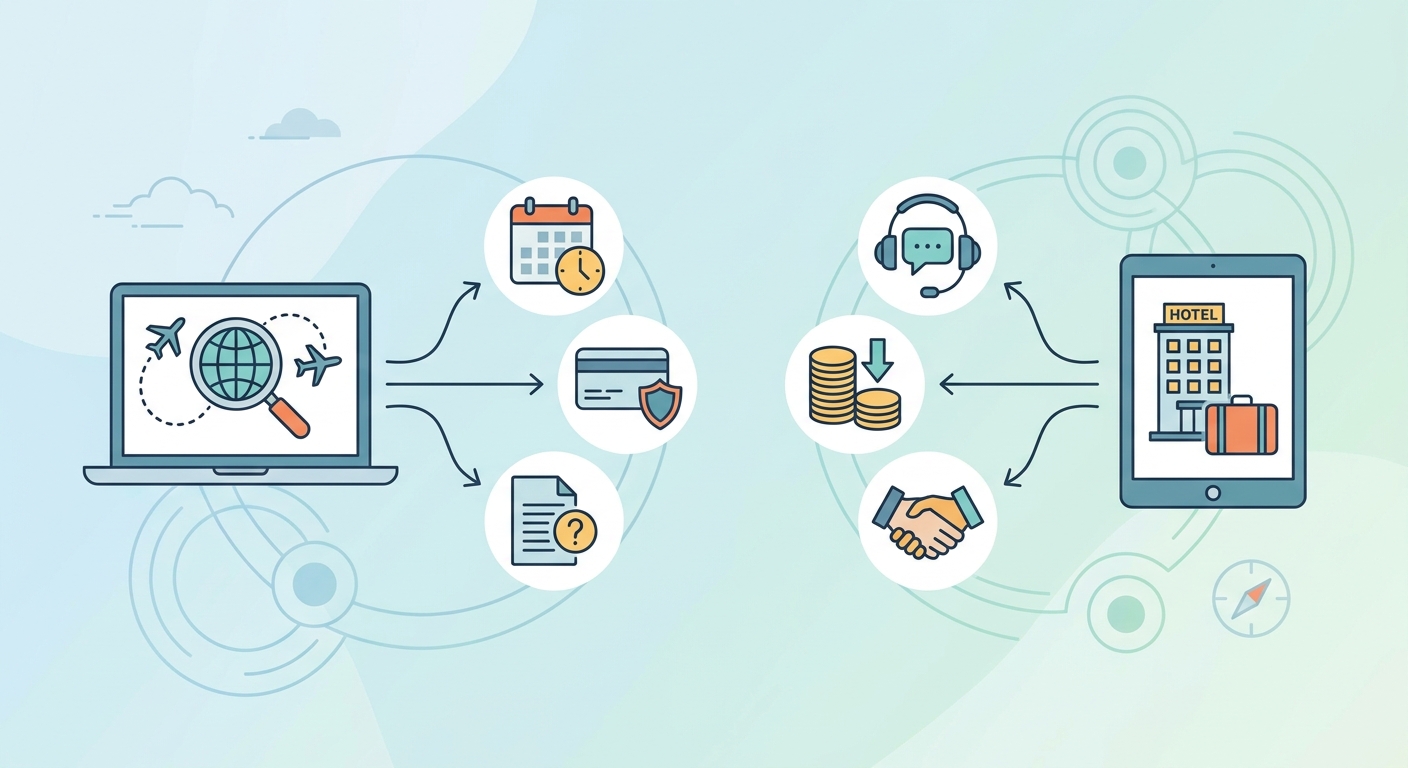
What Exactly is an Online Travel Agency (OTA) and How Does It Work?
An Online Travel Agency, or OTA, is a third-party website that acts as a digital marketplace for travel services. These platforms aggregate and sell inventory such as flights, hotel rooms, car rentals, and vacation packages from a vast network of suppliers, presenting them to consumers in a searchable, one-stop-shop format.
At its core, an OTA functions as a powerful intermediary. Instead of you visiting dozens of individual airline and hotel websites, the OTA uses a connection to a Global Distribution System (GDS) and direct partnerships to pull all that information into one place. They make money primarily through two models. In the agency model, the OTA earns a commission from the supplier (e.g., the hotel) for each booking made through their site. In the merchant model, the OTA buys inventory in bulk at a wholesale rate and then resells it to consumers at a markup, giving them more control over the final price.
This middleman role is the source of both their greatest strength and their most significant weakness. Their strength lies in aggregation and comparison. They allow you to compare the price of a flight on American Airlines against United and Delta simultaneously, something that would be tedious to do manually. They can also create dynamic packages, bundling a flight from one company with a hotel from another, often at a price that seems lower than the sum of its parts. This convenience is a primary driver of their popularity.
However, this same role creates a layer of separation between you and the end provider. When you book a hotel room via Expedia, your contract is with Expedia, not the hotel. Expedia then has a separate contract with the hotel to provide you with that room. This creates a chain of communication that can become incredibly problematic. If there's an issue with your booking, the hotel may be unable or unwilling to help, telling you that you must contact the OTA, as they are the 'client'. Understanding this fundamental structure is the first step in navigating the complexities of booking through these powerful platforms.
Real-World Scenario: The Booking Process
Imagine you're booking a trip to Rome. You go to an OTA website and enter your dates and destination. The OTA's system instantly queries its GDS connections and direct inventory, pulling flight options from dozens of airlines and room availability from hundreds of hotels. It then presents these options to you, sorted by price, rating, or other criteria. You select a British Airways flight and a room at an independent boutique hotel. You enter your payment information on the OTA's site and receive a confirmation email with an OTA-specific booking number. Behind the scenes, the OTA's system sends the booking details and payment to both British Airways and the hotel, securing your reservations. To you, it was one seamless transaction.
Actionable Takeaway
Always remember that an OTA is a reseller, not a provider. The convenience they offer comes from their role as a middleman. This means for every booking, there are at least three parties involved: you, the OTA, and the travel supplier. This is a crucial distinction to keep in mind, especially when considering what might happen if your plans need to change.

Are You Really Saving Money When Booking Through an OTA?
You can often find lower upfront prices on OTAs, especially for bundled packages or last-minute deals. However, the initial price displayed is not the full story, and true savings are not guaranteed when booking flights and hotels through an OTA once you account for potential fees, lost perks, and less flexible fare conditions.
OTAs leverage several strategies to appear cheaper. Their most effective tool is the package deal. By bundling a flight and hotel, they can use confidential, deeply discounted 'net rates' from hotels that are not available to the public. The hotel is willing to offer this rate because the OTA obscures the exact price of the room within the total package cost, preventing direct price comparisons. This is a legitimate way to save money, but it almost always comes with extreme inflexibility. Another tactic is offering 'opaque' deals, like Priceline's 'Express Deals', where you see the price and general location but not the exact hotel name until after you've made a non-refundable booking.
However, this initial saving can be quickly eroded. Many of the cheapest airfares advertised on OTAs are for Basic Economy tickets. These fares come with severe restrictions: no seat selection, no carry-on bag, no changes, and no cancellations. While airlines also sell these fares directly, OTAs sometimes make the restrictive nature of these tickets less obvious during the booking process. Furthermore, you might miss out on direct-booking perks that have tangible value. Hotels often offer members-only rates, free Wi-Fi, resort credits, or complimentary breakfast exclusively to guests who book on their own website. These benefits could easily outweigh the small discount offered by the OTA.
Comparison Table: OTA vs. Direct Booking Pricing
| Factor | Booking Through an OTA | Booking Direct |
|---|---|---|
| Upfront Price | Often appears lower, especially for packages. | May appear slightly higher but can have member-only discounts. |
| Included Perks | Typically none. No free breakfast, upgrades, or resort credits. | Often includes valuable perks like free Wi-Fi, breakfast, or potential upgrades. |
| Hidden Fees | Risk of booking highly restrictive fares (e.g., Basic Economy) without clear warnings. OTA service fees for changes. | All fees and fare rules are typically stated clearly by the provider. |
| Final Value | The initial saving can be negated by extra fees and lack of perks. | The total value can be higher once perks and flexibility are considered. |
Real-World Scenario: The 'Cheaper' Hotel Room
John finds a room at the Hilton Waikiki for $250 per night on an OTA, while the Hilton website lists it for $270. He books the cheaper option. Upon arrival, he learns the OTA booking doesn't include the 'free continental breakfast' and 'premium Wi-Fi' that direct bookers receive. He ends up spending $30 per day on breakfast and Wi-Fi, making his total cost $280 per night - $10 more than the direct price. He also misses out on earning Hilton Honors points for his stay. His perceived saving was an illusion.
Actionable Takeaway
Look beyond the headline price. Before booking on an OTA, always open a second tab and check the price on the airline or hotel's official website. This is just one of the best strategies to find cheap flights. Factor in the value of any direct-booking perks, member rates, and loyalty points to calculate the true cost and determine the best overall value.

What Happens When You Need to Change or Cancel Your Reservation?
The process of changing or cancelling a reservation is one of the biggest challenges when booking flights and hotels through an OTA, and it's almost always more difficult and stressful than with a direct booking. You are forced to navigate two separate sets of policies and customer service channels - the OTA's and the travel supplier's - which often creates delays, confusion, and extra fees.
When you book direct, there is one contract and one point of contact. If you need to change your flight, you call the airline. If you need to cancel your hotel, you do it on their website. The process is straightforward. With an OTA booking, a frustrating layer of bureaucracy is added. Your first and only point of contact is the OTA. You cannot call the airline or hotel directly to make changes to the core reservation because, in their system, the OTA is the customer, not you. You must call the OTA, who will then contact the supplier on your behalf.
This creates two major problems. First, delay. In a time-sensitive situation, like a flight cancellation where you need to be rebooked immediately, waiting on hold for an OTA agent who then has to call the airline can mean losing your seat on the next available flight to someone who booked direct and called the airline immediately. Second, it creates a 'finger-pointing' scenario. The OTA might tell you the airline's policy prevents a refund, while the airline might say they've authorized a refund but are waiting for the OTA to process it. You, the traveler, are stuck in the middle with no clear path to resolution. Furthermore, many OTAs add their own administrative fees for any changes or cancellations, on top of whatever fees the airline or hotel charges.
Real-World Scenario: The Cancelled Flight
A snowstorm cancels all flights out of Denver. Mary, who booked her United flight directly on their app, immediately receives a notification, clicks a button, and is automatically rebooked on a flight the next morning. Tom, who booked the exact same United flight through an OTA to save $15, gets no notification. He finds out at the airport. The United gate agent tells him they can't help him because it's a 'third-party booking' and he must contact his travel agency. Tom spends two hours on hold with the OTA's call center. By the time he gets through, the flight Mary was rebooked on is full. The best the OTA can do is a flight two days later, completely disrupting his trip.
Actionable Takeaway
If your travel plans have even a small chance of changing, the risk of booking through an OTA increases dramatically. The potential for customer service nightmares during disruptions is the single biggest reason many experienced travelers choose to book direct, even if it costs slightly more upfront. Always read both the supplier's and the OTA's cancellation and change policies before you book.

How Does Booking Through an OTA Affect Your Loyalty Points and Status?
For most travelers, booking through an OTA significantly diminishes or completely eliminates the ability to earn hotel loyalty points and enjoy elite status benefits. While you can typically still earn airline frequent flyer miles, the hotel side of the equation is where the loyalty trade-off becomes most apparent.
Major hotel chains like Marriott, Hilton, Hyatt, and IHG have a clear policy: to receive loyalty points, elite night credits, and on-site elite status recognition (like room upgrades, free breakfast, or late checkout), you must book directly through their official channels. When you book via a third-party OTA, the hotel views you as a customer of that OTA, not as their own loyal guest. They are paying a commission to the OTA for your booking, and they are unwilling to 'double dip' by also providing you with expensive loyalty benefits. This means your Gold or Platinum status effectively becomes worthless for that stay.
For airlines, the situation is better. In most cases, you can and should earn frequent flyer miles on flights booked through OTAs. The key is to ensure your frequent flyer number is correctly added to the reservation. Most OTAs have a field for this during the booking process. It is crucial to double-check that your name on the ticket exactly matches your frequent flyer account and that the number is present. After booking, you should always go to the airline's website, find your reservation using the airline's confirmation number (which may be different from the OTA's), and verify that your loyalty number is attached.
Real-World Scenario: The Ignored Hotel Elite
Sarah is a top-tier Hyatt Globalist member, a status that entitles her to suite upgrades, free breakfast, and 4 PM late checkout. She finds a Hyatt hotel on sale through an OTA and books a three-night stay, saving $40 per night. She adds her World of Hyatt number to the booking. At check-in, the front desk agent politely informs her that because she booked through a third party, they cannot honor her Globalist benefits. She is not eligible for an upgrade, will have to pay for breakfast, and must check out at 11 AM. She also earns zero elite night credits for the stay, slowing her progress toward requalifying for her status. The $120 she saved is quickly offset by the loss of perks worth far more.
Actionable Takeaway
If you are loyal to a specific hotel brand and value your elite status benefits, booking through an OTA is almost never a good idea. The direct booking is the only way to guarantee you'll receive the points and perks you've earned. For flights, always double- and triple-check that your frequent flyer number is correctly added to your OTA reservation to ensure you receive your miles.

Who Do You Contact When Something Goes Wrong During Your Trip?
When a problem arises with a booking made through an OTA, your official and primary point of contact is the OTA's customer service, not the airline or hotel. This is one of the most misunderstood and frustrating aspects of using a third-party booking service, especially when you need immediate assistance.
The reason for this lies in the contractual relationship. The airline or hotel's agreement is with the Online Travel Agency. The OTA is their client. Your agreement, in turn, is with the OTA. This creates a firewall between you and the service provider. An airline gate agent or hotel front desk manager may have limited ability to modify your reservation because it is 'owned' or 'controlled' by the third-party agent. They can't change tickets, process refunds, or alter room types on a reservation that wasn't made in their own system.
This can lead to infuriating situations. Imagine arriving at a hotel late at night to find it's overbooked. The hotel staff might be sympathetic, but they will likely direct you to call the OTA you booked with to find a resolution. This means, instead of the hotel manager solving the problem on the spot, you are left trying to reach a remote call center, potentially in a different time zone, to advocate on your behalf. The people who are physically present and capable of helping you are often contractually unable to do so. This dynamic shifts the responsibility for problem-solving away from the on-site provider and onto you and a faceless OTA customer service agent.
Real-World Scenario: The Phantom Hotel Reservation
The Miller family arrives at their pre-paid resort in Cancun, excited to start their vacation. At the check-in counter, the clerk has no record of their reservation. The Millers show their confirmation email from the OTA, but the hotel's system is empty. The hotel explains that the OTA may have failed to transmit the booking details correctly and that since the payment was made to the OTA, the hotel cannot help. The family spends the first three hours of their vacation in the lobby, on an international call with the OTA's support line, trying to get the booking sorted out. The direct bookers next to them, who had a minor issue with their room type, had it resolved by the front desk manager in five minutes.
Actionable Takeaway
Before you book with an OTA, consider the worst-case scenario. If your flight is cancelled or your hotel is overbooked, are you prepared to deal with a remote call center instead of the person standing in front of you? For complex or important trips where the risk of disruption is higher, the direct line of communication offered by booking direct can be invaluable and is often worth a price premium.
Are 'Package Deals' on OTAs a Good Value?
OTA package deals, which bundle flights and hotels together, can represent one of the best opportunities for genuine savings, but they come with a significant trade-off: extreme inflexibility. These deals are often a good value for travelers with firm, unchangeable plans, but they can become a financial trap if any part of the trip needs to be altered.
The savings in a package deal come from the OTA's ability to use specially negotiated, confidential rates from suppliers that aren't available for standalone bookings. A hotel, for instance, might give an OTA a very low 'net rate' for a room on the condition that the OTA doesn't display that price publicly. By bundling it with a flight, the OTA can pass the savings to you without revealing the hotel's discounted rate. This can lead to total package prices that are considerably lower than booking the same flight and hotel separately.
The downside is that these components are contractually linked and are almost always governed by the most restrictive rules possible, which usually means they are 100% non-refundable and non-changeable. Trying to alter one part of the package can be impossible or can trigger a complete repricing of the entire trip, wiping out any initial savings. If you need to cancel your flight, you will likely forfeit the entire cost of the hotel as well, and vice-versa. There is no concept of a partial refund. This 'all or nothing' nature makes them a high-risk proposition for anyone who isn't completely certain about their travel dates, destination, and traveling party.
Real-World Scenario: The Inflexible Family Vacation
The Chen family books a non-refundable flight-plus-hotel package to Orlando through an OTA for $2,500, saving $400 compared to booking direct. Two weeks before the trip, their child's school changes the dates for a mandatory event, and they need to shift their vacation by two days. They contact the OTA, who informs them that because it's a package deal, no changes are permitted. Their only option is to cancel the entire trip and forfeit the full $2,500. Had they booked the flight and hotel separately and directly, they might have paid a change fee to the airline and simply modified the hotel dates, preserving most of their vacation's value.
Actionable Takeaway
Only consider an OTA package deal if your travel plans are 100% confirmed and you have a very low risk of needing to make changes. For the best protection, purchase comprehensive 'Cancel For Any Reason' travel insurance from a standalone provider. This can help you recoup your non-refundable costs if your plans fall through, mitigating the significant financial risk of these inflexible but potentially high-value deals.
What Are the Hidden Risks and Fine Print You Should Look For?
The biggest hidden risks when booking through an OTA are buried in the fine print and relate to restrictive fare classes, vague booking details, and the OTA's own set of fees. To avoid costly surprises, you must become a diligent detective before you click the final purchase button, as the attractive headline price can often obscure significant back-end costs and limitations.
One of the most common traps is the fare class of your flight ticket. OTAs often default to showing the cheapest possible price, which is typically a 'Basic Economy' or equivalent restrictive fare. These tickets may not include a carry-on bag, advance seat selection, or the ability to make any changes. The OTA's booking interface might not make these limitations as prominent as the airline's own website would. Similarly, for hotels, a booking for a 'Standard Room' or 'Run of House' could mean you end up in the least desirable room on the property - next to the elevator or with a view of the parking lot - with no recourse to complain.
You must also be vigilant about the OTA's own terms and conditions. Many OTAs impose their own administrative fees for any customer-initiated changes or cancellations, which are charged on top of any fees levied by the airline or hotel. A $200 airline change fee could become a $250 charge after the OTA adds its $50 processing fee. Furthermore, simple mistakes like misspelling a name can be a nightmare to fix. While an airline might correct a minor typo for free if you booked direct, an OTA may require a costly and complicated process to make the same change. Finally, pay attention to currency. Some international OTAs may display prices in your local currency but actually charge your card in a foreign currency, potentially leading to foreign transaction fees from your bank.
Checklist for Reviewing the Fine Print:
- Fare Class: Is it Basic Economy? Does it include a carry-on bag and seat selection?
- Hotel Room Type: Is a specific room and bed type guaranteed, or is it 'Run of House'?
- Cancellation Policy: What are the exact deadlines and penalties from BOTH the supplier and the OTA?
- Change Fees: Does the OTA add its own service fees on top of the airline/hotel fees?
- Name Accuracy: Double-check that every traveler's name is spelled exactly as it appears on their government-issued ID.
- Confirmation Numbers: After booking, ensure you receive both an OTA confirmation number and a separate one for the airline/hotel.
Actionable Takeaway
Adopt a 'trust but verify' approach. Treat the initial booking screen as an advertisement and the final confirmation page as a contract. Read every line before you pay. Take screenshots of the policies and booking summary. The few extra minutes you spend scrutinizing the details can save you hundreds of dollars and immense frustration later on.
Can Using an OTA Ever Be Better Than Booking Direct?
Yes, despite the potential pitfalls, there are specific scenarios where booking through an OTA is not only acceptable but is actually the superior choice. Understanding when to leverage the power of an OTA and when to avoid them is the mark of a savvy traveler. Their strengths lie in price comparison, complex itineraries, and access to smaller, independent properties.
The most powerful use case for an OTA is as a research tool. Their ability to aggregate options from hundreds of suppliers into a single, sortable list is unparalleled. You can quickly get a sense of which airlines fly a certain route, what the general price range is, and which hotels are available in your target neighborhood. This initial discovery phase is where OTAs provide immense value, even if you ultimately decide to book direct. They are also ideal for booking complex, multi-airline trips, especially on international routes. For example, piecing together a trip from New York to Bangkok via Frankfurt on one airline, then from Bangkok to a small island on a local Thai carrier, is far simpler on an OTA than trying to book it on separate airline websites.
OTAs also shine when you're booking accommodations at independent or boutique hotels. A small, family-run guesthouse in the Italian countryside may not have a sophisticated online booking engine or the marketing budget to reach a global audience. For these properties, being listed on a platform like Booking.com or Agoda is their lifeline. In these cases, the OTA provides a secure and reliable way to book a property you might not have found otherwise. Finally, for last-minute, non-refundable bookings where your plans are set in stone and you are purely price-sensitive, an OTA can sometimes offer a deal that is simply too good to pass up.
Ideal Scenarios for Using an OTA:
- Initial Research: To compare prices and options across a wide range of suppliers quickly.
- Complex Itineraries: For trips involving multiple airlines that don't have codeshare agreements.
- Independent Hotels: To book smaller, non-chain hotels, guesthouses, or apartments.
- Price-Driven Trips: For last-minute, non-refundable travel where cost is the only priority and flexibility is not needed.
- Car Rentals: OTAs often have excellent rates for car rentals and the risks associated with customer service are generally lower than with flights or hotels.
Actionable Takeaway
Use OTAs strategically. Leverage them for their strengths in research and booking complex trips, but switch to direct booking for important journeys, when you need flexibility, or when you want to utilize your hard-earned loyalty status. It's not about being for or against OTAs; it's about using the right tool for the right job.
How Can You Protect Yourself When Booking Through an OTA?
While booking through an OTA introduces risks, you can take several proactive steps to mitigate potential problems and protect your investment. A combination of smart payment methods, immediate verification, and thorough research can provide a crucial safety net and turn a potentially risky booking into a smooth experience.
Your first line of defense is your payment method. Always book travel with a credit card, never a debit card. Credit cards offer robust fraud protection and dispute resolution channels. More importantly, premium travel credit cards provide a suite of built-in insurance benefits, such as trip cancellation/interruption coverage, baggage delay reimbursement, and primary rental car insurance. These protections can be a lifesaver if the OTA or travel supplier fails to provide a satisfactory resolution during a disruption. This built-in insurance is often more than sufficient for typical travel issues and can save you from having to buy a separate policy.
The second critical step is to verify your reservation immediately after booking. Do not rely solely on the confirmation email from the OTA. This email will contain two important pieces of information: the OTA's booking reference and the airline or hotel's own confirmation number (sometimes called a PNR for flights). Take the supplier's confirmation number and go directly to their website. Use it to pull up your reservation. Check that all details - names, dates, room type, fare class - are exactly as you intended. If you can't find it online, call the airline or hotel directly. Confirming that they have your correct reservation in their system within 24 hours of booking gives you a window to correct any errors before they become costly problems.
Protective Measures Checklist:
- Use a Travel Credit Card: Leverage built-in trip insurance and purchase protection.
- Confirm Directly: Get the airline/hotel confirmation number and verify your booking on their official website immediately.
- Take Screenshots: Save images of the final booking page, the price, and the cancellation policy.
- Vet the OTA: For lesser-known OTAs, check recent reviews on sites like Trustpilot or the Better Business Bureau. Stick to large, reputable OTAs if you have any doubts.
- Read Everything: Don't skim the terms and conditions. Understand the change fees, cancellation rules, and fare restrictions before you commit.
- Consider Separate Insurance: For expensive, non-refundable trips, a comprehensive travel insurance policy from a third-party provider can offer the ultimate protection.
Actionable Takeaway
Booking through an OTA requires you to be your own travel advocate. Take responsibility for verification and protection. By using the right tools and being proactive, you can minimize the risks associated with the middleman model and still take advantage of the convenience and potential savings they offer. A few simple steps after booking can prevent a major headache during your trip.
The decision of whether booking flights and hotels through an OTA is the right move, or if booking directly with the provider is better, is not a simple one-size-fits-all choice. It is a calculated decision based on a fundamental trade-off: convenience and potential upfront savings versus flexibility, customer service, and loyalty benefits. OTAs are undeniably powerful tools for the modern traveler, offering an unparalleled ability to search, compare, and discover options around the globe. For the price-conscious traveler with concrete plans, or for those piecing together a complex multi-provider itinerary, an OTA can be an invaluable ally.
However, that convenience comes at a cost that isn't always visible on the initial price tag. By inserting a middleman into the transaction, you willingly sacrifice a direct line of communication with the company that will actually be providing your service. When flights are cancelled, when hotels are overbooked, or when simple mistakes need correcting, that broken communication link can become a significant source of stress and frustration. Furthermore, for the loyal traveler who values the perks and points that come with elite status, the OTA channel is often a dead end, rendering those hard-earned benefits useless.
Ultimately, the right choice depends on your travel style and the nature of your trip. Are you booking a simple, last-minute weekend getaway where your plans are set in stone? An OTA package deal might be perfect. Are you planning a complex, expensive family vacation months in advance where flexibility is key? Booking direct is almost certainly the wiser, safer path. Use OTAs for what they do best: research and comparison. Let them show you what's possible. But before you click that 'Complete Purchase' button, take a moment to weigh the hidden costs. Understand the risks you are accepting and make an informed decision that values not just the price of your trip, but the quality of your entire travel experience.
Frequently Asked Questions
Yes, it is generally safe to give your credit card information to large, reputable OTAs like Expedia, Booking.com, or their subsidiaries. These companies invest heavily in cybersecurity and use encrypted connections (look for 'https://' in the URL) to protect your financial data during transactions. However, you should be more cautious with smaller, unknown OTAs. Always use a credit card instead of a debit card for better fraud protection. If you are concerned, some OTAs also support secure payment methods like PayPal, which adds another layer of security by not exposing your card details to the merchant.
While not guaranteed, you often have a higher chance of getting a better room by booking direct. Hotels tend to prioritize their direct-booking and loyal customers for complimentary upgrades and preferred rooms (e.g., higher floors, better views). OTA bookings are often viewed as the lowest priority because the hotel pays a commission and views the guest as less loyal. At a minimum, booking direct allows you to make specific requests (like a quiet room or a specific floor) that have a better chance of being honored than if they are passed through an OTA's system.
A flight can sometimes be cheaper on an OTA for a few reasons. The OTA might have access to specially negotiated private fares or bulk fares that aren't available to the general public. In other cases, the OTA may be using a flight from one source and bundling it with its own fees in a way that results in a lower price. Sometimes, they may even be using it as a 'loss leader' - selling the seat at a slight loss to entice you to book a more profitable hotel or car rental along with it. Always double-check the fare rules, as these cheaper tickets are often highly restrictive.
Airlines, not OTAs, are the ones who make schedule changes. However, a critical problem can arise in how you are notified. The airline will send the schedule change notification to the entity that booked the ticket - in this case, the OTA. The OTA is then responsible for relaying that information to you. Delays or failures in this communication chain can lead to travelers showing up for a flight that was rescheduled or cancelled hours or days before. This is a key reason why it's crucial to check your reservation directly on the airline's website periodically after booking through an OTA.
Most major OTAs have a field for your Known Traveler Number (KTN) during the booking process, often in the same section where you enter your name and date of birth. If you miss it, or if the OTA doesn't provide a field, you can almost always add it after the booking is complete. Once you receive the airline's confirmation number (PNR), go to the airline's official website and use their 'Manage My Booking' tool. There, you should be able to edit your passenger details and add your KTN to ensure you get TSA PreCheck benefits at the airport.