Are Hidden City Flights and Throwaway Tickets on Kiwi.com Safe?
In the quest for cheaper airfare, many travelers explore unconventional booking strategies, often stumbling upon concepts like hidden city flights and throwaway ticketing. These methods, designed to exploit airline pricing models, promise significant savings but come with a complex web of risks and potential repercussions. Online Travel Agencies (OTAs) like Kiwi.com, known for their innovative "virtual interlining" technology, often facilitate these intricate itineraries, making them accessible to a broader audience. But the critical question remains: are hidden city flights and throwaway tickets on Kiwi.com truly safe?
The direct answer is complex, leaning heavily towards no, they are generally not safe for most travelers, especially those seeking predictable, low-risk journeys. While the immediate financial savings can be tempting, these strategies expose travelers to substantial risks, including denied boarding, invalidated tickets, lost luggage, and potential blacklisting by airlines. Kiwi.com's unique operational model and its "Kiwi.com Guarantee" aim to mitigate some of these risks, yet they do not eliminate the fundamental challenges posed by violating airline contracts of carriage.
In this comprehensive guide, we will delve into the intricacies of hidden city flights and throwaway ticketing, examining how Kiwi.com's platform interacts with these methods. You will learn about the precise mechanisms of these strategies, the significant dangers they entail, the legal and ethical implications, and the effectiveness - or limitations - of Kiwi.com's protective measures. We will also explore safer, more conventional alternatives to secure affordable flights and empower you to make informed decisions for your future travel plans in 2026 and beyond. Our goal is to provide a depth-driven analysis that goes beyond surface-level warnings, ensuring you understand the full scope of risks before considering such unconventional travel hacks.
What Exactly Are Hidden-City and Throwaway Tickets?
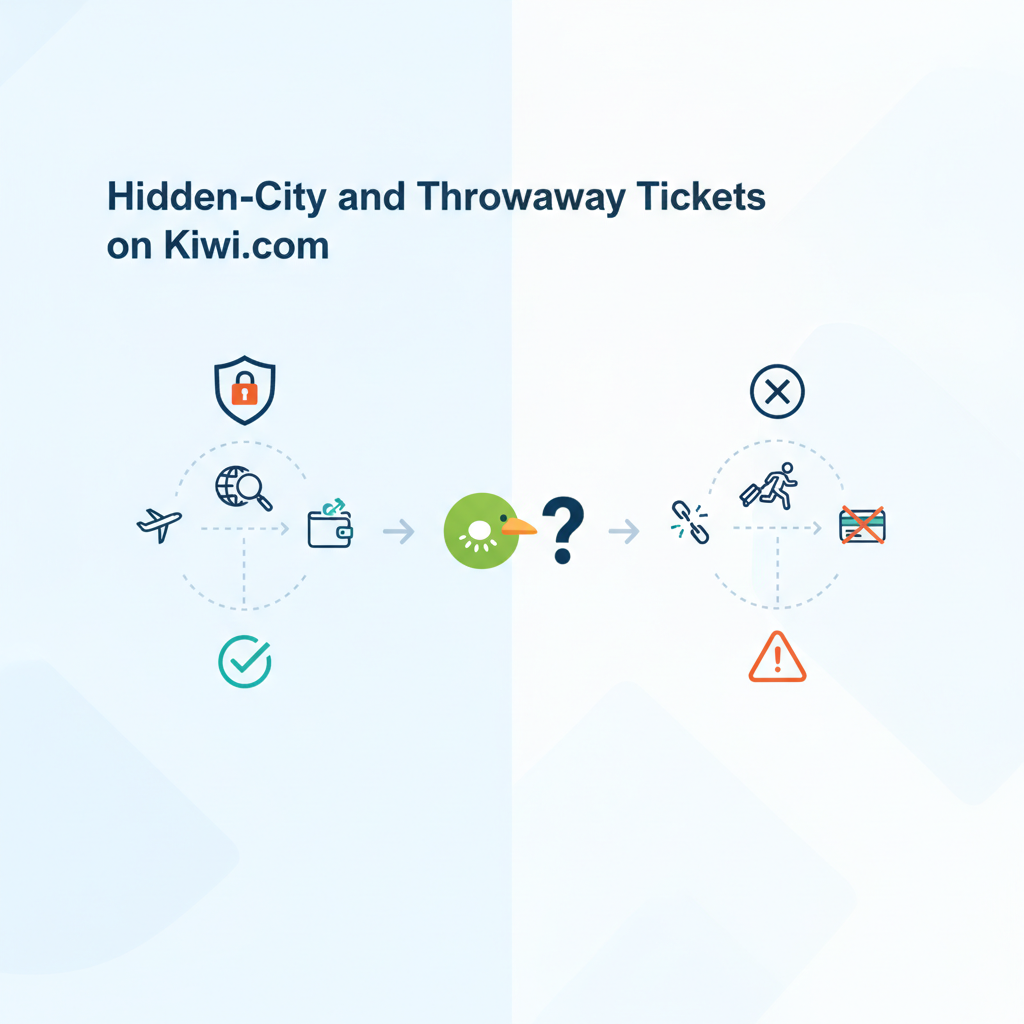
Hidden city flights, also known as skiplagging, are a strategy where a traveler books a multi-leg flight itinerary but intends to disembark at a layover city, rather than the final destination on their ticket. The core premise is that flying to a destination with a connection may sometimes be cheaper than flying directly to the layover city itself. For example, a flight from City A to City C with a stop in City B might be less expensive than a direct flight from City A to City B. A traveler using hidden city flights would book the A-C flight but simply get off at City B, their true desired destination, and forfeit the remaining leg.
This pricing anomaly arises from complex airline revenue management systems, competitive routes, and hub-and-spoke models where certain cities are designated as hubs. Airlines use advanced algorithms to price routes based on demand, competition, and overall network optimization, not always on linear distance. A flight to a less popular destination via a popular hub can sometimes be artificially cheaper to fill seats on the longer, less desirable route, or to compete with other airlines flying to the same hub. The traveler effectively "hacks" this system to save money on what would otherwise be a more expensive direct flight.
Throwaway ticketing, conversely, involves booking a round-trip or multi-leg ticket but only using the outbound portion, or simply discarding one or more segments of a ticket without any intention of using them. This strategy is often employed when a round-trip fare is cheaper than a one-way fare for the same route. For instance, a round-trip ticket from City A to City B might be significantly cheaper than a one-way ticket from A to B. A throwaway ticket user would purchase the round-trip but only use the A-B leg, then simply not show up for the return B-A segment. The return portion is "thrown away" because using it would be inconvenient or, more commonly, because a one-way ticket was disproportionately expensive.
Both hidden city flights and throwaway ticketing are direct violations of an airline's contract of carriage. Airlines explicitly prohibit these practices in their terms and conditions, often stipulating that tickets must be used in sequential order and that travelers must complete all booked segments. These rules are in place to protect airline revenue models, prevent abuse of their complex pricing structures, and maintain operational integrity. When travelers engage in these practices, they are essentially attempting to circumvent these contractual obligations for personal financial gain, which carries inherent risks.
Understanding these definitions is the first crucial step. These are not benign shortcuts; they are deliberate actions taken outside the established rules of air travel. While they appear to offer a compelling financial advantage, this advantage is predicated on bypassing airline policies, which can lead to significant complications if detected or if unforeseen travel disruptions occur. The perception of a 'hack' often overshadows the reality of a policy violation, leading many travelers down a path fraught with uncertainty and potential penalties.
How Does Kiwi.com Facilitate These Booking Strategies?
Kiwi.com stands out in the online travel agency landscape due to its proprietary technology, known as "virtual interlining." This innovative system aggregates flights from various airlines, including those that do not typically codeshare or have interline agreements, and combines them into single itineraries. Unlike traditional OTAs that rely on Global Distribution Systems (GDS) and official airline partnerships, Kiwi.com's algorithm scans billions of flight combinations from both full-service carriers and budget airlines, stitching together routes that no single airline or conventional OTA would offer. This often results in significantly cheaper or more convenient multi-leg routes, sometimes inadvertently creating opportunities for hidden city flights or throwaway ticketing.
When Kiwi.com presents a multi-leg itinerary involving different airlines, each segment is often booked as a separate ticket. For example, a journey from London to Tokyo via Dubai might involve a Ryanair flight to Dubai and then an Emirates flight to Tokyo, booked as two distinct reservations. This fragmented booking structure, inherent to virtual interlining, is precisely what makes hidden city flights and throwaway ticketing technically feasible. Since the airline operating the first leg (e.g., Ryanair) has no contractual obligation or awareness of the subsequent leg (e.g., Emirates), and vice versa, a traveler can theoretically skip the second leg without immediate repercussion from the first airline. However, this technical feasibility does not equate to policy compliance or safety.
Kiwi.com's platform actively encourages exploration of diverse routes, and while it doesn't explicitly promote hidden city flights or throwaway ticketing, its system naturally identifies and presents itineraries that can be adapted for these purposes. Travelers might find a flight to their desired layover city, note that a connecting flight to a further destination is cheaper, and then choose to book that longer itinerary with the intent to disembark early. The platform's strength - finding unconventional routes - becomes a double-edged sword, inadvertently exposing travelers to the temptation of violating airline rules. Kiwi.com primarily focuses on connecting flights and often highlights the potential savings, but the onus of understanding the risks associated with skipping segments ultimately falls on the traveler.
Crucially, Kiwi.com often sells tickets that are entirely separate reservations, even if they appear as a single journey on their website. This means that if you miss a connection due to a delay on an earlier flight, the subsequent separate ticket is likely to be forfeited without compensation from the airline, as there's no official interline agreement protecting your connection. This is where Kiwi.com's own "Guarantee" comes into play, aiming to provide a safety net where airlines won't. However, this guarantee has specific terms and conditions, and its effectiveness in complex situations, especially those involving policy violations like hidden city flights or throwaway ticketing, is often debated and can be limited. The ease of booking these fragmented itineraries masks the underlying contractual separation and the associated risks that are typically borne by the traveler.
What Are the Primary Risks of Hidden-City Ticketing?
Hidden city flights, while tempting for their cost-saving potential, are fraught with significant risks that can derail your travel plans and incur substantial additional costs. The most immediate and critical danger is the potential for denied boarding or cancellation of your entire itinerary. Airlines strictly prohibit skipping segments. If detected, even before departure, the airline can refuse to let you board your initial flight. If detected after you've flown the first leg and skipped the second, they can cancel any remaining flights on the same ticket, including your return journey, without refund.
Another major concern is checked baggage. When you book a hidden city flight, your luggage is typically checked through to the final destination on your ticket, not your intended layover city. This means you will not have access to your bags if you disembark early. Attempting to retrieve checked luggage at a layover city is often impossible or requires significant intervention with airline staff, who may then question your intentions, leading to detection. For this reason, hidden city flights are generally only feasible for travelers with carry-on luggage, which significantly limits their practicality for longer trips or those requiring more personal items.
Furthermore, schedule changes and flight disruptions pose a substantial risk. Airlines frequently adjust flight times, and if your initial flight is changed or cancelled, the airline may re-route you through a different layover city, completely negating your hidden-city strategy. You could end up flying to an entirely different location than intended, or miss your original connection if the re-routing is not suitable. Since your true destination is not the one on your ticket, you have no recourse with the airline for these changes, as they are fulfilling their contractual obligation to get you to the ticketed final destination.
In addition to these direct travel impacts, there are potential financial penalties and airline blacklisting. Airlines, if they identify repeated hidden city flights practices, may retroactively charge you the difference between the hidden city flights fare and the direct fare to your actual destination. This can amount to hundreds or even thousands of dollars. In severe cases, particularly for frequent flyers or business travelers, airlines have been known to cancel frequent flyer miles, revoke elite status, and even permanently ban travelers from booking with their airline or associated partners. This 'blacklisting' can have long-term consequences for future travel, making it impossible to book preferred routes or access loyalty benefits.
Finally, there's the critical issue of travel insurance validity. Most travel insurance policies require you to adhere to the terms and conditions of your airline ticket. If an incident occurs during a trip involving a hidden city flight - for example, a medical emergency, lost luggage (which is already a high risk), or trip interruption - your insurance claim may be denied because you were in violation of the airline's contract of carriage. This leaves you exposed to significant out-of-pocket expenses that would otherwise be covered, turning a seemingly cheap flight into a very costly ordeal. The cumulative weight of these risks makes hidden city flights a highly precarious endeavor for most international or complex travel plans.
What Are the Primary Risks of Throwaway Ticketing?
Throwaway ticketing, while appearing less complex than hidden-city, carries its own distinct set of risks, primarily related to the airline's ability to enforce its contract of carriage and its impact on subsequent or future bookings. The most immediate risk is the invalidation of remaining ticket segments. Airlines generally operate under a 'sequential use' rule, meaning if you miss or skip any segment of your itinerary, all subsequent segments on that same ticket are automatically cancelled by the airline, typically without refund. If you book a round-trip A-B-A ticket and only use A-B, then miss the B-A return, any other flights on that same booking reference, or even future bookings linked to your frequent flyer number, could be affected.
This risk is particularly pertinent for those attempting to combine throwaway ticketing with multi-city itineraries or those who frequently travel with the same airline. For example, if you book a complex multi-leg journey where the cheapest option involves throwing away a segment, and then an unforeseen event requires you to change a later leg, the entire booking could be compromised. The airline, detecting a missed segment, would simply cancel the rest of your itinerary, leaving you stranded and responsible for purchasing new, often expensive, last-minute tickets. This lack of flexibility makes throwaway tickets incredibly rigid and prone to failure if any part of your travel plans deviate from the original booking.
Another significant risk is airline detection and potential penalties. While it might seem less obvious to an airline that you've intentionally thrown away a ticket compared to skipping a connection, their sophisticated systems can flag patterns of behavior. If you consistently book round-trip tickets and only use the outbound portion, or frequently miss return flights, airlines can identify this as a violation of their fare rules. Consequences can range from being retroactively charged the difference between the round-trip and a more expensive one-way fare (which was the reason for throwaway ticketing in the first place) to the cancellation of your frequent flyer benefits and even account suspension. This is especially true if you associate a loyalty program number with your booking, as it creates a clear digital trail of your travel patterns.
Furthermore, customer service implications can arise. If you need to make changes or seek assistance with a booking that involves a thrown-away segment, airline representatives may identify the violation. This can lead to unhelpful or punitive responses, as they are not obligated to assist travelers who have breached their terms. In some cases, if you need to travel with that airline again in the near future and your previous throwaway ticket is still lingering in their system, it could cause issues with new bookings or check-in processes. The airline might hold a record of your non-compliance, making future interactions more difficult.
Finally, there's the often-overlooked environmental impact. Throwaway ticketing contributes to 'ghost flights' or partially empty planes. While this might seem minor on an individual level, the cumulative effect can be negative. More importantly, it can influence airline pricing models in ways that are detrimental to all travelers in the long run. If airlines consistently see certain segments being thrown away, they may adjust their pricing to account for this, potentially making one-way fares even more expensive or introducing new surcharges for un-flown segments, thereby reducing the very arbitrage opportunity that throwaway ticketing seeks to exploit. The perceived short-term gain often masks these broader, and personal, long-term disadvantages.
Are There Legal or Ethical Implications When Using These Tickets?
Engaging in hidden city flights or throwaway ticketing treads into a grey area that, while not typically criminal, carries significant legal and ethical implications within the context of air travel. From a legal standpoint, both practices are considered a breach of contract. When you purchase an airline ticket, you enter into a legally binding agreement known as the "contract of carriage." This document, often extensive and overlooked, outlines the rights and responsibilities of both the passenger and the airline. Airlines almost universally include clauses that prohibit ticket misuse, specifically addressing practices like sequential segment usage and the completion of all booked legs.
Violating the contract of carriage empowers the airline to take various punitive actions. These are not arbitrary decisions but rather actions supported by the terms you agreed to. The most common enforcement mechanisms include cancelling remaining flights on the itinerary, charging the difference between the fare paid and the fare for the intended travel (i.e., the direct flight to your hidden city or the one-way fare for a throwaway ticket), revoking frequent flyer miles, and even banning individuals from future travel with the airline. While you won't face jail time, the financial and logistical repercussions can be severe and legally defensible by the airline. There have been several high-profile cases where airlines have successfully pursued legal action against passengers or even third-party platforms that facilitate such practices, reaffirming their right to enforce their terms.
Ethically, these practices raise questions about fair play and the integrity of the pricing system. Airlines invest heavily in complex revenue management systems to optimize loads and offer a range of fares. While consumers are naturally inclined to seek the lowest price, intentionally exploiting loopholes that undermine these systems can be seen as unethical. It can be argued that such practices contribute to price volatility and may even lead to higher costs for other, more compliant travelers in the long run, as airlines seek to recover lost revenue or prevent future exploitation. It's a form of arbitrage that benefits the individual at the potential expense of the broader ecosystem of air travel. This can lead to a sense of unfairness among other passengers who pay the standard fares.
Moreover, hidden city flights and throwaway ticketing can have secondary ethical implications related to operational efficiency and environmental concerns. When a seat on a later segment of a flight goes empty because a passenger deplaned early, it represents a lost opportunity for the airline to sell that seat. While airlines often overbook to account for no-shows, a consistent pattern of deliberate no-shows can disrupt load factor predictions. Furthermore, a plane flying with empty seats due to a hidden-city passenger still consumes fuel and contributes to emissions, raising environmental questions about resource efficiency. The act of skipping a flight segment, therefore, isn't just a personal choice; it ripples through the airline's operations and potentially affects the industry's environmental footprint.
Ultimately, while the immediate gratification of a cheaper ticket is appealing, travelers must weigh these immediate gains against the potential legal battles, financial penalties, the loss of loyalty benefits, and the broader ethical implications of undermining a system designed for collective use. It's a calculation that extends beyond simply saving a few dollars and delves into the reliability and integrity of one's travel future. The convenience of a travel 'hack' should never overshadow the importance of respecting the terms and conditions that govern air travel.
How Does Kiwi.com's Guarantee Address These Risks?
Kiwi.com's unique selling proposition often hinges on its "Kiwi.com Guarantee," a service designed to provide a safety net for travelers booking complex, self-transfer itineraries - particularly those involving different airlines without official interline agreements. The guarantee purports to protect travelers in cases of flight delays, cancellations, or schedule changes that result in a missed connection. If such an event occurs, Kiwi.com states it will rebook you on an alternative flight to your destination, offer a refund, or provide accommodation if an overnight stay is required. This is a significant offering, as traditional airlines would not take responsibility for missed connections between separately booked tickets.
However, it is crucial to understand that the Kiwi.com Guarantee comes with specific terms, conditions, and notable limitations, especially when considering its applicability to hidden city flights or throwaway ticketing. Firstly, the guarantee explicitly states that it only applies if you comply with all terms and conditions of your booking, including those of the individual airlines. Since hidden city flights and throwaway ticketing inherently violate airline contracts of carriage, engaging in these practices could very well invalidate your eligibility for the Kiwi.com Guarantee. If Kiwi.com detects that your missed segment was intentional (e.g., you disembarked early), they are unlikely to honor the guarantee for any subsequent issues.
Furthermore, the guarantee has strict notification requirements. You must contact Kiwi.com immediately - often within a very short timeframe (e.g., 24 hours, or even less for imminent departures) - if your travel plans are disrupted. Failure to do so can also void the guarantee. In the context of a hidden-city scenario, if your original flight is delayed and you miss your connection, but you were never intending to take that connection in the first place, reporting it might expose your hidden-city strategy. This creates a difficult dilemma for the traveler: report the disruption and potentially reveal the violation, or remain silent and forfeit any chance of assistance.
The extent of the guarantee's coverage also varies. While it promises rebooking, this is often for the next available flight, which might not be immediate and could still result in significant delays. Refunds are typically for the unused portion of the ticket or the cost of alternative travel up to a certain limit, which might not cover the full cost of a new, last-minute flight purchased independently. Accommodation and food reimbursements also have caps and require strict adherence to receipt submission. These limitations mean that even when the guarantee is honored, it may not fully alleviate the financial burden or inconvenience of a major travel disruption.
A significant practical limitation, often highlighted in traveler reviews, is the speed and accessibility of Kiwi.com's customer support when a disruption occurs. In urgent situations, such as a missed connection with only hours to spare, getting through to a human representative and having a resolution quickly can be challenging. This delay can be critical, especially for international travel or when visa requirements are involved. While the guarantee offers a theoretical safety net, the real-world application and the burden of proof often fall heavily on the traveler, making it less robust than direct airline support in standard booking scenarios. Therefore, while the Kiwi.com Guarantee offers a unique layer of protection for complex itineraries, it is not a foolproof shield against the inherent risks and airline policy violations associated with hidden city flights and throwaway ticketing.

What Happens If Airlines Detect Hidden-City or Throwaway Practices?
Airline detection of hidden city flights or throwaway ticketing can lead to a range of severe consequences, turning a perceived cost-saving hack into a costly and frustrating ordeal. Airlines employ sophisticated revenue management systems and data analytics that can identify patterns indicative of these practices. While a single, isolated incident might go unnoticed, repeated use, especially when linked to a frequent flyer account, significantly increases the risk of detection. When detected, the airline is within its contractual rights to impose penalties as outlined in their contract of carriage.
The most immediate and common consequence is the cancellation of subsequent flights on your itinerary without refund. If you are caught attempting a hidden city flight by checking baggage to your actual layover city, or if an airline agent simply becomes suspicious, they can deny you boarding on your initial flight. Even if you successfully complete the first leg and skip the second, any remaining flights on that same booking reference - including your return journey - will likely be automatically cancelled. This leaves you stranded at your layover city, responsible for purchasing an expensive, last-minute ticket to your true destination or home, effectively negating any initial savings and often incurring far greater costs.
Retroactive fare adjustment and financial penalties are another serious risk. Airlines can re-price your ticket as if you had booked the direct flight to your hidden city or the one-way fare for a throwaway ticket. They will then charge you the difference, which can amount to hundreds or even thousands of dollars. This charge can be levied against the credit card used for the original booking. In some cases, airlines have sent invoices to travelers for these differences, threatening legal action if not paid. This is particularly prevalent with frequent business travelers whose companies might be targeted for audit if employees are found to be regularly violating fare rules.
For travelers who are part of an airline's loyalty program, detection can lead to the forfeiture of frequent flyer miles and revocation of elite status. Airlines consider these practices a form of fraud against their loyalty programs. Accumulated miles, often painstakingly earned over years, can be wiped out, and any elite benefits (such as lounge access, priority boarding, or free upgrades) can be permanently revoked. This not only strips away valuable perks but also serves as a strong deterrent for future violations, marking the traveler as a high-risk passenger in the airline's internal systems.
In extreme or repeated cases, airlines can go as far as banning travelers from booking future flights with their airline or partner airlines. While rare for individual leisure travelers, this 'blacklisting' is a real possibility, especially for those who consistently abuse fare rules. This can severely limit your travel options, forcing you to use less convenient or more expensive carriers for future journeys. The long-term implications of such a ban can be far-reaching, impacting personal and professional travel plans for years to come. Ultimately, the potential consequences far outweigh the temporary financial gains, making these practices a high-stakes gamble with your travel future.
Are There Safer Alternatives to Save Money on Flights?
While hidden-city and throwaway ticketing present tempting but risky avenues for saving money, numerous safer and more legitimate strategies exist for securing affordable flights. Embracing these alternatives ensures peace of mind, adherence to airline policies, and eligibility for customer support and travel insurance. One of the most effective methods is to be flexible with your travel dates and times. Flight prices fluctuate significantly based on demand, time of year, day of the week, and even time of day. Flying during the off-season, opting for mid-week departures, or taking early morning/late-night flights can lead to substantial savings compared to weekend or peak-season travel. Using flight comparison websites with flexible date search features (like a "cheapest month" calendar) can quickly highlight these opportunities.
Another powerful strategy is to be flexible with your destination and departure/arrival airports. Sometimes, flying into a nearby, smaller airport can be significantly cheaper than a major international hub, even with the added cost of ground transportation. Similarly, being open to different destinations based on current deals can unlock incredible value. "Everywhere" search functions on metasearch engines are excellent for discovering unexpected cheap flights. Additionally, exploring different layover cities, even if it adds a bit more travel time, can often yield lower fares, as long as these are legitimate connections booked on a single ticket or through a protected virtual interlining service like Kiwi.com's, with its guarantee.
Booking in advance, but not too far in advance, is key. The sweet spot for international flights is typically 2-8 months before departure, while domestic flights often see the best prices 1-3 months out. Prices tend to rise sharply closer to the departure date. Conversely, booking too early (e.g., a year in advance) can also be more expensive as airlines haven't yet begun their competitive pricing adjustments. Setting up price alerts for your desired routes can notify you when fares drop, allowing you to snatch up deals without constant manual checking. Many flight search engines offer this feature, sending email notifications directly to your inbox.
Consider budget airlines for short-haul travel. While they often charge for extras like checked baggage, seat selection, and meals, their base fares can be incredibly low. For minimalist travelers or those on short trips, flying budget can be a significant money-saver. Always calculate the total cost, including any add-ons, to ensure it remains cheaper than a full-service carrier. Also, look into loyalty programs; while throwaway ticketing can lead to forfeiture, legitimate use of loyalty programs and co-branded credit cards can earn valuable miles and points, redeemable for free flights or upgrades, providing long-term savings.
Finally, exploring package deals (flight + hotel) or vacation bundles can sometimes offer better value than booking each component separately. OTAs often have agreements with hotels and airlines that allow them to offer discounted rates when bundled together. While this limits flexibility, it can be a convenient and cost-effective option for certain types of trips. Using incognito mode when searching for flights is a myth, but clearing cookies or using different devices can sometimes show different prices due to dynamic pricing algorithms. While not always reliable, it's a low-risk strategy to try. By combining these proven methods, travelers can achieve substantial savings without resorting to risky, policy-violating tactics that jeopardize their travel plans and future with airlines.
What Should Travelers Consider Before Booking Complex Itineraries?
Booking complex itineraries, especially those involving multiple airlines, layovers, or self-transfers facilitated by platforms like Kiwi.com, requires a meticulous approach and a thorough understanding of the associated risks. Before clicking "book," travelers must engage in a comprehensive risk assessment that goes beyond just the ticket price. A primary consideration is the transfer time between flights. While Kiwi.com might show very short connection times, these can be unrealistic, especially if you're changing airlines, terminals, or airports, or if you need to re-check baggage. Always allow ample time - at least 3-4 hours for international self-transfers, and more if you have to clear immigration, collect luggage, and re-check for the next flight. A tight connection might save money but significantly increases the risk of missing your next flight.
Baggage policies are critically important. When booking separate tickets, each airline's baggage allowance and fees apply individually. This means you might pay different amounts for checked bags on different legs, or even be forced to check a carry-on if the first airline has stricter limits than the second. More importantly, luggage typically does not transfer automatically between non-partner airlines. You will need to collect your bags at the end of each separate ticket's journey, even if it's just a layover, and re-check them for the next flight. This process consumes valuable time and adds stress, making very short connections practically impossible. Always review each airline's specific baggage rules before booking.
Visa and entry requirements for layover countries are often overlooked. Even if you are just transiting through an airport, some countries require a transit visa, especially if you need to clear immigration to collect and re-check baggage or change airports. Research the visa requirements for all countries involved in your itinerary, not just your final destination. Failure to secure the necessary transit visa can result in denied boarding at your origin or deportation upon arrival at the layover, leading to severe disruptions and financial loss. These rules are complex and can change, so always check official government sources for the most up-to-date information.
Travel insurance becomes indispensable for complex itineraries. While it won't cover risks from violating airline policies (like hidden-city ticketing), a robust travel insurance policy can protect against legitimate disruptions such as flight delays, cancellations, lost luggage (when handled correctly), and medical emergencies. Ensure your policy covers self-transfer connections, as some standard policies might have exclusions for tickets not booked on a single itinerary. Read the fine print carefully and consider "cancel for any reason" (CFAR) insurance for maximum flexibility, although this is typically more expensive and only covers a percentage of non-refundable costs.
Finally, understand the customer support structure. When booking with an OTA like Kiwi.com, your primary point of contact for issues is often the OTA, not the individual airlines. While Kiwi.com offers its guarantee, navigating their support channels during a crisis can be challenging. For simple, direct flights, booking directly with the airline provides a single point of contact and clearer lines of responsibility. For complex itineraries, be prepared for potentially fragmented support across multiple entities. Always have a backup plan, including access to funds for last-minute bookings, and consider the worst-case scenarios before committing to an intricate, potentially high-risk travel plan. Forethought and preparation are your best allies when dealing with the complexities of modern air travel.
Is Booking Directly with Airlines Always Safer Than Using Kiwi.com?
The question of whether booking directly with airlines is always safer than using an online travel agency (OTA) like Kiwi.com is nuanced, but generally, for most standard flight bookings, the answer leans towards yes, booking directly with the airline often offers a safer and more straightforward experience, particularly regarding support and flexibility. When you book directly, you establish a direct contractual relationship with the service provider. This means there's a single point of contact for all your travel needs, from initial booking to in-flight services, changes, cancellations, and disruption handling. This simplifies communication and accountability, eliminating potential blame games between an OTA and an airline during complex issues.
One of the primary advantages of direct booking is clearer policy understanding and enforcement. Airline websites clearly outline their specific baggage rules, change fees, cancellation policies, and contract of carriage. There's no intermediary interpretation. If a flight is delayed or cancelled, the airline is directly responsible for re-routing you, offering compensation (where applicable), or providing refunds according to their specific policies and relevant passenger rights regulations (e.g., EU261). With an OTA, you often have to navigate both the OTA's policies and the airline's policies, which can sometimes conflict or add layers of complexity to an already stressful situation. The airline's responsibility is unambiguous when you book direct.
Customer support for direct bookings is generally more reliable and accessible, especially during urgent travel disruptions. Airlines typically have dedicated customer service lines, airport counters, and in-app support that can handle immediate rebooking, issue refunds, or provide assistance. While OTAs like Kiwi.com have their own support channels and guarantees, traveler reviews often highlight challenges in reaching timely human support, particularly for complex issues or during peak travel times. The direct relationship with the airline means you're often prioritized, and decisions can be made more quickly without requiring authorization from a third party.
Moreover, loyalty programs and benefits are exclusively tied to direct bookings. When you book directly, you ensure that you earn frequent flyer miles, contribute to elite status qualification, and can easily apply any associated benefits like free upgrades, lounge access, or priority services. While some OTAs allow you to add your loyalty number, booking direct ensures seamless integration and avoids potential issues with mileage accrual or benefit recognition, which can sometimes occur with third-party bookings. For frequent travelers, this aspect alone can represent significant long-term value that outweighs minor price differences.
However, it's important to acknowledge that OTAs like Kiwi.com do offer unique benefits that direct booking cannot, primarily in price comparison and innovative itinerary building. Kiwi.com's virtual interlining can indeed uncover routes and price combinations that are unavailable through direct airline channels. For travelers prioritizing the absolute lowest price or highly unconventional multi-leg journeys, an OTA can sometimes offer compelling options. But this comes with the aforementioned trade-offs in terms of risk, support, and policy clarity. Therefore, while direct booking generally offers a safer and more predictable travel experience, the choice ultimately depends on your priorities: maximum control and support versus potential cost savings and route flexibility, always with a full understanding of the inherent risks involved with complex itineraries.
Understanding Virtual Interlining and Self-Transfer Risks
Virtual interlining, the technology pioneered by platforms like Kiwi.com, is a powerful tool that allows travelers to combine flights from airlines that do not have formal agreements with each other. This creates unique, often cheaper, and sometimes more convenient itineraries by piecing together separate tickets. For instance, a flight from your origin to a major hub on a budget airline might be combined with a separate ticket on a full-service carrier from that hub to your final destination. While ingenious, this system introduces a specific set of self-transfer risks that are crucial for travelers to comprehend, distinct from the risks of hidden-city or throwaway ticketing.
The fundamental risk of virtual interlining lies in the lack of airline responsibility for missed connections. In a traditional interlined itinerary (where all flights are on one ticket, even if operated by different partner airlines), if your first flight is delayed and causes you to miss your connecting flight, the airline is obligated to rebook you on the next available flight to your destination, often at no extra cost, and potentially provide compensation or accommodation. However, with virtual interlining, each flight segment is a separate contract. If your first flight is delayed, the second airline has no obligation to you, and your second ticket may be forfeited without refund or rebooking. You are then responsible for purchasing a new, often expensive, last-minute ticket to continue your journey.
This absence of inter-airline protection also amplifies baggage risks. With virtual interlining, your checked luggage will almost certainly not be transferred automatically between airlines. You must collect your bags after each segment, proceed through immigration (if applicable), clear customs, re-check your bags for the next flight, and then go through security again. This process is time-consuming and requires significant buffer time between flights. If your first flight is delayed, this entire process becomes a race against time, making even a seemingly generous layover suddenly precarious. Losing your luggage or having it delayed is also a higher risk, as there isn't a single airline system tracking its journey from start to finish.
Immigration and visa requirements are also critical considerations. If your self-transfer connection involves entering a new country or even just passing through its immigration checkpoint (which is necessary to collect and re-check bags), you must ensure you have the appropriate visa or entry permissions. Some countries require a specific transit visa even if your final destination is elsewhere. A traditional interlined itinerary might allow you to stay in the international transit area, but a self-transfer often forces you to enter the country, making visa compliance paramount. Failure to have the correct documentation can lead to denied boarding at your origin or significant issues at the transfer point.
Kiwi.com attempts to mitigate these self-transfer risks with its "Kiwi.com Guarantee," which promises to rebook you or offer a refund if you miss a connection due to a delay or cancellation on an earlier flight. While this offers a layer of protection that direct booking of separate tickets would not, it's essential to remember the limitations discussed earlier: strict notification windows, potential delays in customer service response, and caps on rebooking or refund amounts. The guarantee is a valuable addition but not a foolproof solution to the inherent fragmentation of virtual interlining. Travelers leveraging this technology must prioritize generous layover times, travel with carry-on only if possible, rigorously check visa requirements, and understand the precise terms of any protection offered.
Comparing Hidden-City, Throwaway, and Standard Bookings
Understanding the distinctions between hidden city flights, throwaway, and standard flight bookings is crucial for making informed travel decisions. Each method presents a unique balance of cost, risk, flexibility, and adherence to airline policy. Let's compare them across key dimensions.
| Feature | Hidden City Flights | Throwaway Ticketing | Standard Booking |
|---|---|---|---|
| Mechanism | Book A-B-C, disembark at B (layover). | Book A-B-A, use A-B, forfeit B-A. | Book and use all segments as intended. |
| Primary Goal | Cheaper fare to a layover city. | Cheaper one-way fare via round-trip. | Reliable travel, adherence to policy. |
| Airline Policy | Direct violation of contract of carriage. | Direct violation of contract of carriage. | Fully compliant. |
| Checked Baggage | High Risk: Typically checked to final destination (C). Only carry-on feasible. | Low Risk: If only outbound used, no return baggage concern. If other segments, risk of cancellation. | Low Risk: Checked to final destination. |
| Missed Connection | Irrelevant if intended to skip. If first leg disrupted, entire trip can collapse. | If outbound disrupted, return can be cancelled automatically. | Airline rebooks, protects itinerary. |
| Airline Detection Risk | High: Especially with checked bags or frequent use. | Medium-High: Patterns of missing return flights can be flagged. | None. |
| Potential Penalties | Denied boarding, ticket cancellation, retroactive fare charge, loyalty loss, ban. | Ticket cancellation, retroactive fare charge, loyalty loss. | None (for policy violation). |
| Travel Insurance Validity | Likely Void due to policy violation. | Likely Void due to policy violation. | Valid if policy terms met. |
| Flexibility | None: Any change invalidates the strategy. | None: Missing one segment cancels others. | Depends on fare class, but generally protected. |
| Best for | No one recommended. Only extremely high-risk, carry-on only travelers. | No one recommended. Only for those willing to accept all risks. | Most travelers seeking reliability, support, and peace of mind. |
As the comparison highlights, both hidden city flights and throwaway ticketing are fundamentally high-risk strategies that directly contravene airline policies. The perceived immediate cost savings are consistently overshadowed by the potential for severe disruption, financial penalties, and a complete lack of support when things go wrong. Standard booking, while sometimes more expensive upfront, offers invaluable peace of mind, reliable customer service, protection from disruptions, and eligibility for travel insurance claims. For the vast majority of travelers, especially those embarking on international journeys, business trips, or family vacations, adhering to standard booking practices remains the safest and most sensible approach to air travel.
Platforms like Kiwi.com, with their virtual interlining capabilities, might inadvertently facilitate the technical execution of these risky strategies by presenting fragmented itineraries. However, it is paramount for travelers to understand that the platform's guarantee does not extend to covering self-inflicted policy violations. The responsibility for navigating airline terms and conditions, and accepting the consequences of their breach, ultimately rests with the individual passenger. Prioritizing long-term travel reliability and avoiding potential airline blacklisting should always take precedence over short-term, risky cost-cutting measures.
The Role of Customer Support in Complex Kiwi.com Bookings
When booking complex itineraries, especially those involving virtual interlining on platforms like Kiwi.com, the quality and accessibility of customer support become paramount. Unlike booking directly with a single airline, where your point of contact is clear, a Kiwi.com booking effectively introduces a middleman between you and multiple airlines. This layered support structure can significantly impact your experience, particularly when unexpected disruptions occur, and can become a critical factor in determining the safety and success of your journey.
Kiwi.com offers various customer support channels, including a help center, email, phone support, and sometimes live chat. Their support is designed to assist with issues related to their bookings, activate the Kiwi.com Guarantee, and mediate between travelers and airlines. However, the effectiveness and speed of this support are frequently discussed in traveler reviews. During peak travel times or major industry disruptions (like widespread cancellations due to weather or strikes), reaching a human representative quickly can be challenging. This delay can be critical when you have a tight self-transfer connection and need immediate rebooking or assistance.
A key challenge arises from the nature of virtual interlining itself. If you miss a connection because an earlier flight was delayed, Kiwi.com's support team must then work to apply their guarantee. This involves verifying the disruption, finding alternative flights (which might be with different airlines), and potentially arranging refunds or accommodation. This process can be more time-consuming than if a single airline were responsible for the entire journey. Travelers often report having to provide extensive documentation, follow specific communication protocols, and wait for resolutions, which can add significant stress to an already difficult situation. The support experience is often characterized by its reactive nature, rather than proactive problem-solving.
Furthermore, the scope of Kiwi.com's customer support and guarantee does not extend to covering policy violations. If a traveler attempts a hidden city flight or throwaway ticket and encounters issues, the Kiwi.com Guarantee is unlikely to apply. Their support team is not there to bail out travelers who have intentionally breached airline rules. In such scenarios, travelers are left entirely to their own devices, facing the direct consequences from the airlines involved without any intermediary protection. This crucial distinction often goes unappreciated by travelers attracted to the platform's flexible routing capabilities.
Comparison with direct airline support highlights the difference. When you book directly with an airline, their customer service is directly accountable for your entire journey on their network. They have immediate access to their booking systems, can make real-time changes, and are equipped to handle unforeseen circumstances under their specific terms of service. While no customer support system is perfect, the direct relationship simplifies problem resolution. For complex Kiwi.com itineraries, travelers should temper their expectations regarding instantaneous support and be prepared for a multi-step resolution process, underscoring the importance of building in generous buffer times and understanding all terms before departure.
Why Understanding Airline Contracts of Carriage is Non-Negotiable
For any traveler, but especially those considering unconventional booking methods like hidden city flights or throwaway ticketing, a thorough understanding of an airline's Contract of Carriage is not just advisable - it is absolutely non-negotiable. This document, often hundreds of pages long and accessible on every airline's website, forms the legally binding agreement between you and the airline the moment you purchase a ticket. It dictates every aspect of your flight, from baggage allowances and check-in procedures to denied boarding, flight disruptions, and, crucially, rules regarding ticket usage. Ignoring or misunderstanding it can lead to severe consequences, irrespective of whether you booked directly or through an OTA.
The Contract of Carriage explicitly outlines the conditions under which a ticket is considered valid and the obligations of both the passenger and the carrier. Within these terms, you will find clauses that address the sequential use of flight segments, the prohibition of practices like hidden city flights or throwaway ticketing, and the airline's right to cancel tickets, deny boarding, or levy additional charges if these rules are violated. For example, many contracts state that if any segment of a multi-leg journey is not flown, all subsequent segments may be cancelled without refund. This is the legal basis for airlines to impose penalties on travelers attempting fare manipulation.
For travelers using OTAs like Kiwi.com, this understanding becomes even more critical. While Kiwi.com offers its own guarantee, that guarantee operates within the framework of the airlines' contracts of carriage. Kiwi.com cannot override an airline's terms. If your actions (e.g., skipping a flight segment) put you in direct violation of the airline's contract, Kiwi.com's guarantee may be rendered null and void, as it typically requires you to adhere to all terms of your booking. This creates a dual layer of contracts - one with the airline and one with the OTA - and you are bound by both. The airline's contract, being primary for the flight service itself, will almost always take precedence in matters of ticket validity and usage.
Failing to read and understand this document is akin to signing a legal agreement without knowing its contents. Many travelers assume that a ticket simply grants them passage from A to B, but the reality is far more complex. The contract details your rights as a passenger (e.g., in cases of delay or cancellation) but also the airline's rights to enforce its policies and protect its revenue. Ignorance of these terms is rarely an acceptable defense when issues arise, and airlines are increasingly sophisticated in detecting and addressing violations.
Therefore, before embarking on any complex or unconventional itinerary, take the time to locate and review the Contract of Carriage for every airline involved in your booking. Pay particular attention to sections concerning ticket validity, sequential use, changes, cancellations, and remedies for breach of contract. This proactive step will empower you to make truly informed decisions, avoid unknowingly violating terms, and better understand your standing should any dispute or disruption occur. It transforms you from a passive passenger into an informed traveler, capable of navigating the complexities of modern air travel with greater confidence and safety.
Rating Summary
For transparency and ease of comparison, here's a rating summary of using platforms that facilitate complex itineraries like Kiwi.com, especially in the context of hidden city flights and throwaway tickets:
| Dimension | Score | Notes |
|---|---|---|
| Price & Value | 8.5/10 (Initial) / 3.0/10 (Actual) | Initial perceived value is high due to low fares. Actual value plummets due to high risks and potential penalties. |
| Transparency & Fees | 6.0/10 | Platform shows base fees, but hidden risks and potential penalties are not explicitly transparent until issues arise. |
| Search Experience | 9.0/10 | Excellent for finding diverse, unconventional, and often cheaper multi-segment routes. |
| Booking Experience | 7.5/10 | Relatively smooth booking flow, but key policy warnings might be overlooked by beginners. |
| Flexibility | 4.0/10 | Virtually no flexibility for risky tickets; any change invalidates the strategy. Standard bookings vary by fare. |
| Refunds & Support | 5.0/10 | Kiwi.com Guarantee offers some protection for legitimate disruptions, but can be slow and does not cover policy violations. |
| App Experience | 8.0/10 | Generally good for itinerary tracking, but real-time support for complex issues can be challenging. |
| Overall Safety & Risk | 2.0/10 | Hidden city flights/throwaway tickets are inherently high-risk, violating airline terms and leading to significant potential penalties. |
Best for: Travelers who prioritize finding the absolute cheapest, unconventional routes for standard, low-risk virtual interlining (where all segments are intended to be flown, and the Kiwi.com Guarantee is understood and accepted as a backup). Only suitable for those with extensive travel experience, a deep understanding of airline policies, and a high tolerance for risk.
Not ideal for: Travelers seeking maximum safety, direct airline support, guaranteed refunds, or those who value peace of mind. Absolutely not recommended for travelers using hidden city flights or throwaway ticketing strategies, families, business travelers, or anyone with checked luggage.
Conclusion: Navigating the Complexities of Kiwi.com and Risky Tickets
The allure of significantly cheaper airfare through unconventional methods like hidden city flights and throwaway ticketing is undeniable, and platforms like Kiwi.com, with their advanced virtual interlining technology, make these complex itineraries accessible. However, as this comprehensive exploration has revealed, the question of their safety is unequivocally answered with a strong caution: these practices are generally not safe for the vast majority of travelers. The immediate financial savings are almost always outweighed by the substantial risks of denied boarding, ticket invalidation, lost luggage, retroactive fare charges, and potential blacklisting by airlines. These methods directly violate the legally binding contract of carriage, leaving travelers vulnerable with little to no recourse.
While Kiwi.com's innovative approach to stitching together disparate flights can indeed uncover unique and often cheaper travel options, its "Kiwi.com Guarantee" - while a valuable safety net for legitimate self-transfer disruptions - explicitly does not cover issues arising from intentional breaches of airline policy. The responsibility for understanding and adhering to airline rules ultimately rests with the traveler. Relying on an OTA's guarantee to circumvent airline terms is a fundamental misunderstanding of how these complex travel ecosystems operate, placing the traveler in a precarious position should any unforeseen event occur, or if the airline detects the policy violation.
For those contemplating such strategies, the counsel is clear: prioritize peace of mind and reliability over perceived short-term savings. The consequences of detection, ranging from financial penalties to long-term travel bans, can far exceed any initial cost benefits. Instead, embrace safer, legitimate alternatives such as being flexible with travel dates and destinations, booking in advance, utilizing budget airlines strategically, and leveraging loyalty programs. These methods offer tangible savings without compromising your travel integrity or exposing you to unnecessary risks.
In 2026, as air travel continues to evolve, the message for travelers remains constant: transparency, adherence to policy, and robust travel insurance are your best allies. Before booking any complex itinerary, especially through an intermediary, meticulously review all airline policies, understand visa requirements for all layover points, and build in generous buffer times for self-transfers. While Kiwi.com provides powerful tools for discovering new routes, discerning travelers will use these tools responsibly, avoiding the high-stakes gamble of hidden city flights and throwaway ticketing. Your journey should be about the destination, not the anxiety of whether your ticket will be honored.
Frequently Asked Questions
No, booking <strong>hidden city flights</strong> on Kiwi.com is generally not safe. While Kiwi.com can technically facilitate these bookings, the practice violates airline contracts of carriage. Airlines can deny boarding, cancel subsequent flights, or charge retroactive fare adjustments. Kiwi.com's guarantee does not cover issues arising from such policy violations. Travelers risk significant financial loss, being stranded, and potential blacklisting by airlines, making it a high-risk strategy for any traveler, especially those with checked luggage or rigid travel plans. Always prioritize legitimate booking methods to ensure a smooth and protected journey.
If an airline detects you've used a throwaway ticket by consistently skipping segments, several consequences can occur. Most commonly, all subsequent flights on that same ticket will be automatically cancelled without refund. Airlines can also retroactively charge you the difference between the throwaway fare and the more expensive one-way fare you implicitly purchased. For frequent flyers, this can lead to the forfeiture of loyalty miles and revocation of elite status. In severe or repeated cases, airlines may even ban you from future travel. These actions are within the airline's rights, as throwaway ticketing violates their contract of carriage.
No, the Kiwi.com Guarantee explicitly does not cover issues arising from <strong>hidden city flights</strong> or throwaway ticketing. The guarantee is designed to protect travelers against legitimate disruptions like flight delays or cancellations when booking self-transfer itineraries through Kiwi.com. However, it requires adherence to all terms and conditions of your booking, including those of the individual airlines. Since <strong>hidden city flights</strong> and throwaway ticketing violate airline contracts, engaging in these practices invalidates your eligibility for Kiwi.com's protection, leaving you fully exposed to airline penalties and without support from the platform.
While <strong>hidden city flights</strong> and throwaway ticketing are not criminal offenses, they are considered a breach of the legally binding contract of carriage between you and the airline. This allows airlines to impose various civil penalties, including denying boarding, cancelling remaining flight segments without refund, charging the difference to the correct fare, revoking frequent flyer miles, and even banning you from future travel. These are legally defensible actions by airlines, as they are enforcing the terms you agreed to upon ticket purchase. Travelers engaging in these practices accept these significant legal and financial risks.
There are many safer and legitimate ways to save money on flights. These include being flexible with your travel dates and times (e.g., flying mid-week or during the off-season), being open to different departure or arrival airports, and utilizing flight comparison websites to find the cheapest routes. Booking in advance (typically 2-8 months for international, 1-3 months for domestic), setting up price alerts, and considering budget airlines for short-haul trips are also effective. Leveraging loyalty programs and looking into flight + hotel package deals can also yield significant savings without violating airline policies.
Checked baggage is a major problem with <strong>hidden city flights</strong> because airlines typically check your luggage through to the final destination printed on your ticket, not to your intended layover city. This means if you disembark at the layover, your bags will continue to the final, unintended destination, making them inaccessible to you. Attempting to have your bags pulled at a layover airport is difficult, time-consuming, and often impossible, as it disrupts airline operations and alerts staff to your hidden-city intentions. For this reason, hidden-city travel is almost exclusively limited to carry-on baggage only.
For most travelers, especially those seeking maximum safety and support, booking complex itineraries directly with an airline (if it's a single airline or partner airlines on one ticket) is generally safer. This provides a single point of contact, clearer policy enforcement, and more reliable support during disruptions. While Kiwi.com can offer unique, cheaper virtual interlining options, these carry inherent self-transfer risks not covered by airlines. If opting for Kiwi.com, understand its guarantee limitations, allow generous layover times, and be prepared for potential complexities in customer support compared to direct airline booking.