
Are Agoda Asia Hotels Better Than Europe Hotels?
When planning international travel, selecting the right hotel booking platform can significantly impact your experience, from the initial search to the final stay. For many globe-trotters, Agoda emerges as a strong contender, especially for its purported strength in Asian markets. However, a common question arises: Is Agoda truly better for Asia hotels than Europe hotels, or is this merely a perception? The answer, as with many aspects of travel, is nuanced, leaning heavily on Agoda’s historical roots, market penetration, and strategic partnerships. This guide specifically explores the advantages of booking Agoda Asia hotels compared to its European offerings.
In this comprehensive guide, we will dissect Agoda’s performance across both continents, evaluating its inventory depth, pricing competitiveness, payment flexibility, user experience, and customer support. While Agoda often shines brightly in Asia due to its extensive local network and tailored offerings, its presence in Europe is continually evolving, providing a strong, albeit different, value proposition. Travelers will learn precisely when and why Agoda might be their go-to platform for specific regions, understanding the critical factors that differentiate its service quality and booking advantages between the bustling metropolises of Asia and the historic charm of European destinations.
By the end of this deep dive, you will have a clear, actionable understanding of Agoda’s strengths and weaknesses in each region. We will equip you with the insights needed to make informed decisions, whether you are seeking a budget-friendly hostel in Bangkok, a luxury resort in the Maldives, a boutique hotel in Paris, or a charming guesthouse in the Italian countryside. Our goal is to provide a balanced perspective, allowing you to leverage Agoda’s unique advantages and navigate any potential drawbacks, ensuring your next hotel booking is as seamless and cost-effective as possible, wherever your adventures take you in 2026.
What is Agoda, and How Does It Position Itself Globally?
Agoda is a prominent online travel agency (OTA) that primarily facilitates hotel bookings, though it also offers flights, vacation rentals, and activity packages. Founded in 2005 in Singapore and later acquired by Booking Holdings (the parent company of Booking.com and Kayak) in 2007, Agoda has grown into a global powerhouse with a distinct focus that sets it apart from its sister brands. Its initial strategy heavily emphasized the Asian market, building an extensive network of accommodations, from sprawling resorts to independent guesthouses, often not found on other international platforms.
This strategic focus allowed Agoda to develop deep expertise and strong local partnerships within Asia, leading to an unparalleled inventory and localized payment solutions that resonate with the regional traveler base. In essence, Agoda positioned itself as the "Asia specialist," cultivating trust and recognition among travelers venturing through countries like Thailand, Vietnam, Indonesia, and Japan. Its platform was designed to cater to the nuances of these markets, offering not just competitive prices but also a wide array of lesser-known properties and unique experiences that appeal to both international and domestic tourists.
While Agoda’s reputation was forged in Asia, its global ambitions have steadily pushed it into other regions, including Europe. Here, Agoda operates in a more competitive landscape, often going head-to-head with established players like Booking.com and Expedia, which boast strong European presences. In Europe, Agoda leverages its vast global inventory from Booking Holdings, but it still works to carve out its own niche. It often targets budget-conscious travelers or those seeking unique deals, occasionally providing rates that undercut competitors, especially during promotional periods or for less common properties. This dual positioning - a dominant specialist in Asia and a competitive challenger in Europe - defines Agoda’s current global strategy, offering travelers varying advantages depending on their destination.
The core philosophy behind Agoda's expansion is to provide choice and value, adapting its offering to local market demands. This involves not only technological adaptations to its search algorithms and user interface but also strategic relationships with hoteliers and payment providers in specific regions. For example, in Asia, Agoda might have direct contracts with small, independent hotels that prefer to work with a platform known for its regional reach, while in Europe, it might primarily list properties through larger chains or established aggregators. Understanding this inherent duality is the first step to evaluating whether Agoda is indeed better for hotels in one continent over another.
Does Agoda Offer Superior Hotel Inventory and Coverage in Asia?
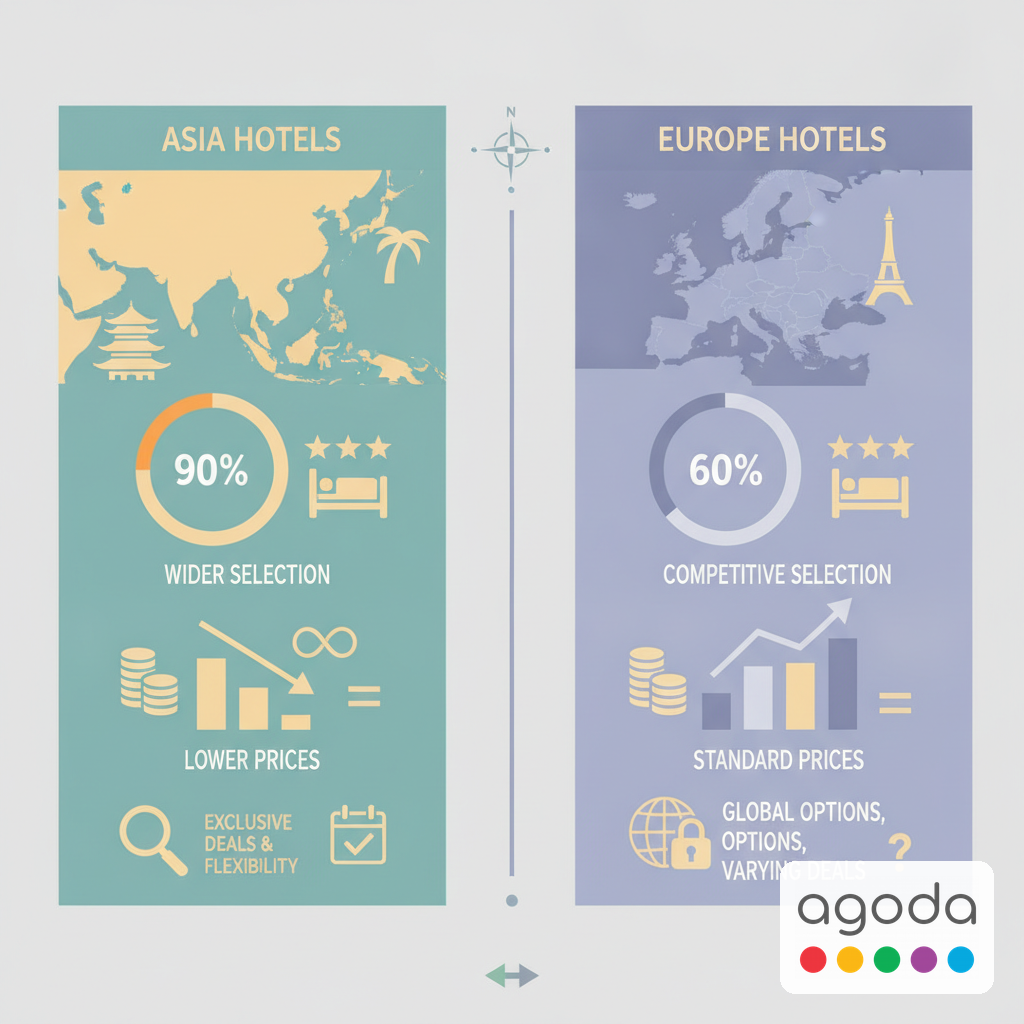
Yes, Agoda generally offers superior hotel inventory and coverage in Asia compared to Europe, particularly when it comes to independent, local, and budget-friendly accommodations. This is largely due to its historical focus and deep market penetration within the continent. Agoda has spent years cultivating relationships with a vast array of properties, including many smaller guesthouses, boutique hotels, and unique local stays that may not be extensively listed or even available on other major international OTAs.
For instance, if you are searching for a charming homestay in Chiang Mai, Thailand, or a hidden gem ryokan in Kyoto, Japan, Agoda is highly likely to present a wider and more diverse selection than its competitors. This extensive coverage extends beyond just the quantity of listings; it also encompasses a greater variety of property types tailored to Asian travel experiences. From beach bungalows in the Philippines to urban capsules in bustling Tokyo, Agoda’s platform reflects the rich diversity of Asian hospitality, making it an invaluable resource for travelers seeking authentic and localized stays. This deep inventory is not only about numbers but about providing options that genuinely match the local travel culture and expectations, which often differ significantly from Western markets.
In Europe, while Agoda offers a substantial number of properties, its inventory largely mirrors that of other large OTAs within the Booking Holdings ecosystem. You will find major hotel chains, well-known resorts, and popular city hotels readily available. However, for smaller, hyper-local guesthouses, specialized "agriturismo" farms in Italy, or unique countryside inns in France, Agoda’s selection might not be as exhaustive or "off-the-beaten-path" as what a local European booking site or even Booking.com might offer. The market in Europe is saturated with strong local and regional players, meaning Agoda often competes on price and user experience rather than exclusive, deep-niche inventory.
A real-world scenario highlights this difference: planning a backpacking trip through Southeast Asia, an Agoda search for "hostels in Ho Chi Minh City" might yield dozens of results, including many highly-rated, independently run hostels with unique amenities and cultural programs. A comparable search for "hostels in Berlin" on Agoda would still provide many options, but the proportion of globally recognized chains or larger, more standardized hostels might be higher, and it may not surface as many genuinely "local" independent finds as a platform primarily focused on the European market. This difference in inventory depth and local appeal means Agoda is often the first choice for travelers prioritizing authentic and diverse accommodation options when exploring Asia. This is particularly true for those seeking the best deals on Agoda Asia hotels.
How Does Agoda's Pricing and Deals Compare Between Asia and Europe?
Agoda is widely renowned for its aggressive pricing and frequent deals, particularly in the Asian market, where it often presents some of the most competitive rates available. This pricing advantage stems from its strong relationships with local hoteliers, who frequently offer exclusive discounts to Agoda to fill rooms, especially during off-peak seasons or for last-minute bookings. Travelers to Asia can often find "secret deals," "member-only prices" (via Agoda Genius), and significant percentage-based discounts that make luxury stays more accessible or budget travel even cheaper. These deals are often dynamic and location-specific, reflecting the intense competition and varied demand across different Asian destinations, making Agoda Asia hotels a top choice for value.
For example, a boutique hotel in Bali might offer a flash sale through Agoda that isn’t matched on other platforms, or a resort in Phuket could provide a 40% discount during the monsoon season. This aggressive pricing strategy is a key differentiator for Agoda in Asia, making it a go-to for many budget-conscious travelers and those seeking exceptional value. The platform also frequently employs a "pointsmax" system, allowing users to earn loyalty points with various airline programs, further enhancing the perceived value of their bookings in Asia.
In Europe, Agoda’s pricing remains competitive, but the "edge" it holds in Asia is often less pronounced. While you can still find good deals and occasional flash sales on European properties through Agoda, these are typically in line with what competitors like Booking.com, Expedia, or even direct hotel websites might offer. The European market is mature and highly competitive, with less room for dramatic pricing discrepancies on major properties. Agoda’s deals in Europe tend to be more aligned with global promotions rather than exclusive local agreements.
Consider a scenario where you’re booking a hotel in Rome. Agoda might offer a "Genius" discount of 10-15%, which is attractive. However, Booking.com or the hotel’s direct website might offer a similar discount for loyalty members or a "book direct" incentive. The key difference lies in the frequency and depth of exclusive, region-specific discounts. In Asia, these are a core part of Agoda’s value proposition, driving a perception of "always finding a deal." In Europe, Agoda is a strong competitor that occasionally leads on price, but it’s less consistently the undisputed cheapest option. Travelers should always conduct a side-by-side comparison for European bookings, whereas for Asian destinations, Agoda is often a reliable first check for the best price.
Are Agoda's Payment Options and Currency Support More Tailored for Asia?
Agoda’s payment options and currency support are indeed more extensively tailored for Asian markets, reflecting the diverse financial landscapes and consumer preferences across the continent. In many Asian countries, traditional credit card usage can be less prevalent, and local payment methods like e-wallets, bank transfers, or even cash-on-delivery (in some specific contexts) are highly popular. Agoda has invested significantly in integrating these local payment solutions, making it incredibly convenient for both international and domestic travelers within Asia.
For example, in countries like Indonesia, Thailand, and Vietnam, Agoda supports a wide array of local debit card networks, popular e-wallets such as GrabPay or GoPay, and even bank transfer options that are commonplace for online transactions. This commitment to localization extends to currency support, where Agoda often allows transactions in a broader range of Asian currencies, helping travelers avoid hefty foreign transaction fees or unfavorable exchange rates imposed by their banks. The "Pay at Property" option is also frequently available and highly valued in Asia, providing flexibility and peace of mind, especially for last-minute changes or those wary of upfront payments.
In contrast, Agoda’s payment options in Europe, while comprehensive, are more aligned with global standards and the widely adopted payment infrastructure of the region. You will find support for major credit cards (Visa, Mastercard, American Express), PayPal, and sometimes local European payment methods like iDEAL in the Netherlands or Sofort in Germany. However, the sheer breadth of country-specific e-wallets or alternative bank transfer methods available in Asia is generally not replicated for European bookings. European travelers typically rely on established card networks or popular digital wallets, and Agoda caters to this efficiently.
The flexibility of "Pay at Property" is also generally available for many European hotels on Agoda, but its prevalence and specific terms might vary. In certain European destinations or for particular hotel types, a prepayment might be required, or the "Pay at Property" rate could be slightly higher. This is often dictated by the individual hotel’s policy and the broader financial practices of the region. While Agoda provides secure and diverse payment options globally, its deeper integration of localized, non-traditional payment methods truly stands out in Asia, making the booking process remarkably smoother and more accessible for a wider demographic of travelers in that region.

What Are the Differences in Booking and User Experience on Agoda for Each Region?
The core booking and user experience on Agoda remains largely consistent across both Asia and Europe, upholding its reputation for a clean interface and efficient search functionality. However, subtle but significant differences emerge when considering the depth of filters, local context, and overall optimization for each region. Agoda’s strength in Asia allows it to offer highly granular and locally relevant filters, which significantly enhance the search experience for travelers navigating complex and diverse accommodation landscapes.
For example, when searching for hotels in Southeast Asia, you might find specific filters for "rice field view," "infinity pool," or "close to night markets," which are highly relevant to the unique travel styles and attractions of the region. The map search functionality in Asian cities is often exceptionally detailed, highlighting specific districts, local attractions, and even transportation hubs with remarkable accuracy. Guest reviews, too, can sometimes feel more extensive and culturally contextualized for Asian properties, offering insights into local etiquette, food options, or specific amenities that cater to regional preferences. This localized content and filtering capability streamline the decision-making process for travelers seeking particular experiences in Asia.
In Europe, the booking experience is equally robust, but the filters tend to be more generic and globally applicable, focusing on standard amenities like "free Wi-Fi," "parking," "pet-friendly," or "close to city center." While these are perfectly functional, they might not offer the same level of granular, culturally specific filtering that enhances discovery in Asia. The map search in European cities is excellent for pinpointing major landmarks and neighborhoods, but might not always highlight the same level of "local charm" or niche attractions as it does in Asian counterparts. This isn't a weakness of Agoda in Europe, but rather a reflection of the differing information needs and search behaviors of travelers in these distinct regions.
Furthermore, the language options and localized content within the booking flow can also present subtle regional differences. While Agoda supports numerous languages globally, the depth of content and the availability of local translations for specific property descriptions or amenity details might be more extensive and accurate for Asian properties, given Agoda’s historical focus. The checkout process itself is straightforward in both regions, but the presentation of payment methods, as discussed earlier, is where regional tailoring becomes most apparent. Ultimately, while both regions benefit from Agoda's strong platform, the experience in Asia often feels more "native" and optimized for local nuances.
How Do Agoda's Cancellation, Flexibility, and Refund Policies Vary Regionally?
Agoda’s cancellation, flexibility, and refund policies are primarily dictated by the individual property and the specific rate booked, rather than varying strictly by continent. However, regional business practices and consumer protection laws can indirectly influence the prevalence and terms of these policies, leading to perceived differences between Asia and Europe. Generally, Agoda clearly labels refundable, partially refundable, and non-refundable rates at the time of booking, and it is crucial for travelers to review these terms carefully before confirming their reservation.
In Asia, particularly with independent guesthouses and smaller hotels, there can sometimes be more flexibility or a willingness to negotiate directly with the property, especially for unforeseen circumstances. While Agoda’s official policy will govern, some Asian properties, in an effort to maintain good customer relations, might be more amenable to last-minute changes or partial refunds outside of strict policy if contacted directly. This informal flexibility, however, is not guaranteed and depends entirely on the property owner’s discretion. On the Agoda platform itself, "free cancellation" windows are common for many Asian bookings, often allowing changes up to 24-48 hours before check-in, providing peace of mind for dynamic travel plans in the region.
For European hotels, particularly larger chains or properties in destinations with high demand, cancellation policies can sometimes be more rigid, with stricter deadlines or higher penalties for changes. This often reflects established European hospitality practices and consumer laws, which, while offering robust protection, can also mean less leeway for ad-hoc negotiations once a non-refundable rate is booked. Travelers booking in Europe might find a slightly higher proportion of non-refundable "deal" rates, which offer significant savings but come with zero flexibility. Refund processing times also tend to be consistent globally, typically taking 7-14 business days once approved, but the approval process itself is directly tied to the property’s policy and Agoda’s ability to secure the refund from the hotel.
A key actionable insight for travelers is to always use Agoda’s filters to specifically search for "free cancellation" options, regardless of the continent. While these rates may sometimes be slightly higher, they offer invaluable protection against unforeseen travel disruptions. For "Pay at Property" bookings, the cancellation terms are usually more lenient, as no money has exchanged hands, but understanding the specific deadline to avoid charges is still paramount. Ultimately, while the underlying rules are global, the prevailing business culture and common practices of hoteliers in Asia can sometimes lead to a perception of greater leniency, whereas European policies might feel more formal and less negotiable.
Is Agoda's Customer Support and Disruption Handling More Effective in Asia or Europe?
Agoda’s customer support and disruption handling capabilities are designed to be globally accessible, offering assistance through various channels like live chat, phone, and email. However, the effectiveness and nuances of this support can subtly differ based on regional factors, particularly concerning language barriers, time zone differences, and the nature of local partnerships. While Agoda aims for consistent service quality, its deep roots and extensive operational presence in Asia often translate to more effective and culturally attuned support for issues arising in that region.
In Asia, Agoda benefits from a larger network of local support teams and a more profound understanding of regional travel complexities. This means that if you encounter an issue with a booking in, say, Vietnam or Thailand, there’s a higher likelihood of speaking to a support agent who is not only familiar with the local context but also potentially speaks the local language or a dialect. This can be invaluable when dealing with small, independent properties where direct communication might be challenging. Furthermore, Agoda’s direct relationships with many Asian hoteliers can sometimes expedite problem resolution, such as rebooking during overbooking situations or mediating disputes over room discrepancies. The speed and efficiency in navigating local bureaucracy or communication styles often feel more optimized in Asia.
For bookings in Europe, Agoda’s customer support is still robust, but it operates in a highly competitive environment where other OTAs also have strong local teams. While multilingual support is available, the agent might not always have the same deep, nuanced understanding of a specific local custom or a very small, independent European property that they might have for an equivalent property in Asia. Disruption handling, such as rebooking due to an airline cancellation affecting a hotel stay, typically follows standard global protocols. Agoda will act as an intermediary, contacting the hotel on your behalf, but the response time and flexibility often depend heavily on the hotel’s own policies and its responsiveness to a third-party booking agent.
A key actionable insight is that for urgent issues, particularly those requiring immediate intervention while traveling, utilizing Agoda’s live chat feature is often the quickest route to assistance, regardless of location. However, for complex problems or those requiring intricate local knowledge, the Asian support experience might feel marginally more seamless due to Agoda’s inherent market strength. It’s always wise to have both your Agoda booking confirmation and the hotel’s direct contact information handy, as this dual approach can sometimes expedite solutions, especially in situations where language or time zones create communication hurdles.
Does Agoda's Loyalty Program (Agoda Genius) Offer More Value in Asia?
Agoda’s loyalty program, known as Agoda Genius, offers tangible benefits to frequent users, including discounts on eligible properties, free breakfast at some locations, and priority customer service. While the program structure and benefits are global, the perceived and actual value derived from Agoda Genius can indeed feel more significant and frequently leveraged when booking hotels in Asia. This is primarily due to Agoda’s extensive network of partner properties in Asia and the nature of the deals it can secure within that market.
In Asia, a vast number of hotels, from budget guesthouses to luxury resorts, participate in the Agoda Genius program. This means that travelers booking within Asian destinations are far more likely to encounter "Genius Member Only" discounts, often ranging from 10% to 20% off the standard rate, on a wider selection of properties. The sheer volume and diversity of participating hotels ensure that Genius members consistently find opportunities to save money or receive added perks. For example, a Genius member planning a multi-city trip across Thailand, Vietnam, and Cambodia might find Genius discounts on almost every leg of their journey, accumulating significant savings over several bookings. The "free breakfast" or "airport transfer" perks, though less common, also tend to be offered by a higher density of properties in Asia, enhancing the overall value proposition.
In Europe, while Agoda Genius discounts are available, the proportion of properties offering these specific "Genius" rates might be slightly lower compared to Asia. Major hotel chains in Europe often have their own robust loyalty programs, and while they might still list on Agoda, their deepest discounts or exclusive perks are typically reserved for direct bookings or their own loyalty members. This means that while Agoda Genius can still offer competitive rates in Europe, it might not consistently provide the "extra layer" of savings or perks on as broad a spectrum of properties as it does in Asia. Travelers to Europe might find that Genius discounts are most prevalent on independent hotels or smaller properties that rely more heavily on OTA partnerships.
Therefore, for travelers who frequently visit Asia, investing in Agoda Genius (which is free to join and tiered based on booking frequency) offers a clear and recurrent advantage. The constant availability of Genius discounts across a diverse range of Asian accommodations makes it a powerful tool for cost savings and enhanced value. For European travel, while still beneficial, it serves more as an occasional bonus rather than a consistent game-changer, necessitating a broader comparison strategy with other OTAs or direct booking options to ensure the best overall deal.
What Are the Hidden Costs and Transparency Issues to Consider in Each Region?
While Agoda generally strives for price transparency, travelers should be aware of potential hidden costs and nuances in how prices are displayed, which can sometimes differ in prominence between bookings in Asia and Europe. Understanding these aspects is crucial for comparing the "final price" versus the initially advertised rate, ensuring no unpleasant surprises during your trip.
In Asia, one of the most common "hidden costs" or transparency issues can revolve around local taxes and service charges. While Agoda typically includes these in the final price displayed at checkout, some smaller, independent hotels, particularly in countries like Indonesia or Vietnam, might have slightly different interpretations of "local taxes" that could be added upon arrival. This is rare for bookings made through Agoda where the "total payable" is clearly stated, but it’s a phenomenon sometimes reported with direct local bookings. More significantly, resort fees are becoming increasingly prevalent in high-end Asian resort destinations, particularly in places like the Maldives or certain Thai islands. These are usually clearly stated by Agoda during the booking process but can significantly add to the base price. Similarly, breakfast is often an add-on, and while clearly listed, some travelers might expect it to be included by default, especially in certain types of accommodations.
In Europe, the primary hidden costs to watch out for are city taxes or tourist taxes. Many European cities – Rome, Paris, Berlin, Amsterdam – levy a per-person, per-night city tax that is almost universally paid directly to the hotel upon check-out. Agoda will typically state this clearly on the booking page, often with an estimated amount, but it’s a cost that won’t be included in the "total payable to Agoda." For example, a family of four staying in Rome for three nights might incur an additional €48-€60 in city taxes, which can be a significant addition if not anticipated. Resort fees are less common in traditional European city hotels but can appear in some coastal resorts or specialized accommodations. Parking fees, especially in city centers, are almost always extra and can be substantial, so travelers with rental cars should specifically check these. While Agoda does a good job of flagging these, their payment structure (at property, not to Agoda) means they are "hidden" from the initial booking total.
Another common "hidden cost" for both regions can be currency conversion fees if you pay in a currency different from your card’s base currency or the property’s local currency. While Agoda supports many currencies, always double-check the final charge on your credit card statement. The actionable insight here is to always scrutinize the "Price Details" or "What’s Included/Excluded" section on Agoda’s checkout page, regardless of your destination. This is where all mandatory and optional charges are itemized, allowing you to calculate the true final cost of your stay.
Who Should Use Agoda for Asia, and Who Should Prefer Alternatives for Europe?
Agoda stands out as an exceptional choice for travelers heading to Asia, making it a primary recommendation for a wide range of individuals and groups. It is particularly well-suited for budget-conscious travelers who value competitive pricing and frequent exclusive deals, as Agoda’s aggressive promotions in Asia can lead to significant savings. Explorers seeking local and authentic experiences will find Agoda invaluable due to its extensive inventory of independent guesthouses, boutique hotels, and unique local stays that are often not as widely listed on other platforms. Flexible travelers who appreciate diverse payment options, including numerous local e-wallets and "Pay at Property" choices, will also find Agoda highly convenient for their Asian adventures. Furthermore, frequent visitors to Asia can maximize the benefits of the Agoda Genius loyalty program, accruing valuable discounts and perks across a vast network of participating properties. For those prioritizing value and authentic experiences, choosing Agoda Asia hotels is often a smart move.
For example, a solo backpacker planning a month-long journey through Thailand, Malaysia, and Singapore will likely find Agoda to be their most effective tool for finding affordable, well-reviewed accommodations that align with local culture. A family looking for a unique villa stay in Bali or a comfortable hotel near a specific attraction in Tokyo will also benefit from Agoda’s deep inventory and detailed local filters. The platform’s strong regional partnerships and localized approach make it the go-to for experiencing Asia’s diverse hospitality.
Conversely, while Agoda is a perfectly viable option for booking hotels in Europe, certain types of travelers might find alternatives more consistently advantageous. Travelers prioritizing maximum brand loyalty benefits with major international hotel chains might prefer booking directly with those chains or via platforms like Booking.com or Expedia, which may have stronger integrations for earning/redeeming points in Europe. Those seeking highly specialized, niche European accommodations like specific agriturismos, historic castles, or remote countryside inns might find a more comprehensive selection on local European booking sites or even through platforms renowned for unique luxury stays. While Agoda offers a solid selection in Europe, it rarely holds the same exclusive inventory advantage it boasts in Asia.
For instance, a business traveler who always stays with Marriott or Hilton for loyalty points will likely benefit more from direct booking or a platform that seamlessly integrates with those programs. Similarly, a couple planning a very specific "foodie" tour through Tuscany, staying only in farmhouses with cooking classes, might find more specialized listings on a local Italian travel site. Therefore, while Agoda should always be considered for European bookings, especially for price comparison, it’s often wise for certain traveler profiles to also consult other platforms or direct booking options to ensure they meet their specific needs and priorities.
| Feature/Benefit | Agoda for Asia Hotels | Agoda for Europe Hotels | Best For |
|---|---|---|---|
| Inventory & Coverage | Extensive, diverse local guesthouses & unique stays | Strong for major chains & city hotels, less niche local | Asia: Authentic, budget stays; Europe: Standard, reliable options |
| Pricing & Deals | Highly competitive, frequent exclusive & "Genius" deals | Competitive, but less exclusive; comparable to other OTAs | Asia: Budget savings, flash sales; Europe: Price comparison tool |
| Payment Options | Broad local e-wallets, bank transfers, & "Pay at Property" | Standard credit cards, PayPal, some regional options | Asia: Local convenience, flexibility; Europe: Global standards |
| User Experience | Detailed local filters, culturally contextualized content | Robust, globally applicable filters; efficient map search | Asia: Niche discovery; Europe: General usability |
| Loyalty Program (Genius) | More frequent & wider range of participating properties | Beneficial, but fewer exclusive Genius properties than Asia | Asia: Maximizing recurrent savings; Europe: Occasional bonus |
| Customer Support | Often more culturally attuned, local context understanding | Globally accessible, standard protocols & multilingual | Asia: Complex local issues; Europe: Standard booking queries |
| Hidden Costs | Resort fees, local taxes (check carefully) | City/tourist taxes (paid locally), parking fees | Both: Scrutinize "Price Details" at checkout |
| Best Traveler Fit | Budget, authentic experience, long-term Asia traveler | General traveler, price comparer, major city stays | Asia: Primary platform; Europe: Strong alternative |
| Where to Buy | View Deal | View Deal |
Agoda vs. Booking.com & Expedia: A Regional Comparison
Understanding Agoda's regional strengths also necessitates a brief comparison with its primary global competitors, Booking.com and Expedia, which also have significant presences in both Asia and Europe. While all three are major online travel agencies, their historical market focus and operational strategies often result in different strengths depending on the continent, directly influencing a traveler's best choice for hotel bookings in 2026.
In Asia: Agoda often holds a distinct advantage over both Booking.com and Expedia, primarily due to its deeper inventory and localized approach. As discussed, Agoda's network of small, independent hotels, guesthouses, and unique accommodations in Asia is often unparalleled. This translates to more options for budget travelers, more authentic experiences, and a better chance of finding a "hidden gem." Agoda's aggressive pricing, flash sales, and tailored payment methods (like various local e-wallets) also give it an edge in many Asian markets. While Booking.com has made significant inroads into Asia, and Expedia has a presence, neither typically matches Agoda's sheer depth of local inventory or its localized payment flexibility in the region. Booking.com might offer a slightly more polished user interface for some, but for finding unique value in Asia, Agoda often leads.
In Europe: The playing field becomes much more level, with Booking.com often emerging as a formidable competitor, and Expedia also holding its own. Booking.com, being a European-founded company and Agoda's sister brand under Booking Holdings, boasts an exceptionally strong presence and deep inventory across Europe. It often has direct contracts with a vast number of European hotels, from large chains to small bed-and-breakfasts, and its user interface is highly optimized for European preferences. Expedia, through its various brands (including Hotels.com), also offers a comprehensive selection of European properties and often competes on package deals (flight+hotel). Agoda, while still competitive on price and offering a good range of hotels in Europe, doesn't typically possess the same exclusive inventory or market dominance it enjoys in Asia. For European bookings, comparing Agoda with Booking.com and Expedia is crucial, as any of the three could offer the best deal or most suitable property depending on the specific destination, dates, and traveler preferences. It's less about one platform being universally "better" and more about finding the best fit for that particular trip.
Ultimately, the choice between these major OTAs for Europe often comes down to personal preference, specific deals available at the time, and the type of property desired. For Asia, Agoda frequently positions itself as the specialist, offering a more tailored and extensive experience. This regional strength is a key takeaway for any international traveler planning their accommodation strategy.
Conclusion
In conclusion, the question "Is Agoda better for Asia hotels than Europe hotels?" can largely be answered with a qualified yes. Agoda demonstrates a clear and consistent advantage in the Asian market, leveraging its foundational roots, extensive local partnerships, and tailored operational strategies to offer unparalleled inventory depth, aggressive pricing, and highly localized payment options. For travelers venturing into the diverse landscapes of Asia, Agoda often provides a superior booking experience, making it the go-to platform for finding unique, authentic, and competitively priced accommodations, from bustling city centers to serene island retreats.
Conversely, while Agoda is a strong and reliable contender in the European hotel market, its edge is less pronounced. Here, it competes fiercely with other established global and local OTAs, offering a robust selection of properties and competitive deals but seldom the same exclusive inventory or specialized local insights it boasts in Asia. European travelers will find Agoda to be a valuable tool for price comparison and finding good deals, especially for standard hotel types, but it may not always be the sole or primary choice, often requiring cross-referencing with platforms like Booking.com or direct hotel websites to secure the optimal booking.
The actionable guidance for travelers in 2026 is clear: for any trip planning to Asia, Agoda should be your first port of call. Its strengths in this region are undeniable and consistently provide value. For Europe, Agoda remains a highly recommended platform to include in your search, particularly for its competitive pricing and occasional deals, but it should be part of a broader comparison strategy. Always scrutinize the final price, cancellation policies, and review the "What’s Included/Excluded" sections, regardless of your destination. By understanding Agoda’s distinct regional strengths, you can confidently navigate the complex world of hotel bookings and secure the best possible stay for your adventures, wherever they take you. When planning your next adventure, keep the distinct advantages of Agoda Asia hotels in mind.
Frequently Asked Questions
Yes, Agoda is a legitimate and safe online travel agency (OTA) owned by Booking Holdings, one of the largest travel companies globally. It uses secure payment processing and offers various traveler protections. However, as with any OTA, understanding specific cancellation policies, potential fees, and the level of customer support for complex issues is crucial. Always verify booking details and final prices at checkout, and for high-value or complex itineraries, consider travel insurance to mitigate risks. Agoda’s robust infrastructure makes it a trustworthy platform for international hotel bookings.
Agoda generally strives for transparency, displaying most taxes and service fees in the final price at checkout. However, there are some common "hidden costs" that travelers should anticipate. In Asia, resort fees in high-end destinations and some local taxes might be added upon arrival, though Agoda usually flags these. In Europe, city or tourist taxes are almost universally paid directly to the hotel upon check-out and are not included in Agoda's payable total, though they are typically stated as an estimate. Always review the "Price Details" section thoroughly before confirming your booking.
Agoda’s "Pay at Property" option allows you to reserve a room without immediate payment, settling the cost directly with the hotel upon arrival or departure. This offers flexibility, especially for last-minute changes or uncertain plans. While widely available, it is not offered for every property or every rate type. Its prevalence can also vary regionally; it's often a highly popular and readily available option in many Asian countries, reflecting local preferences. In Europe, it is common, but you might also find more attractive prepaid rates. Always check the specific terms and conditions for your chosen booking, including the cancellation deadline to avoid charges.
Agoda Genius is a free loyalty program that provides tiered discounts and benefits based on your booking frequency. For occasional travelers, even the entry-level Genius status (Level 1, after just two bookings) offers a 10% discount on many eligible properties. While frequent travelers will unlock higher discounts and occasional perks like free breakfast, even occasional users can benefit from immediate savings. Given that it costs nothing to join and benefits accumulate quickly, it is generally worth enrolling in Agoda Genius for any traveler, as the discounts can be applied to a wide range of hotels globally, with particular strength in Asia.
If your Agoda hotel booking is canceled by the property, Agoda typically acts as an intermediary to help resolve the situation. In such cases, Agoda will usually attempt to find you a comparable alternative accommodation at no additional cost or offer a full refund for the canceled booking. It is crucial to contact Agoda customer support immediately through their app, phone, or live chat. The specific resolution may depend on the reason for cancellation, local consumer protection laws, and the availability of alternative rooms. Keeping a record of all communications is always advisable.
The choice between booking directly with a hotel or using Agoda depends on your priorities. Book directly when you prioritize earning hotel loyalty points, desire maximum flexibility for changes, or prefer direct communication with the property. Hotels sometimes offer exclusive perks or better flexibility for direct bookings. Use Agoda when you're seeking the lowest price, want to compare many options across different brands, appreciate diverse payment methods (especially in Asia), or want to leverage Agoda Genius discounts. For Asia, Agoda often provides unmatched inventory and deals. For Europe, compare both Agoda and direct booking for the best value.
Agoda offers 24/7 customer support through live chat, phone, and email, which is critical for urgent travel disruptions. While the service is designed to be globally accessible, the effectiveness for urgent issues can depend on the complexity of the problem, the specific region, and time zone differences. Many travelers report success using live chat for quick resolutions. For highly complex or sensitive issues, direct phone support might be necessary. Having your booking ID readily available and being clear about the issue helps expedite the process. While not always instant, Agoda generally provides the necessary channels for support during travel disruptions.