

Kiwi.com Flights Review 2026: One-Way, Return, or Multi-City?
Kiwi
Yes, Kiwi can be worth booking your flights with in 2026, especially if you are planning complex multi-city itineraries, self-transfer routes, or are a budget-conscious traveler prioritizing unique flight combinations. Its strength lies in finding routes and prices that traditional booking engines might miss by combining flights from non-partner airlines. However, for simple one-way or return flights where direct airline booking offers better security, loyalty perks, or straightforward customer support, Kiwi might introduce unnecessary complexity. Travelers should always consider their tolerance for risk, the importance of direct airline support, and their comfort with managing potential self-transfer challenges. If your itinerary is complex, your budget is tight, and you're comfortable with the nuances of virtual interlining, then Kiwi is a strong contender. Otherwise, it's prudent to compare against booking directly or through a more conventional platform.
View DealOverall Score
Introduction: Navigating Flight Bookings with Kiwi in 2026
In the dynamic world of online travel in 2026, choosing the right flight booking platform can significantly impact both your wallet and your travel experience. This comprehensive Kiwi.com flights review dives deep into Kiwi, a prominent online travel agency (OTA) known for its innovative approach to flight search and booking. Specifically, we'll address a crucial question for many travelers: Is Kiwi better suited for one-way, return, or complex multi-city flights?
Kiwi has carved out a unique niche by specializing in combining flights from non-partner airlines - a concept often referred to as 'virtual interlining' or 'self-transfer'. This can unlock routes and price combinations that traditional booking engines might miss. However, this flexibility comes with its own set of considerations regarding convenience, potential risks, and customer support.
This review is for any traveler looking to understand Kiwi's strengths and weaknesses, whether you're planning a simple domestic hop, a classic round trip, or an ambitious multi-country adventure. We'll provide a data-driven, editorial-quality analysis of its pricing, search capabilities, flexibility, and crucial support mechanisms, helping you make a confident buying decision without sounding overly promotional. By the end, you'll have a clear understanding of when Kiwi truly shines and when alternatives might be a safer bet for your specific travel needs.
Summary Table: Kiwi at a Glance
| Feature | Kiwi | Notes |
|---|---|---|
| Best For | Complex multi-city, self-transfer routes, budget-conscious explorers | Unlocks unique itineraries and potential savings. |
| Price Range | Often competitive, but final price varies with add-ons | Base fares can be low; always check total cost including fees. |
| Key Strength | Advanced multi-city and virtual interlining search capabilities | Finds routes others can't, especially for complex trips. |
| Key Weakness | Complexity of self-transfer and potential for support challenges | Requires traveler awareness of risks and policy nuances. |
| Price & Value Rating | 8.5/10 | Excellent for finding unique low-cost routes, but requires careful fee review. |
| Transparency & Fees Rating | 7.8/10 | Fees are visible, but baggage and add-ons need active checking. |
| Search Experience Rating | 8.9/10 | Outstanding for flexible and complex route discovery. |
| Flexibility & Cancellation Rating | 7.5/10 | Offers flexible options, but cheaper fares are restrictive. |
| Refunds & Disruption Support Rating | 7.2/10 | Dependent on Kiwi.com Guarantee and supplier terms; can be complex. |
| Traveler Fit Rating | 8.6/10 | Ideal for adventurous, budget-savvy travelers comfortable with self-transfers. |
| Overall Rating | 8.1/10 | A powerful tool for specific travel needs, but not for everyone. |
| Call to Action | Compare Live Prices on Kiwi | Check for unique routes and potential savings today. |
| Where to Buy | View Deal |
Quick Verdict: Is Kiwi Worth Booking Your Flights With?
Yes, Kiwi can be worth booking your flights with in 2026, especially if you are planning complex multi-city itineraries, self-transfer routes, or are a budget-conscious traveler prioritizing unique flight combinations. Its strength lies in finding routes and prices that traditional booking engines might miss by combining flights from non-partner airlines. However, for simple one-way or return flights where direct airline booking offers better security, loyalty perks, or straightforward customer support, Kiwi might introduce unnecessary complexity. Travelers should always consider their tolerance for risk, the importance of direct airline support, and their comfort with managing potential self-transfer challenges. If your itinerary is complex, your budget is tight, and you're comfortable with the nuances of virtual interlining, then Kiwi is a strong contender. Otherwise, it's prudent to compare against booking directly or through a more conventional platform.
Short Answer: Kiwi for Flight Bookings
Kiwi is an innovative online travel agency best for travelers seeking unique, often cheaper, multi-city or self-transfer flight combinations that traditional platforms miss. Its advanced search capabilities excel in finding complex routes. However, its virtual interlining model introduces potential risks for missed connections and can complicate customer support, making it less ideal for risk-averse travelers or simple one-way/return trips where direct booking offers greater peace of mind and simpler policies.
Rating Summary
| Dimension | Score | Notes |
|---|---|---|
| Price & Value | 8.5/10 | Competitive for flexible travelers, but final price should be checked carefully. |
| Transparency & Fees | 7.8/10 | Fees are visible at checkout, but travelers must review baggage and add-ons. |
| Search Experience | 8.9/10 | Strong filters and route discovery make comparison easier. |
| Flexibility & Cancellation | 7.5/10 | Flexible options exist, but cheaper rates may be restrictive. |
| Refunds & Disruption Support | 7.2/10 | Refund outcomes depend on supplier terms and booking type. |
| Traveler Fit & Overall Convenience | 8.6/10 | Best for travelers who value savings and flexibility over direct-supplier simplicity. |
| Overall Rating | 8.1/10 | Best for: flexible travelers who want to compare routes, prices, and booking options quickly. Not ideal for: travelers who need maximum refund flexibility, direct supplier support, or simple low-risk itineraries. |
Kiwi earns its highest score in Search Experience (8.9/10) due to its unparalleled ability to combine flights from non-partner airlines and its sophisticated multi-city and 'Nomad' search features. This allows travelers to discover unique routes and potentially significant savings that other platforms simply cannot offer. The intuitive interface and powerful filtering options contribute greatly to this high rating, making it a go-to for route discovery.
Conversely, Kiwi's lowest score is in Refunds & Disruption Support (7.2/10). While the platform offers the Kiwi.com Guarantee to mitigate risks associated with self-transfers, the process can be complex and depends heavily on the specific terms purchased and the nature of the disruption. Compared to booking directly with a single airline, resolution for delays, cancellations, or missed connections on virtual interlining itineraries can be more challenging and time-consuming, requiring travelers to be proactive and understand their protections.
For the Online Travel Agency (OTA) and Flight Booking Platforms niche, the Traveler Fit & Overall Convenience scoring category matters most. Kiwi is not a one-size-fits-all solution; its value is highly dependent on the traveler's specific needs, risk tolerance, and itinerary complexity. Understanding who Kiwi is best for, and who should avoid it, is paramount to a satisfactory booking experience.
What is Kiwi? An Innovative Approach to Flight Booking
Kiwi is an online travel agency (OTA) that has revolutionized the way travelers search for and book flights, particularly for complex itineraries. At its core, Kiwi's claim to fame is its proprietary 'virtual interlining' technology. This Kiwi.com flights review highlights its core claim to fame: its proprietary 'virtual interlining' technology. This system allows the platform to combine flights from airlines that do not have official partnership agreements, often referred to as self-transfer flights. Unlike traditional OTAs that typically present routes from a single airline alliance or code-share partners, Kiwi can stitch together segments from low-cost carriers and major airlines alike, creating unique routes and often uncovering significantly cheaper fares.
Operating globally, Kiwi positions itself as a smart travel companion for those looking to explore the world on a budget or embark on ambitious multi-city journeys. It doesn't just display direct flights; it actively seeks out the most efficient or cost-effective combinations, even if it means booking separate tickets with different carriers and requiring a self-transfer. This model extends beyond flights, allowing users to combine trains and buses into single itineraries, offering a truly multimodal travel planning experience.
For travelers in 2026, understanding Kiwi means recognizing its role as an intermediary that facilitates these complex bookings. While it offers a convenient search interface and handles the initial transaction, the underlying flights are with individual airlines. This distinction is crucial because it dictates how changes, cancellations, and disruptions are managed, often relying on Kiwi's own guarantee rather than direct airline policies for self-transfer scenarios. The platform's goal is to simplify the discovery of complex travel possibilities, making global exploration more accessible, albeit with a unique set of operational considerations.
Is Kiwi Worth It in 2026? A Value Analysis for Different Flight Types
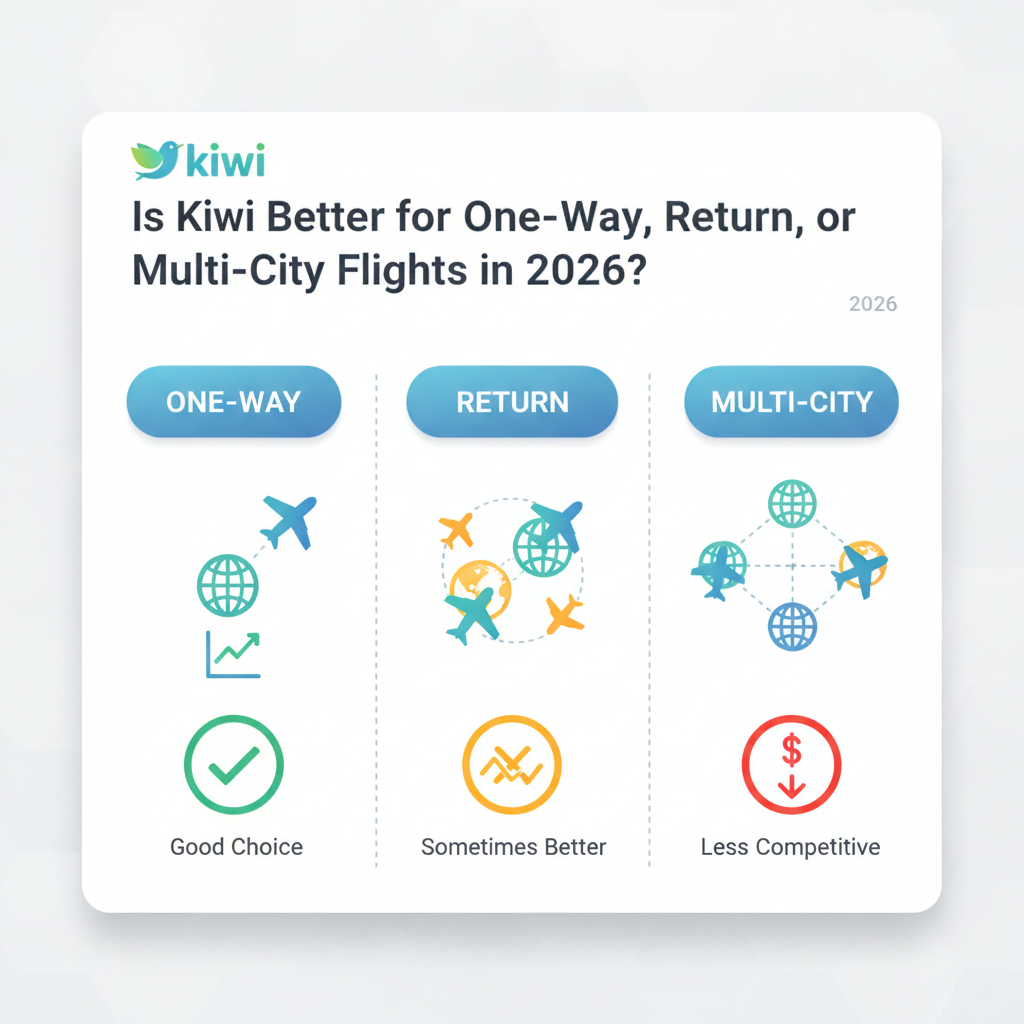
Determining if Kiwi is 'worth it' in 2026 largely depends on your specific flight booking needs and travel style. This Kiwi.com flights review finds that for multi-city flights, Kiwi often presents exceptional value and is arguably one of the best platforms available. Its virtual interlining technology excels at piecing together complex itineraries across multiple destinations and airlines, frequently revealing routes and price points that are unattainable through conventional booking methods. If your goal is to visit several cities or countries on a single trip, and you're comfortable with the concept of self-transferring between flights, the potential savings and unique route options make Kiwi highly worthwhile.
For one-way flights, Kiwi can still be a strong contender, particularly if you're flying an unusual route, need to combine a low-cost carrier with a major airline for a segment, or are seeking the absolute lowest price without concern for a return journey. Its robust search engine can often find cheaper one-way fares than direct airline websites or other OTAs, especially for international routes or those involving less common connections. However, for straightforward domestic one-way trips, the difference in price might be minimal, and booking direct could offer simpler management.
When it comes to return flights, the value proposition is more nuanced. For simple, direct return trips with a single airline, booking directly with the carrier or through a traditional OTA might offer greater peace of mind, clearer baggage rules, and more straightforward customer support in case of disruption. Kiwi's strength here lies in finding return trips that involve self-transfers or combinations of low-cost carriers, which can significantly reduce costs for longer-haul or less common routes. However, if flexibility and seamless connections are paramount for your return journey, the inherent complexities of virtual interlining might outweigh the potential savings.
Ultimately, Kiwi's worth in 2026 is highest for travelers who are flexible, budget-conscious, and comfortable with managing the specific dynamics of self-transfer itineraries. It's a powerful tool for unlocking new travel possibilities, but it requires an informed approach to ensure the perceived value translates into a positive overall experience.
Key Features for Flight Booking: Unlocking Unique Itineraries with Kiwi
Kiwi distinguishes itself from typical booking platforms through a suite of powerful features designed to find and facilitate complex flight itineraries. Understanding these is crucial to leveraging the platform effectively, especially when considering one-way, return, or multi-city travel.
Virtual Interlining and Self-Transfer Routes
This is Kiwi's signature feature. It allows the platform to combine flights from airlines that do not typically cooperate, even if it means booking separate tickets for different legs of your journey. For multi-city flights, this opens up a vast array of route possibilities and often results in significantly lower prices. For one-way or return trips, it can create unique connections to less-served destinations or combine a budget flight with a full-service carrier. This feature is a game-changer for finding unique itineraries but requires travelers to be aware of the self-transfer process, including rechecking baggage and potentially clearing customs during layovers.
Nomad Search and Flexible Date Tools
Kiwi's 'Nomad' search is perfect for multi-city explorers who want to visit several destinations without a fixed order or specific dates. You input the cities you want to visit, and Kiwi intelligently finds the cheapest order and dates for your journey, making it ideal for backpackers, digital nomads, and spontaneous adventurers. Additionally, its flexible date calendar and 'Cheapest Month' feature are invaluable for all flight types, allowing users to quickly identify the most cost-effective times to fly, even if their exact travel dates are not set in stone. This granular flexibility significantly enhances value for money by targeting optimal pricing.
Extensive Inventory and Low-Cost Carrier Integration
Kiwi boasts an impressive booking coverage, integrating a vast network of airlines, including many low-cost carriers (LCCs) that might not appear on traditional Global Distribution Systems (GDS). This breadth of inventory, combined with its virtual interlining, means it can often find the cheapest possible combination of flights by leveraging the competitive pricing of LCCs. This is particularly advantageous for budget travelers seeking one-way or return flights to or from destinations well-served by budget airlines.
Kiwi.com Guarantee
To mitigate the inherent risks of self-transfer flights, Kiwi offers the Kiwi.com Guarantee (often an optional add-on). This protection plan aims to cover travelers in case of a missed connection due to a delay or cancellation by one of the carriers on a self-transfer itinerary. While it provides a safety net, understanding its terms, exclusions, and the process for claiming support is paramount. For multi-city and complex one-way routes, this guarantee can offer peace of mind, but it's not a substitute for comprehensive travel insurance.

Real-World Performance and User Experience with Kiwi
In the real world of 2026 travel, Kiwi delivers a user experience that is both powerful and, at times, demanding. Its search experience is where the platform truly shines, particularly for flexible and complex itineraries. Users can effortlessly input multi-city routes, utilize the 'Nomad' search, or explore destinations with flexible dates and nearby airports. The interface is clean, fast, and the filtering options are robust, allowing travelers to narrow down results by stops, airlines, luggage, departure times, and even duration. This makes finding the 'right' option for one-way, return, or multi-city flights remarkably quick and efficient, often revealing combinations that other platforms overlook.
However, the booking flow, while generally straightforward, can introduce elements of complexity. As an intermediary, Kiwi presents many add-ons during the checkout process, such as various tiers of the Kiwi.com Guarantee, baggage options, and seat selection. While these are clearly presented, a first-time user might find the sheer number of choices overwhelming, especially when trying to understand the implications of self-transfer flights. Price transparency is generally good, with taxes and service fees clearly displayed before final payment, but travelers must actively review all optional extras to ensure the final total matches their expectations.
The app and mobile experience are commendable. The Kiwi app is responsive and provides essential itinerary management features, including live updates, access to e-tickets and vouchers, and alerts for gate changes or delays. This is particularly valuable for travelers on complex multi-city routes with self-transfers, as real-time information is critical for navigating tight connections. Post-booking, confirmation documents are typically delivered promptly via email and are accessible within the app, ensuring travelers have all necessary information at their fingertips.
The main performance consideration for real-world users is the management of self-transfer itineraries. While the search and booking are efficient, the onus is often on the traveler to understand visa requirements for layovers, retrieve and recheck baggage, and navigate between terminals or even airports. The Kiwi.com Guarantee aims to support these scenarios, but the actual execution of a complex self-transfer requires traveler diligence. For simple one-way or return flights without self-transfers, the experience is largely seamless, comparable to other OTAs, but the value proposition lies more in price competitiveness than unique route discovery.
Pros and Cons of Using Kiwi for Flight Bookings
Kiwi presents a compelling option for many travelers, but like any powerful tool, it comes with its own set of advantages and disadvantages. Here's a detailed breakdown of the pros and cons to help you decide if it's the right choice for your 2026 travel plans:
Pros:
-
Unbeatable Route Combinations and Price Discovery: Kiwi's virtual interlining is its biggest strength, allowing it to combine flights from non-partner airlines. This often results in discovering unique routes and significantly cheaper fares, especially for complex multi-city or less common one-way international flights.
-
Advanced Multi-City and Nomad Search: The platform excels at planning intricate itineraries. The 'Nomad' search feature, in particular, is revolutionary for travelers wanting to visit multiple destinations in a flexible order, optimizing for the lowest price.
-
Excellent Search Filters and Flexibility: Kiwi offers robust filtering options (stops, airlines, baggage, duration, etc.) and flexible date searches (e.g., 'Cheapest Month'), making it easy to pinpoint the ideal travel option based on your preferences and budget.
-
Access to Low-Cost Carriers: By integrating a vast network of budget airlines, Kiwi can often find the absolute lowest prices by combining these carriers with major airlines, which many other OTAs might not do.
-
Kiwi.com Guarantee for Self-Transfers: For the inherent risks of self-transfer flights, the optional Kiwi.com Guarantee provides a safety net, offering rebooking or refunds if you miss a connection due to an airline's delay or cancellation.
-
User-Friendly App for In-Trip Management: The mobile app is well-designed, providing live updates, access to booking documents, and notifications, which are crucial for managing complex, multi-leg journeys.
-
Price Alerts: Users can set up price alerts for specific routes, ensuring they are notified when fares drop, which is excellent for long-term planning and securing the best value.
Cons:
-
Complexity of Self-Transfer Itineraries: While the Kiwi.com Guarantee exists, self-transfer flights require more traveler responsibility. This includes rechecking baggage, navigating different terminals or airports, and potentially clearing customs during layovers, which can be stressful, especially with tight connection times.
-
Potential for Hidden Costs: While base fares can be very low, travelers must be diligent about checking baggage fees, seat selection costs, and other add-ons that can accumulate, especially when flying with multiple budget airlines.
-
Customer Support Challenges for Disruptions: While Kiwi offers support, resolving issues for complex, self-transfer flights can be more intricate and time-consuming than dealing directly with a single airline, particularly if the Kiwi.com Guarantee is not purchased or its terms are misunderstood.
-
Less Direct Airline Relationship: Booking through Kiwi means you're an intermediary's customer. This can sometimes complicate direct communication with airlines for changes, special requests, or loyalty program benefits.
-
Refund Process Can Be Slow and Complex: If a refund is needed, particularly for non-guaranteed bookings or those where the airline's policy is restrictive, the process can be lengthy and less straightforward compared to direct bookings.
-
Visa Requirements for Layovers: Self-transfer itineraries might involve layovers in countries requiring a transit visa, even if you don't leave the airport. This is a critical responsibility for the traveler to research and secure, and a common oversight.
-
Not Always the Cheapest for Simple Flights: For very straightforward one-way or return flights on a single airline, the price difference might be negligible, and the added layer of an intermediary could be seen as an unnecessary complication.
The complexity of self-transfer itineraries and potential customer support challenges for disruptions are significant deal-breakers for risk-averse or inexperienced travelers. For budget-conscious, adventurous travelers, the potential for hidden costs and slower refund processes are minor trade-offs, provided they are aware and prepared.
Who Should Use Kiwi? Tailoring the Platform to Your Travel Style
Kiwi is not a universal solution for all travelers in 2026, but it is an exceptionally powerful tool for specific travel styles and needs. Understanding these use cases is key to a positive experience:
-
Budget-Conscious Travelers Seeking Unique Routes: If your primary goal is to find the absolute lowest price, even if it involves multiple airlines and self-transfers, Kiwi is an excellent choice. Its virtual interlining excels at unearthing cost-effective combinations that major search engines often miss, making it ideal for those willing to trade some convenience for significant savings.
-
Adventurous Multi-City Explorers: For travelers planning complex itineraries across several cities or countries, Kiwi's 'Nomad' search and multi-city functionality are unparalleled. It can help you piece together a seamless, yet budget-friendly, journey that would be incredibly difficult to construct manually or with other platforms. This is where Kiwi truly shines, offering unparalleled flexibility in destination order and dates.
-
Flexible Travelers with Unfixed Dates: If you have a destination in mind but your travel dates are flexible, Kiwi's 'Cheapest Month' and flexible date calendars are invaluable. These tools allow you to quickly identify the most economical times to fly, whether for a one-way, return, or multi-city trip, maximizing your value for money.
-
Travelers Comfortable with Self-Transfer Risks: Those who understand the implications of separate tickets - including rechecking baggage, navigating airports, and potential visa requirements for layovers - and are prepared to manage these aspects, will find Kiwi highly rewarding. The optional Kiwi.com Guarantee offers a layer of protection, but proactive traveler awareness is still crucial.
-
Digital Nomads and Long-Term Travelers: For individuals on extended journeys or those who frequently move between locations, Kiwi's ability to find unique one-way and multi-leg flights can be a significant advantage, providing efficient and affordable ways to connect disparate parts of the world.
If you fit into these categories, Kiwi offers a robust platform to empower your travel planning and unlock possibilities that might otherwise remain hidden. It's about smart, informed travel, rather than simply point-to-point booking.
Who Should NOT Buy It? Identifying When Kiwi Isn't the Right Fit
While Kiwi offers incredible advantages for certain types of travelers, it's equally important to recognize when the platform might not be the best choice. Honest counter-recommendations build trust, and for many, the inherent complexities of Kiwi's model can outweigh its benefits.
-
Risk-Averse Travelers: If the thought of a missed connection due to an airline delay, or the need to recheck baggage and clear customs during a layover, causes significant anxiety, Kiwi's self-transfer itineraries are likely not for you. Even with the Kiwi.com Guarantee, managing disruptions can be stressful, and a seamless journey is often preferred over potential savings.
-
Travelers Needing Seamless, Direct Airline Support: If you value direct communication with a single airline for all your flight needs - including changes, special assistance, or loyalty program benefits - booking through an intermediary like Kiwi for complex routes can complicate matters. Direct booking offers a simpler chain of command for customer service and issue resolution.
-
Families with Young Children or Extensive Baggage: The logistics of self-transfer flights, especially those with tight layovers, can be incredibly challenging for families. Managing multiple pieces of luggage, keeping children entertained during long waits, and navigating customs and security checkpoints adds significant stress that often negates any cost savings.
-
First-Time International Travelers: Navigating international travel, especially with multiple airlines and layovers, can be daunting. Adding the layer of self-transfer requirements, including understanding complex visa rules for transit countries, can be overwhelming for those new to global journeys. A simpler, direct booking is often recommended for a less stressful introduction to international travel.
-
Travelers Prioritizing Convenience and Simplicity: If your priority is a straightforward, hassle-free booking and travel experience without worrying about the nuances of separate tickets, baggage recheck, or potential rebooking scenarios, then traditional return flights booked directly with an airline or through a conventional OTA will likely be a better fit. The time and effort required to manage a complex Kiwi itinerary might not be worth the savings for everyone.
In these scenarios, the potential for added stress, logistical challenges, or complicated customer service interactions means that booking through Kiwi might detract from, rather than enhance, your travel experience. Always weigh the potential savings against your personal comfort level and travel priorities.

How Does Kiwi Compare With Typical Alternatives in 2026?
Kiwi occupies a distinct position in the 2026 travel landscape, offering a unique value proposition that differentiates it from other booking avenues. When comparing it against generic alternative categories, its strengths and weaknesses become clearer, especially for one-way, return, and multi-city flights.
Kiwi vs. Metasearch Engines
Metasearch engines (like a typical flight comparison site) aggregate prices from various OTAs and airlines, acting as a research tool. Kiwi, however, often features as one of the booking partners found by these engines. The key difference is that Kiwi also acts as a full-fledged OTA, taking the booking directly. More importantly, Kiwi's proprietary virtual interlining often allows it to display unique self-transfer itineraries that even metasearch engines might not initially generate themselves, as they primarily link to existing airline or OTA offers. For discovering truly novel and cheap multi-city or complex one-way routes, Kiwi's internal search capabilities often surpass what a pure metasearch engine can offer.
Kiwi vs. Traditional Online Travel Agencies (OTAs)
Traditional OTAs (a common booking platform) typically focus on flights offered by partner airlines or within alliances, providing more conventional itineraries. While they may offer competitive pricing for standard return or one-way flights, they rarely venture into virtual interlining. This means for multi-city or complex self-transfer routes, Kiwi often presents significantly more options and potentially lower prices. However, traditional OTAs generally offer simpler booking flows, more straightforward customer support (as they deal with a single airline's policy), and less risk of missed connections for guaranteed itineraries. For simple return flights, a traditional OTA might be more convenient, while Kiwi excels in complexity.
Kiwi vs. Direct Airline Booking
Booking directly with an airline (the primary carrier) offers maximum control, direct customer support, easier changes/cancellations (within the airline's policy), and eligibility for loyalty points. For simple one-way or return flights, booking direct is often the lowest-risk option. However, for multi-city or complex one-way trips involving multiple airlines, booking direct is impractical or impossible without creating separate bookings, which then lack any form of connection protection. Kiwi's ability to combine disparate airlines into a single, protected (via its guarantee) itinerary is its strongest advantage over direct booking, despite the trade-offs in direct support and loyalty points.
Here's a comparison table summarizing these differences:
| Feature | Kiwi | Typical Metasearch Engine | Traditional OTA | Direct Airline Booking |
|---|---|---|---|---|
| Best For | Complex multi-city, self-transfer routes | Price comparison, research | Standard return/one-way, packages | Simple direct flights, loyalty perks |
| Route Combinations | Virtual interlining, unique routes | Aggregates existing offers | Conventional, partner airlines | Single airline routes |
| Price Competitiveness | Often cheapest for complex routes | Varies, shows lowest available | Competitive for standard routes | Can be competitive, especially with sales |
| Self-Transfer Risk | High (mitigated by Guarantee) | High (no protection) | Low (generally avoids) | N/A (single airline) |
| Customer Support | Via Kiwi (can be complex for disruptions) | Via booking partner | Via OTA (usually straightforward) | Directly with airline |
| Flexibility & Changes | Varies by fare, Kiwi.com Guarantee | Varies by booking partner | Varies by fare, OTA policy | Airline policy, often flexible options |
| Loyalty Program Benefits | Generally none (as intermediary) | Varies by booking partner | Generally none (as intermediary) | Full eligibility |
| Where to Buy | View Deal |
Pricing and Value for Money: Deciphering Kiwi's Cost Structure
Kiwi's pricing strategy is fundamentally tied to its ability to find unique and often cheaper flight combinations, particularly for multi-city and complex one-way routes. However, understanding the true value for money requires a careful look beyond the initial advertised base price. Prices, availability, fees, and cancellation rules can change by route, date, supplier, and country. Always confirm the final terms at checkout before booking.
The platform often presents very attractive base fares, especially when it leverages virtual interlining to combine low-cost carriers. For a multi-city trip, for example, Kiwi might show a total price significantly lower than what could be achieved by booking each leg separately or through a traditional OTA that doesn't combine non-partner airlines. This is where its value truly lies for budget-conscious explorers.
However, it's crucial to pay close attention to the final price transparency during the booking flow. Kiwi, like many OTAs, presents various add-ons that can increase the total cost. These include:
-
Service Fees: Kiwi charges a service fee, which is typically transparently displayed before the final payment stage. This fee contributes to the platform's operational costs and its proprietary technology.
-
Baggage Fees: When combining multiple airlines, especially low-cost carriers, baggage policies and fees can vary significantly per flight segment. Kiwi will prompt you to add baggage, but travelers must carefully consider the total baggage cost across all flights, as this can quickly inflate the overall price.
-
Seat Selection: Often an optional extra, seat selection costs can add up, particularly on longer multi-leg journeys.
-
Kiwi.com Guarantee: While highly recommended for self-transfer itineraries, the various tiers of the Kiwi.com Guarantee are an additional cost. Travelers must weigh the protection it offers against its price, considering their risk tolerance.
-
Payment Processing Fees: Depending on the payment method and currency, small processing fees might apply, though these are typically clearly stated.
For one-way and return flights, the value for money is competitive if the route involves unconventional connections or low-cost carriers. For simple, direct flights, the final price on Kiwi (after service fees and any optional add-ons) might be comparable to or even slightly higher than booking directly with the airline, especially if you factor in loyalty points you might miss. The true value comes from the unique route combinations it provides, making otherwise impossible or prohibitively expensive multi-city journeys accessible.
Here's a breakdown of how pricing impacts different flight types on Kiwi:
| Flight Type | Potential Base Price | Typical Add-ons & Fees | Overall Value Proposition |
|---|---|---|---|
| One-Way | Often competitive, especially for international/complex routes. | Service fee, baggage, seat selection, Kiwi.com Guarantee (optional). | Strong for unique connections or LCC combinations; less so for simple direct flights. |
| Return | Competitive if using virtual interlining; standard for direct. | Service fee, baggage (x2), seat selection, Kiwi.com Guarantee (optional). | Good for budget-focused long-haul or complex returns; less for simple, low-risk trips. |
| Multi-City | Often significantly lower due to virtual interlining. | Service fee, baggage (per leg), seat selection, Kiwi.com Guarantee (highly recommended). | Excellent for unlocking otherwise expensive or impossible itineraries. |
Check Latest Prices and Options on Kiwi to see how these factors apply to your specific travel plans.
Flexibility, Cancellations, and Refunds: Navigating Kiwi's Policies
Flexibility, cancellations, and refunds are critical considerations for any travel booking, and with Kiwi's unique virtual interlining model, these aspects require particular attention. The policies can be more complex than booking a simple return flight directly with a single airline, especially in 2026.
Flexibility and Changes
Kiwi does offer options for flexibility, primarily through its various fare types and the optional Kiwi.com Guarantee. When booking, you might encounter different fare classes, some of which allow for date changes or cancellations for a fee, while others are strictly non-refundable. The key is to carefully review the specific fare rules presented at checkout. For multi-city bookings, changing one leg can sometimes impact the entire itinerary, potentially incurring multiple change fees or requiring rebooking of subsequent segments. This is a common policy risk across OTAs, but amplified by the separate-ticket nature of virtual interlining.
Cancellation Options
Cancellation policies on Kiwi are largely dictated by the underlying airlines' rules for each segment of your journey. If you cancel a booking, Kiwi will process the request according to those rules. If you've purchased a flexible fare, you might be eligible for a partial or full refund (minus any fees). However, for the cheaper, more restrictive fares - which are often the ones enabling significant savings on multi-city or self-transfer routes - cancellations typically result in no refund or only a small return of taxes and fees.
Refunds & Credits
The refund process with Kiwi can be less straightforward than booking direct. If you cancel and are eligible for a refund, Kiwi acts as the intermediary, processing the refund from the airline(s) and then forwarding it to you. This can mean longer processing times. For bookings covered by the Kiwi.com Guarantee, if a disruption occurs and you're eligible for a refund or rebooking, Kiwi will handle this under the terms of the guarantee, which often provides more favorable outcomes than the underlying airline policies for self-transfers. However, without the guarantee, a missed self-transfer connection due to a delay is often considered separate bookings, meaning you lose the subsequent flight with no recourse.
It is paramount to read Kiwi's terms and conditions, especially regarding the Kiwi.com Guarantee, before booking. Understand what is included and excluded, particularly concerning missed connections on self-transfer itineraries, baggage handling, and emergency support. For multi-city trips and complex one-way routes, the added cost of the Kiwi.com Guarantee often provides crucial peace of mind, making it a valuable investment despite the additional expense.
Customer Support and Disruption Handling: A Critical Look for Kiwi Users
Customer support and disruption handling are arguably the most critical dimensions to evaluate for an OTA like Kiwi, especially given its focus on complex, self-transfer itineraries. What happens when something goes wrong - a delay, a cancellation, or a missed connection - can significantly impact a traveler's experience in 2026.
Customer Support Channels
Kiwi offers multiple customer support channels, including a help center with FAQs, live chat, email support, and phone lines. For non-urgent inquiries, the help center is comprehensive, and live chat can provide quick answers. However, for urgent travel disruptions, timely access to human support becomes paramount. Traveler reviews indicate mixed experiences, with some praising efficient resolution and others reporting challenges with response times during peak periods or for highly complex issues.
Disruption Handling for Self-Transfers
This is where Kiwi's unique model truly tests its support capabilities. For itineraries involving virtual interlining, a delay on one flight can cause a traveler to miss a subsequent, separately booked flight. This is the primary scenario the Kiwi.com Guarantee is designed to address. If the guarantee is purchased, Kiwi aims to rebook the traveler on an alternative flight, provide accommodation, or offer a refund, depending on the circumstances and the chosen guarantee level. Without the guarantee, the traveler is typically responsible for rebooking any missed connections themselves, with no recourse from Kiwi or the airlines involved.
The process for utilizing the guarantee involves contacting Kiwi's support immediately after a disruption. While the intention is to provide rebooking support, users must be prepared to follow specific instructions and potentially wait for solutions, which can be stressful during a live travel emergency. The policy clarity around what constitutes a covered disruption, the rebooking options, and the timeline for claims is crucial to understand upfront.
General Change and Cancellation Support
For standard changes or cancellations not related to a disruption, Kiwi facilitates the process based on the airlines' fare rules. Travelers can typically initiate changes or cancellations through their account or by contacting support. However, as an intermediary, Kiwi must often liaise with the individual airlines, which can add a layer of complexity and delay to the process compared to dealing directly with a single carrier. Refund speed and eligibility are also subject to the underlying airline policies and Kiwi's own processing times.
Ultimately, Kiwi's customer support and disruption handling are designed to manage the complexities of its unique flight combinations. While the Kiwi.com Guarantee offers a valuable safety net for self-transfers, travelers must be proactive, understand the terms, and be prepared for potentially more involved resolution processes than they might experience with a simple, direct booking. For simple one-way or return flights without self-transfers, the support experience is more aligned with other OTAs.
Trust, Safety, and Traveler Risk: Evaluating Kiwi's Reliability
When booking travel, especially complex itineraries, trust and safety are paramount. In 2026, Kiwi has established itself as a legitimate and widely used online travel agency. It is not a scam and processes millions of bookings annually. However, its unique operational model introduces specific traveler risks that users must be fully aware of before committing to a booking.
Brand Reputation and Legitimacy
Kiwi has a significant market presence and is a recognized player in the travel industry. Its business model of virtual interlining is well-documented, and it operates transparently as an intermediary. Payment security is handled with standard encryption protocols, ensuring sensitive financial data is protected. While like any large OTA, it receives its share of customer complaints (often related to the complexities of self-transfers or refund processes), these patterns are typical for platforms dealing with intricate travel logistics rather than indicators of illegitimacy.
The Primary Risk: Self-Transfer Itineraries
The main element of traveler risk associated with Kiwi stems from its core strength: virtual interlining. When you book a self-transfer itinerary, you are essentially purchasing separate tickets for each leg of your journey. This means:
-
Missed Connection Risk: If the first flight is delayed or canceled, you risk missing your subsequent flight(s) because the airlines involved do not recognize your booking as a single itinerary. Without the Kiwi.com Guarantee, airlines are not obligated to rebook you or compensate you for the missed connection.
-
Baggage Recheck: You will almost certainly need to collect your checked baggage at each layover airport and recheck it for the next flight, passing through security and potentially customs again. This requires sufficient layover time and physical effort.
-
Visa Requirements: A critical, often overlooked risk. For self-transfer layovers, you might need a transit visa or even a full entry visa for the country where you have a layover, even if you don't intend to leave the airport. Failure to secure the correct visa will result in denied boarding for that segment, with no refund.
Mitigating Risk: The Kiwi.com Guarantee
Kiwi attempts to mitigate these risks with its optional Kiwi.com Guarantee. This protection plan aims to cover travelers for missed connections due to airline delays or cancellations on self-transfer itineraries. While it provides a crucial safety net, it's not foolproof. Travelers must understand its specific terms, coverage limits, and the exact process for activating it. It's an important layer of protection, but it requires active engagement from the traveler during a disruption.
Recommendations for Safer Booking
To ensure a safer booking experience with Kiwi, especially for multi-city and complex one-way flights:
-
Purchase the Kiwi.com Guarantee: For any self-transfer itinerary, consider this a mandatory add-on.
-
Allow Ample Layover Time: Always build in generous layover times (3+ hours for domestic, 4+ hours for international self-transfers) to account for delays, baggage recheck, and customs.
-
Research Visa Requirements: Thoroughly check transit visa requirements for all layover countries before booking.
-
Understand Baggage Policies: Be aware of each airline's baggage allowance and fees to avoid surprises.
-
Consider Travel Insurance: Complement the Kiwi.com Guarantee with independent travel insurance for broader coverage (medical emergencies, trip interruption, etc.).
By taking these precautions, travelers can significantly reduce the inherent risks associated with Kiwi's powerful, but complex, booking model.
Final Verdict: Should You Book Your Flights with Kiwi in 2026?
After a thorough review of its features, performance, and traveler fit, the final verdict from this Kiwi.com flights review in 2026 is clear: it is a highly valuable platform, but primarily for a specific segment of travelers and types of itineraries. Our overall rating of 8.1/10 reflects its strengths in innovation and cost-effectiveness, balanced against the complexities and risks inherent in its model.
Buy if: You are a budget-conscious, adventurous traveler looking to explore multiple cities or unique, complex routes that traditional booking engines simply cannot find. If you prioritize potential savings and route flexibility over seamless, direct airline support, and you are comfortable managing the logistics and potential risks of self-transfer flights (especially with the Kiwi.com Guarantee), then Kiwi is an indispensable tool. It excels at unlocking otherwise impossible or prohibitively expensive multi-city and unconventional one-way itineraries.
Skip if: You are a risk-averse traveler, require maximum convenience and simplicity, or are booking a straightforward one-way or return flight where direct airline booking offers better security, loyalty benefits, or more predictable customer support. Families with young children, travelers with extensive baggage, or first-time international travelers may find the complexities of self-transfer flights too stressful, even with the guarantee.
Wait for a sale if: Given that Kiwi's primary value often lies in its ability to find the lowest prices, waiting for a general drop in airfares or monitoring price alerts can further enhance its value proposition, especially for long-term planning of complex trips. However, its unique route combinations mean that 'sales' on Kiwi are often less about promotional discounts and more about its algorithm finding an optimal, low-cost combination at any given time.
Ultimately, Kiwi is not just another booking site; it's a travel planning tool for the savvy, informed explorer. It empowers you to go further for less, but it requires you to be an active participant in managing your journey. For those who understand its nuances, this Kiwi.com flights review confirms that Kiwi remains a top choice for unlocking the world's most intricate and affordable flight paths in 2026.
Compare flights and baggage rules before booking on Kiwi to ensure it meets your specific travel needs.
Frequently Asked Questions
Yes, Kiwi is a legitimate and established online travel agency (OTA) with a significant global presence. It is safe in terms of payment security and processes millions of bookings. However, its unique 'virtual interlining' model for combining flights introduces inherent risks, particularly regarding self-transfers and potential missed connections. While the optional Kiwi.com Guarantee mitigates some of these risks, travelers must be aware of visa requirements for layovers, baggage recheck procedures, and the specific terms of their booking to ensure a safe and smooth journey. It's legitimate, but requires an informed approach to safety.
Kiwi can often be cheaper than booking directly with airlines, especially for complex multi-city itineraries or one-way routes that involve combining flights from non-partner airlines. Its virtual interlining technology finds unique, cost-effective combinations that direct airline websites cannot. For simple, direct one-way or return flights with a single airline, the price difference might be negligible, and booking direct could offer better perks or simpler support. Always compare the final checkout price on Kiwi, including service fees, baggage, and any optional guarantees, against direct airline prices to determine the true cost-effectiveness for your specific trip in 2026.
If your flight is cancelled or delayed after booking through Kiwi, the outcome depends on whether you purchased the Kiwi.com Guarantee and the nature of your itinerary. For standard, single-airline bookings, Kiwi will work to facilitate rebooking or refunds based on the airline's policy. However, for self-transfer itineraries (where you have separate tickets), a delay or cancellation on one flight can cause you to miss a subsequent flight. If you have the Kiwi.com Guarantee, Kiwi aims to rebook you or offer a refund. Without it, you are typically responsible for rebooking any missed connections yourself, with no recourse from Kiwi or the airlines involved.
Yes, Kiwi is generally considered significantly better and more advantageous for multi-city flights than for simple one-way or return trips. Its proprietary 'virtual interlining' technology and 'Nomad' search feature are specifically designed to piece together complex itineraries across multiple cities and non-partner airlines, often uncovering unique routes and substantial savings. While it can still find competitive prices for one-way or return flights, especially those involving budget carriers or unusual connections, its core strength and unmatched value proposition truly lie in facilitating intricate, budget-friendly multi-city adventures. For straightforward one-way or return trips, the benefits might not outweigh the inherent complexities of its model.
Travelers who are risk-averse, prioritize seamless convenience, or require direct airline support should generally avoid booking complex itineraries with Kiwi. This includes families with young children or extensive baggage, first-time international travelers, and those who prefer straightforward policies for changes and refunds. The complexities of self-transfer flights, including potential baggage recheck, navigating customs during layovers, and the reliance on Kiwi's guarantee for missed connections, can be stressful and challenging for these traveler types. For simple one-way or return flights, while the risks are lower, direct airline booking might still offer a less complicated experience.
Kiwi generally offers good price transparency, displaying service fees and taxes clearly before final payment. However, travelers must be diligent about checking for 'hidden' costs that can arise from optional add-ons or varying airline policies. These can include baggage fees (which vary per airline and segment on self-transfer routes), seat selection fees, and the cost of the optional Kiwi.com Guarantee. While these are presented during the booking flow, they are not always included in the initial advertised base fare. Always review the final price breakdown carefully at checkout to understand the total cost before confirming your booking in 2026.
The Kiwi.com Guarantee is an optional protection plan offered by Kiwi, designed to cover travelers in case of flight disruptions on self-transfer itineraries. If you miss a connecting flight due to a delay or cancellation by one of the airlines, the guarantee aims to rebook you on an alternative flight, provide accommodation, or offer a refund. It is highly recommended to purchase the Kiwi.com Guarantee for any self-transfer or complex multi-city booking, as it provides a crucial safety net against the inherent risks of separate tickets. For a small additional cost, it can offer significant peace of mind and protection against substantial financial loss if your plans go awry in 2026.
Generally, when booking flights through an online travel agency like Kiwi, you might not be eligible to earn airline loyalty points or miles directly. This is because Kiwi acts as an intermediary, and the booking is not made directly with the airline. While some airlines might still allow you to add your loyalty program number to your booking, the eligibility for earning points often depends on the specific fare class booked and the airline's policy for third-party bookings. For travelers prioritizing loyalty benefits, booking directly with the airline is typically the most reliable way to accrue points and enjoy status perks. For one-way, return, or multi-city flights where loyalty points are a key consideration, this is a trade-off to weigh.
For self-transfer flights booked through Kiwi, you are typically responsible for managing your baggage at each layover. This means you will need to collect your checked luggage from the baggage carousel, pass through immigration (if international), clear customs, and then proceed to the check-in counter for your next flight to recheck your bags. This process applies even if your layover is relatively short. It's crucial to allow ample layover time for this, as well as to be aware of the individual baggage allowances and fees for each airline on your itinerary to avoid unexpected costs or delays. Kiwi's app can help manage your itinerary, but the physical baggage transfer is on you.