
Agoda Japan Hotels Review: Is It Good for Booking in 2026?
Agoda
For travelers targeting hotels in Japan in 2026, Agoda presents a strong and often competitive option, particularly for those seeking a wide array of choices, including budget-friendly stays and local accommodation types often found across Asia. Its robust inventory, especially in major cities and popular tourist regions, often provides more diverse options than some other global platforms. Agoda is particularly good for travelers who value finding unique deals, are comfortable navigating slightly more complex cancellation policies for potentially lower prices, and appreciate a platform with a strong regional focus.
View DealOverall Score
Introduction: Navigating Japan's Hotel Scene with Agoda in 2026
Japan continues to be a top global travel destination in 2026, drawing millions with its unique blend of ancient traditions and hyper-modern innovation. For travelers planning a trip, securing the right accommodation is paramount, and online travel agencies (OTAs) like Agoda play a significant role in this process. But the crucial question remains: Is Agoda good for booking hotels in Japan in 2026? This Agoda Japan hotels review dives deep into Agoda's offerings, focusing specifically on its suitability for the Japanese market. We'll explore its strengths, scrutinize its potential drawbacks, and provide a clear verdict to help you make an an informed decision for your next Japanese adventure.
Booking hotels in Japan presents unique considerations, from the prevalence of specific hotel types like business hotels and traditional ryokans to the intricacies of pricing and local customs. Our analysis, drawing from Agoda's official policies, platform features, and aggregated third-party review patterns, aims to cut through the noise. We'll assess Agoda's coverage of Japanese properties, the clarity of its pricing, its booking experience, and the crucial aspects of flexibility and customer support. By the end, you'll have a comprehensive understanding of whether Agoda aligns with your travel needs, ensuring a confident and stress-free booking experience for your 2026 Japan trip.
This review is designed for any traveler researching hotel options in Japan, whether you're a budget-conscious backpacker, a family planning a multi-city tour, or a business traveler seeking efficiency. We understand that the cheapest option isn't always the best, especially in travel. Therefore, we'll weigh the total value proposition, including convenience, reliability, and support, against the potential trade-offs. Our goal is to empower you to make a confident buying decision without sounding overly promotional, providing a balanced perspective on Agoda's performance in the discerning Japanese market.
Quick Verdict: An Agoda Japan Hotels Review Summary
For travelers targeting hotels in Japan in 2026, this Agoda Japan hotels review finds Agoda presents a strong and often competitive option, particularly for those seeking a wide array of choices, including budget-friendly stays and local accommodation types often found across Asia. Its robust inventory, especially in major cities and popular tourist regions, often provides more diverse options than some other global platforms. Agoda is particularly good for travelers who value finding unique deals, are comfortable navigating slightly more complex cancellation policies for potentially lower prices, and appreciate a platform with a strong regional focus.
However, travelers prioritizing maximum flexibility, needing highly personalized human customer support for complex issues, or preferring direct hotel loyalty benefits might find Agoda less ideal. While it offers a broad selection, the nuances of its cancellation terms and reliance on supplier policies mean that a thorough review of the fine print is essential for every booking. For most travelers heading to Japan, Agoda is worth considering, but always cross-reference final prices and policy details before confirming your reservation. It generally offers a compelling value proposition if you're diligent about checking the terms.
Short Answer: Is Agoda Good for Booking Hotels in Japan?
Yes, this Agoda Japan hotels review concludes that Agoda is generally a good option for booking hotels in Japan in 2026, offering extensive property coverage, particularly strong in Asian markets, and often competitive pricing. Its key strength lies in its diverse inventory, including many local Japanese accommodations like business hotels and ryokans that might be harder to find elsewhere. However, its main drawback can be the complexity of its refund and cancellation policies, which vary significantly by property and rate type, requiring careful attention from the traveler. Agoda is best suited for budget-conscious and flexible travelers who prioritize variety and potential savings, but less so for those who need absolute policy clarity or premium-tier customer support for urgent issues.
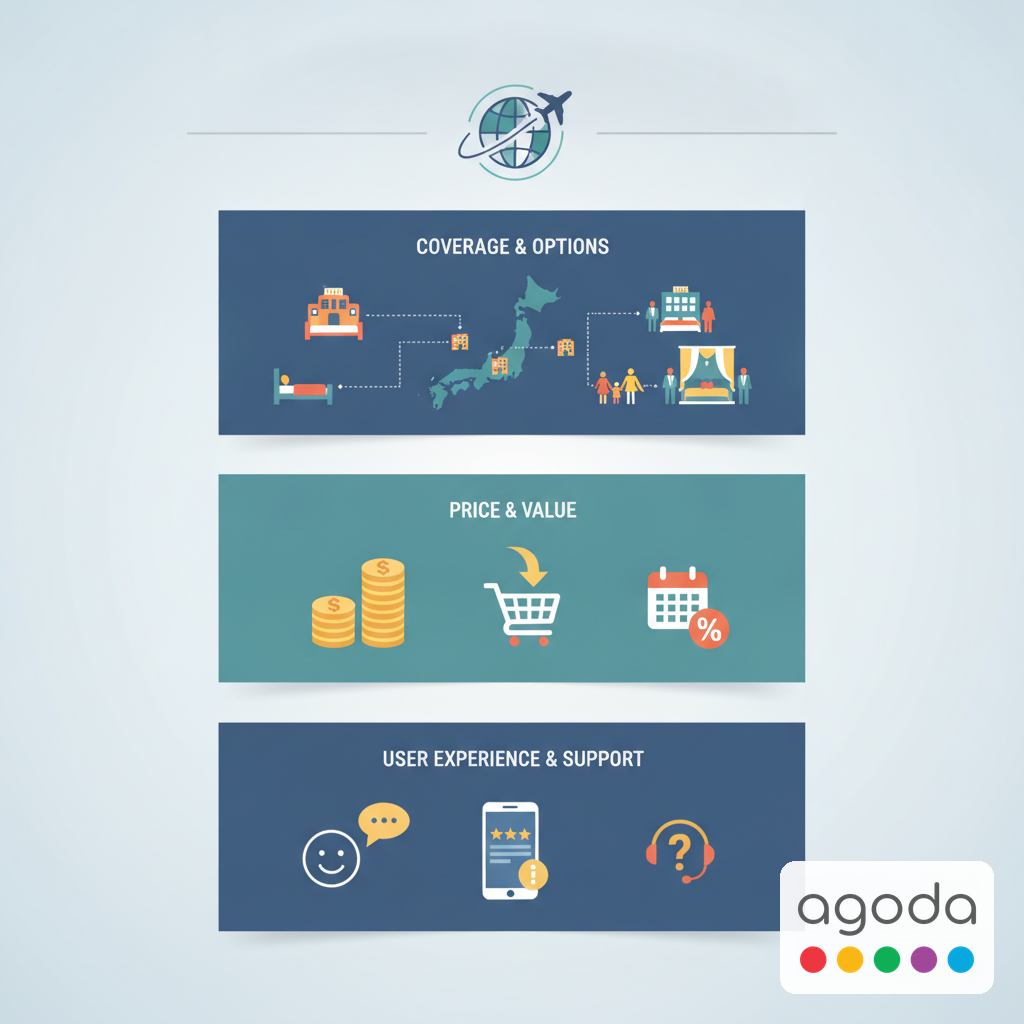
Rating Summary
Agoda scores highly in Price & Value and Coverage & Availability for Japan, reflecting its strong market presence and ability to offer a broad range of properties, from international chains to unique local guesthouses. This is particularly crucial for a destination like Japan where accommodation styles are diverse. The platform often surfaces deals that are genuinely competitive, making it a go-to for many budget-conscious travelers and those looking for specific property types.
The lowest-rated dimension is Customer Support & Reliability. While Agoda provides multiple support channels, user feedback sometimes points to slower resolution times for complex issues, especially those requiring coordination with local Japanese properties or during peak travel seasons. This matters most for urgent, in-trip problems where quick, decisive action is needed. However, for straightforward bookings, the support is generally adequate.
For booking hotels in Japan, Coverage & Availability is arguably the most critical scoring category. Japan's unique geography and high demand in popular areas mean that having access to a wide selection of hotels, across different price points and locations, is indispensable. Agoda's strength here allows travelers to find suitable options even in less common destinations or during busy periods, which greatly enhances the overall trip planning experience.
What is Agoda?
Agoda is a prominent online travel agency (OTA) that specializes in accommodation bookings, including hotels, resorts, hostels, and vacation rentals, with a particularly strong footprint across Asia. Established in 2005 and later acquired by Booking Holdings, the parent company of Booking.com, Agoda has grown to become a key player in the global travel market, especially favored by travelers exploring destinations in the Asia-Pacific region. Its core claim is to offer a vast selection of properties at competitive prices, often featuring deals and discounts unique to its platform. For the 2026 traveler, this Agoda Japan hotels review highlights that Agoda functions as a comprehensive search and booking engine, aggregating listings from numerous suppliers and independent properties into a single, user-friendly interface.
In the context of Japan, Agoda aims to simplify the often-complex process of finding and booking suitable lodging. It provides tools for searching by city, neighborhood, specific landmarks, and a wide array of filters to narrow down choices based on price, star rating, amenities, and property type. Beyond standard hotels, Agoda also features traditional Japanese accommodations like ryokans and guesthouses, which are crucial for experiencing local culture. The platform facilitates the entire booking flow, from initial search and price comparison through secure payment processing and confirmation. It positions itself as a one-stop shop for finding the perfect place to stay, regardless of whether you're planning a bustling city break in Tokyo, a serene escape to Kyoto, or an adventurous journey through Hokkaido.
Agoda's operation revolves around being an intermediary between travelers and accommodation providers. When you book through Agoda, you are typically contracting with Agoda, which then secures the room from the hotel. This model allows Agoda to offer varied payment options, including 'Pay Now' and 'Pay Later' rates, and to manage cancellations and modifications according to its own and the supplier's policies. While this structure can offer convenience and aggregated deals, it also means that customer service and refund processes are handled by Agoda, rather than directly by the hotel, which is an important consideration for travelers who prefer direct communication with their accommodation provider.
Ultimately, Agoda's purpose is to empower travelers with choice and competitive pricing for their lodging needs, especially in regions where it has deep market penetration. For Japan in 2026, it leverages its extensive network to provide options that cater to diverse preferences and budgets, aiming to make hotel booking as efficient and cost-effective as possible for its users.
Is Agoda Worth It for Japan Hotels in 2026?
Deciding if Agoda is worth it for booking hotels in Japan in 2026 largely depends on a traveler's priorities and booking habits. For many, Agoda offers significant value due to its extensive inventory and competitive pricing, particularly across the Asian market. If your primary goal is to find the widest possible selection of properties, including unique local options like business hotels, capsule hotels, or traditional ryokans that might be less prominent on other global platforms, Agoda is absolutely worth considering. Its strength in offering a diverse range of accommodations, from budget hostels to luxury resorts, allows for comprehensive comparison and often leads to uncovering excellent deals.
Another major factor in Agoda's value proposition is its pricing. While prices fluctuate, Agoda frequently offers member-only deals, flash sales, and discounts that can result in substantial savings compared to booking direct or through other booking platforms. For budget-conscious travelers or those planning longer stays, these potential savings can significantly impact the overall trip cost. The platform's 'AgodaCash' loyalty program also adds value for frequent users, providing credits that can be applied to future bookings, enhancing its long-term worth for repeat visitors to Japan or other destinations.
However, the value equation can shift if your priorities lean heavily towards maximum flexibility or seamless customer support for complex issues. Agoda's cancellation and refund policies, while clearly stated, can be more restrictive or convoluted for certain non-refundable rates or specific properties compared to direct bookings. If you anticipate frequent changes to your travel plans or require instant, highly personalized assistance for unforeseen disruptions, the platform's value might diminish slightly. In such cases, the peace of mind offered by booking directly with a hotel, often with more straightforward policies and direct access to their support, could outweigh the potential cost savings from Agoda.
In summary, Agoda is generally worth it for Japan hotel bookings in 2026 for travelers who are proactive in reviewing terms, prioritize wide selection and potential savings, and are comfortable with an OTA's intermediary role in customer service. It offers a powerful tool for discovering and securing accommodation in Japan's dynamic market, provided you understand its operational nuances.
Key Features and Strengths of Agoda for Japan Hotel Bookings
Agoda stands out for several key features and strengths that make it a compelling choice for booking hotels in Japan in 2026. One of its most significant advantages is its unparalleled property coverage across the Japanese archipelago. Unlike some global platforms that might focus primarily on major international chains, Agoda boasts an incredibly deep inventory that includes a vast array of local Japanese hotels, traditional ryokans, guesthouses, and even unique accommodations like capsule hotels. This breadth of choice means travelers are more likely to find exactly what they're looking for, whether it's a budget-friendly stay near a train station, a luxurious ryokan with an onsen, or a family-friendly apartment in a residential neighborhood.
Another strong point is Agoda's competitive pricing and deal discovery capabilities. The platform is renowned for offering aggressive discounts, flash sales, and 'member-only' prices that can often undercut other booking channels. For travelers to Japan, where accommodation costs can be a significant portion of the budget, these savings are highly attractive. Agoda's interface also makes it easy to spot these deals, often highlighting percentage discounts or special packages directly in the search results. This focus on value makes it a favorite for those aiming to maximize their travel budget without compromising on quality or location.
The search experience and filter quality on Agoda are also particularly robust for Japan. Users can filter by a comprehensive range of criteria, including specific neighborhoods (crucial in sprawling cities like Tokyo or Osaka), amenities like onsen baths or breakfast included, property types, and even unique requirements like family rooms or pet-friendly options. The integrated map search is highly effective, allowing travelers to visualize hotel locations relative to attractions, train stations, and desired areas, which is invaluable for navigating Japan's efficient public transport system and planning daily itineraries. This granular control over search parameters ensures that travelers can quickly narrow down their options to find the perfect fit for their specific trip.
Finally, Agoda's mobile app experience is a significant strength for in-trip management. The app allows users to easily access booking confirmations, manage itineraries, and receive real-time alerts. For international travelers navigating Japan, having all booking details readily available on a mobile device, potentially offline, provides immense convenience and peace of mind. This comprehensive suite of features positions Agoda as a highly effective tool for planning and managing Japan hotel bookings.
Real-World Booking Performance and User Experience on Agoda in Japan
In the real world, Agoda's performance for booking hotels in Japan generally delivers on its promises, particularly regarding its extensive selection and user-friendly interface. The search experience is typically fast and responsive, allowing travelers to quickly input their destination and dates. For Japan, the ability to specify regions, prefectures, and even specific districts within major cities proves incredibly useful, catering to the nuanced geographical planning often required for Japanese itineraries. The platform's filter system functions effectively, enabling users to refine results by price, star rating, guest review scores, and a plethora of amenities relevant to Japanese stays, such as 'non-smoking rooms' (a common filter in Japan), 'free Wi-Fi,' or 'hot spring bath.'
The map experience is a standout feature, providing a clear visual representation of hotel locations relative to train stations, popular attractions, and other points of interest. This is particularly valuable in Japan, where proximity to public transport hubs can significantly impact convenience and travel time. Users can easily pan and zoom to explore different neighborhoods, identify hotel clusters, and make informed decisions about where to stay based on their itinerary. The map updates dynamically with prices, offering a quick way to compare options geographically.
When it comes to review quality, Agoda hosts a robust collection of guest reviews, often accompanied by photos. These reviews are typically verified, providing valuable insights into real traveler experiences regarding cleanliness, staff helpfulness, room comfort, and location accuracy. For Japan, where hospitality standards are generally high, these reviews can help differentiate between properties and highlight specific nuances, such as the size of rooms (which can be smaller in Japanese city hotels) or the quality of traditional breakfast offerings. The ability to filter reviews by language and traveler type (e.g., solo, couple, family) further enhances their utility, allowing prospective bookers to gauge suitability for their specific needs.
The booking flow itself is generally straightforward. Once a property is selected, users proceed through clear steps to choose room types, add extras (though these are typically minimal for Japanese hotels beyond breakfast), and enter payment details. Agoda supports various payment methods, including major credit cards and sometimes local payment options, catering to an international audience. Confirmation is usually swift, with e-vouchers and detailed booking information sent directly to the user's email and accessible via the Agoda app. While occasional upsells for travel insurance or car rentals might appear, they are generally not overly intrusive. Based on available product information and third-party review patterns, the process is efficient and reliable, making it a solid choice for securing accommodation in Japan.
Pros and Cons of Using Agoda for Japan Hotels
When considering Agoda for booking hotels in Japan, it's essential to weigh its specific advantages against its potential drawbacks. This balanced perspective helps travelers determine if the platform aligns with their individual needs and preferences.
Pros of Agoda for Japan Hotels:
- Extensive Property Inventory: Agoda boasts an incredibly wide selection of hotels across Japan, including many local establishments, business hotels, capsule hotels, and traditional ryokans that might not be as prominently featured on other global platforms. This diversity is a major plus for experiencing authentic Japanese stays.
- Competitive Pricing and Deals: The platform is well-known for offering significant discounts, flash sales, and 'member-only' rates. For budget-conscious travelers or those looking for special offers, Agoda often provides some of the best prices for Japanese accommodation.
- Strong Asia-Pacific Focus: Given its historical strength in the region, Agoda often has better relationships with local Japanese properties, potentially leading to exclusive deals or broader availability, especially in smaller cities or during peak seasons.
- Excellent Search Filters and Map Functionality: Agoda's search filters are highly granular, allowing users to narrow down options by specific neighborhoods, amenities (like onsen, breakfast), and property types. The interactive map is invaluable for understanding hotel proximity to transport hubs and attractions in Japan's complex urban landscapes.
- Loyalty Program (AgodaCash): For frequent travelers, the AgodaCash rewards program offers credits that can be used for future bookings, adding long-term value for repeat visits to Japan or other destinations.
- User-Friendly Mobile App: The Agoda app provides seamless booking management, access to e-vouchers, and real-time notifications, which is highly convenient for travelers on the go in Japan.
- Diverse Payment Options: Agoda typically supports a wide range of payment methods, including various credit cards and sometimes local payment solutions, accommodating international travelers.
Cons of Agoda for Japan Hotels:
- Varying Cancellation and Refund Policies: While clear, the cancellation and refund terms can be more complex and restrictive compared to direct hotel bookings, especially for cheaper non-refundable rates. Travelers must read the fine print carefully.
- Customer Support Can Be Inconsistent: While support channels exist, some users report slower response times or challenges in resolving complex issues, particularly when dealing with urgent, in-trip disruptions or disputes with local properties.
- Intermediary Role in Disputes: As an OTA, Agoda acts as an intermediary. In cases of significant issues with a hotel, resolution may take longer as Agoda mediates between the traveler and the property, rather than direct communication with the hotel.
- Potential for Hidden Fees (Price Transparency): While improving, travelers must still be diligent in checking the final price at checkout, as some local taxes or service charges might not be fully transparent until the later stages of the booking process.
- Limited Direct Hotel Loyalty Benefits: Booking through Agoda generally means you won't earn points or status with specific hotel loyalty programs, which can be a deal-breaker for frequent travelers loyal to a particular hotel chain.
- Upsells During Booking: While not overly aggressive, the booking flow can include several prompts for travel insurance or other add-ons, which can be a minor distraction for some users.
Overall, the pros often outweigh the cons for many travelers to Japan, especially those who prioritize choice and value. However, the cons highlight the importance of careful review of booking terms and managing expectations regarding customer support for complex scenarios. The most significant deal-breaker for some might be the potential for less straightforward cancellation policies, particularly if travel plans are prone to change.
Who Should Use Agoda for Booking Hotels in Japan?
Agoda is an excellent choice for several distinct traveler profiles heading to Japan in 2026, primarily due to its strengths in inventory depth, competitive pricing, and regional focus. Budget-conscious travelers will find Agoda particularly appealing. Its frequent discounts, member-only deals, and wide selection of affordable accommodations - from hostels and guesthouses to well-located business hotels - make it easy to find options that fit a tighter budget without sacrificing quality or location. If you're aiming to maximize savings on your Japan trip, Agoda should be high on your list.
Travelers seeking diverse and local accommodation types will also greatly benefit from Agoda. Unlike some platforms that might have a more limited selection of traditional Japanese properties, Agoda excels in showcasing ryokans, minshuku, and various unique local stays across Japan. This is ideal for those who want to immerse themselves in Japanese culture through their lodging, or simply explore options beyond standard international hotel chains. If you're looking for that specific, authentic Japanese experience, Agoda's inventory is hard to beat.
Furthermore, flexible and last-minute bookers can leverage Agoda's dynamic pricing and broad availability. While last-minute deals can sometimes be found, Agoda's sheer volume of listings means that even when popular areas are booked solid on other sites, you might still find an available room on Agoda. This is particularly useful for spontaneous trips or for travelers whose plans are subject to change, provided they carefully review the specific cancellation policies for their chosen rate.
Finally, travelers planning multi-city itineraries across Japan will find Agoda's comprehensive coverage across different prefectures and cities extremely convenient. The ability to book all their accommodation through a single platform, with a consistent user interface and app integration, streamlines the planning process. Whether you're moving from Tokyo to Kyoto, Osaka, and then to a smaller regional city, Agoda's network ensures you have options at every stop. This makes it a practical choice for those embarking on extensive explorations of Japan.
Who Should NOT Buy It?
While Agoda offers significant benefits for booking hotels in Japan, there are specific traveler profiles for whom it might not be the ideal choice in 2026. Understanding these limitations is crucial for making the right decision and avoiding potential frustrations.
Travelers prioritizing maximum booking flexibility and straightforward refund processes should approach Agoda with caution, especially for non-refundable rates. While Agoda offers flexible options, the most competitive prices often come with stricter cancellation policies. If your travel plans are highly uncertain, or if you need the absolute assurance of easy, full refunds without complex conditions, booking directly with a hotel or opting for a more flexible (though potentially more expensive) rate on a different platform might be a safer bet. The refund process, while generally functional, can sometimes be slower or more dependent on supplier policies when mediated by an OTA.
Those who rely heavily on immediate, personalized customer support for urgent, in-trip issues might find Agoda's support system less robust than direct hotel contact. While Agoda provides various support channels, including chat and phone, user experiences suggest that resolving complex or time-sensitive problems (e.g., last-minute cancellations by the hotel, booking discrepancies upon arrival) can sometimes be challenging or involve longer wait times. If you foresee a high likelihood of needing rapid, human-to-human intervention during your stay in Japan, direct booking often offers a more direct line to problem resolution.
Furthermore, travelers who are loyal to specific hotel chains and wish to accrue loyalty points or status benefits should generally avoid booking through Agoda. OTAs typically do not qualify for loyalty program earnings or elite status recognition. If collecting points with a major hotel brand (e.g., for free nights or upgrades) is a key part of your travel strategy, booking directly via the hotel's official website is almost always the required route. Sacrificing these loyalty perks for a potentially lower price on Agoda might not be worth it for frequent guests.
Finally, first-time international travelers who prefer simple, low-risk itineraries with minimal complexity might find the nuances of OTA bookings, including varying policies and the intermediary support model, slightly overwhelming. While Agoda is generally safe, the added layer of an OTA can introduce minor complexities that some inexperienced travelers might prefer to avoid by booking directly with a known hotel brand.
How Does Agoda Compare With Typical Hotel Booking Alternatives for Japan?
When planning a trip to Japan in 2026, travelers have several avenues for booking accommodation beyond Agoda. Understanding how Agoda stacks up against these typical alternatives provides crucial context for making the best choice. These alternatives generally fall into categories such as direct hotel bookings, other large global booking platforms, and niche local booking services.
Comparison with Direct Hotel Bookings:
Booking directly with a hotel in Japan offers the clearest path for maximum control and direct communication. Travelers benefit from straightforward cancellation policies, direct access to the hotel's customer service for any issues, and the ability to earn loyalty points or status with specific hotel brands. Direct bookings often allow for special requests to be handled more easily and can sometimes include unique packages or perks not found elsewhere. However, direct booking might not always yield the absolute lowest price, especially compared to Agoda's aggressive promotional rates. Agoda often acts as a price aggregator, sometimes securing better wholesale rates that it passes on to consumers, making it potentially cheaper than direct booking for certain dates or properties.
Comparison with Other Large Global Booking Platforms:
Compared to other major international booking platforms, Agoda often holds a distinct advantage in Japan due to its strong regional focus and deeper inventory. While other platforms certainly list many Japanese hotels, Agoda frequently features a broader selection of local, independent properties, traditional ryokans, and smaller guesthouses that might be less visible elsewhere. This is particularly true outside of major international hotel chains. Price competitiveness can be a mixed bag; sometimes other platforms might have a better deal, but Agoda's consistent focus on discounts for Asian destinations often gives it an edge. The user experience can be quite similar across these large platforms, but Agoda's filters might be more tailored to Asian-specific amenities or property types.
Comparison with Niche Local Booking Services:
Some travelers might consider using smaller, local Japanese booking services or direct booking for very specific, often traditional, accommodations. These platforms can sometimes offer unique insights or very specialized properties. However, Agoda generally surpasses these in terms of breadth of choice, ease of use for international travelers, and payment flexibility. Local services might have interfaces primarily in Japanese or fewer international payment options. Agoda bridges this gap by offering a global interface with a local inventory, making it more accessible for most international visitors.
Ultimately, Agoda often strikes a balance between the extensive reach of global platforms and a nuanced understanding of the Asian market, making it a powerful tool for Japan. Its strength lies in its ability to offer competitive prices and a wide, locally relevant selection, which can be invaluable for many travelers.
| Feature | Agoda for Japan | Typical Global OTA | Direct Hotel Booking |
|---|---|---|---|
| Property Coverage | Excellent: Deep inventory, many local options | Good: Major chains, some local options | Limited: Only specific hotel's properties |
| Price Competitiveness | Often very competitive, unique deals | Competitive, but varies | Can be higher, but sometimes includes perks |
| Cancellation Flexibility | Varies by rate, can be complex | Varies by rate, generally clear | Generally clear and flexible |
| Customer Support | Adequate, but can be slow for complex issues | Generally good, varied response times | Direct, often fastest resolution |
| Loyalty Benefits | AgodaCash (platform specific) | Platform specific or none | Hotel chain loyalty points/status |
| Ease of Use (Intl. Traveler) | Excellent interface, clear filters | Good, standard interface | Varies by hotel website quality |
| Where to Buy | View Deal |
Pricing and Value for Money with Agoda in Japan
Assessing the pricing and value for money with Agoda for Japan hotels in 2026 requires a close look at its advertised rates, potential fees, and the overall benefit derived from its services. Agoda is widely recognized for its competitive base prices, often displaying rates that appear lower than those found on other platforms or even direct hotel websites. This is a significant draw for many travelers, especially those to Japan where accommodation costs can quickly add up. Agoda frequently runs promotions, flash sales, and offers exclusive 'member-only' discounts, which can lead to genuinely substantial savings, particularly if you're flexible with your travel dates or property choices. The platform's 'AgodaCash' loyalty program further enhances its value, providing credits that translate into discounts on future bookings, creating an incentive for repeat usage.
However, price transparency and potential hidden costs are crucial considerations. While Agoda has made strides in displaying the final price more clearly, travelers must remain diligent. The initial advertised price might not always include all local taxes, service charges, or resort fees that are sometimes levied by Japanese hotels. These additional charges typically become fully visible during the final stages of the checkout process. It's imperative to review the 'total price' breakdown before confirming payment to avoid any surprises. Baggage fees are not applicable for hotels, but for certain accommodation types like vacation rentals, cleaning fees might be present, though less common for traditional hotels in Japan. Currency conversion rates, if paying in a currency other than JPY, should also be monitored, as Agoda's rates might include a small markup compared to interbank rates.
The value for money with Agoda ultimately stems from its combination of competitive pricing and extensive selection. For many travelers, the ability to find a wide array of properties, including those unique to Japan, at a lower cost outweighs the minor diligence required to check for all-inclusive pricing. If you value breadth of choice and potential savings, and you're comfortable with the platform's cancellation policies for your chosen rate, Agoda provides excellent value. Its payment experience is generally secure, supporting major credit cards and offering 'Pay Now' or 'Pay Later' options, which can add flexibility to travel budgeting. However, if absolute transparency from the very first search result is your highest priority, or if you prefer a 'no surprises' approach without needing to scrutinize the final checkout page, then booking directly with a hotel that clearly states all-inclusive pricing upfront might offer better perceived value.
| Pricing Aspect | Agoda's Approach for Japan | Value Implication |
|---|---|---|
| Base Price Competitiveness | Often very strong, especially with deals | High potential for savings on accommodation |
| Taxes & Service Fees | Visible at checkout, but check final total | Requires diligence to confirm all-inclusive price |
| Member-Only Discounts | Frequent and often significant | Adds extra value for registered users |
| Loyalty Rewards (AgodaCash) | Credits for future bookings | Long-term savings for frequent Agoda users |
| Payment Options | Diverse (cards, Pay Later) | Convenient for various budgeting styles |
| Where to Buy | View Deal |
Flexibility, Support, and Traveler Risk with Agoda for Japan Bookings
When booking hotels in Japan through Agoda in 2026, understanding the interplay of flexibility, customer support, and potential traveler risks is paramount for a smooth trip. Agoda offers various rate types, prominently featuring "free cancellation" options alongside non-refundable or partially refundable rates. For travelers whose plans might change, opting for these flexible rates is highly recommended. The platform clearly indicates the cancellation window and any associated fees, but it's crucial to read these terms carefully, as they can vary significantly by property, date, and specific booking conditions. Cheaper rates almost universally come with stricter, often non-refundable, policies, which represent a higher risk if your trip is uncertain.
In terms of customer support and disruption handling, Agoda provides multiple channels, including a comprehensive help center, live chat, and phone support. For urgent issues or in-trip disruptions (e.g., a hotel overbooking or an unexpected closure), the ability to get timely human support is critical. User feedback suggests that while straightforward queries are handled efficiently, more complex problems requiring mediation with a Japanese hotel or involving refunds can sometimes lead to longer resolution times. Agoda's role as an intermediary means that it processes refunds according to both its own policies and the hotel's rules, which can add a layer of complexity compared to direct bookings. Travelers should be prepared to provide all necessary documentation and follow the platform's refund request process diligently.
Regarding trust, safety, and traveler risk, Agoda is a legitimate and widely used booking platform, part of a major global travel group. Payment security is robust, utilizing standard encryption protocols to protect sensitive financial data. However, as with any OTA, there are inherent risks. The primary risk revolves around policy clarity and the intermediary nature of customer support. If a booking is non-refundable and plans change, you might forfeit the entire amount. Likewise, if a hotel unexpectedly changes its reservation, Agoda will assist in finding alternatives, but the process might not be as immediate or seamless as if you had booked directly. It's also important to be aware of the 'price risk,' where the initial advertised price may increase slightly with taxes and fees at checkout, requiring careful final review.
For a generally low-risk booking experience in Japan, always prioritize flexible cancellation options if available, thoroughly read the terms and conditions for each specific hotel and rate, and understand that while Agoda provides support, direct communication with a hotel for immediate, on-the-ground issues might sometimes be faster. The platform is safe for sensitive data and payments, but proactive traveler diligence is the best defense against potential inconveniences.
App and In-Trip Experience for Agoda Users in Japan
The Agoda mobile application significantly enhances the in-trip experience for travelers in Japan, serving as a crucial tool for managing bookings and accessing information while on the go in 2026. The app is generally well-designed, offering a fast and intuitive interface for both searching and managing reservations. Its performance is robust on both iOS and Android platforms, ensuring a smooth user journey from initial booking to post-stay review.
One of the app's strongest features is its itinerary management capability. All confirmed bookings are neatly organized within the app, providing instant access to hotel addresses, check-in and check-out times, booking confirmation numbers, and contact details for the property. For international travelers navigating Japan, having these details readily available, often without needing an internet connection (if details are downloaded beforehand), is incredibly convenient. This eliminates the need for printing paper vouchers and ensures that all necessary information is at your fingertips, which is especially helpful when dealing with language barriers or unfamiliar locations.
The Agoda app also excels in providing real-time notifications and alerts. These can include reminders for check-in and check-out, updates on booking status, or even special offers for your current destination. While in Japan, these alerts can be invaluable for staying organized and ensuring you don't miss important timings. For instance, a notification about an upcoming check-in can be a helpful prompt when you're busy exploring. The app's integration with map services can also help with navigation to your booked hotel, further streamlining your arrival experience.
Furthermore, the app often provides in-app customer support access, allowing users to initiate chat sessions or find contact numbers directly from their booking details. While the effectiveness of support for complex issues can vary, having this immediate access within the app is a considerable advantage for travelers who might need assistance during their trip. The app also frequently features destination guides and curated lists of attractions, offering additional value beyond just booking management. Overall, the Agoda app transforms the booking platform into a comprehensive travel companion, making it a highly practical tool for any visitor to Japan, enhancing convenience and reducing potential stress during their journey.
Final Verdict: Booking Japan Hotels with Agoda in 2026
After a thorough Agoda Japan hotels review of its features, performance, and user experience, Agoda emerges as a highly recommended platform for booking hotels in Japan in 2026, particularly for a wide segment of travelers. Its most compelling strengths lie in its expansive property coverage across the entire Japanese archipelago, offering an impressive array of options from budget-friendly hostels to traditional ryokans and modern business hotels. This depth of inventory, coupled with Agoda's consistent delivery of competitive pricing and exclusive deals, makes it a powerful tool for finding significant value in Japan's dynamic accommodation market.
For travelers who prioritize choice and potential savings, and are comfortable with diligently reviewing booking terms, Agoda offers an excellent proposition. Its user-friendly search interface, robust filtering options tailored to specific needs (including local Japanese amenities), and effective map functionality greatly enhance the planning process. The Agoda mobile app further solidifies its value, providing seamless in-trip management and access to crucial booking details.
However, it's crucial to reiterate the trade-offs. While Agoda is a legitimate and secure platform, travelers who demand maximum flexibility with easy, no-questions-asked refunds, or those who require instant, highly personalized human customer support for complex, urgent issues, should proceed with careful consideration. The intermediary nature of an OTA means that direct hotel loyalty benefits are typically forgone, and dispute resolution can sometimes be more indirect. These are not deal-breakers for most, but rather important factors to weigh against the advantages.
Buy if: You are a budget-conscious traveler, you seek a wide variety of accommodation types including local Japanese options, you're comfortable reviewing booking terms carefully, or you plan a multi-city trip across Japan and value a single platform for all bookings.
Skip if: Your travel plans are highly uncertain and you require absolute, no-fuss refund flexibility, you prioritize earning loyalty points with specific hotel chains, or you anticipate needing immediate, direct human support for any potential in-trip emergencies.
Wait for a sale if: You're planning well in advance and are not in a rush to book, as Agoda frequently rolls out flash sales and seasonal promotions that could offer even greater savings on your preferred Japan hotels.
Ultimately, Agoda provides a compelling and valuable service for most travelers to Japan. By understanding its strengths and limitations, you can leverage its platform to secure excellent accommodation that enhances your 2026 Japanese adventure.
Frequently Asked Questions
Yes, Agoda is a legitimate and widely recognized online travel agency for booking hotels in Japan in 2026. It is part of Booking Holdings, a major global travel group. While it acts as an intermediary, it processes millions of bookings annually and is a trusted platform for many travelers, particularly across Asia. Its legitimacy is supported by its extensive network of properties and secure payment processing. However, as with any OTA, understanding its specific policies and terms for each booking is crucial.
Agoda can often be cheaper for Japan hotels than booking direct, especially due to its frequent flash sales, member-only discounts, and promotional rates. It leverages its buying power to secure competitive prices. However, this isn't always guaranteed, and direct bookings might offer exclusive perks or loyalty points. Always compare the final checkout price on Agoda, including all taxes and fees, against the direct hotel website to ensure you are getting the best value for your specific dates and room type.
If your Agoda Japan booking is cancelled, the outcome depends on the cancellation policy you selected. For 'free cancellation' rates, you typically receive a full refund within a specified window. Non-refundable rates, however, usually mean you forfeit the payment. If the hotel cancels, Agoda will generally assist in finding an alternative or processing a refund, though this process can take time as Agoda mediates with the property. It is vital to review the specific cancellation terms for each booking carefully before confirming.
The choice between booking direct or through Agoda for Japan hotels depends on your priorities. Book direct if you prioritize earning hotel loyalty points, desire maximum flexibility with straightforward cancellation, or prefer direct communication with the hotel for special requests or issues. Choose Agoda if you seek the widest selection of properties (especially local Japanese ones), aim for potentially lower prices through deals, or value the convenience of managing all bookings through one app. Always compare final prices and policies.
Travelers who prioritize absolute, no-fuss refund flexibility for uncertain plans should reconsider Agoda's non-refundable rates. Those who are loyal to specific hotel chains and wish to earn points or status should book direct. Additionally, travelers who anticipate needing immediate, highly personalized human customer support for complex in-trip emergencies might find direct hotel contact more reassuring than an OTA's intermediary support. First-time international travelers seeking minimal complexity might also prefer direct bookings.
Agoda offers various customer support channels, including a help center, live chat, and phone support, which are generally adequate for routine inquiries. For Japan trips, the app provides convenient access to support. However, user feedback suggests that for complex or urgent issues requiring coordination with local Japanese properties, resolution times can sometimes be slower or more challenging compared to direct communication with the hotel. While support is available, its effectiveness for critical in-trip disruptions can be inconsistent.
Agoda has improved price transparency, but travelers should always scrutinize the final checkout page for potential 'hidden' fees. The initial advertised price might not always include all local taxes, service charges, or resort fees levied by some Japanese hotels. These additional costs typically appear in the 'total price' breakdown just before final payment. While not truly 'hidden' if disclosed at checkout, they can make the final price higher than initially expected. Always confirm the final total before completing your booking.
Yes, Agoda can be quite good for finding last-minute hotel deals in Japan. Its extensive inventory means that even when other platforms show limited availability, Agoda might still have options. The platform often features dynamic pricing and last-minute promotions, especially for properties looking to fill rooms. While the best deals often require some flexibility on property type or location, Agoda's robust search and filter tools make it efficient to scout for last-minute opportunities across various Japanese cities and regions.
Yes, Agoda offers its own loyalty program called AgodaCash. When you book eligible hotels in Japan through Agoda, you can earn AgodaCash credits, which can then be applied as discounts to future bookings on the platform. This provides a form of loyalty reward specific to Agoda, encouraging repeat usage. However, it's important to note that booking through Agoda typically does not allow you to earn points or status with specific hotel chain loyalty programs, which is a key distinction from booking directly.