
Booking.com vs. Expedia (2026): Which Travel Site Offers the Best Deals and User Experience?
Booking.com
Booking.com is the superior choice for travelers focused on booking accommodations. Its clean user interface, transparent pricing, and excellent map feature make it the easiest and most efficient platform for finding the perfect hotel or apartment.
Overall Score
Top Picks
Booking.com
Booking.com excels with its intuitive design, transparent pricing for accommodations, and a simple, valuable loyalty program. It's the best choice for travelers who prioritize a seamless hotel booking experience.
Expedia
Expedia's strength lies in its comprehensive travel packages, offering significant savings when bundling flights, hotels, and cars. Its flexible One Key rewards program is a major plus for frequent travelers using the Expedia Group ecosystem.
Comparison
User Interface & Experience
Search & Filtering Speed
Value for Money
Ease of Use
Customer Support
Features
Choosing the right online travel agency (OTA) can be the difference between a seamless, budget-friendly vacation and a frustrating, overpriced ordeal. For years, two giants have dominated the landscape: Booking.com and Expedia. Both promise the best prices, the widest selection, and an easy booking process, but beneath the surface lie critical differences in their loyalty programs, pricing strategies, and overall user experience. Deciding which platform is truly better isn't just about finding the cheapest room; it's about aligning the platform's strengths with your specific travel style.
In this comprehensive, data-driven comparison, we dive deep into every facet of the Booking.com vs. Expedia debate. We'll dissect their new loyalty programs - Booking.com's established Genius program versus Expedia's unified One Key - analyze their search functionality, compare real-world pricing on identical trips, and provide clear, actionable advice for every type of traveler. Whether you're a last-minute deal hunter, a meticulous family vacation planner, or a frequent business traveler, this guide will give you the clarity needed to book your next trip with confidence.
| Feature | Booking.com | Expedia |
|---|---|---|
| Overall Rating | 9.0/10 | 8.5/10 |
| Primary Focus | Accommodations (hotels, apartments) | Full travel packages (flights, hotels, cars, activities) |
| Loyalty Program | Genius Program (Tiered discounts & perks) | One Key (Unified cash-back system across Expedia, Hotels.com, Vrbo) |
| Pricing Strategy | Often displays final price upfront. Strong member-only deals. | Competitive package deals. Prices can sometimes have added fees at checkout. |
| User Experience | Clean, fast, and highly intuitive interface. Map-based search is excellent. | Comprehensive but can feel cluttered with upsells and package offers. |
| Inventory Size | Vast global inventory, especially strong in Europe and Asia with independent hotels. | Massive inventory, particularly strong in North America with major hotel chains. |
| Pros |
|
|
| Cons |
|
|
| Best For | Travelers who prioritize accommodation, deal transparency, and a straightforward booking experience. | Travelers who want to book their entire trip in one place and maximize savings through bundling. |
| CTA | Check Deals on Booking.com | Explore Packages on Expedia |
Quick Verdict: Which Platform Should You Choose?
For travelers who need a fast, definitive answer: Booking.com is better for its superior user experience and transparent pricing on accommodations, making it ideal for those who book hotels and apartments separately. Expedia is the winner for travelers seeking the best value on complete travel packages, as its bundling feature for flights, hotels, and car rentals often provides significant savings.
Choose Booking.com if: Your primary goal is to find the best deal on a specific hotel, apartment, or unique stay. You value a clean, map-centric interface that makes comparing properties simple and transparent. The Genius loyalty program is straightforward, offering immediate discounts and perks that are easy to understand and use. If you are a frequent traveler who values simplicity and direct accommodation deals, especially in Europe and Asia, Booking.com is your go-to platform.
Choose Expedia if: You are planning a complete vacation and want to book your flight, hotel, and potentially a rental car all at once. Expedia's strength lies in its package deals, where the bundled savings can often surpass any individual deal found elsewhere. Its One Key loyalty program, while more complex, offers a flexible cash-back system that can be earned and used across Expedia, Hotels.com, and Vrbo, making it valuable for users loyal to the entire Expedia Group ecosystem. This is the better choice for family vacations and complex itineraries where one-stop shopping is a priority.
Rating Breakdown: Booking.com vs. Expedia
Booking.com - Overall Rating: 9.0/10
- User Interface & Experience: 9.5/10
- Search & Filtering Speed: 9.0/10
- Value for Money: 8.5/10
- Ease of Use: 9.5/10
- Customer Support: 8.0/10
- Features: 8.5/10
Where Booking.com Wins: Booking.com excels in its user-centric design. The interface is exceptionally clean, fast, and intuitive, making the process of finding and booking a hotel almost frictionless. Its map feature is best-in-class, and its transparent pricing model builds user trust. The Genius program is simple to understand and provides immediate, tangible benefits.
Expedia - Overall Rating: 8.5/10
- User Interface & Experience: 8.0/10
- Search & Filtering Speed: 8.5/10
- Value for Money: 9.0/10
- Ease of Use: 8.0/10
- Customer Support: 8.5/10
- Features: 9.5/10
Where Expedia Wins: Expedia's core strength is value, particularly through its bundled deals. The ability to save hundreds of dollars by booking a flight and hotel together is its main draw. Its feature set is also more comprehensive, covering flights, hotels, cars, cruises, and activities more robustly than Booking.com. The One Key program offers great flexibility for those who use other Expedia brands.
Which is Better: Booking.com or Expedia?
The direct answer is: Booking.com is generally better for booking accommodations due to its superior user interface and price transparency, while Expedia is better for booking comprehensive travel packages that include flights, cars, and hotels. The choice ultimately hinges on your booking habits and travel priorities. One platform excels at doing one thing exceptionally well, while the other thrives as a versatile, all-in-one travel marketplace.
Booking.com has built its reputation on a foundation of simplicity and vast selection in lodging. Its search engine is lightning-fast, and the results are presented in a clean, easily digestible format. The star of the show is its interactive map, which allows users to see prices and availability geographically, a feature that is invaluable when choosing a location in an unfamiliar city. Furthermore, what you see is often what you get; Booking.com tends to include taxes and fees in the initial price display more consistently than Expedia, reducing the frustrating surprise of a price hike at the final checkout screen. This focus makes it the preferred tool for travelers who have already sorted their transportation and are now laser-focused on finding the perfect place to stay.
On the other hand, Expedia operates as a full-service travel supermarket. Its true power is unlocked when you bundle multiple travel components. By packaging a flight with a hotel, for instance, Expedia can offer proprietary discounts that are not available when booking each item separately. This is where the most significant savings are found. For a family planning a week-long trip to Orlando, booking flights, a hotel, and a rental car through an Expedia package could save hundreds of dollars compared to booking each element on different sites. While its interface can feel more cluttered with upsells and advertisements, the sheer breadth of its offerings and the potential for deep discounts on packages make it a powerhouse for comprehensive trip planning.
Consider this real-world scenario: a couple is planning a weekend getaway to Chicago. If they are driving to the city and only need a hotel, Booking.com's powerful filtering, map view, and clear pricing would likely provide the best and easiest experience. However, if that same couple is flying from another state, they should start their search on Expedia. By searching for a flight + hotel package, they might find that the total cost is less than the cost of the flight alone on an airline's website, essentially making the hotel stay heavily discounted. This fundamental difference in their core business models is the most critical factor in deciding which platform is better for your specific needs.
What Are the Key Differences?
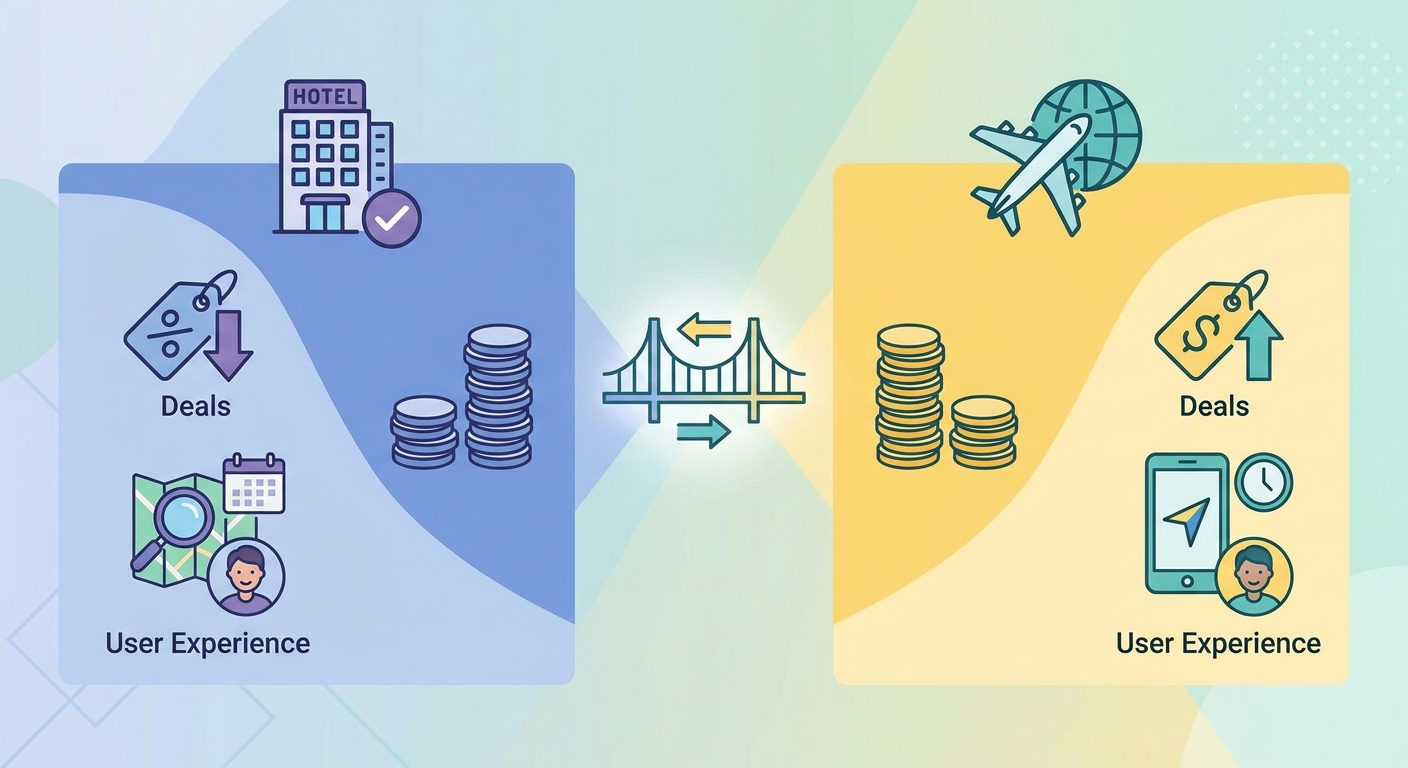
The key differences between Booking.com and Expedia lie in their core business focus, loyalty programs, and user interface philosophy. Booking.com operates primarily as an 'agency' model for accommodations, focusing on a seamless hotel booking experience. Expedia functions as a comprehensive travel 'merchant', excelling at bundling different travel products like flights and hotels into discounted packages.
First, their business models diverge significantly. Booking.com, part of Booking Holdings, historically focused on the agency model, where they act as a middleman connecting customers to hotels and take a commission. The hotel itself processes the payment. This often leads to more flexible 'pay at the hotel' options. Expedia, in contrast, heavily utilizes the merchant model. They buy inventory from airlines and hotels at wholesale rates and then sell it to consumers. When you book a package on Expedia, you are paying Expedia directly, which allows them to create unique pricing structures and deep discounts that aren't possible in a pure agency model. This is the engine behind their powerful package deals.
Second, their loyalty programs represent fundamentally different approaches to customer retention. Booking.com's Genius program is a tiered system based on the number of stays. As you ascend the levels, you unlock permanent discounts (10-20%), free breakfasts, and room upgrades at participating properties. The value is immediate and easy to grasp: book more, save more on future bookings. Expedia's One Key program is a unified rewards currency. You earn OneKeyCash (2% on hotels, cars, activities; 0.2% on flights) for every dollar spent across Expedia, Hotels.com, and Vrbo. This cash can then be spent like real money on future bookings. It's more flexible, as you aren't limited to 'participating properties', but it can be more complex to calculate the true value and redemption options.
Finally, this strategic difference is reflected in their user interfaces. Booking.com's website and app are minimalist and hyper-focused on finding a place to stay. The filters are robust, the map is central to the experience, and the path to booking is clear of distractions. Expedia's interface is, by necessity, more complex. It's designed to encourage users to add more components to their trip. You'll see prompts to 'add a car' or 'add a hotel to your flight' throughout the process. While this can sometimes feel cluttered, it's an intentional design choice to guide users toward their biggest value proposition: the bundled package. Understanding these core differences is crucial to leveraging each platform's strengths effectively.
User Interface & Experience Comparison
Booking.com offers a superior user interface and a more streamlined user experience, especially for booking accommodations. Its design is cleaner, faster, and more intuitive, while Expedia's interface, though powerful, can feel cluttered and slower due to its focus on upselling and package deals.
From the moment you land on the Booking.com homepage, the focus is singular: finding a place to stay. The search bar is prominent, and the layout is uncluttered. Once you search, the results page is a masterclass in usability. The critical information - price, rating, location - is presented clearly. The filtering options on the left sidebar are exhaustive yet easy to navigate, allowing you to quickly drill down by budget, star rating, amenities, and more. However, the standout feature is the integrated map view. It updates in real-time as you pan and zoom, showing property prices directly on the map. This is incredibly powerful for travelers who prioritize location, as you can instantly see if a cheaper hotel is worth the longer walk to the city center. The entire process from search to checkout feels logical and frictionless.
Expedia's user experience, in contrast, is built around its all-in-one travel model. The homepage immediately presents you with options for stays, flights, cars, packages, and activities. This can be great for brainstorming but can also lead to a sense of being overwhelmed. On the search results page, there is significantly more information competing for your attention. You'll find sponsored listings, prompts to join One Key, and various tags like 'Great deal' or '20% off'. While the filters are also robust, the interface can feel less responsive than Booking.com's. The map feature exists and is functional, but it feels less central to the experience and not as seamlessly integrated as its competitor's.
Let's consider a practical example: finding a pet-friendly hotel in downtown Denver. On Booking.com, you would enter your destination and dates, and then on the results page, you'd simply click the 'Pet-friendly' filter. The results, including the map, would instantly update to show only relevant properties. The process is quick and efficient. On Expedia, the process is similar, but the page will likely contain more visual noise. You might see pop-ups or banners encouraging you to bundle your hotel with a flight you weren't looking for. The checkout process on Expedia can also involve more steps and prompts to add extras like travel insurance or a rental car. While these options are valuable to some, they detract from the simple, clean booking path that makes Booking.com a favorite for many users.
Search Performance & Filtering Comparison
Booking.com has a slight edge in search performance and filtering, offering a faster, more responsive experience with filters that feel more granular and intuitive for accommodations. Expedia's search is powerful and comprehensive, especially for complex multi-product searches, but can feel slower and less refined for simple hotel queries.
The speed and responsiveness of Booking.com's search engine are immediately noticeable. Results load almost instantly, and applying filters updates the page without perceptible lag. This speed is crucial when you're rapidly refining your search. The filtering options themselves are incredibly detailed. Beyond standard filters like price and star rating, you can drill down to specifics like '24-hour front desk', 'balcony/terrace', or even 'hotels with electric vehicle charging stations'. This level of granularity saves an immense amount of time, preventing you from having to click into each hotel's details to see if it meets your specific needs. The seamless integration with the live map means that every time you apply a filter, you can see the geographical impact immediately.
Expedia's search engine is a heavy-lifter, designed to query massive databases for flights, hotels, cars, and packages simultaneously. For a simple hotel search, this can sometimes translate to a slightly slower load time compared to Booking.com. While its filtering options are also very comprehensive, they can sometimes be organized less intuitively. For instance, finding specific accessibility features might require more clicks than on Booking.com. Where Expedia's search truly shines is in its package and flight searches. The ability to search for 'flight + hotel' from the outset and see a single, bundled price is its killer feature. The flight search filters are excellent, allowing you to specify airlines, layover times, and baggage policies effectively.
Imagine you're a business traveler looking for a hotel near a specific convention center for a 3-night stay. On Booking.com, you could search for the convention center's address, and the map would instantly show you the closest hotels and their prices. You could then filter for 'Free Wi-Fi', 'Breakfast Included', and 'Excellent' review scores. The whole process would take less than a minute. On Expedia, you could perform the same search. The results would be similar, but the page might load a fraction slower, and you might have to sift through more promotional content. However, if that business traveler also needed to book a flight, starting on Expedia to search for a package deal would be far more efficient. They could compare the total cost of the trip in one go, a task that would require two separate searches and manual comparison on Booking.com.

Features Comparison: Beyond the Booking
Expedia offers a more robust and comprehensive set of features, positioning itself as a true one-stop-shop for all travel needs, including flights, cars, cruises, and activities. Booking.com has a strong feature set focused on accommodations but is less developed in other travel categories.
Expedia's feature breadth is its defining characteristic. Beyond just booking, the platform is a full-fledged travel planning tool. You can book complex multi-city flights, reserve rental cars from dozens of providers, book tickets for tours and attractions, and even plan entire cruises. Its itinerary management tool is a significant advantage; once you book a flight, hotel, and car, Expedia automatically compiles them into a single, easy-to-access itinerary in your account and on the mobile app. This is incredibly convenient for keeping track of confirmation numbers, addresses, and times. The Expedia mobile app is also a powerhouse, providing travel alerts, gate change notifications, and mobile-exclusive deals. The integration of Vrbo's vacation rental inventory and the unified One Key rewards system further solidify its position as an all-encompassing travel ecosystem.
Booking.com, while expanding, remains laser-focused on its core competency: accommodations. Its feature set is designed to perfect that experience. Features like detailed reviews with verified-stay labels, extensive property photos, and clear information on amenities are executed flawlessly. In recent years, it has made significant strides in offering flights and rental cars, but the integration doesn't feel as seamless as Expedia's. The process often feels like you are being handed off to a partner site rather than booking within a single, unified system. The 'Attractions' tab is present but offers a less comprehensive selection than Expedia's 'Things to Do'. The Booking.com app is excellent for managing hotel bookings and communicating with properties, but it lacks the holistic itinerary management capabilities of its competitor.
Let's use the scenario of planning a family trip to Hawaii. Using Expedia, you could research and book flights for the whole family, find a resort with a kids' club, book a minivan for the week, and even pre-purchase tickets for a luau and a snorkeling tour, all within one platform. The entire trip would be organized under a single itinerary, and you would earn OneKeyCash on almost every component. If you were to plan the same trip using Booking.com, you would likely have a fantastic experience booking the resort, with many options and clear pricing. You could then book flights and a car, but the process might feel more disjointed. You would likely need to go to a separate provider for the luau and snorkeling tour tickets. While the end result might be the same, the planning process on Expedia is undeniably more integrated and convenient for such a multi-faceted trip.
Find Your Perfect Stay on Booking.com Bundle & Save on ExpediaPricing & Value for Money
Expedia generally offers better value for money on travel packages, while Booking.com often has more transparent and sometimes slightly lower standalone hotel prices, especially with its Genius discounts. The ultimate value depends entirely on what you are booking.
The pricing strategy at Booking.com is built on transparency. More often than not, the price you see on the search results page is very close to the final price you'll pay (though some resort fees, a hotel-level charge, may still be separate). This builds trust and simplifies the comparison process. The Genius loyalty program is a key driver of value. Even at Level 1 (just by creating an account), you can access 10% discounts on thousands of properties. As you move up the tiers, these discounts increase and perks like free breakfast are added, which represent real, tangible savings. For travelers who book hotels frequently and separately from flights, Booking.com's model often yields excellent value and a frustration-free checkout.
Expedia's value proposition is centered on the bundle. While its standalone hotel prices are competitive, they are not always the absolute cheapest. The real magic happens when you combine a hotel with a flight or car rental. Expedia receives wholesale rates from its partners and can pass those savings on to consumers in the form of a package discount. It's not uncommon to find a flight + hotel package on Expedia for a price that is equal to or even less than the cost of the flight alone on the airline's website. However, a key point of caution with Expedia is to watch the final checkout screen. Sometimes, the initial price shown does not include all taxes and fees, which are added at the last step. While this is becoming less common, it's something to be aware of when comparing prices.
Here's a data-driven example. Let's search for a 3-night stay at the 'MGM Grand' in Las Vegas and a round-trip flight from Los Angeles. * On Booking.com: You might find the hotel for $150/night, totaling $450. The Genius discount could bring this down to $405. You would then search for flights separately, which might cost $200. Total trip cost: $605. * On Expedia: The same hotel might be listed at $155/night. The flight is still $200. Booked separately, the total is $665. However, when you search for a 'flight + hotel' package, Expedia might offer the entire bundle for $550. In this scenario, bundling on Expedia saved $55 over booking the best individual prices on Booking.com. This illustrates the core value proposition of each site perfectly. For the hotel alone, Booking.com was cheaper. For the whole trip, Expedia provided better overall value.
Pros and Cons: A Detailed Breakdown
Choosing between Booking.com and Expedia requires a clear understanding of their respective strengths and weaknesses. Here's a detailed breakdown to help you align their offerings with your travel needs.
Booking.com
Pros:
- Exceptional User Interface: The website and app are incredibly clean, fast, and easy to navigate. The focus on a frictionless booking process is evident in every design choice.
- Superior Map Functionality: The interactive map is the best in the business for comparing properties based on location and price simultaneously.
- Transparent Pricing: Generally, the price shown in the search results is closer to the final price, with fewer surprise fees added at the last stage of checkout.
- Extensive Accommodation Variety: Beyond hotels, Booking.com has a massive inventory of apartments, B&Bs, hostels, and vacation homes, often surpassing Expedia in this area, especially outside North America.
- Simple and Effective Loyalty Program: The Genius program is easy to understand. The discounts are applied directly, providing instant gratification and clear value.
Cons:
- Weaker Package Deals: While flight and car booking options exist, they are not as deeply integrated or discounted as Expedia's bundled offerings.
- Limited Ancillary Bookings: The options for booking tours, activities, and attractions are less comprehensive than on Expedia.
- Inconsistent Customer Service: Because Booking.com often acts as an intermediary, customer service issues can sometimes require you to deal with both Booking.com and the hotel directly, which can be frustrating.
Expedia
Pros:
- Unbeatable Package Savings: The ability to bundle flights, hotels, and cars can lead to substantial savings that are impossible to find when booking items separately.
- Comprehensive Travel Hub: It's a true one-stop-shop for nearly every travel need, from flights and hotels to cruises and local activities.
- Flexible Loyalty Program: The One Key program allows you to earn and spend a flexible 'cash' currency across multiple major travel sites (Expedia, Hotels.com, Vrbo).
- Strong North American Presence: Expedia often has a slight edge in inventory and deals with major hotel chains within the United States.
- Better Itinerary Management: All bookings are automatically compiled into a single, easy-to-manage itinerary, which is a huge convenience for complex trips.
Cons:
- Cluttered User Interface: The site can feel busy and overwhelming, with numerous upsells, pop-ups, and promotional banners that can distract from the core task of booking.
- Less Transparent Pricing: While improving, there can still be instances where the final price at checkout is higher than the initial price displayed due to the later addition of taxes and fees.
- Complex Loyalty Program: Understanding the earn and burn rates of OneKeyCash and the tier benefits can be more confusing than Booking.com's straightforward discount model.
Loyalty Programs: Booking.com Genius vs. Expedia One Key
Booking.com's Genius program is better for its simplicity and immediate discounts, while Expedia's One Key is better for its flexibility and ability to earn rewards across a wider ecosystem. The best program depends on whether you prefer upfront savings or a flexible points currency.
The Booking.com Genius program is a tiered system that rewards repeat customers with tangible, ongoing perks. It's brilliantly simple. After just two stays in two years, you reach Level 1, which unlocks a 10% discount on participating properties. After five stays, you hit Level 2, which increases the discount to 15%, and adds free breakfast and free room upgrades on select stays. The top tier, Level 3 (15 stays), boosts the discount to 20% and adds priority customer support. The beauty of this system is its immediacy. The discount is applied before you book, so you see the savings right away. The main limitation is that these perks are only available at 'participating properties', though the selection is vast.
Expedia's One Key program, launched in 2023, is a more ambitious, unified system. It replaces the old rewards programs of Expedia, Hotels.com, and Vrbo. You earn a single currency, OneKeyCash, on all eligible bookings: 2% back on hotels, car rentals, activities, and vacation rentals, and 0.2% back on flights. You can then redeem this OneKeyCash on future bookings, where $1 in OneKeyCash equals $1 off your booking. The system also has tiers (Blue, Silver, Gold, Platinum) based on how many 'trip elements' you book. Higher tiers unlock perks like room upgrades and access to VIP properties. The main advantage is flexibility. You can earn on an Expedia hotel and spend it on a Vrbo vacation rental. The downside is the complexity and the delayed gratification. You don't save money upfront; you accumulate a balance to use later.
Let's compare a real-world scenario. A traveler spends $2,000 on hotels over a year. * With Booking.com Genius (Level 2): On their next $500 hotel booking at a participating property, they would receive an instant 15% discount, saving $75 immediately. They might also get a free breakfast, valued at $40 for two people over two days. Total immediate value: $115. * With Expedia One Key: After spending $2,000, they would have accumulated $40 in OneKeyCash (2% of $2,000). On their next $500 hotel booking, they could apply this $40 to reduce the price to $460. The value is real, but it's less than half of the immediate savings from the Genius program in this specific scenario. The value of One Key increases dramatically if you also book rental cars, activities, or use Vrbo, where you can pool all your earnings.
| Feature | Booking.com | Expedia |
|---|---|---|
| Mobile App | Excellent for managing hotel bookings, clean UI. | Comprehensive itinerary management, flight alerts, mobile-only deals. |
| Cancellation Policies | Very clear 'Free Cancellation' filter. Policies are set by the property and displayed prominently. | Clear filter available. Policies are generally easy to understand but can vary with packages. |
| Customer Support | Offers support via messaging and phone. Can be inconsistent as it's often a liaison between you and the property. | Centralized support for all trip components (flights, hotels, etc.). Generally more equipped to handle complex issues. |
| Payment Options | Frequently offers 'Pay at Property' options. Accepts all major credit cards and some digital wallets. | Typically requires pre-payment, especially for packages. Wide range of payment options including financing. |
| Price Match Guarantee | Yes, 'Price Match' offered if you find a lower price on another site for the same booking. | Yes, 'Price Match Promise' is available, but conditions apply, especially for package deals. |
Use-Case Segmentation: Who Should Choose What?
The best platform is not universal; it's personal. Your ideal choice depends entirely on your travel style, priorities, and the nature of your trip. Here's a breakdown of which platform to use for different types of travelers and trips.
For the Meticulous Hotel Researcher: Booking.com
If you're the type of traveler who spends hours comparing hotels, reading reviews, and scrutinizing map locations to find the absolute perfect spot, Booking.com is your tool. Its clean interface, powerful filters, and best-in-class map view are designed for this purpose. You can quickly compare dozens of properties without being distracted by irrelevant offers. The transparent pricing and straightforward Genius discounts mean you can be confident you're making a well-informed decision based on the merits of the accommodation itself.
For the Family Vacation Planner: Expedia
Planning a trip for a family of four involves juggling flights, a hotel with a pool, and a minivan rental. This is where Expedia shines. The ability to search for and book all these components in a single package is a massive time-saver. More importantly, the bundled discounts can free up hundreds of dollars in your budget for activities and meals. The centralized itinerary management on the Expedia app means all your confirmation numbers and details are in one place, which is a lifesaver when you're navigating an airport with kids in tow.
For the Last-Minute Deal Hunter: Booking.com
When you need a hotel for tonight, speed and clarity are paramount. Booking.com's mobile app is exceptionally fast and makes finding nearby, available hotels a breeze. The 'Deals for Tonight' feature and clear pricing allow you to make a quick, confident decision without worrying about hidden fees. Its large inventory of independent hotels and apartments often means more unique, last-minute options are available compared to chain-focused competitors.
For the All-Inclusive Resort Seeker: Expedia
Expedia has a stronger focus and a more extensive inventory when it comes to all-inclusive resorts, particularly in destinations like Mexico and the Caribbean. Because these trips almost always involve flights, Expedia's package-deal engine is perfectly suited to provide the best possible price. You can easily filter by resort features, compare different packages, and book your entire stress-free vacation in just a few clicks.
For the Digital Nomad or Long-Stay Traveler: Booking.com
Travelers looking for monthly stays or apartment-style accommodations will find a much broader and better-curated selection on Booking.com. The platform has heavily invested in its non-hotel inventory, making it a go-to for finding furnished apartments with kitchens and workspaces. The filtering system is well-adapted for these stays, with options for 'kitchen facilities' and other home-like amenities.
| Traveler Type / Trip | Winner | Reason |
|---|---|---|
| Solo Hotel Booker | Booking.com | Superior UI, map feature, and transparent pricing for accommodation-only bookings. |
| Family Vacation (Flights + Hotel) | Expedia | Significant savings through package bundling and centralized itinerary management. |
| Business Traveler | Tie | Booking.com for simple hotel stays; Expedia for flight + hotel + car packages. |
| Backpacker / Hostel Seeker | Booking.com | Larger inventory of hostels and budget-friendly guesthouses. |
| Luxury Resort Planner | Expedia | Stronger package deals for high-end resorts, especially when including flights. |
| Last-Minute Booking | Booking.com | Faster mobile app experience and clear, immediate pricing. |
Final Verdict: Making the Right Choice for Your 2026 Travels
After a comprehensive deep dive into every aspect of Booking.com and Expedia, from their user interfaces and pricing models to their loyalty programs and feature sets, a clear picture emerges. There is no single 'best' platform, but there is a 'better' platform for your specific needs. The decision boils down to a simple question: Are you booking a place to stay, or are you booking an entire trip?
Booking.com is the undisputed champion of accommodation booking. Its relentless focus on creating a simple, transparent, and powerful search experience makes it the best tool for finding hotels, apartments, and unique stays. The clean interface, lightning-fast search, and unparalleled map functionality remove friction from the research process. When you add the straightforward and valuable Genius loyalty program, which provides immediate discounts, Booking.com becomes the go-to choice for any traveler who books their lodging separately from their transportation. If your travel planning is modular, and your primary goal is to find the perfect room at a fair price, your search should start and end with Booking.com.
Expedia, however, is the master of the package deal. It has built its empire on the value proposition of bundling, and it delivers on that promise exceptionally well. For anyone planning a traditional vacation that involves a flight and a hotel, and potentially a rental car, Expedia is almost always the more economical choice. The savings generated by its package deals are significant and often unmatchable by booking each component individually. While its interface is busier and its loyalty program more complex, the platform's power as a comprehensive, all-in-one travel agency is undeniable. If you prioritize convenience and overall trip cost over a minimalist booking experience, Expedia is your best bet.
Ultimately, the smartest traveler doesn't choose one and abandon the other. They use both. Use Expedia when you're in the initial planning stages of a multi-component trip to see what package deals are available. Use Booking.com when you need to book a standalone hotel, leveraging its superior search tools to find the perfect property. By understanding the core strengths of each platform, you can use them strategically to save both time and money, ensuring every trip you take is a success.
Frequently Asked Questions
Not always. For standalone hotel bookings, Booking.com is often slightly cheaper or the same price, especially once you factor in its Genius program discounts. Expedia's main pricing advantage comes from its package deals. If you bundle a hotel with a flight, Expedia will almost always be cheaper than booking the two components separately on Booking.com. Therefore, for hotels alone, compare both but lean towards Booking.com; for a full trip, Expedia likely offers better value.
Neither is definitively 'better' - they serve different purposes. Booking.com's Genius program is better for its simplicity and immediate gratification, offering direct discounts (10-20%) on future bookings. Expedia's One Key is better for its flexibility, allowing you to earn a cash-back currency (OneKeyCash) across Expedia, Hotels.com, and Vrbo, which you can then spend on any booking. If you want easy, upfront savings on hotels, choose Genius. If you book various travel types across multiple sites, One Key is more versatile.
Expedia generally has a slight edge in customer service, particularly for complex issues involving multiple bookings like flights and hotels. Because Expedia acts as the direct merchant for packages, they have a centralized support system to handle all components of your trip. Booking.com's service can be inconsistent as they often act as an intermediary, meaning you may need to communicate with both them and the hotel to resolve an issue, which can sometimes be less efficient.
Yes, you can book flights on Booking.com. The platform has expanded its services beyond accommodations to include flights and car rentals. However, its flight booking engine is not as robust or integrated as Expedia's. The primary strength and focus of Booking.com remain on accommodations, whereas Expedia is built from the ground up as a comprehensive travel agency where flights are a core component of their powerful package deals.
Both platforms offer vacation rentals, but they have different strengths. Expedia has a significant advantage now that it has integrated its sister site, Vrbo, into its One Key rewards program. This gives it access to a massive inventory of traditional vacation homes. Booking.com also has an extensive list of apartments and homes, often from individual hosts, and its search filters for these property types are excellent. For whole-home rentals in traditional vacation spots, start with Expedia/Vrbo. For city apartments, Booking.com is extremely competitive.