
Trip.com vs. Booking.com: The Ultimate Data-Driven Comparison (2026)
Booking.com
Booking.com is the superior choice for most travelers globally, offering an unmatched selection of accommodations, a highly intuitive user interface, and a valuable loyalty program that makes booking stays simple and rewarding.
Overall Score
Top Picks
Booking.com
The global leader for a reason. Booking.com offers an unparalleled user experience for booking accommodations, with powerful filters, a massive inventory, and the best loyalty program in the business.
Trip.com
The ultimate travel super-app for Asia-focused and complex itineraries. Trip.com excels with its integrated flight, hotel, and train bookings, offering great value and convenience.
Comparison
Design
Performance
Value for Money
Ease of Use
Durability
Features
Choosing the right online travel agency (OTA) can be the difference between a seamless, budget-friendly vacation and a trip riddled with logistical headaches and hidden costs. In the vast landscape of travel booking sites, two giants consistently battle for dominance: Trip.com, a powerhouse with deep roots in the Asian market, and Booking.com, the global leader with an unparalleled inventory of accommodations. Deciding between them isn't just about finding the lowest price; it's about understanding which platform aligns best with your travel style, destination, and priorities.
This comprehensive, data-driven analysis will dissect every facet of Trip.com and Booking.com. We'll move beyond surface-level observations to compare their pricing structures, loyalty programs, user interfaces, customer support, and unique features. Whether you're a budget backpacker exploring Southeast Asia, a family planning a European holiday, or a business traveler needing flexibility, this guide will provide the clarity you need to book your next trip with confidence.
| Feature | Trip.com | Booking.com |
|---|---|---|
| Primary Focus | All-in-one travel (strong in Asia for flights, hotels, trains) | Accommodations (hotels, apartments, vacation rentals) |
| Hotel Inventory | Vast, with exceptional coverage in Asia-Pacific | Largest global inventory, especially strong in Europe & North America |
| Flight Booking | Robust, with competitive pricing and multi-city options | Integrated, but less of a core focus than accommodations |
| Loyalty Program | Trip Coins (earn on bookings, redeem for discounts) | Genius Program (level-based perks like discounts & upgrades) |
| Unique Features | Extensive train booking (especially in China/Asia), travel guides | Vast vacation rental selection, airport taxis, restaurant reservations |
| Pricing Strategy | Often highly competitive, especially for Asian destinations | Transparent pricing, strong last-minute deals |
| User Interface | Modern, clean, feature-rich | Simple, intuitive, and highly refined for accommodation search |
| Best For... | Travelers focusing on Asia, all-in-one package seekers, train travelers | Travelers prioritizing accommodation choice, European/American travel, loyalty perks |
| Overall Rating | 8.8 / 10 | 9.2 / 10 |
| Call to Action | Check Deals on Trip.com | Find Stays on Booking.com |
Quick Verdict: Which Platform Should You Choose?
For travelers in a hurry, here's the direct answer: Booking.com is the better choice for the majority of global travelers, especially those prioritizing accommodation variety and transparent pricing in Europe and the Americas. Its Genius loyalty program offers immediately tangible benefits, and its user interface is the industry standard for a reason - it's incredibly efficient for finding and booking places to stay.
Choose Booking.com if: Your primary need is finding the perfect hotel, apartment, or vacation rental. You travel frequently in Europe or North America and can benefit from the Genius program's tiered discounts and perks. You value a simple, no-fuss booking process with a massive, reliable inventory and millions of user reviews.
Choose Trip.com if: Your travels are heavily focused on Asia, particularly China. You need to book complex itineraries involving flights, hotels, and especially trains, all in one place. You are a savvy traveler who can leverage Trip Coins and promotional deals to secure significant discounts, and you appreciate having a comprehensive travel super-app.
In essence, Booking.com has perfected the art of booking a place to sleep, making it the most reliable and user-friendly option for that specific task worldwide. Trip.com, on the other hand, excels as a holistic travel planner, offering a wider range of services that are particularly potent for navigating the intricacies of the Asian travel market. Your ideal choice depends entirely on where you're going and what you need to book.
Trip.com: Overall Rating - 8.8/10
- User Experience: 9.0/10
- Features & Services: 9.5/10
- Pricing & Value: 8.5/10
- Customer Support: 8.0/10
- Loyalty Program: 9.0/10
Wins: Trip.com is a true all-in-one platform, excelling where others falter, such as with its integrated train booking system. Its Trip Coins program is flexible and rewarding, and its flight search engine is often more competitive than Booking.com's.
Loses: While its hotel inventory is large, it can't match Booking.com's sheer depth and breadth outside of Asia. Customer service experiences can be inconsistent, a common issue for large OTAs but one that users report more frequently here.
Booking.com: Overall Rating - 9.2/10
- User Experience: 9.5/10
- Features & Services: 8.5/10
- Pricing & Value: 9.0/10
- Customer Support: 9.0/10
- Loyalty Program: 9.5/10
Wins: Booking.com offers an unparalleled user experience for booking accommodations, with powerful filters and a simple interface. Its Genius loyalty program is arguably the best in the industry, providing real, consistent value. Its global inventory is second to none.
Loses: It's not a true 'super-app'. While it offers flights and car rentals, these services feel more like add-ons than core, deeply integrated features. It lacks the specialized travel options, like train tickets, that Trip.com provides.
Which is Better Overall: Trip.com or Booking.com?
The direct answer is that Booking.com is the better overall platform for most travelers worldwide due to its unmatched hotel inventory, user-friendly interface, and a highly rewarding loyalty program. It has spent decades refining one thing: making it incredibly easy to find and book accommodations anywhere on Earth. For this core travel task, it remains the undisputed leader. Its massive scale translates into competitive pricing, extensive review data, and a level of reliability that gives travelers peace of mind, especially when visiting popular destinations in Europe, North America, and South America.
However, this doesn't mean Trip.com is an inferior choice; it's simply more specialized. Trip.com emerges as the superior option for a significant and growing segment of travelers, particularly those whose itineraries are centered on the Asia-Pacific region. Its origins as Ctrip, a Chinese OTA, give it a deep, native understanding of this market. This manifests in better hotel deals in cities like Tokyo, Shanghai, and Bangkok, and in its unique ability to seamlessly integrate train bookings - a critical mode of transport in China, Japan, and parts of Europe. For anyone planning a multi-destination trip across Asia that involves more than just flights and hotels, Trip.com is not just better; it's practically essential.
The decision framework is clear: if your primary concern is finding the best possible hotel, apartment, or guesthouse, and you value a simple, powerful search tool with dependable customer service, Booking.com should be your default choice. Its Genius program will quickly reward your loyalty with tangible discounts. But if your travel plans are more complex, involve multiple transport types (especially trains), and are focused on Asia, Trip.com's all-in-one 'super-app' approach offers a level of convenience and regional expertise that Booking.com cannot currently match. Ultimately, Booking.com wins on global breadth and accommodation focus, while Trip.com wins on regional depth and integrated travel services.
What Are the Key Differences Between Trip.com and Booking.com?
The fundamental difference between Trip.com and Booking.com lies in their core business philosophy and market focus. Booking.com is an accommodation-first platform that has expanded into other travel services, whereas Trip.com was built as an all-in-one travel service provider with a strategic focus on the Asian market. This distinction shapes every aspect of their user experience, from search functionality to loyalty rewards.
First, their inventory and geographical strengths are starkly different. Booking.com, part of Booking Holdings, boasts the world's largest and most diverse collection of accommodations. This includes over 28 million listings, ranging from five-star hotels to hostels, apartments, and unique homes. Its stronghold is undeniably Europe and the Americas, where its inventory is so comprehensive that it's often the only booking site a traveler needs. Trip.com, owned by the Trip.com Group, also has a massive global inventory but its competitive edge is in the Asia-Pacific region. It frequently offers more hotel options and lower prices in cities like Beijing, Singapore, and Seoul, thanks to its deep-rooted local partnerships.
Second, their approach to travel services varies significantly. For Booking.com, flights, car rentals, and attractions are ancillary services added to its core accommodation business. The integration is smooth, but the platform's heart and soul remain in booking a place to stay. Trip.com, in contrast, treats all travel components as equals. Its flight search engine is powerful and often finds unique routing options. Its most significant differentiator is the seamless integration of train ticket bookings for numerous countries, a feature Booking.com lacks entirely. This makes Trip.com a true 'super-app' for planning complex, multi-modal journeys.
Finally, their loyalty programs operate on different principles. Booking.com's Genius program is a tiered system based on the number of stays. Once you unlock a level, you receive permanent benefits like discounts (10-20%), free breakfasts, or room upgrades at participating properties. It's simple and provides consistent value. Trip.com uses a points-based system called Trip Coins. You earn coins on virtually every booking (flights, hotels, etc.), which can then be applied as a direct cash discount on future bookings. This system is more flexible, rewarding all spending on the platform, but requires users to actively manage and apply their points, whereas Genius benefits are often applied automatically.
Design & User Experience Comparison
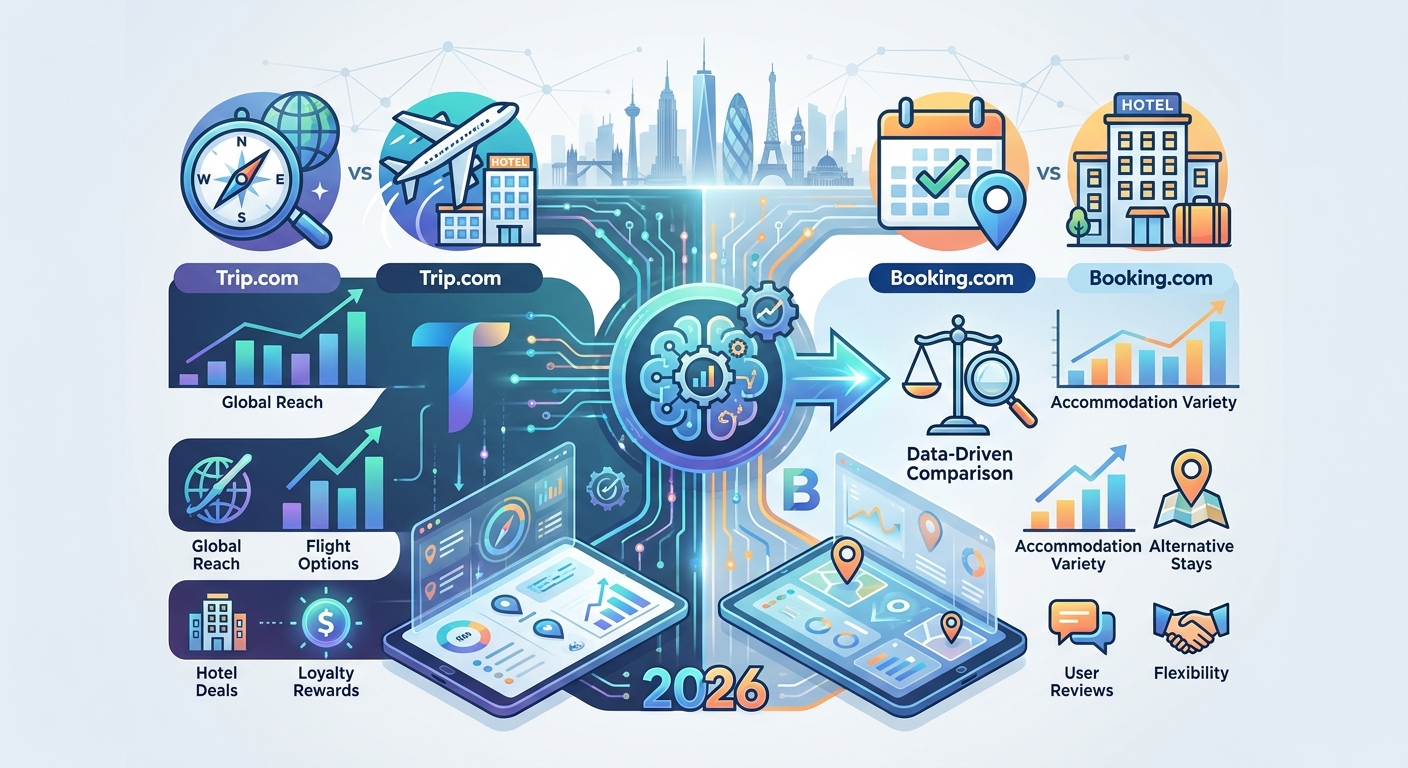
When comparing design and user experience, Booking.com offers a more streamlined, intuitive, and faster interface for its core purpose of booking accommodations, while Trip.com provides a more feature-dense, all-encompassing interface that can feel slightly more cluttered but is powerful for booking entire trips. The better choice depends on user preference: simplicity and speed versus comprehensive functionality.
Booking.com's interface, both on desktop and its mobile app, is a masterclass in conversion rate optimization. The design is clean, with a prominent search bar and minimal distractions. The search results page is where it truly shines. The filters are incredibly granular and intuitive, allowing users to effortlessly narrow down thousands of options by price, review score, property type, amenities (like 'pet-friendly' or 'electric vehicle charging station'), and even sustainability practices. The map view is fast and responsive, making it easy to find properties in a specific neighborhood. The entire process, from search to checkout, is designed to be as frictionless as possible. It remembers your details, simplifies payment, and provides clear confirmation. It does one thing, booking a room, exceptionally well.
Trip.com, on the other hand, presents itself as a travel command center. The homepage immediately showcases its wide range of services: flights, hotels, trains, cars, tours, and more. This can be slightly overwhelming for a new user compared to Booking.com's focused approach. The search results for hotels are detailed, but the filtering options, while extensive, can feel less refined than Booking.com's. For example, a real-world scenario of booking a family trip to London might feel easier on Booking.com, where filtering for 'family rooms' and 'kitchenette' is a two-click process. On Trip.com, this might require more careful navigation through the options. However, where Trip.com's UX excels is in the integration of these services. Planning a trip from London to Paris, you can book your flight into London, your hotel there, your Eurostar train ticket to Paris, and your Paris hotel all within the same ecosystem, often with bundled deal suggestions. This cross-service integration is something Booking.com's more siloed approach doesn't offer as seamlessly.
The mobile apps mirror this philosophy. Booking.com's app is lightning-fast and purpose-built for finding and managing accommodation bookings on the go. Trip.com's app is more of a Swiss Army knife, packed with features that are incredibly useful but result in a slightly steeper learning curve. For the power user planning a complex Asian itinerary, the Trip.com app is invaluable. For the average user who just needs to book a hotel for the weekend, the Booking.com app provides a superior, more focused experience.
Performance & Search Speed Comparison
In terms of raw performance and search speed, Booking.com generally delivers faster and more responsive search results for accommodations, a direct result of its specialized focus and highly optimized infrastructure. Trip.com is also fast, but its broader search query capabilities can sometimes lead to slightly longer load times, especially for complex, multi-product searches.
Booking.com's performance is a key part of its competitive advantage. When a user searches for hotels in a major city like New York, the platform queries its massive database and returns thousands of results, complete with pricing, availability, and initial review scores, often in under two seconds. The subsequent filtering and sorting actions are nearly instantaneous. This speed is crucial in retaining user engagement and preventing booking abandonment. This is achieved through a globally distributed network of servers and a relentless focus on optimizing the accommodation search algorithm. A real-world test of searching for a 3-night stay in Rome for next month will almost invariably see Booking.com populate the initial list of properties faster than Trip.com.
Trip.com's performance is by no means slow; it is a top-tier platform that handles immense traffic. However, its architecture has to support a wider array of search types. When you search for a flight, it's querying Global Distribution Systems (GDS) and multiple airline direct connections. When you search for a hotel, it's querying its own inventory. When you search for a train, it's connecting to national rail APIs. A 'flight + hotel' package search is even more complex. While these individual searches are quick, they can occasionally feel a fraction of a second slower than Booking.com's hyper-specialized hotel search. For example, running a search for a one-week vacation package to Bali on Trip.com might take a few seconds longer to aggregate all the flight and hotel combinations compared to just searching for hotels on Booking.com.
The accuracy of the results is high on both platforms. Both provide real-time pricing and availability with a very low error rate. Where a slight difference can emerge is in the final booking price. Booking.com has a reputation for showing an 'all-in' price (excluding some local taxes payable at the property) very early in the process. Trip.com sometimes has a more complex pricing display, especially with flights, where the initial attractive price might not include baggage, leading to adjustments at a later stage. However, for hotels, both are generally transparent. In essence, for the specific task of finding a hotel quickly, Booking.com's performance is unparalleled. For the broader task of trip planning, Trip.com's robust performance across multiple travel products is highly impressive, even if it doesn't win on pure speed in every category.
In-Depth Features Comparison
A deep dive into the features of Trip.com and Booking.com reveals their distinct strategies. Trip.com excels with its comprehensive suite of integrated travel services, particularly its unique train booking feature, while Booking.com dominates with its superior accommodation search filters, massive volume of user reviews, and a more rewarding loyalty program for frequent travelers.
Accommodation Booking
This is Booking.com's home turf. Its key feature is the sheer depth of its inventory and the power of its search filters. You can filter by minute details like '24-hour front desk', 'balcony', 'soundproof rooms', or even by specific bed types. This granularity is unmatched. Furthermore, its review system is a powerful feature in itself. With hundreds of millions of verified reviews, users can get an incredibly detailed picture of a property, often with specific feedback on individual rooms or staff members. Trip.com's hotel search is good, but it lacks this level of filtering precision and its review base, while large, is less comprehensive outside of Asia. For a traveler with very specific needs - say, a light sleeper who needs a quiet room with a king-sized bed away from the elevator - Booking.com's features make finding the right hotel far easier.
Flights, Cars, and Packages
Here, the tables turn slightly. Trip.com's flight search engine is a core feature and is often more powerful than Booking.com's. It allows for complex multi-city searches and sometimes uncovers lower fares by combining different airlines (a feature known as 'hacker fares'). Booking.com's flight search is functional but basic. A real-world scenario: booking a trip from New York to Bangkok, then to Singapore, and finally back to New York. This multi-leg journey is more intuitively planned and often cheaper on Trip.com. When it comes to packages ('flight + hotel'), Trip.com is more aggressive with its bundling, often providing a noticeable discount compared to booking separately. Booking.com offers packages, but they feel less central to its business model.
Unique Differentiators: Trains and Loyalty Programs
Trip.com's standout feature is its integrated train booking system. For travel within China, South Korea, the UK, Germany, and several other countries, you can book e-tickets directly on the app. This is a game-changer for tourists planning a multi-city European or Asian tour, eliminating the need to navigate multiple confusing national rail websites. Booking.com has no direct equivalent. The other major feature difference is the loyalty program. Booking.com's Genius program is simple: book more, get permanent perks. Reaching Genius Level 3 (after 15 stays in 2 years) grants up to 20% discounts, free breakfast, and free room upgrades at thousands of properties. The value is consistent and requires no effort from the user. Trip.com's Trip Coins are more like a cashback system. You earn coins on bookings, which can then be used to reduce the cost of future bookings. It's highly flexible and can be applied to flights, but it requires the user to accumulate and remember to spend their coins. For a frequent business traveler who stays in hotels 20+ nights a year, the automatic, high-value perks of the Genius program are likely more appealing.
Feature Breakdown Table
| Feature Category | Trip.com | Booking.com | Winner |
|---|---|---|---|
| Hotel Search Filters | Good, covers all basics | Excellent, extremely granular and specific | Booking.com |
| Vacation Rentals | Growing selection | Massive, market-leading inventory | Booking.com |
| Flight Search Engine | Advanced, with multi-city and flexible options | Functional, but basic compared to specialists | Trip.com |
| Train Ticket Booking | Yes, for many countries in Asia and Europe | No | Trip.com |
| Loyalty Program | Trip Coins (flexible points/cashback system) | Genius Program (tiered, permanent perks) | Booking.com |
| User Reviews | Large volume, strongest in Asia | Largest verified review database globally | Booking.com |
| All-in-One Integration | Excellent, seamless booking across flights, hotels, trains | Good, but services feel more separated | Trip.com |

Pricing & Value for Money
When it comes to pricing and overall value, Trip.com often presents more opportunities for significant discounts through promotional codes and its Trip Coins system, especially in Asian markets, while Booking.com provides more consistent and transparently competitive pricing globally, with its Genius program offering reliable, long-term value. Neither platform is universally cheaper; the best value depends on the destination, type of booking, and the user's loyalty status.
To illustrate, let's consider a real-world scenario: booking a 5-night stay at the Mandarin Oriental in Bangkok. A price check might reveal that the base room rate is nearly identical on both platforms. However, Trip.com might have a '24-hour flash sale' or a coupon code available that knocks 10% off the price. Additionally, a user with a stash of Trip Coins could apply them to reduce the cost even further. Booking.com's price might appear higher initially, but for a Genius Level 3 member, a 15% discount could be automatically applied, along with a free room upgrade or complimentary breakfast, adding significant value that isn't reflected in the initial price. In this case, the 'cheaper' option depends entirely on the user's circumstances.
For flights, Trip.com generally has the edge. Its search technology is more adept at finding competitive fares and clever routing options. A search for a round-trip flight from San Francisco to Tokyo on Trip.com might yield a fare on a combination of airlines that is $50-$100 cheaper than the options presented on Booking.com, which tends to favor more straightforward itineraries. However, it's crucial to watch for ancillary fees. Trip.com's initial flight prices can sometimes be for basic economy fares, with costs for checked bags or seat selection added later, whereas Booking.com is often clearer about these inclusions upfront.
The concept of 'value for money' extends beyond the sticker price. Booking.com's value comes from reliability, trust, and the friction-free experience. The value of its Genius program is immense for frequent travelers, as the perks are guaranteed and widespread. Trip.com's value proposition is rooted in its all-in-one convenience and the potential for deep discounts for savvy shoppers. If you are willing to hunt for deals and manage a points system, Trip.com can deliver exceptional value. If you prefer a system that consistently rewards your loyalty with no extra effort, Booking.com provides better long-term value. For North American and European travel, Booking.com's pricing is consistently competitive and transparent. For Asian travel, it's always worth checking Trip.com, as its regional partnerships often allow it to undercut global competitors.
See Today's Top Deals on Trip.com
Unlock Genius Discounts on Booking.com
Pros and Cons: A Detailed Breakdown
Every platform has its strengths and weaknesses, and understanding them is key to making an informed choice. This is not just a simple list; it's a detailed examination of the practical implications of each platform's advantages and disadvantages.
Trip.com: Pros
- True All-in-One Platform: Trip.com's biggest advantage is its seamless integration of flights, hotels, cars, tours, and, most importantly, trains. For a traveler planning a complex multi-city trip across Europe or Asia, the ability to manage all bookings in one app, with a single payment history and itinerary view, is incredibly powerful. This consolidation saves time and reduces the mental load of juggling multiple booking confirmations from different providers.
- Strong Position in Asia: Its deep roots in the Asian market translate to tangible benefits for travelers. This means a wider selection of hotels (especially non-chain local properties), more competitive pricing, and a better understanding of regional travel nuances. If you're traveling to China, this is not just a pro; it's a necessity, as Trip.com is one of the few international platforms that can reliably book Chinese hotels and trains.
- Flexible Loyalty Program: The Trip Coins system is straightforward and flexible. Unlike airline miles or hotel points that are often restricted, Trip Coins act as a direct cash equivalent that can be applied to almost any booking on the site. This makes it easy to extract value from the program, even for infrequent travelers.
Trip.com: Cons
- Inconsistent Customer Service: While Trip.com offers 24/7 support, the quality can be hit-or-miss. Users sometimes report challenges with communication, especially when dealing with complex issues like flight cancellations or refund requests that require coordination with third-party suppliers. The experience can feel less polished than the support offered by Booking.com.
- Slightly Cluttered Interface: The sheer number of features and deals packed into the interface can be overwhelming for new users. While powerful, it lacks the elegant simplicity of Booking.com, and finding specific information can sometimes require a few extra clicks.
- Pricing Can Be Less Transparent: Particularly with flights, the headline price might not be the final price. Baggage fees, seat selection, and other ancillaries can add up, requiring careful attention during the booking process to understand the true total cost.
Booking.com: Pros
- Unmatched Accommodation Inventory: With over 28 million listings, the breadth and depth of Booking.com's inventory are simply unbeatable. From major hotel chains to tiny bed-and-breakfasts in rural villages, if a place offers lodging, it's likely on Booking.com. This makes it a one-stop-shop for accommodation needs anywhere in the world.
- Superlative User Experience: The platform is designed for one primary purpose - booking a room - and it executes this flawlessly. The search filters are powerful yet intuitive, the map interface is fast, and the booking process is incredibly streamlined. This relentless focus on usability makes it a joy to use.
- Excellent 'Genius' Loyalty Program: The Genius program is arguably the best OTA loyalty scheme. It's simple to understand, the tiers are achievable for regular travelers, and the benefits (discounts, free breakfast, upgrades) are tangible and widely available. It provides consistent, predictable value without requiring any effort to redeem points.
Booking.com: Cons
- Limited Non-Accommodation Services: While it offers flights, cars, and attractions, these are not its core focus. The flight search tool is basic, and it lacks the integrated train booking feature of Trip.com. It's an accommodation platform first, with other travel services bolted on, rather than a truly integrated travel planner.
- Fewer Aggressive Promotions: Compared to Trip.com, which frequently features flash sales and coupon codes, Booking.com's pricing relies more on its standard rates and Genius discounts. While competitive, you're less likely to find a surprise '50% off' coupon to slash the price of a booking.
- Can Lack Local Nuance in Some Regions: While its global reach is a strength, it can sometimes lack the deep-rooted local knowledge that Trip.com has in Asia. This might mean fewer listings for hyper-local guesthouses or a less nuanced understanding of regional travel patterns.
Which is Best for Beginners?
For beginners or infrequent travelers, Booking.com is unequivocally the better and safer choice. Its platform is designed with simplicity and clarity at its core, minimizing the learning curve and reducing the potential for costly booking errors. The entire user journey is optimized to be intuitive, guiding the user logically from search to confirmation.
The primary reason for this recommendation is Booking.com's focused user interface. A first-time user landing on the homepage is presented with a clear, simple task: 'Find your next stay'. There are no distracting banners for trains, tours, or complex financial products. The search results page is equally straightforward, with filters that are easy to understand and apply. Terms like 'Free cancellation' and 'Breakfast included' are clearly marked, which is crucial for beginners who may not be familiar with the fine print of travel bookings. The verified review system also provides a huge safety net, allowing new travelers to rely on the collective wisdom of millions to avoid subpar properties.
Furthermore, the customer service process on Booking.com tends to be more streamlined and easier to navigate for simple queries. The ability to communicate with the property directly through the Booking.com messaging system is a fantastic feature for beginners who might have a question about check-in times or amenities. A real-world example: a student planning their first solo trip to Europe. They need to book hostels in five different cities. Booking.com's app allows them to find, book, and manage all these stays in one place, with clear cancellation policies and a map view to ensure the hostels are centrally located. The process is so simple it builds confidence.
Trip.com, while a powerful tool, presents more complexity. Its all-in-one nature means a beginner is immediately confronted with choices between flights, hotels, and trains. The pricing, especially for flights, can involve more variables like baggage allowances that a novice might overlook. The Trip Coins loyalty system, while flexible, requires an extra layer of understanding to use effectively. For a seasoned traveler, these options are a benefit, but for someone just starting, they can lead to confusion or analysis paralysis. Therefore, for anyone new to booking travel online, Booking.com provides a more supportive, less intimidating, and ultimately more user-friendly entry point.
Use-Case Segmentation: Who Should Choose Trip.com vs. Booking.com?
The best booking platform is not a one-size-fits-all solution. The right choice depends entirely on your travel profile. Here we break down different traveler types and recommend the optimal platform for each.
For the Budget Backpacker in Southeast Asia:
Winner: Trip.com
A budget backpacker hopping between Thailand, Vietnam, and Cambodia needs flexibility and low costs. Trip.com's strength in the Asian market means it often has a better selection of budget guesthouses and hostels at lower prices than Booking.com. More importantly, the ability to book cheap regional flights on airlines like AirAsia and buses or trains between cities all within one app is a massive convenience. They can use Trip Coins earned from a flight to get a discount on a hostel bed, maximizing every dollar.
For the Family Planning a Two-Week European Holiday:
Winner: Booking.com
A family of four planning a trip to Italy and France needs specific types of accommodation: apartments with kitchens, hotels with family rooms, or properties with pools. Booking.com's superior filtering system is perfect for this. They can easily filter for 'apartments', 'kitchen facilities', and 'family-friendly' to narrow down the options. The vast number of verified reviews from other families provides invaluable insight. The Genius program can also provide a 10-15% discount on a pricey two-week stay, representing significant savings, and the promise of free breakfast can simplify mornings with kids.
For the Business Traveler on a Multi-City US Trip:
Winner: Booking.com
A consultant flying from New York to Chicago to Los Angeles needs efficiency, reliability, and easy expensing. Booking.com for Business offers a streamlined service for this. The Genius program rewards their frequent travel with perks like room upgrades, which are highly valued. The interface is fast, allowing them to book a hotel near their client's office in minutes. Clear invoices and easy cancellation policies are paramount, and Booking.com excels at both. While Trip.com could handle the bookings, Booking.com's ecosystem is more finely tuned to the needs of the Western business traveler.
For the Digital Nomad Setting Up a Base in Asia:
Winner: Trip.com
A digital nomad looking to spend a month in Taipei or Kuala Lumpur needs more than just a hotel. Trip.com's platform can help them book their initial flight, find a long-stay apartment deal, and even book weekend train trips to explore the country. Its local partnerships in Asia may uncover serviced apartment deals that aren't listed on Booking.com. The platform's integration of local activities and tours also helps them get acquainted with their new temporary home.
Use-Case Comparison Table
| Traveler Profile | Primary Need | Recommended Platform | Reason |
|---|---|---|---|
| Budget Backpacker (Asia) | Low cost, transport integration | Trip.com | Better prices in Asia, integrated flight/bus/train booking. |
| Family Vacation (Europe/US) | Specific amenities, reliable reviews | Booking.com | Superior filters for family needs, larger review base. |
| Business Traveler | Efficiency, loyalty perks, reliability | Booking.com | Fast interface, excellent Genius perks, easy expensing. |
| Luxury Couple | High-end hotels, premium perks | Booking.com | Genius upgrades, strong inventory of luxury properties. |
| Complex Asia Itinerary | Multi-modal transport (trains) | Trip.com | Essential for booking trains in China/Asia seamlessly. |
Alternatives to Trip.com and Booking.com
While Trip.com and Booking.com are titans of the industry, they are not the only options. Savvy travelers often cross-reference prices and availability with other platforms to ensure they're getting the best possible deal. Understanding the alternatives can provide you with more tools for your travel planning arsenal.
Agoda: Often considered the third major player, especially in Asia, Agoda is part of the same parent company as Booking.com (Booking Holdings). However, it operates independently and has its own distinct strengths. Agoda is extremely competitive on hotel pricing in Asia, often going head-to-head with Trip.com and sometimes even beating it. It features unique pricing models like 'AgodaCash', a rewards system, and often has 'secret deals' for members. If your travel is focused on Asia, it is always worth checking your hotel price on Agoda in addition to Trip.com and Booking.com.
Expedia: A major global player, Expedia is perhaps the most direct competitor to Trip.com's all-in-one model. Expedia Group (which also owns Hotels.com and Vrbo) offers flights, hotels, car rentals, cruises, and vacation packages. Its key strength is in package deals, particularly for North American travelers. Bundling a flight and hotel on Expedia can often result in significant savings compared to booking them separately. Its loyalty program, Expedia Rewards, is point-based and applies across different booking types, similar to Trip.com.
Google Hotels / Google Flights: These are not booking sites themselves but powerful meta-search engines. They aggregate prices from hundreds of OTAs (including Booking.com and Trip.com) and direct hotel/airline websites. Their primary advantage is providing a comprehensive market overview in a single click. You can use Google Hotels to see if booking directly with a hotel is cheaper than through an OTA. Google Flights is widely considered one of the best tools for finding the cheapest airfare, with features like price tracking and an explorable map. These tools are essential for the initial research phase of trip planning before you decide where to book.
Hostelworld: For budget travelers, backpackers, and solo travelers, Hostelworld is a specialist platform that is often superior to the hostel sections of the larger OTAs. It has a massive inventory of hostels and budget accommodations, and its community features, including hyper-relevant reviews from fellow backpackers and information on social events, provide value that Booking.com or Trip.com can't match for this specific niche.
Final Verdict: Trip.com vs. Booking.com
After a thorough, feature-by-feature analysis, the final verdict is nuanced but clear. There is no single 'best' platform, only the 'best' platform for a specific journey and a specific traveler. The choice between Trip.com and Booking.com hinges on a simple question: Are you booking a place to stay, or are you planning a complex journey?
Booking.com is the definitive winner for the vast majority of accommodation-focused travel. It has refined the process of finding and booking a hotel, apartment, or vacation rental to near perfection. Its global inventory is unparalleled, its user interface is the industry benchmark for simplicity and power, and its Genius loyalty program provides consistent, tangible value to its users. For travelers whose primary destination is within Europe, North America, or South America, Booking.com offers a combination of choice, reliability, and ease of use that is almost impossible to beat. It is the safe, dependable, and powerful choice for your lodging needs.
Trip.com, however, is the superior choice for the multi-faceted traveler, especially one venturing into Asia. It is not just a booking site; it is a comprehensive travel planning ecosystem. Its key advantages - a powerful flight search engine, competitive pricing in Asia, and the unique, invaluable ability to book train tickets - make it an indispensable tool for complex itineraries. If your trip involves multiple modes of transport and crosses several borders within Asia, Trip.com's ability to consolidate everything into a single app provides a level of convenience that Booking.com cannot offer. The Trip Coins system, while requiring more active management, is flexible and can lead to substantial savings across all aspects of your trip.
Ultimately, the smartest traveler uses both. Start your hotel search on Booking.com for its incredible filters and review data. For any trip in Asia, or one involving train travel, cross-check prices and book on Trip.com. Use Booking.com for its consistent Genius perks on hotel stays, and use Trip.com to hunt for flight deals and manage your entire itinerary. By understanding the distinct strengths of each platform, you can leverage them both to plan smarter, save money, and travel better.
Frequently Asked Questions
Yes, Trip.com is a legitimate and trustworthy online travel agency. It is a publicly traded company on the NASDAQ (under Trip.com Group Ltd.) and one of the largest OTAs in the world. While any large travel company will have some negative reviews, millions of travelers use it successfully every year. It is particularly reliable for bookings within Asia, where it has deep-rooted partnerships. For added security, always book with a credit card that offers travel protection.
There is no single answer, and it's always wise to check both. OTAs like Booking.com often secure wholesale rates and can offer lower prices than the hotel's own website. However, some hotels offer 'best rate guarantees' and extra perks (like free Wi-Fi or a welcome drink) for booking direct. Booking.com's Genius discounts can often make it the cheapest option for loyal users. The best strategy is to use Booking.com to find a hotel and then quickly check the direct price before confirming.
Generally, Booking.com has a reputation for more consistent and reliable customer service. Its processes are highly refined, and the ability to message properties directly through the platform resolves many issues without needing to contact a support agent. Trip.com's customer service can be effective but is sometimes reported as being less consistent, particularly for complex issues involving multiple suppliers like airlines and hotels. For peace of mind, Booking.com tends to have the edge in this department.
No, the loyalty programs are entirely separate and not transferable. Booking.com's Genius program provides perks only when you book through a Booking.com platform. Similarly, Trip.com's Trip Coins are earned and redeemed exclusively on Trip.com. You cannot use benefits from one on the other, which is why it's important to consider which program's benefits align better with your travel frequency and style before committing to one platform.
Trip.com is generally better for booking flights. Its flight search engine is a core part of its business and is more powerful and flexible than Booking.com's offering. Trip.com often finds more competitive prices and offers more complex search options, such as multi-city itineraries. While Booking.com's flight booking service is functional and convenient for adding a flight to a hotel booking, it is not as robust as the dedicated flight tools provided by Trip.com or other specialized flight search engines.