
What Should You Know Before Booking Any Hotel Online? The Ultimate 2026 Guide
Booking a hotel online has become as routine as ordering a coffee, yet the simplicity of a one-click reservation often masks a complex web of variables that can turn a dream vacation into a frustrating ordeal. That enticingly low price on the screen can quickly balloon with hidden fees, the stunning ocean view might actually be a glimpse of water over a noisy parking lot, and the 'flexible' cancellation policy could be a financial trap. Before you enter your credit card details and commit to a non-refundable stay, it's crucial to look beyond the glossy photos and marketing promises.
The most important thing to know before booking any hotel online is that the initial price and description are just the starting point. You must proactively investigate the hotel's true location, decipher real guest experiences from curated reviews, understand the full cost including all mandatory fees, and scrutinize the cancellation policy to protect yourself from unexpected charges and disappointment. This isn't about being cynical; it's about being a smart, informed traveler who takes control of their experience from the very first click.
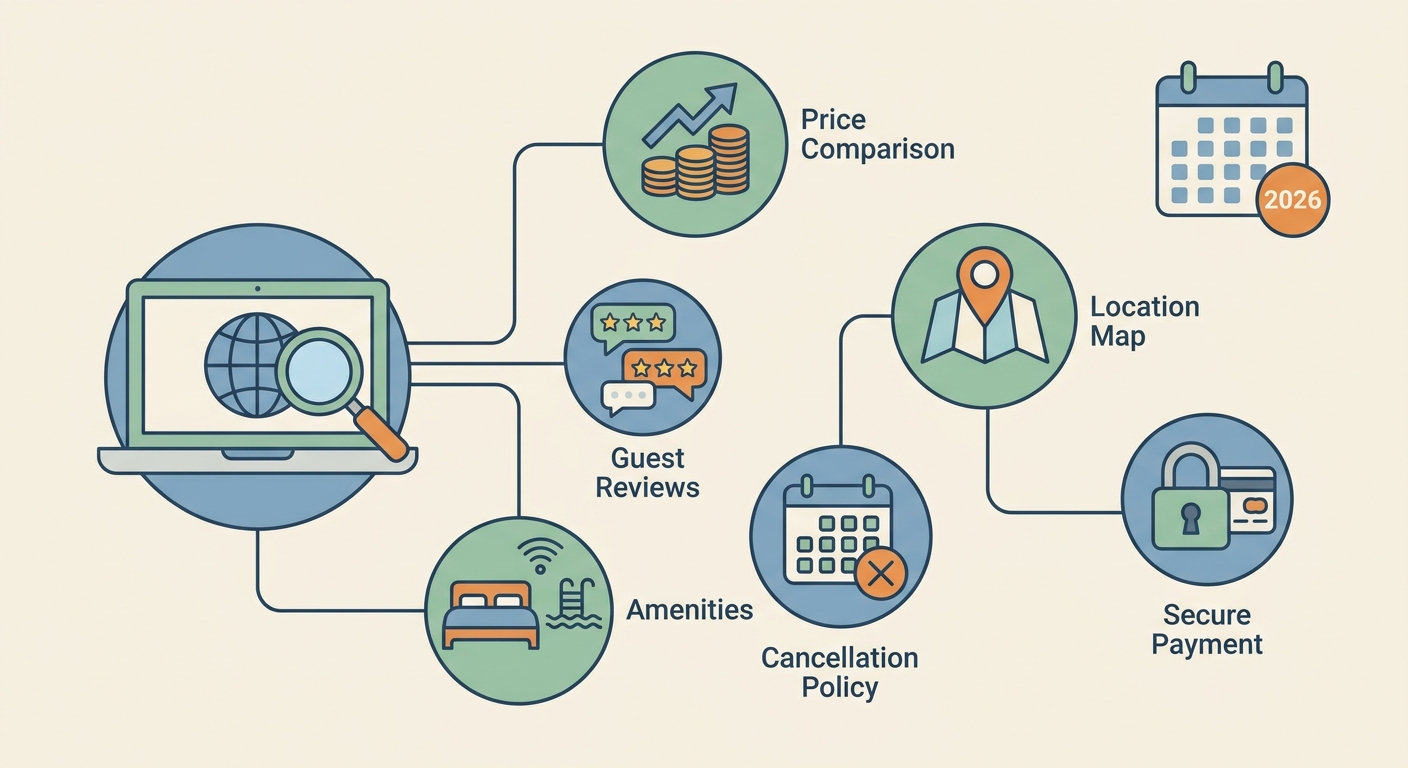
This comprehensive guide will walk you through every critical step of the online booking process. We'll explore how to verify a hotel's actual neighborhood, not just its map pin. You'll learn the strategic pros and cons of booking directly with a hotel versus using a third-party booking site. We will teach you how to decode professional photos, uncover hidden fees, spot fake reviews, and navigate the labyrinth of cancellation policies. By the end, you'll have a complete checklist of what to know before booking a hotel online, what to ask, and what to confirm before you book, ensuring your next trip is memorable for all the right reasons.
How Do You Verify a Hotel's True Location and Neighborhood?
A key part of what to know before booking a hotel online is that you must look beyond the hotel's address and map pin by using tools like Google Maps Street View and reading recent guest reviews that mention the surrounding area. A hotel's advertised location can be technically accurate but practically misleading, placing you far from attractions or in an undesirable neighborhood.
The marketing description might say "steps from the beach" or "city center convenience," but these phrases are subjective. "Steps" could mean a ten-minute walk down a busy road, and "city center" could be on the noisy, less scenic edge of the district. Relying solely on the booking site's map can be a critical mistake, as it doesn't show the neighborhood's character, safety, or ambiance. Your first step should always be to question the advertised convenience and investigate the reality of the location yourself.
Actionable Steps for Location Verification:
- Use Google Maps Street View: This is your most powerful tool. Drop the little yellow Pegman right on the hotel's address. Virtually "walk" around the block. What do you see? Are the neighboring buildings well-maintained, or are they derelict? Is it next to a noisy nightclub, a busy highway, or a serene park? This ground-level view provides unfiltered context that professional photos will never show.
- Check Proximity to Your Priorities: Don't just look for the hotel's location; map the distance to the specific places you plan to visit. Use the directions feature to calculate walking times and public transport routes to key attractions, restaurants, or business meetings. A hotel that looks close on a map might be a 30-minute uphill walk or require a convoluted bus transfer.
- Read Reviews for Location Keywords: When scanning guest reviews, specifically search for terms like "location," "neighborhood," "walkable," "safe," "noise," and "transport." Recent reviews are invaluable. A guest from last month might mention new construction next door or that the advertised "quiet street" has become a late-night hotspot. Pay attention to recurring comments, both positive and negative.
- Research the Neighborhood Independently: Search online for guides or articles about the specific neighborhood or district the hotel is in. Travel blogs, local news sites, and expat forums can offer candid insights into the area's vibe, safety profile, and amenities, helping you understand if it aligns with your travel style.
For example, a family booking a trip to Paris might see a hotel listed in the 18th arrondissement, near Montmartre. While technically close to a famous landmark, a quick Street View tour might reveal it's on a very steep hill, difficult for strollers, or in a part of the neighborhood that feels less safe at night. An independent search would reveal that while some parts of the 18th are charming, others are best avoided by tourists. This level of due diligence prevents surprises and ensures the hotel's location enhances, rather than detracts from, your trip.

What's the Real Difference Between Booking Direct and Using a Third-Party Site?
Booking directly with the hotel often provides better customer service, more flexibility with changes, and access to loyalty program benefits. In contrast, using a third-party Online Travel Agency (OTA) like Expedia, Booking.com, or Agoda is excellent for comparing prices across multiple properties and finding exclusive package deals.
Neither method is universally superior; the best choice depends on your travel priorities. OTAs are powerful research tools, offering a one-stop-shop to survey the market, read aggregated reviews, and identify potential hotels. However, when you book through them, your contract is with the OTA, not the hotel. This can create a frustrating layer of complication if you need to make changes, request a specific room, or resolve an issue. For a deeper dive, you should understand what to know before booking with an OTA. Booking direct establishes a direct relationship with the property, which can be invaluable when you need assistance. The key is to understand the trade-offs between the convenience and price comparison of an OTA and the service and loyalty benefits of a direct booking.
Let's break down the advantages and disadvantages in a clear comparison:
| Feature | Booking Direct with Hotel | Booking with Third-Party OTA |
|---|---|---|
| Customer Service | Direct line to hotel staff for requests, changes, or issues. More likely to accommodate special needs. | You must go through the OTA's customer service first, who then contacts the hotel. Can be slow and inefficient. |
| Loyalty Programs | Earn points, receive elite status benefits (upgrades, late checkout), and use member-only rates. | Typically, you do not earn hotel loyalty points or receive status benefits. Some OTAs have their own reward programs. |
| Room Selection | Often have access to all available room types. Easier to request a specific room location (e.g., high floor, away from elevator). | May have a limited allocation of rooms. Less likely to have requests honored as OTA bookings can be prioritized last. |
| Price | May offer a "Best Rate Guarantee" to match OTA prices. Can sometimes be higher if not running a promotion. | Excellent for comparing prices. Can offer exclusive package deals (flight + hotel) or lower rates due to bulk purchasing. |
| Flexibility | Hotel staff have more authority to bend rules, waive fees, or modify reservations in extenuating circumstances. | Bound by the strict terms and conditions of the OTA booking. Less wiggle room for changes or cancellations. |
A Real-World Scenario: Imagine you booked a non-refundable room for a trip in three months. A week before your stay, a family emergency arises. If you booked directly with the hotel, you can call the front desk manager, explain the situation, and they might offer a credit for a future stay as a gesture of goodwill. If you booked through an OTA, their customer service agent is bound by the policy. They will contact the hotel on your behalf, but the hotel has no direct relationship with you and is less likely to make an exception. You will most likely lose your money.
Actionable Insight: Use a hybrid approach. Start your research on an OTA to compare options and get a feel for pricing. Once you've narrowed down your choices to two or three hotels, visit their official websites. Check if they offer a better rate for members of their free loyalty program or if they have a price-match guarantee. For important trips, trips with uncertain plans, or if you value elite hotel status, booking direct is often the safer and more rewarding choice.

How Can You Decode Hotel Photos and Room Descriptions to Avoid Disappointment?
You must critically analyze professional photos for signs of digital enhancement and cross-reference them with candid traveler photos on review sites. Hotel marketing materials are designed to sell the best possible version of a property, often using photography tricks and vague language that can be misleading.
The images you see on a booking website are the hotel's primary sales tool. They are taken by professional photographers using specialized equipment and techniques, such as wide-angle lenses that make rooms appear significantly larger and more spacious than they are. Photos are often edited to be brighter, more colorful, and blemish-free. Similarly, room descriptions use appealing but often ambiguous terms like "partial ocean view" or "cozy double room." To avoid the classic "what I booked vs. what I got" scenario, you need to become a visual detective and a savvy interpreter of hotel jargon.
Common Photography and Description Traps:
- The Wide-Angle Lens Illusion: This is the most common trick. It distorts perspective to make a small 250-square-foot room look like a spacious suite. Pay attention to the furniture proportions; if a king-sized bed looks small in the photo, the room is likely very compact.
- Strategic Cropping and Angles: A photo of a balcony might be tightly cropped to show a sliver of the ocean while hiding the fact that the primary view is of a noisy air conditioning unit on the neighboring roof. Always be suspicious of photos that don't show the entire view.
- Showing Only the Best Room: Hotels often feature photos of their most recently renovated or premium suite, even for standard room listings. The room you book may be older, more worn, and have a different layout.
- Vague Terminology: Understand what the descriptions really mean. "Ocean view" means you can see the ocean, but it might be from a distance. "Oceanfront" means the room directly faces the ocean. "Cozy" almost always means small. "City view" could be a stunning skyline or a brick wall.
How to Find the Visual Truth:
Your best defense is to seek out user-generated content. Go to review sites like TripAdvisor, Google Reviews, or even the geo-tagged location on Instagram. Search for photos uploaded by actual guests. These unedited, smartphone-quality pictures will show you the room's true size, the actual view from the balcony, the state of the bathroom grout, and the level of wear and tear on the furniture. Look for photos from recent visitors to get the most up-to-date picture of the property's condition.
Example Scenario: You're booking a resort in Cancun. The professional photos show a pristine, empty white-sand beach and a sparkling, deserted pool. The description promises a "tranquil oasis." However, after a quick search of traveler photos on TripAdvisor from the same travel period, you see images of a crowded beach with rows of lounge chairs packed together and a pool full of people. One reviewer even posts a photo of the "partial sea view" room, which primarily overlooks the resort's service entrance. By comparing the marketing materials with reality, you can adjust your expectations or choose a different hotel that better aligns with your desire for tranquility.

What Are the Most Common Hidden Fees and How Can You Uncover Them?
The most common hidden hotel fees are mandatory resort or destination fees, parking charges, and extra costs for amenities like Wi-Fi or breakfast. You can uncover them by carefully reading the fine print during the booking process and, most importantly, by viewing the final price breakdown just before you pay.
The attractive nightly rate advertised on the search results page is rarely the final price you'll pay. Many hotels, especially in tourist-heavy destinations, tack on additional mandatory charges that are not included in the initial quote. These fees can add a significant amount to your total bill, sometimes increasing the cost by 20-30% or more. Being aware of these potential charges and knowing where to look for them is an essential part of what to know before booking a hotel online and is crucial for accurate budgeting and avoiding sticker shock at checkout.
A Checklist of Potential Hidden Costs:
- Resort/Destination Fees: These are the most notorious. They are mandatory daily charges, often ranging from $25 to $75 per night, for a bundle of amenities like pool access, gym use, in-room coffee, or local calls, regardless of whether you use them. They are especially common in places like Las Vegas, Hawaii, and major US cities.
- Parking Fees: Never assume parking is free, especially in urban areas. Hotels can charge $30 to $80+ per night for self-parking or valet services. Always check this cost beforehand if you're driving.
- Early Check-in / Late Check-out Fees: Arriving before the standard 3 PM check-in or wanting to stay past the 11 AM checkout time can incur hefty fees, sometimes equal to half a night's stay.
- Extra Person Fees: Room rates are typically based on double occupancy (two people). If you have a third or fourth person, even a child, the hotel may add a per-person, per-night charge.
- Wi-Fi Charges: While many hotels now offer free basic Wi-Fi, some still charge for it, or they'll offer a slow, free version and charge a premium for a high-speed connection suitable for streaming or video calls.
- Baggage Holding Fees: Some hotels, particularly in major cities, may charge a few dollars per bag to store your luggage before check-in or after check-out.
- In-Room Safe Fee: A small daily fee for using the safe in your room can sometimes be automatically added to your bill.
- Taxes and Tourism Levies: Beyond standard sales tax, many cities impose additional tourism or occupancy taxes that are calculated on the final bill, not always shown upfront.
How to Uncover These Fees: The key is to proceed almost to the final step of the booking process. Most booking websites are required to show you a complete breakdown of all costs, including taxes and mandatory fees, on the final confirmation page before you enter your payment details. Do not click "Confirm" until you have reviewed this breakdown. If you see a "Resort Fee" or "Hotel-Imposed Fee" listed, factor that into your total budget. If you are unsure, call the hotel directly and ask for a complete list of all mandatory fees for your intended dates. This simple phone call can save you hundreds of dollars in surprises.

How Should You Properly Read and Interpret Hotel Reviews?
You should read a large volume of recent reviews, focusing on patterns of complaints or praise rather than individual outlier experiences. Learn to filter for specific keywords relevant to your priorities and be skeptical of reviews that are overly vague, excessively positive, or use generic, repetitive language, as these can be signs of fake reviews.
Guest reviews are a goldmine of information, offering a real-world glimpse into a hotel's quality and service. However, not all reviews are created equal. A single scathing one-star review about a rude clerk might be an isolated incident, just as a glowing five-star review might be written by someone with very different standards than your own. The skill lies in aggregating the data, identifying consistent themes, and understanding the context behind the comments to form an accurate, balanced picture of the property.
A Strategy for Effective Review Analysis:
- Sort by Date, Not by Rating: Always start by reading the most recent reviews first. A hotel's quality can change quickly due to new management, recent renovations, or staffing issues. Reviews from three years ago are largely irrelevant. Focus on feedback from the last 3-6 months.
- Look for Patterns, Not Perfection: No hotel has a perfect record. The key is to identify recurring themes. If one person complains about a slow elevator, it's an anecdote. If ten people in the last month mention only one of three elevators is working, it's a systemic problem. Similarly, if multiple reviewers consistently praise the comfortable beds or the helpfulness of a specific concierge, that's a reliable indicator of quality.
- Filter by Traveler Type: Many booking sites allow you to filter reviews by traveler type (e.g., families, couples, solo travelers, business travelers). Your needs as a family with young children are very different from those of a solo business traveler. Reading reviews from people like you provides more relevant insights. A business traveler might rave about the fast Wi-Fi, while a family might complain about the lack of a kids' menu.
- Read the Middle-of-the-Road Reviews: The most detailed and balanced feedback often comes from three- and four-star reviews. These guests are more likely to provide a nuanced perspective, listing specific pros and cons rather than just venting or gushing. They might say, "The room was clean and the location was great, but the breakfast was overpriced and the pool was smaller than expected."
Spotting Potentially Fake Reviews:
- Overly Generic Praise: Reviews that say "Great hotel! Wonderful stay! Highly recommend!" with no specific details are suspicious. Authentic reviews usually mention a specific aspect they enjoyed, like the rooftop bar or the comfortable bedding.
- Extreme Language: Reviews that use excessive hyperbole, either positive ("the most unbelievably perfect paradise on Earth") or negative ("an absolute nightmare hellhole that ruined my life"), can be red flags.
- Reviewer History: On some platforms, you can click on a reviewer's profile. If they have only ever written one review, or if all their reviews are five-star raves for the same hotel chain, be skeptical.
By applying this critical approach, you move from passively reading reviews to actively analyzing data. This allows you to build a realistic set of expectations and choose a hotel based on a consensus of recent, relevant experiences, not just the marketing hype or a few unrepresentative comments.
Why is Understanding the Cancellation Policy Non-Negotiable?
Understanding the cancellation policy is non-negotiable because it dictates your financial risk if your plans change. A non-refundable booking can mean a total loss of your money, while a flexible policy provides a crucial safety net. This is arguably the most important thing of what to know before booking a hotel online, as mistaking one policy for another is one of the costliest errors you can make.
In the excitement of planning a trip, it's easy to overlook the legal terms and conditions attached to your booking. The cancellation policy is the most important of these. It's a binding agreement that specifies exactly what will happen to your money if you need to cancel or modify your reservation. With travel plans being more unpredictable than ever, booking a room without fully comprehending these terms is like making a significant investment without reading the contract. The allure of a cheaper, non-refundable rate can be tempting, but the potential financial loss often outweighs the initial savings.
Decoding Different Types of Cancellation Policies:
- Free Cancellation: This is the most flexible option. It allows you to cancel your booking without penalty up to a certain deadline, typically 24 to 72 hours before your check-in date. This is ideal when your plans are not yet finalized or when booking far in advance.
- Partial Refund / Cancellation Fee: This policy might state that if you cancel, you will be charged a penalty, such as the cost of the first night's stay or a fixed percentage of the total booking amount.
- Non-Refundable: This is the strictest and usually the cheapest rate. Once you book, you are charged the full amount immediately, and you will not get any money back if you cancel for any reason. This option should only be considered if your travel plans are 100% confirmed and you are willing to accept the risk.
- Book Now, Pay Later: This option allows you to reserve a room without immediate payment. However, it is NOT the same as free cancellation. You still must adhere to the cancellation policy. If you forget to cancel before the deadline, your card on file will be charged the full amount or a penalty fee.
A Costly Mistake Scenario: A couple books a romantic getaway to New York City six months in advance. They find a "great deal" on a hotel that is 20% cheaper than other options and quickly book the non-refundable rate to lock it in. Two months later, one of them gets a new job that requires them to be in a different city on the dates of the trip. When they try to cancel the hotel, they are reminded that their $1,500 booking is completely non-refundable. The $300 they saved upfront has now resulted in a $1,500 loss. Had they paid slightly more for a room with free cancellation, they would have received a full refund.
Actionable Takeaway: Always read the cancellation deadline carefully. Put a reminder in your calendar for a day or two before the free cancellation period ends. For expensive or long-term trips, especially those with non-refundable components, strongly consider purchasing travel insurance. A comprehensive travel insurance policy can reimburse you for non-refundable travel costs, including hotels, if you have to cancel for a covered reason like illness, a family emergency, or severe weather.
What On-Site Amenities and Services Should You Confirm Before Booking?
Before booking, you should confirm the availability, operating hours, and any associated costs for the specific amenities that are important to your stay. Never assume an amenity listed on the hotel's website - like a pool, gym, or airport shuttle - will be open, included in the price, or operating as expected during your visit.
Hotel websites and booking pages often present a long list of amenities to attract guests. However, the mere existence of an amenity does not guarantee its accessibility or quality. The '24/7 fitness center' might be a tiny room with one broken treadmill, the 'sparkling swimming pool' could be closed for maintenance during your entire stay, and the 'complimentary breakfast' might be a pre-packaged muffin and a coffee machine. To avoid disappointment, you need to dig deeper than the checklist of features and verify the details of the services that you actually plan to use.
Key Amenities to Scrutinize:
- Swimming Pool: Is it seasonal? What are the hours? Is it an indoor or outdoor pool? Sometimes pools are closed for private events or have limited hours that might not fit your schedule. A quick email or call to the hotel can confirm its status for your travel dates.
- Breakfast: The term "breakfast included" can mean many things. Is it a full hot buffet, a continental spread (pastries, cereal, fruit), or a grab-and-go bag? Check recent reviews or the hotel's website for specifics to see if it meets your expectations and is worth any extra cost.
- Wi-Fi: Is it free throughout the entire property, or only in the lobby? Is it a reliable high-speed connection, or a slow basic service with a paid upgrade option? For remote workers or those needing to stream, this is a critical detail.
- Parking: As mentioned with hidden fees, it's vital to confirm if parking is on-site or in a nearby garage, the cost per night, and whether it includes in-and-out privileges.
- Airport Shuttle: If a shuttle is advertised, confirm its schedule. Does it run 24/7 or only during limited hours? Do you need to book a spot in advance? Is it complimentary or is there a fee?
- Accessibility: If you or a travel companion requires accessible features, you must call the hotel directly to confirm the specifics. Ask about ramp access, elevator dimensions, roll-in showers, and grab bars. Do not rely on a generic accessibility icon on a booking site.
Scenario for Confirmation: A business traveler chooses a hotel specifically because it lists a "24-hour business center" and a "fitness center." They plan to print a large presentation upon arrival and work out early in the morning. After booking, they decide to call the hotel to double-check. They learn the "business center" is just a single computer in the lobby and the printer is currently out of order. They also discover the fitness center doesn't open until 7 AM, which is too late for their pre-meeting schedule. By making this simple call, they are able to cancel their booking (thanks to a flexible policy) and find a hotel that better suits their essential needs, avoiding significant professional inconvenience.
How Does the Payment Process Work and What Are the Safest Methods?
The hotel payment process typically involves either pre-payment at the time of booking or providing a credit card to guarantee the reservation, with full payment taken at check-in or check-out. The safest method is always to use a credit card, as it offers robust fraud protection and dispute resolution benefits that debit cards and other payment forms lack.
Handing over your payment information online requires a level of trust. Understanding how and when you will be charged, as well as the security implications of your payment method, is crucial for protecting your finances. Hotels use different procedures for securing and charging for a room, from taking the full amount upfront for non-refundable rates to placing a temporary hold on your card for incidentals. Knowing what to expect can prevent confusion and help you manage your travel budget effectively.
Understanding a Hotel's Charging Process:
- Pre-Payment: For non-refundable or advance purchase rates, your card will be charged the full amount of the stay at the moment you click "confirm." This payment is final.
- Guaranteeing a Reservation: For most flexible bookings, the hotel will ask for a credit card to hold the room. They won't charge you for the room itself, but they will verify the card is valid. If you fail to show up or cancel outside the permitted window, this card will be charged the no-show penalty.
- Pre-Authorization Hold: Upon check-in, the hotel will almost always swipe your credit card to place a pre-authorization hold. This is not a charge, but it temporarily freezes an amount of money on your card. The hold covers the estimated total of your stay plus an additional amount for potential incidentals (like mini-bar purchases or restaurant charges), often $50-$100 per day. This amount is unavailable for you to spend until the hold is released after you check out, which can take several days.
Why a Credit Card is Your Best Tool:
Using a credit card instead of a debit card for hotel bookings is one of the smartest travel decisions you can make. If a pre-authorization hold is placed on a debit card, that is real money being frozen in your checking account, which can impact your ability to pay for other things. If it's on a credit card, it only reduces your available credit line. Furthermore, credit cards offer significant consumer protections under laws like the Fair Credit Billing Act. If the hotel overcharges you, fails to provide the service you paid for, or if there's a fraudulent charge, you can dispute the charge with your credit card company, which will investigate on your behalf. These protections are far weaker for debit card transactions.
Safety and Security Tip: Always book on a secure website. Look for "https://" in the URL and a padlock icon in the address bar. Avoid using public Wi-Fi for making any financial transactions, including booking hotels. If you are ever asked to pay via wire transfer, cryptocurrency, or a gift card, it is a major red flag and almost certainly a scam. Stick to reputable booking sites and direct hotel websites, and always pay with a major credit card.
What Should You Do Immediately After Booking to Secure Your Reservation?
Immediately after booking, you must locate your official confirmation email and then call the hotel directly to verbally confirm they have your reservation in their system. This simple two-step process bridges the gap between the online booking agent and the hotel itself, preventing potential issues where a reservation gets lost in translation.
Hitting the 'confirm' button feels like the end of the process, but one final, crucial step remains. Technology is not infallible, and systems between third-party booking sites and a hotel's internal reservation software can sometimes fail to sync properly. A reservation might be confirmed by the OTA but never actually appear on the hotel's end. Showing up at midnight after a long flight only to be told the hotel has no record of your booking is a travel nightmare you can easily avoid with a proactive five-minute phone call.
Your Post-Booking Checklist:
- Scrutinize the Confirmation Email: As soon as it arrives, open and read your confirmation email carefully. Do not just glance at it. Verify every single detail: your name (spelled correctly), the check-in and check-out dates, the room type you selected, the total price, and the cancellation policy. If there are any discrepancies, contact the booking site's customer service immediately to correct them. Save this email in a dedicated travel folder and consider printing a physical copy as a backup.
- Make the Confirmation Call: Wait an hour or two for the reservation to process, then find the hotel's direct phone number (not the central reservations line for a chain). Call the front desk and politely say, "I'd like to confirm a reservation I just made through [Booking Site Name] for [Your Name] arriving on [Your Check-in Date]." Provide them with the confirmation number from your email.
- Confirm Key Details and Add Requests: While you have them on the phone, this is the perfect opportunity to re-confirm critical details and add any special requests. You can ask: "I have a note here for a king bed away from the elevator. Can you confirm you see that request?" or "Could you please confirm the pool will be open during our stay?" This not only verifies your booking but also attaches your specific preferences directly to the reservation in the hotel's own system, increasing the likelihood they will be honored.
The Peace of Mind Scenario: A family books a two-room stay for a wedding through a third-party website. They receive a confirmation email that looks correct. As a precaution, the mother calls the hotel directly. The front desk agent confirms the reservation for the parents' room but says they have no record of the second room for their adult children. It turns out a glitch occurred when the OTA sent the booking details. Because they called a week in advance instead of discovering the problem at check-in, the hotel was able to find and link another room for them, saving the family from a major crisis during an important event.
This final verification step transforms you from a passive customer into an active participant in your travel planning. It ensures you have a confirmed reservation directly with the people who will be checking you in, giving you complete confidence as you head to your destination.
Conclusion: Booking with Confidence in the Digital Age
Booking a hotel online has revolutionized travel, offering unparalleled choice and convenience right at our fingertips. Yet, this ease of use demands a new level of diligence from the modern traveler. The journey from browsing to booking is fraught with potential pitfalls, from misleading photos and confusing location descriptions to costly hidden fees and rigid cancellation policies. As we've explored, simply finding the lowest price is not the ultimate goal; the real objective is to find the best value and ensure the hotel experience you pay for is the one you actually receive.
The key to mastering what to know before booking a hotel online is to adopt a proactive, investigative mindset. It begins with questioning everything. Question the location by using digital tools to walk the virtual streets. Question the price by digging for hidden fees until you see the true total. Question the glowing reviews by seeking out patterns and reading between the lines. Question the professional photos by comparing them with candid shots from fellow travelers. And most importantly, question the terms of your agreement by reading the cancellation policy as if it were a binding legal contract - because it is.
By shifting your approach from a quick transaction to a thoughtful research project, you empower yourself. You learn to leverage the strengths of both third-party agencies and direct hotel websites, to decode marketing jargon, and to protect your financial interests. The final, simple act of calling the hotel to confirm your reservation closes the loop, providing the ultimate peace of mind. Armed with this knowledge, you can navigate the vast digital landscape of travel with confidence, transforming the uncertainty of an online booking into the exciting and assured beginning of a wonderful journey.
Frequently Asked Questions
It is almost always cheaper to book a hotel online in advance than to walk in. Hotels use dynamic pricing models that reward early bookings and often have very high 'rack rates' for last-minute walk-in guests. Booking online allows you to compare prices across multiple platforms, take advantage of promotional deals, and secure your room. A walk-in booking relies on last-minute availability, which is often limited and priced at a premium, especially during busy seasons. The only exception might be an independent motel in a remote area during the off-season, where you might be able to negotiate a rate.
The phrase 'subject to availability' means the amenity is not guaranteed with your booking. It's a disclaimer hotels use for things like room upgrades, early check-in, late check-out, specific room views, or connecting rooms. While you can request these items, the hotel is under no obligation to provide them. Fulfillment depends on the hotel's occupancy and other factors at the time of your arrival. If an amenity is absolutely critical for your stay (e.g., a ground-floor room for mobility reasons), you must call the hotel directly to confirm and have it noted on your reservation, rather than relying on a request made online.
Yes, absolutely. When you book a room, you provide a credit card to guarantee the reservation. This guarantee is a contract. If you do not arrive for your booking and fail to cancel within the period specified by the cancellation policy, the hotel will charge your card a 'no-show' fee. This fee is typically the cost of the first night's stay, but for some non-refundable bookings, it could be the entire cost of the reservation. This is why it is critically important to understand the cancellation policy and cancel your booking in time if your plans change.
There is no single perfect answer, but a general sweet spot is to book around 1-3 months in advance for most destinations. This often provides a good balance of reasonable prices and good availability. Booking too far in advance (6+ months) might mean you miss out on later promotions. Booking last-minute (within two weeks) can sometimes yield deals if hotels are trying to fill empty rooms, but it's a gamble that can backfire with high prices and limited options, especially for popular destinations or during holidays. Always book with a free-cancellation policy when possible to lock in a good rate while retaining flexibility.
A booking reference is typically the number provided by the third-party website (like Expedia or Booking.com) that you used to make the reservation. A hotel confirmation number is the unique code generated by the hotel's own internal reservation system. When you book through a third party, you'll get their reference number first. It's wise to then contact the hotel directly to get their confirmation number. Having the hotel's own number is proof that your booking is successfully in their system and can make check-in or any direct communication with the hotel much smoother.