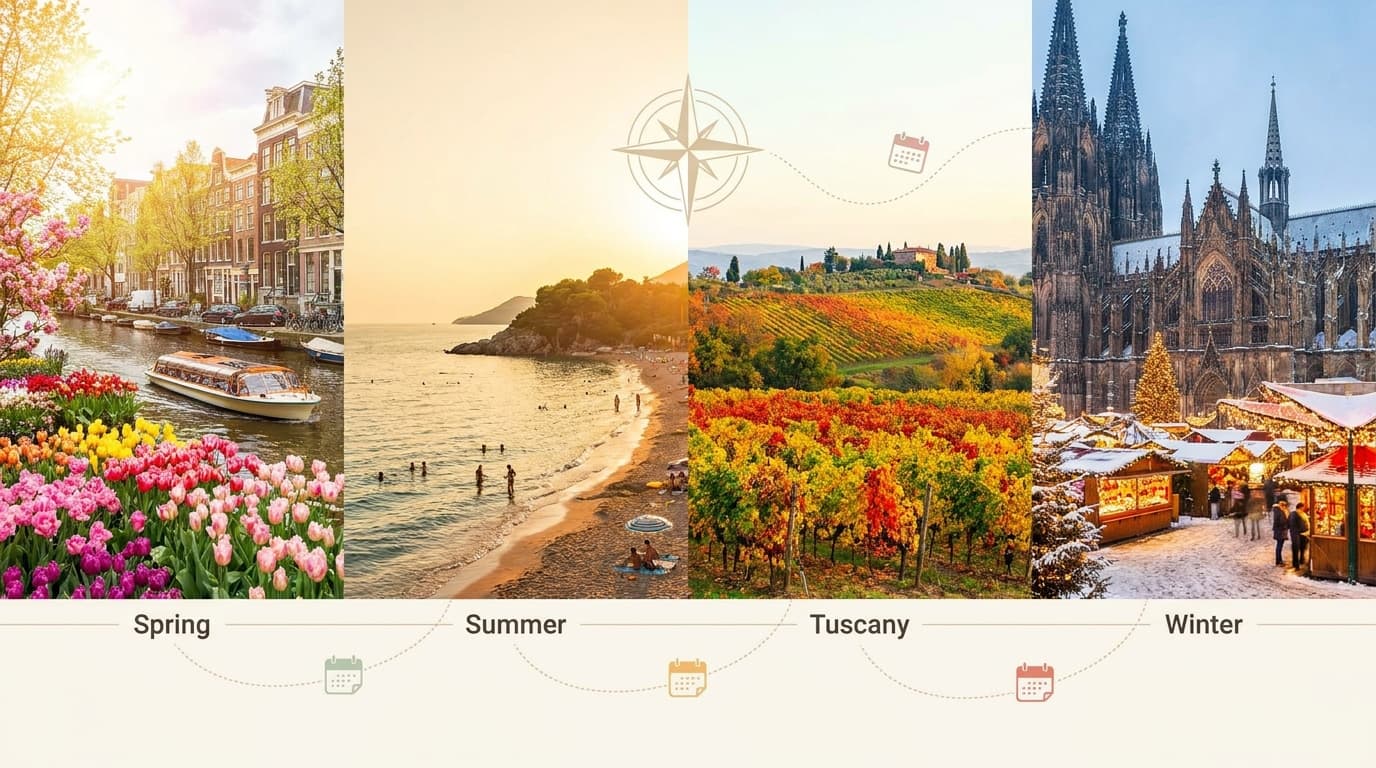
What's the Best Way to Plan a Multi-City European Trip? The Ultimate 2026 Guide
The dream of a multi-city European adventure is a potent one. It's a tapestry woven with images of sipping espresso in a Roman piazza, wandering through the art-filled halls of the Louvre in Paris, and watching the sunset over the canals of Amsterdam. Yet, the moment you move from dreaming to planning, that beautiful tapestry can quickly unravel into a tangled mess of logistics. How many cities? In what order? Train or plane? How much will it all cost? The sheer volume of choices can be paralyzing, turning excitement into anxiety.
So, what's the best way to plan a multi-city European trip? The best way is to adopt a structured, four-phase approach: Dream, Draft, Detail, and Book. This method transforms an overwhelming task into a manageable series of steps, ensuring you build a trip that is not only well-organized but also perfectly tailored to your interests, budget, and travel style. It's about making smart, sequential decisions that build upon each other, preventing backtracking and costly mistakes. This isn't just about connecting dots on a map; it's about designing an experience.
In this comprehensive guide, we will walk you through every stage of that process. You will learn how to choose destinations that resonate with you, craft a geographically logical route that saves time and money, and determine a realistic pace for your journey. We'll dive deep into the crucial debate of trains versus planes, break down how to create a practical budget, and reveal the best digital tools to manage your bookings. By the end, you'll have a clear, actionable blueprint to turn your European dream into a perfectly planned reality.
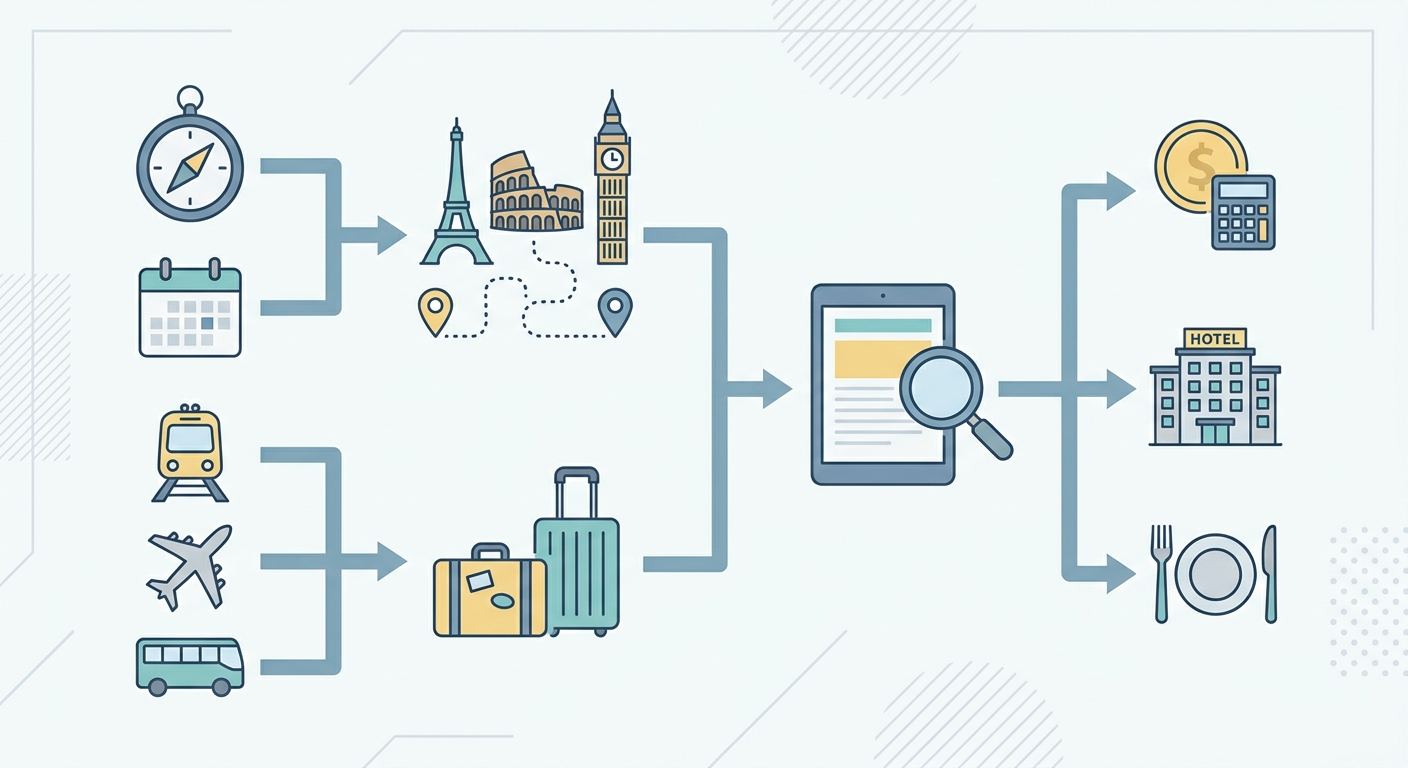
How Do You Even Begin to Choose Your European Cities?
The best way to begin choosing your European cities is to first define your travel 'why'. Before you ever look at a map, you must understand your core interests, desired travel pace, and budget constraints. This inward-looking first step is fundamental when you plan a multi-city european trip, ensuring you select destinations that genuinely excite you, rather than just ticking off a generic list of popular capitals.
Start by asking yourself what kind of experience you're seeking. Are you a history aficionado who wants to walk through ancient ruins and marvel at Renaissance art? Then cities like Rome, Athens, and Florence should be at the top of your list. Are you a foodie dreaming of Michelin-starred dinners and bustling food markets? Consider Lyon, San Sebastián, or Bologna. Perhaps you're an adventurer seeking mountain hikes and outdoor thrills, which would point you towards Interlaken in Switzerland or the fjords of Norway. Or maybe you just want to relax on sun-drenched beaches, making the Greek Islands or Portugal's Algarve region the ideal choice. Creating a 'theme' for your trip can provide incredible focus. For example, a 'Central European Capitals' theme could include Prague, Vienna, and Budapest, which are all conveniently connected and share a rich imperial history.
Next, consider your travel pace. Are you a 'slow traveler' who prefers to immerse yourself in one or two places, or do you thrive on a fast-paced journey, seeing as much as possible? Be honest with yourself. Trying to cram five major cities into a ten-day trip will result in exhaustion and a superficial experience, where you spend more time in transit than in the destinations themselves. A traveler with two weeks might choose a deep dive into Italy (e.g., Rome, Florence, Venice) or a more varied trip covering three well-connected but culturally distinct cities like Paris, Brussels, and Amsterdam. The key is to match the number of cities to your available time, not the other way around.
Finally, your budget will inevitably shape your choices. Western European hubs like London, Paris, and Zurich are significantly more expensive than their Eastern European counterparts like Krakow, Prague, or Lisbon. If you're on a tight budget, focusing on Eastern or Southern Europe can make your money go much further, allowing for a longer trip or more comfortable accommodations. By starting with these foundational elements - interests, pace, and budget - you create a powerful filter. Instead of being overwhelmed by the 44 countries in Europe, you'll have a curated shortlist of cities that align perfectly with the trip you truly want to take. This is the crucial first step in the 'Dream' phase of your planning.

What's the Most Logical Way to Map Your Route?
The most logical way to map your European route is to prioritize geographical efficiency, creating a path that minimizes travel time and eliminates backtracking. Think of your route as a smooth, continuous line on a map, not a zig-zagging spiderweb. This approach saves you precious vacation days, reduces transportation costs, and lowers your overall travel stress.
The first practical step is to visualize your potential cities on a map using a tool like Google Maps. Pin your 'must-visit' and 'would-like-to-visit' locations. Instantly, you'll start to see geographical clusters and logical paths emerge. For instance, if your list includes Lisbon, Madrid, and Barcelona, a linear path through the Iberian Peninsula makes perfect sense. Conversely, a route that jumps from Lisbon to Berlin and then back to Madrid is highly inefficient. This visualization exercise is the cornerstone of the 'Draft' phase of planning. It forces you to confront the reality of distance and the time it takes to traverse it.
A game-changing strategy for efficient routing is booking 'open-jaw' or 'multi-city' flights for your transatlantic or international travel. This means you fly into one European city (e.g., London) and out of another (e.g., Rome). This completely eliminates the need to waste a day and money on a return trip to your starting point just to catch your flight home. For a classic European tour, flying into a northern city like Amsterdam and out of a southern one like Athens, or vice versa, is a classic and highly effective strategy. Most airline booking websites have a 'multi-city' search option that makes this surprisingly easy and often no more expensive than a standard round-trip ticket.
Let's consider a real-world example. A first-time planner wants to see London, Paris, and Rome in 10 days. An illogical route would be booking a round-trip flight to London, traveling to Paris, then Rome, and then having to fly all the way from Rome back to London for the flight home. A far more logical route is to fly into London, take the Eurostar train to Paris, then a flight from Paris to Rome, and finally fly home directly from Rome. This saves nearly an entire day of travel. The key takeaway is to let geography be your guide. Your itinerary should flow naturally from one region to the next, whether it's a circular route (e.g., Munich -> Salzburg -> Vienna -> Prague -> Munich) or a linear one (e.g., Amsterdam -> Berlin -> Prague -> Budapest). This simple principle is the single most important factor in creating a seamless and enjoyable multi-city experience.

How Many Cities Can You Realistically Visit?
To determine how many cities you can realistically visit when you plan a multi-city european trip, you should follow the 'three-night rule' as a baseline: allocate a minimum of three nights for each major city. This gives you two full days for exploration, which is just enough to see the main highlights without feeling completely rushed. Crucially, you must also factor in travel days between cities as partial or full write-offs.
The biggest mistake travelers make is underestimating the impact of transit time. A two-hour train ride is never just two hours. It involves packing up, checking out of your accommodation, navigating to the train station, waiting for the train, the journey itself, arriving in a new city, navigating to your new accommodation, and checking in. This entire process can easily consume half a day or more. Therefore, a 'travel day' is not a sightseeing day. Treating it as such leads to burnout and a feeling of constantly being on the move. When you schedule your trip, physically block out these travel days on your calendar to get a true sense of your available exploration time.
Let's break this down with practical examples based on trip duration:
- For a 10-day trip: With travel days to and from Europe, you likely have 8 usable nights. Applying the three-night rule, you can comfortably visit two major cities (e.g., 4 nights in Paris, 4 nights in Amsterdam) with one travel day in between. Trying to squeeze in a third city would leave you with only two nights in each, which means only one full day of sightseeing - a frantic and unsatisfying pace.
- For a 2-week (14-day) trip: This is a popular duration and offers more flexibility. With roughly 12-13 nights on the ground, you can comfortably fit in three, or even four, cities if they are close together. A classic three-city itinerary could be London (4 nights), Paris (4 nights), and Rome (4 nights), with two travel days. A four-city itinerary might work if the destinations are tightly clustered, like Prague (3 nights), Vienna (3 nights), and Budapest (3 nights), connected by short train rides, leaving a couple of extra nights to add to your favorite spot.
- For a 1-month trip: This longer timeframe allows for a much deeper and more varied experience. You could comfortably visit 5 to 7 cities, mixing major hubs with smaller towns. You could spend a full week in a large city like Berlin, then take shorter 3-4 night stops in places like Krakow, Munich, and Zurich. The luxury of time allows you to move beyond the 'greatest hits' and adopt a more relaxed pace.
Ultimately, the actionable insight is to prioritize quality over quantity. It is far more memorable to truly experience three cities than to have a blurry, rushed memory of five. Look at your total number of nights in Europe, subtract the cities you want to visit (each representing at least three nights), and then subtract the number of travel days (one less than the number of cities). If you're left with a positive number, your plan is realistic. If you're in the negative, it's time to cut a destination. This simple formula will save you from the most common planning pitfall: over-scheduling.
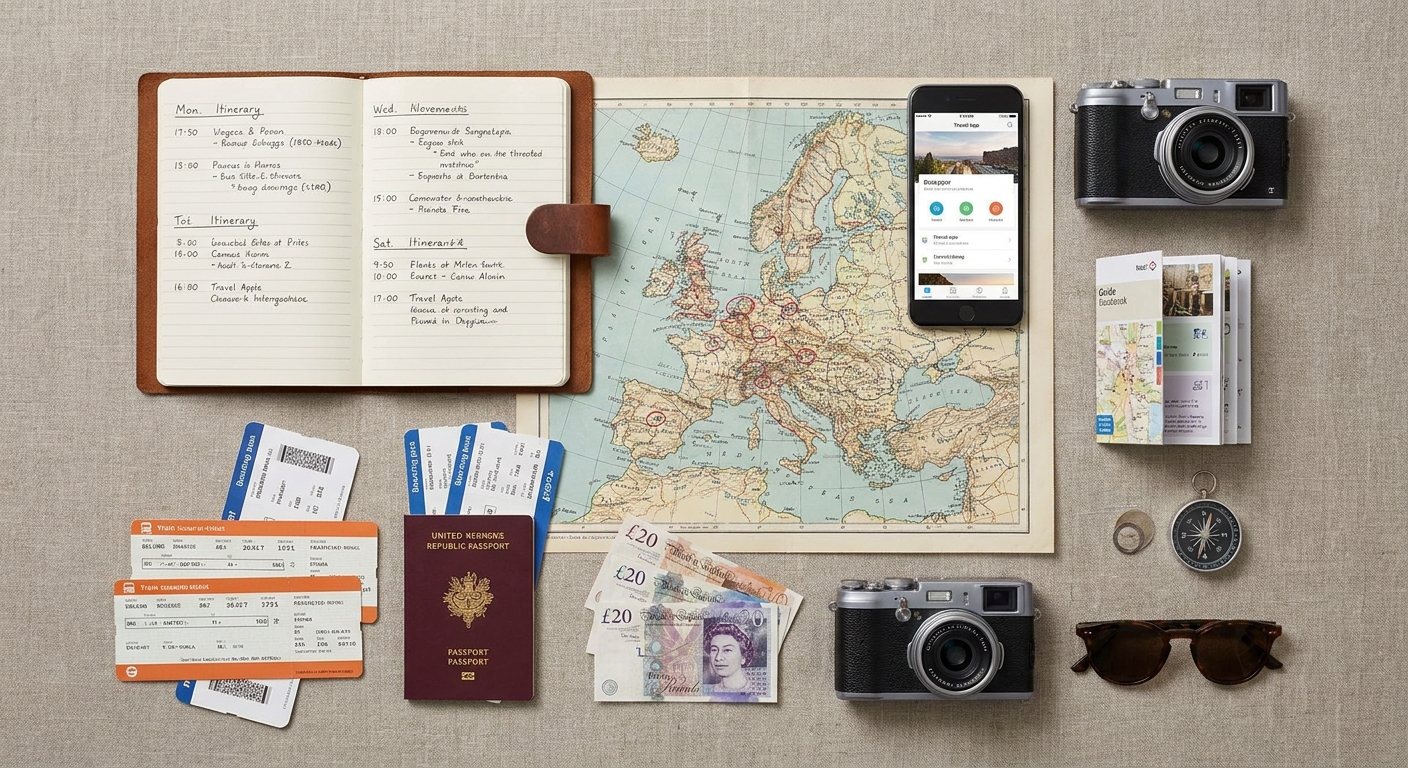
Is It Cheaper to Fly or Take a Train Between Cities in Europe?
As a general rule, trains are often the better and more cost-effective option for journeys under five hours, while budget flights are superior for longer distances. However, the 'cheapest' option depends heavily on the specific route, how far in advance you book, and hidden costs like baggage fees and airport transfers.
Trains offer several distinct advantages for shorter to medium-distance travel. Their biggest selling point is convenience. Train stations are almost always located in the city center, whereas airports are typically miles outside of town. This means you can walk out of your hotel and be at the station in minutes, saving significant time and money on expensive airport taxis or shuttles. Furthermore, the security process is much faster and less intrusive, and luggage allowances are far more generous. The price you see is often the price you pay. The journey itself can be part of the experience, offering scenic views of the European countryside from a comfortable seat. For routes like Paris to Brussels (under 2 hours) or Florence to Rome (around 1.5 hours), the train is unequivocally the superior choice in terms of both time and overall cost.
On the other hand, for spanning larger distances, such as traveling from Barcelona to Amsterdam or Lisbon to Rome, flying is the only practical option. Europe is served by a vast network of budget airlines like Ryanair, EasyJet, and Wizz Air, which can offer incredibly low base fares, sometimes as cheap as a pizza. However, these low prices come with caveats. You must be vigilant about extra fees for everything from checked baggage and seat selection to printing a boarding pass at the airport. When you factor in the cost of getting to and from remote airports, these 'cheap' flights can sometimes end up costing more than a train ticket. The key to securing the best deals is to book several months in advance and pack light to avoid baggage fees.
To make the best decision, you must compare the total journey time and total cost. For a trip from Amsterdam to Berlin, a flight might be 1.5 hours, but add 1 hour to get to Schiphol Airport, 2 hours for security and waiting, and 1 hour to get from the Berlin airport to the city center, and your total travel time is 5.5 hours. A direct train, however, might take about 6 hours from city center to city center, with far less hassle. In this scenario, the costs and time are comparable, so the decision comes down to personal preference. The actionable takeaway is to use a comparison platform like Omio or Rome2Rio. These tools show you all the options - train, plane, and bus - side-by-side, allowing you to compare the true door-to-door travel time and all-in cost for your specific route.
Comparison: Train vs. Plane vs. Bus in Europe
| Factor | High-Speed Train | Budget Airline | Inter-City Bus |
|---|---|---|---|
| Best For | Journeys 2-5 hours, city-center convenience | Long distances (5+ hours by train), crossing water | Extreme budget travel, routes not served by train |
| Cost | Moderate to High (book early for discounts) | Low base fare, but many extra fees | Very Low |
| Total Time | Fastest for short/medium distances (door-to-door) | Fastest for long distances, but add 3-4 hours for airport logistics | Slowest |
| Convenience | Very High (city-center stations, easy security) | Low (remote airports, long security lines) | Moderate (stations can be central or peripheral) |
| Comfort | High (spacious seats, ability to walk around) | Low (cramped seating) | Low to Moderate |
| Luggage | Generous, usually 2 large bags + carry-on included | Very restrictive, high fees for checked bags | Usually one checked bag included, varies by company |

How Do You Create a Realistic Budget for a Multi-City Trip?
The most effective way to create a realistic budget for a multi-city European trip is to break it down into four distinct categories: Pre-Trip Major Costs, Inter-European Transport, Accommodation, and Daily Spending. By estimating costs for each bucket separately, you can build a comprehensive financial picture and avoid surprise expenses that can derail your plans.
First, tackle the Pre-Trip Major Costs. This category is dominated by your round-trip or multi-city flights to and from Europe. This will likely be your single largest expense. Learning the best strategies to find cheap flights is crucial, so use tools like Google Flights or Skyscanner and start looking 3-6 months in advance to get a sense of average prices. This category also includes essential pre-trip purchases like travel insurance (non-negotiable), any necessary visas, and perhaps a new piece of luggage or travel gear.
Second, budget for Inter-European Transport. This is the cost of moving between your chosen cities. Research the specific train or flight routes you identified in your 'Draft' phase. Use sites like Omio or The Trainline to get real-time price estimates for train tickets and check budget airline websites for flights. Remember that train prices often increase significantly closer to the travel date, so booking in advance can lead to substantial savings. For a three-city trip, you'll need to budget for at least two major journeys. For example, a Eurostar from London to Paris and a flight from Paris to Rome.
Third is Accommodation. This cost can vary dramatically based on your travel style. Are you a backpacker content with hostels, or do you prefer the comfort of private hotel rooms or Airbnbs? A dorm bed in a Lisbon hostel might cost €30 per night, while a mid-range hotel in Paris could easily be €200. A good strategy is to set an average nightly budget. For a mid-range traveler, aiming for an average of €100-€150 per night is a reasonable starting point for most of Western Europe. Multiply this by the number of nights on your trip to get your total accommodation cost. Use sites like Booking.com or Hostelworld to research prices in your specific cities.
Finally, and most importantly, estimate your Daily Spending. This covers everything else: food, local transport (metro, buses), museum tickets, attractions, and miscellaneous purchases. This is the most flexible part of your budget. A good average for a mid-range traveler in Western Europe is between €75-€100 per person per day. This would allow for a mix of eating at cafes and casual restaurants, visiting one or two paid attractions, and using public transport. In cheaper destinations in Eastern Europe, this could be closer to €50-€60. To create your total budget, simply sum the estimates from these four categories. Always add a 10-15% contingency fund for unexpected costs. This structured approach moves budgeting from a vague guess to a concrete, actionable plan.
What Are the Best Tools for Booking Flights, Trains, and Accommodation?
The best tools for booking your multi-city trip are a combination of powerful aggregators for comparison and direct booking with providers for better customer service. For initial research and price comparison, use sites like Google Flights, Omio, and Booking.com. For the final purchase, booking directly with the airline, train company, or hotel is often the safest bet.
For flights, especially your main international ticket, start with an aggregator like Google Flights or Skyscanner. Their power lies in their flexibility. You can use the 'Multi-City' search function to easily price out open-jaw tickets (e.g., flying into London, home from Rome). Their calendar views show you the cheapest days to fly, and you can set up price alerts for your desired route. These tools scan hundreds of airlines and online travel agencies (OTAs) to find the best deals. However, once you find a flight you like, it's often wise to go to the airline's official website (e.g., Delta, Lufthansa) to book it directly. If there are any changes or cancellations, dealing with the airline's customer service is almost always easier than going through a third-party OTA.
When it comes to booking trains and buses between your European cities, platforms like Omio and The Trainline are invaluable. Europe's train network is fragmented, with different national operators in each country (e.g., Deutsche Bahn in Germany, Trenitalia in Italy). These aggregator sites bring all the options into one user-friendly interface. You can compare train versus bus for a specific route, see all the available departure times, and book your ticket in English with a credit card. They simplify a potentially confusing process. While they sometimes add a small booking fee, the convenience and clarity they provide are well worth it for most travelers.
For accommodation, the landscape is dominated by a few key players. Booking.com is arguably the most comprehensive platform, offering everything from hostels and guesthouses to luxury hotels and apartments. Its powerful filtering system and map view are essential for finding a place in your desired neighborhood and price range. For travelers on a tighter budget or those seeking a more social atmosphere, Hostelworld is the go-to resource, with extensive reviews and ratings specifically for hostels. Similar to flights, once you've found a hotel you like, it can be beneficial to check its own website. Sometimes they offer slightly better rates or small perks like free breakfast for booking direct. The key takeaway is to use a two-step process: use aggregators for broad searching and comparison to find the best options, then make an informed decision about whether to book through the aggregator for convenience or directly with the provider for potentially better service and perks.
How Should You Pack for a Trip with Multiple Climates and Activities?
The best way to pack for a multi-city European trip with varying climates is to embrace the art of layering and create a versatile capsule wardrobe. This means selecting a small number of high-quality, mix-and-match pieces that can be combined in different ways to suit any weather or occasion. The goal is to pack light, ideally in a carry-on-sized bag, to maximize mobility and minimize hassle.
The foundation of this strategy is the layering system. Instead of packing a bulky coat for a cool city and light dresses for a warm one, you pack items that work together. This typically involves three types of layers. First, a base layer of comfortable t-shirts and long-sleeved shirts made from breathable materials like merino wool or moisture-wicking synthetics. Second, a mid-layer for warmth, such as a fleece jacket, a cashmere sweater, or a packable down vest. Finally, a waterproof and windproof outer shell or trench coat. With these three layers, you can handle a wide range of temperatures. On a warm day in Lisbon, you might wear just a t-shirt. On a cool, rainy evening in Amsterdam, you can wear all three layers and stay comfortable and dry.
When selecting your wardrobe, stick to a neutral color palette (e.g., black, navy, grey, beige) for your main items like trousers, jackets, and shoes. Then, add pops of color with a few scarves, tops, or accessories. This ensures that almost every item of clothing you pack can be worn with every other item, dramatically increasing the number of possible outfits from a limited selection. For a two-week trip, a sample capsule wardrobe might include: two pairs of versatile trousers or jeans, one skirt or dress, five to seven tops, one sweater, one fleece or mid-layer, one waterproof jacket, and one or two scarves. The most important item is footwear: bring one pair of extremely comfortable, broken-in walking shoes. You will be walking far more than you expect. A second pair of slightly dressier flats or loafers can be included for evenings.
To make this all fit, packing cubes are a non-negotiable game-changer. These small zippered bags allow you to compress your clothes and organize your suitcase into neat compartments (e.g., one for tops, one for bottoms, one for underwear). This not only saves space but also makes it easy to find what you need without destroying your perfectly packed bag every time you arrive in a new city. The final, crucial piece of advice is to do a trial pack a week before you leave. Lay everything out on your bed, and be ruthless. If you hesitate on an item and think, 'I might wear this,' leave it behind. A lighter bag is the greatest gift you can give yourself on a multi-city European journey.
What Common Mistakes Should First-Time Planners Avoid?
The most common and detrimental mistake first-time planners make is over-scheduling their itinerary, driven by a fear of missing out. This manifests as trying to cram too many cities into too short a time, leading to exhaustion and a superficial travel experience. Avoiding this and a few other key pitfalls is crucial for a successful trip.
Here are the five most common mistakes to avoid:
The 'One Day Per City' Trap: This is the cardinal sin of European travel planning. Seeing a list that says 'Rome - 1 Day, Florence - 1 Day' is a recipe for disaster. As discussed earlier, travel between cities consumes a significant portion of a day. Arriving in a city in the afternoon and leaving the next morning doesn't count as 'seeing' it. You'll spend your entire trip in a blur of train stations and airports, with no time to immerse yourself in the culture, wander aimlessly, or discover hidden gems. Stick to the 'three-night rule' as a minimum for major cities.
Forgetting the 'Hidden' Travel Day: Planners often look at a 2-hour flight and think it's a quick hop. They fail to budget for the total transit time: getting to the airport, security checks, boarding, the flight itself, deplaning, baggage claim, and traveling to the new hotel. This 'hidden' time adds up to at least 4-5 hours for even the shortest flight. Always assume a travel day is primarily for transit, with perhaps a low-key dinner or evening walk as a bonus, not a full day of sightseeing.
The Geographical Zig-Zag: This mistake happens in the 'Draft' phase when a planner chooses cities based on appeal without looking at a map. An itinerary like Paris -> Rome -> Amsterdam makes no geographical sense. It involves a long flight south followed by another long flight north, wasting an entire day and hundreds of dollars in unnecessary travel. A logical route (e.g., Amsterdam -> Paris -> Rome) follows a smooth geographical progression and is infinitely more efficient.
Ignoring Booking Details: In the rush of booking, small details get missed with big consequences. This includes booking a flight from the wrong airport (Paris has three!), spelling a name incorrectly on a ticket, or booking a hotel for the wrong month. Budget airlines are notoriously unforgiving with name changes, and many bookings are non-refundable. The actionable takeaway is to slow down during the 'Book' phase. Double-check every date, time, airport code, and name before you click 'confirm'.
Not Planning for Downtime: A packed itinerary with back-to-back museum visits, tours, and activities from dawn till dusk leads to burnout. Europe's greatest joys often come from unplanned moments - sitting at a cafe for two hours, getting lost in a charming neighborhood, or simply resting your feet in a park. Build empty blocks of time into your daily schedule. This 'planned spontaneity' ensures you have the energy and mental space to truly enjoy your surroundings rather than just checking items off a list.
How Can You Manage Your Itinerary and Bookings While Traveling?
The best way to manage a complex multi-city itinerary while on the road is to use a dedicated trip management app, such as TripIt or Google Travel. These digital tools act as a central hub, automatically consolidating all your flight, hotel, train, and rental car confirmations into a single, chronological master itinerary that is accessible both online and offline.
The magic of these apps is their simplicity. Once you've set up an account, you simply forward your confirmation emails (from airlines, hotels, train lines, etc.) to a specific email address provided by the app. The app's technology then parses these emails, extracts the critical information - flight numbers, departure times, hotel addresses, confirmation numbers - and organizes it all into a clean, easy-to-read timeline. This eliminates the frantic search through your inbox for that one crucial booking number while standing at a check-in counter. For example, your itinerary for 'Tuesday' might show your 8:00 AM hotel checkout, the address and directions to the train station, your 10:15 AM train ticket details, and the address and check-in time for your next hotel, all in one place.
Beyond consolidation, these tools offer other powerful features. They often provide real-time flight alerts, notifying you of delays or gate changes. They can store important documents like passport copies and contact numbers. Crucially, most of the core itinerary information is available offline, which is a lifesaver when you've just arrived in a new country and don't yet have Wi-Fi or a local SIM card. Google Travel is seamlessly integrated with Gmail, automatically creating trips from bookings found in your inbox, making it an effortless option for Google users.
While a digital organizer is primary, it's wise to have a backup system. This could be a simple Google Doc or a note on your phone with a plain-text list of all your confirmation numbers, addresses, and contact details. It's also highly recommended to have physical printouts of your most critical documents: your passport, your flight ticket home, and perhaps your first night's hotel reservation. This redundancy protects you in the rare case of a dead phone battery or a tech glitch. By combining the power of a centralized app with a simple, reliable backup, you create a robust system that keeps you organized and stress-free, allowing you to focus on enjoying the journey rather than managing its logistics.
In conclusion, a successful multi-city European adventure is not the result of luck, but of knowing how to properly plan a multi-city european trip. By breaking down the monumental task into the four distinct phases of Dream, Draft, Detail, and Book, you transform an overwhelming challenge into a series of achievable steps. It begins with introspection - understanding your own travel desires and constraints to choose destinations that truly resonate with you. It then moves to the logical, map-based exercise of crafting an efficient route that respects geography and saves your two most valuable resources: time and money.
The journey continues with a commitment to realism. This means accepting that you cannot see everything and that a slower pace with fewer cities leads to a richer, more memorable experience. It involves a clear-eyed approach to budgeting, where you account for all potential costs upfront, and a strategic selection of transportation that balances speed, cost, and convenience. From the macro decision of flying open-jaw to the micro decision of packing in layers, each choice builds upon the last to create a seamless and enjoyable trip.
Ultimately, the 'best way' to plan your trip is the way that empowers you to travel with confidence. It's about front-loading the logistical work so that when your feet are finally on European soil, you can be present in the moment. You can savor the flaky crust of a Parisian croissant, stand in awe of the Colosseum's ancient grandeur, and wander without a fixed plan, knowing that the underlying structure of your journey is solid. The detailed planning you do beforehand is not a restriction; it is the very thing that grants you the freedom to fully immerse yourself in the magic of your European adventure.
Frequently Asked Questions
The '3-day rule,' often cited as the '3-night rule,' is a guideline suggesting you spend a minimum of three nights in any major city you visit. This provides two full, uninterrupted days for exploration. The first day is often partially consumed by arrival and check-in, while the last day involves packing and departure. Following this rule helps prevent travel burnout and ensures you have enough time to see the main attractions, explore a neighborhood, and enjoy a few nice meals without feeling constantly rushed. It's a simple way to prioritize depth over breadth in your travel itinerary.
A Eurail pass is worth it only in specific scenarios, typically for travelers planning frequent, long-distance, or spontaneous train journeys across multiple countries. For most planned multi-city trips with 2-4 stops, it is almost always cheaper to buy point-to-point tickets in advance directly from national rail operators. A pass offers flexibility, but this comes at a premium price. To determine its value, you must price out your individual train legs and compare the total cost to the price of the pass, also factoring in mandatory seat reservation fees that apply to many high-speed trains even with a pass.
For the best balance of price and availability, you should book different components of your European trip at different times. Book international flights 3 to 6 months in advance for optimal pricing. Accommodation, especially in popular cities or during peak season, should also be booked in this timeframe. For inter-city high-speed trains, booking 2 to 3 months ahead often secures the best promotional fares, as prices rise sharply closer to the travel date. Last-minute planning is possible but will almost always result in significantly higher costs for both transport and lodging.
The cheapest months to travel to Europe are typically during the 'shoulder' seasons and the off-season. This includes January through March, and October through November. During these periods, airfare and accommodation prices are at their lowest due to decreased demand. You'll also encounter fewer crowds at major attractions. While the weather will be cooler and potentially wetter, the cost savings can be substantial. The most expensive time to visit is the peak summer season from June to August, along with the Christmas holiday period in December.
While many European countries use the Euro (€), several do not, such as the UK (Pound), Switzerland (Franc), and the Czech Republic (Koruna). The best approach is to use a credit card with no foreign transaction fees for most purchases. For cash, avoid airport currency exchanges. Instead, use an ATM upon arrival to withdraw a small amount of local currency for minor expenses. Inform your bank of your travel dates to prevent your cards from being frozen. Using a credit card gives you the best exchange rate, and carrying minimal cash reduces risk.