How to Book the Best Tours and Activities for Your Trip: A Comprehensive Guide
The difference between a good trip and an unforgettable one often lies in the experiences you have. A perfectly planned itinerary can fall flat if your guided tour is overcrowded, your cooking class is uninspired, or the "must-see" attraction is sold out. In a world of endless options, from global booking platforms to local guides on Instagram, the process of choosing and booking activities has become a daunting task. Knowing how to book tours and activities effectively is the key to sifting through the noise to find experiences that truly match your travel style and deliver on their promises.
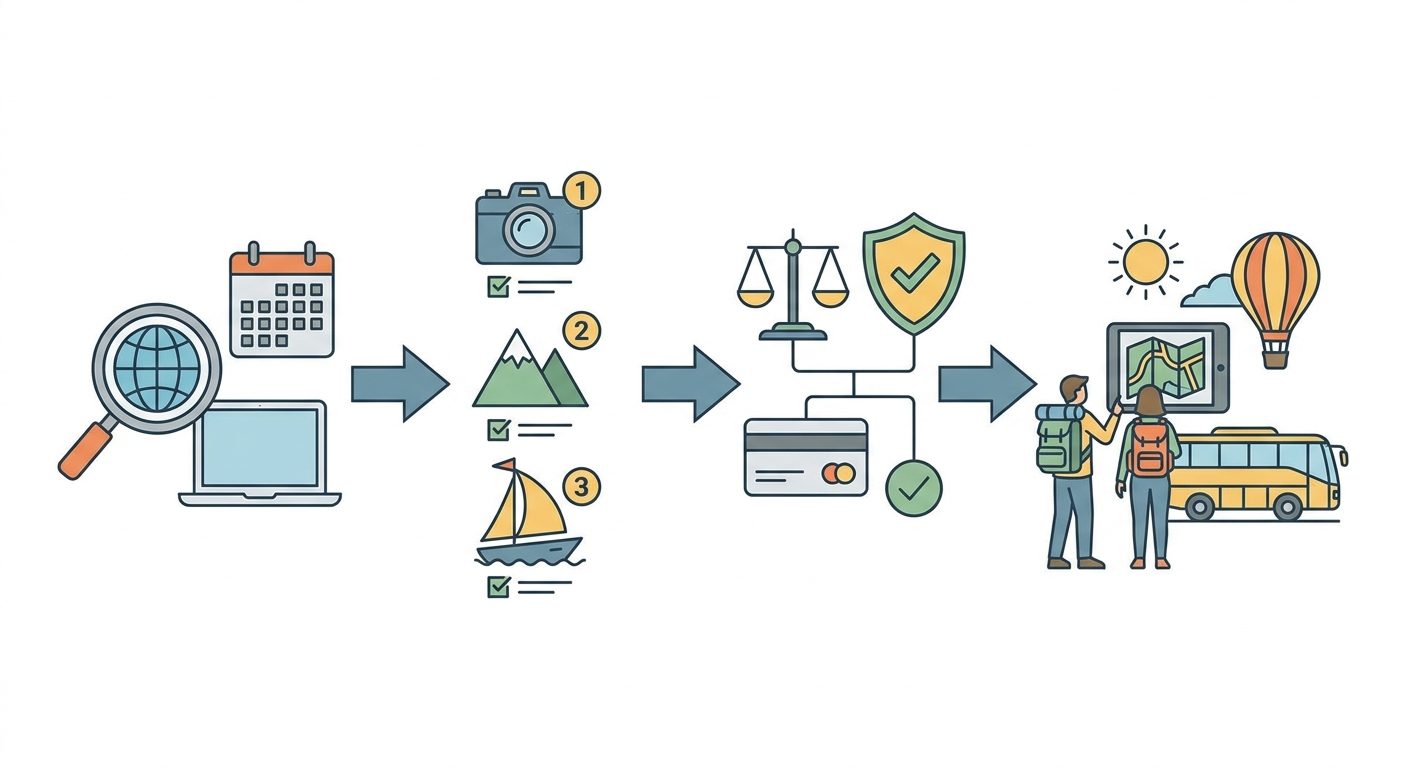
The best way to book tours and activities is to follow a structured, multi-step process. This involves first identifying your personal travel style, then leveraging a mix of large online travel agencies (OTAs), niche booking platforms, and direct local contacts to find options. From there, it's crucial to critically vet reviews, understand the fine print of what's included, and strategically decide whether to book in advance or upon arrival. This methodical approach transforms a potentially stressful task into an exciting part of your trip planning, ensuring you secure the best experiences without falling for common tourist traps.
This comprehensive guide will walk you through that exact process. We will deconstruct every stage of booking your trip's activities, from initial research to managing your itinerary and handling any issues that may arise. You'll learn how to navigate the world's biggest booking sites, uncover hidden gems, read between the lines of customer reviews, and build a balanced itinerary that combines pre-planned highlights with room for spontaneous discovery. Get ready to stop guessing and start planning your adventures with confidence.
Why is Pre-Planning Your Activities More Important Than Ever?
Pre-planning your activities is more important than ever because it saves you significant time and money, and most importantly, it secures your spot for high-demand experiences that frequently sell out. In the current travel landscape, the casual "show up and see" approach often leads to disappointment, long queues, or inflated last-minute prices.
The era of spontaneous, unplanned travel has faced a significant challenge in recent years. A surge in global travel demand means more people are competing for the same popular activities. Attractions like the Anne Frank House in Amsterdam or Alcatraz in San Francisco are often booked solid for weeks, if not months, in advance. Arriving with the hope of buying a ticket on the day is no longer a viable strategy for these iconic sites. Pre-booking is the only way to guarantee your entry and avoid the profound disappointment of missing out on a key part of your trip.
Furthermore, many tour operators and attractions now use dynamic pricing models, similar to airlines. Prices can fluctuate based on demand, seasonality, and how far in advance you book. Booking early often locks in a lower price, protecting you from surge pricing as your travel dates approach. This financial benefit is compounded by the time you save. Instead of spending precious vacation hours standing in ticket lines or scrambling to find an available tour, you can arrive with your tickets in hand, ready to enjoy the experience. This time can be better spent exploring a local neighborhood, enjoying a longer lunch, or simply relaxing.
Pre-planning also provides crucial structure to your itinerary, allowing for more efficient travel. Knowing you have a 10 AM walking tour in one part of the city and a 3 PM museum slot in another allows you to plan your transport, meals, and other smaller activities around these fixed points. This logistical advantage reduces stress and helps you make the most of every day. While spontaneity is still a wonderful part of travel, a framework of pre-booked anchor activities ensures your must-do experiences are secured, leaving the in-between moments open for delightful, spontaneous discoveries. This balance is a core principle of how to book tours and activities for a modern trip.

How Do You Define Your "Travel Style" to Find the Right Activities?
You can define your travel style to find the right activities by honestly assessing four key elements: your interests, your budget, your desired physical activity level, and your preferred pace. Understanding these pillars helps you filter out unsuitable options and focus on experiences that will genuinely resonate with you, ensuring a more fulfilling trip.
Your travel style is your personal blueprint for adventure. It's about recognizing what truly excites and energizes you. Start by considering your core interests. Are you a history buff who would rather spend a day in a museum than on a beach? A foodie who dreams of market tours and cooking classes? Or an adrenaline junkie looking for hiking, diving, or zip-lining? Being specific is key. Instead of just "I like food," think "I want to learn how to make authentic pasta from a local in Bologna." This clarity immediately narrows your search to more relevant and satisfying activities.
Next, evaluate your budget and physical comfort zone. Your budget dictates whether you're looking at private luxury tours or free city walking tours. There's no right or wrong answer, but being realistic prevents you from booking an expensive yacht trip that strains your finances or a cheap but overcrowded bus tour that you won't enjoy. Similarly, be honest about your physical limits. A 10-mile mountain hike might sound amazing in theory, but if you're not an active hiker, it could ruin a day of your vacation. Conversely, if you're highly active, a slow-paced bus tour might feel restrictive and boring. Choose activities that match your actual fitness level, not your aspirational one.
Finally, consider your preferred pace. Do you thrive on a packed itinerary, seeing as much as possible from dawn till dusk (a "Maximizer")? Or do you prefer a more relaxed approach, focusing on one or two key experiences per day with plenty of downtime (a "Relaxer")? A Maximizer might book a full-day trip covering three ancient sites, while a Relaxer would choose a leisurely, in-depth tour of just one. Acknowledging your pace helps you avoid burnout or the feeling of a wasted day. By combining these four elements - interests, budget, physicality, and pace - you create a clear profile that acts as a powerful filter, making it infinitely easier to find and book the perfect activities for your unique travel style.

What Are the Best Platforms for Booking Tours and Activities Online?
The best platforms for booking tours online fall into three main categories: large aggregators like Viator and GetYourGuide for the widest selection, niche platforms like Airbnb Experiences for unique local encounters, and direct bookings with local operators for potentially better prices and customization. The ideal choice depends on the type of experience you are looking for, as a key part of learning how to book tours and activities is matching the right platform to your travel style.
Large Online Travel Agencies (OTAs) or aggregators are the giants of the industry. Platforms like Viator (owned by Tripadvisor), GetYourGuide, and Klook (popular in Asia) are essentially massive marketplaces. Their primary strength is their sheer volume and variety. You can find almost anything here, from skip-the-line tickets for the Louvre to multi-day desert treks. They offer a centralized booking system, multi-language support, and often have generous cancellation policies (typically 24-hour free cancellation), which provides flexibility. The user reviews are a huge asset, offering social proof and insights from thousands of travelers. The downside is that they are middlemen; the experience can sometimes feel less personal, and a portion of your payment goes to the platform rather than entirely to the local guide or company. For a deeper dive into two of these giants, see our complete Klook vs Viator (2026) comparison.
Niche platforms cater to specific interests and often provide more authentic experiences. Airbnb Experiences is a prime example, focusing on activities hosted by locals, such as a pottery class in a home studio or a guided street art tour with a local artist. These tend to be small-group or private affairs that offer a deeper connection to the destination. Similarly, platforms like Eatwith specialize in culinary experiences, connecting travelers with local hosts for dinner parties, cooking classes, and market tours in their own homes. The advantage is uniqueness and authenticity. The potential drawback is a more limited selection and sometimes less standardized quality control compared to the major OTAs.
The third option is booking directly with local tour operators. This requires more research, often involving digging through travel blogs, local tourism board websites, or social media to find recommended local guides and companies. The primary benefit is that 100% of your money supports the local business. It also opens the door for customization; you can often communicate directly with the guide to tailor a tour to your specific interests. You might even find a better price by cutting out the middleman's commission. However, this method comes with more risk. Payment security may be less robust, cancellation policies can be stricter, and there's no central platform to mediate if something goes wrong.
Comparison of Major Tour Booking Platforms
| Platform | Best For | Selection Size | Typical Cancellation Policy | Key Feature |
|---|---|---|---|---|
| Viator | Massive variety, classic tours, major attractions | Largest (300,000+) | Free cancellation up to 24 hours | Tripadvisor integration and reviews |
| GetYourGuide | Well-curated selection, excellent mobile app, 'Originals' tours | Large (60,000+) | Free cancellation up to 24 hours | User-friendly interface and exclusive tours |
| Klook | Activities & transport in Asia, theme park deals | Large (100,000+) | Varies by activity; often 24-48 hours | Focus on mobile ticketing and deals |
| Airbnb Experiences | Unique, host-led activities, small groups, authentic feel | Varies by city | Free cancellation up to 7 days prior | Direct interaction with local hosts |
How Can You Critically Read Reviews to Avoid Tourist Traps?
You can critically read reviews to avoid tourist traps by ignoring the extreme 5-star and 1-star ratings and focusing on the detailed 3- and 4-star reviews. Look for recent feedback that provides specific details about the experience, such as the guide's name or a particular highlight, and watch for red flags like mentions of hidden fees or forced shopping stops.
The sheer volume of reviews on sites like Viator and GetYourGuide can be overwhelming, but learning to analyze them is a superpower for any traveler. Your first step should always be to sort reviews by "Newest." A tour that was fantastic in 2022 might have changed guides, management, or structure by 2026. Recent reviews provide the most accurate picture of the current state of the activity. An experience with glowing reviews from last year but a string of mediocre ones in the last month is a major red flag.
Next, develop a healthy skepticism for the most extreme ratings. Many 5-star reviews are low-effort posts saying "Great tour!" without any substance. Similarly, some 1-star reviews come from people with unrealistic expectations or a one-off bad experience. The most valuable insights are often found in the 3- and 4-star reviews. These are typically written by more balanced customers who enjoyed the tour overall but are also willing to point out its flaws. They might say, "The guide was incredibly knowledgeable, but the group was a bit too large for my liking," or "The sights were amazing, but the included lunch was very basic." This nuanced feedback gives you a realistic preview of the pros and cons.
When reading, look for specifics, not just generalities. A review that says, "Our guide, Elena, was a history graduate and her passion for Roman history was infectious; she showed us a fascinating detail on the Arch of Constantine that other tours walked right past," is far more credible than one that just says "Good guide." These details indicate an authentic experience. Conversely, be on high alert for red flags that signal a tourist trap. Common warning signs in reviews include:
- Mentions of feeling rushed or not having enough time at key locations.
- Complaints about large, impersonal group sizes.
- Unexpected or "hidden" fees for things like entrance tickets or water.
- Unscheduled and high-pressure stops at souvenir shops or artisan factories.
- Descriptions that don't match the advertised itinerary.
By focusing on recent, detailed, and balanced reviews while actively looking for these common pitfalls, you can effectively separate the genuinely great experiences from the cleverly marketed tourist traps. This is the secret to how to book tours and activities you'll actually love.

Should You Book Activities in Advance or When You Arrive?
You should book high-demand, "must-do" activities and anything with limited capacity well in advance of your trip. For more flexible, weather-dependent, or less popular activities, you can often wait to book upon arrival. A hybrid approach is typically the best strategy for a balanced and stress-free vacation.
The decision of when to book is a strategic one that balances security with flexibility. There is a clear category of activities that should always be booked in advance, as soon as your travel dates are firm. This includes world-famous attractions with timed entry and limited slots, such as the Eiffel Tower summit, the Alhambra in Granada, or a tour of the U.S. Capitol. These can sell out months ahead. Similarly, special events, concerts, or any activity requiring a permit (like hiking the Inca Trail) must be secured early. Full-day tours or complex excursions that form the cornerstone of your itinerary also benefit from advance booking, as it allows you to structure other plans around them.
For example, imagine a 10-day trip to Italy. The "must-do" activities like a skip-the-line tour of the Vatican and Colosseum in Rome, and a timed ticket to see Da Vinci's "The Last Supper" in Milan, should be booked 2-3 months before you leave. These are the pillars of your trip. Missing them due to sold-out tickets would be a major disappointment. Booking these in advance removes the stress and guarantees your access.
On the other hand, there are many activities where booking on arrival makes more sense. This approach preserves your flexibility and allows for spontaneity. Activities like standard museum entries (for museums that don't require timed tickets), local walking tours that run multiple times a day, or visits to public parks and markets don't require pre-booking. This is also the best approach for weather-dependent activities. You wouldn't want to pre-book a boat trip or a scenic hike for a day that turns out to be rainy and miserable. By waiting, you can check the forecast and book a day or two beforehand, or even on the morning of.
Continuing the Italy example, once you're in Rome, you can decide on the day whether you want to take a food tour in Trastevere, rent a bicycle to explore the Borghese Gardens, or visit a smaller, less-crowded museum. This flexibility allows you to adapt to your energy levels and mood. The ideal strategy is, therefore, a hybrid one: lock in your 2-3 non-negotiable, high-demand activities in advance. This creates a solid framework for your trip, but leaves plenty of open days and half-days to be filled with spontaneous adventures you discover or book once you're on the ground.
How Do You Find Unique and Authentic Local Experiences?
To find unique and authentic local experiences, you need to look beyond the front page of major tour aggregators. The best methods involve exploring niche platforms like Airbnb Experiences, diving into local blogs and travel forums, and tapping into on-the-ground resources like your hotel concierge or local residents once you arrive.
While large OTAs are great for mainstream attractions, true authenticity often lives on smaller, more specialized platforms. Airbnb Experiences is a fantastic starting point. Because the hosts are locals sharing their passions, you can find activities that are impossible to find elsewhere - think a street photography walk with a professional photographer in Tokyo, a traditional mosaic-making class in a Lisbon artist's studio, or a foraging tour in the Scottish Highlands. Similarly, sites like Eatwith connect you with local chefs and home cooks for dinner parties and cooking classes, offering a literal taste of the local culture in a personal setting. These platforms prioritize connection and small-group intimacy over mass-market appeal.
Your next step is to become a digital detective. Dive deep into the internet beyond the big booking sites. Use specific search terms like "[City] food blog," "expat life in [City]," or "[Neighborhood] hidden gems." These searches will lead you to content written by people who actually live there. They might recommend a small, family-run tour company that doesn't have the marketing budget to appear on Viator. Travel forums like Reddit's travel subreddits (e.g., r/solotravel or specific country subs) are also goldmines. Posing a question like, "Heading to Mexico City, looking for a non-touristy cooking class" can yield incredible recommendations from fellow travelers and locals.
Don't underestimate the power of on-the-ground research once you arrive. Your hotel concierge or Airbnb host is a valuable resource; their job is to know the local scene. Instead of asking "What tours are there?", ask a more specific question: "We love jazz music. Is there a small, local club you'd recommend over the big touristy ones?" Talk to people you meet - the barista at a local coffee shop, a shopkeeper, or a friendly bartender. Ask them what they like to do on their days off. This human connection can lead to the most memorable and unexpected discoveries, like an invitation to a neighborhood festival or a tip about a stunning viewpoint that isn't in any guidebook. This combination of niche digital tools and real-world conversations is the key to unlocking a destination's most authentic side.
What Key Details Should You Check Before Finalizing Your Booking?
Before finalizing any tour or activity booking, you must meticulously check four critical details: the complete cancellation policy, a clear list of what is included and excluded, the precise meeting point and logistics, and any stated physical or dietary requirements. Overlooking these details is the most common source of vacation frustration and unexpected costs.
First and foremost, dissect the cancellation policy. Don't just glance at the "Free Cancellation" banner. Click on the details. Does it mean you can cancel for a full refund up to 24 hours before the activity starts, or is it 48 hours, 72 hours, or even 7 days? For more expensive or multi-day tours, the policy might be much stricter. Understanding this is crucial for maintaining flexibility in your plans. A tour with a 24-hour cancellation window allows you to easily change your mind, while one with a 7-day policy locks you in much earlier. This detail alone can determine whether a booking is right for your travel style.
Next, scrutinize the "Included" and "Not Included" sections. This is where hidden costs often lurk. For a full-day tour to a historical site, does the price include the entrance fee to the site itself? Is lunch provided, or just a stop at a restaurant where you have to pay? Are drinks like water included? Is hotel pickup and drop-off part of the package, or do you need to make your own way to a central meeting point? A seemingly cheap tour can become expensive once you add up all the extras that aren't covered. A clear understanding of these points allows for accurate budgeting and prevents unpleasant surprises on the day.
Logistics are equally important. Confirm the exact meeting point. Is it a well-known landmark or a confusing street corner? Use Google Maps to see how far it is from your accommodation and how you'll get there. Note the check-in time; many tours require you to arrive 15-20 minutes before the official start time. Being late can mean missing the tour entirely with no refund. Also, check the estimated duration. This helps you plan the rest of your day effectively. Finally, read all the fine print regarding requirements. Is there a dress code (e.g., covered shoulders and knees for religious sites)? Does the tour involve extensive walking, stairs, or uneven terrain? If you have dietary restrictions, does the food tour or cooking class accommodate them? Confirming these details beforehand ensures the activity is suitable for you and that you show up fully prepared for an enjoyable experience.
How Can You Manage Your Bookings and Itinerary Effectively?
You can manage your bookings and itinerary effectively by using a dedicated travel planning app, such as TripIt or Wanderlog, to automatically consolidate all your confirmation emails into a single, chronological master itinerary. For those who prefer manual control, a simple Google Sheets spreadsheet or a shared digital calendar can also be highly effective tools for organization.
The most seamless method for modern travelers is using an itinerary management app. TripIt is a classic example. Its core function is to scan your email inbox (with your permission) for travel confirmations. When it finds a flight, hotel, rental car, or activity booking, it automatically pulls the relevant data - confirmation numbers, dates, times, addresses - and organizes it into a clean, day-by-day itinerary. This eliminates the need for manual data entry. You book a tour, receive the confirmation email, and moments later it appears in your TripIt schedule. Most of these apps also offer offline access, which is invaluable when you're traveling without consistent data service. Wanderlog is another popular option that offers more map-based planning and collaborative features, making it great for group trips.
For travelers who are wary of giving apps access to their email or who prefer a more hands-on approach, a digital spreadsheet is an excellent alternative. Create a simple Google Sheet with columns for Date, Time, Activity/Booking Name, Confirmation Number, Address/Meeting Point, Cost, and Notes. As you book each component of your trip, manually enter the details into the spreadsheet. The advantage of this method is complete customization. You can add columns for anything you want to track, like reservation contact numbers or cancellation deadlines. Because it's a cloud-based document, you can easily share it with travel companions and access it from any device.
A third effective method is to leverage a digital calendar you already use, like Google Calendar or Apple Calendar. When you book an activity, create a new event for it. In the event's location field, paste the exact meeting address. In the notes section, add the booking confirmation number, the tour company's phone number, and any important details like "remember to bring water and a hat." You can even attach the PDF ticket or voucher directly to the calendar event. This method integrates your travel plans directly into your daily life and allows you to set multiple reminders so you never miss a check-in time. Regardless of the tool you choose, the key is consistency. Pick one system and use it for every single booking to create a centralized, reliable source of truth for your entire trip.
What Should You Do If Something Goes Wrong With a Booked Tour?
If something goes wrong with a booked tour, your first step is to immediately and politely communicate with the local tour operator or guide on-site to seek a resolution. If that is not possible or is unsuccessful, you should then contact the customer service department of the booking platform you used, providing them with all relevant documentation like your booking number and photos.
Problems on vacation can be stressful, but having a clear plan of action can make them much easier to resolve. The moment you realize an issue - the tour started late, the guide is unprofessional, the itinerary is not what was advertised - your first move should be to address it directly and calmly with the service provider. If you're on a tour, speak to the guide during a break. If it's an issue with a ticket, go to the customer service desk. Many problems are simple misunderstandings that can be rectified on the spot. A polite inquiry is far more effective than an angry confrontation.
If the on-site staff cannot or will not resolve the issue, your next step is to contact the tour company's office directly, if possible. Their contact information should be on your voucher. This escalates the issue beyond the frontline staff. Explain the situation clearly and state what you would consider a fair resolution - a partial refund, a ticket for another day, etc. It is crucial during this process to document everything. Take photos or videos if they help illustrate the problem (e.g., an overcrowded bus when a small-group tour was promised). Keep a record of who you spoke to and when.
Should direct communication with the operator fail, it's time to leverage the power of the booking platform where you made the reservation. Platforms like GetYourGuide and Viator have dedicated customer support teams to mediate disputes. Open a support ticket through their app or website, providing your booking reference number and a concise, factual account of what happened. Attach any evidence you have. These platforms have significant leverage over the tour operators listed on their site and are often very effective at securing refunds for valid complaints. As a final resort, if you paid by credit card and feel you did not receive the service you paid for, you can contact your credit card company to initiate a chargeback. This should only be done after you have exhausted the other options, as it is a more formal and lengthy process.
The key is a tiered approach: start local and immediate, then escalate methodically. By staying calm, documenting everything, and following the proper channels, you significantly increase your chances of reaching a satisfactory resolution.
Traveling is one of life's greatest pleasures, a chance to create memories that will last a lifetime. The quality of those memories, however, is often directly tied to the quality of the experiences you plan. Navigating the world of tours and activities can seem like a monumental task, filled with endless choices and potential pitfalls. But it doesn't have to be. By adopting a structured and thoughtful approach, you can transform this planning phase from a source of stress into an exciting part of the journey itself. The power to craft an amazing trip is firmly in your hands.
The core lesson is to be an active, informed consumer. It begins with self-reflection - truly understanding your own travel style to filter the world of options down to what will genuinely bring you joy. It continues with smart research, leveraging the vast selection of major platforms while also knowing when and how to dig deeper for those unique, local gems. This guide has shown you that reading reviews is not just about looking at star ratings; it's about becoming a detective, seeking out the details that separate authentic experiences from tourist traps. You now have a framework for deciding what to book in advance and what to leave to the beautiful spontaneity of travel.
Ultimately, the goal is not to schedule every single minute of your vacation. It's to build a solid framework of well-chosen, high-quality experiences that you can genuinely look forward to. By checking the fine print, staying organized with your bookings, and knowing how to handle issues if they arise, you remove the friction and anxiety from the process. This leaves you free to do what you set out to do in the first place: immerse yourself in a new place, learn something new, and create those unforgettable moments. Now that you know how to book tours and activities like a pro, go forth, plan with confidence, and make your next trip the best one yet.
Frequently Asked Questions
Booking directly with a tour operator can sometimes be cheaper, as it cuts out the commission paid to a third-party platform. However, this is not always the case. Large booking sites like Viator or GetYourGuide often negotiate bulk rates, which can be lower than the operator's direct price. They also frequently offer promotional codes and discounts. The best approach is to identify a tour you're interested in on a major platform and then search for the local operator's own website to compare prices directly before making a final decision.
The main difference is that Viator, owned by Tripadvisor, has a larger inventory of tours, offering the most comprehensive selection globally. GetYourGuide, while also having a vast selection, focuses more on curating its offerings and producing its own high-quality 'GetYourGuide Originals' tours. GetYourGuide is often praised for its user-friendly app and modern interface. Both platforms offer competitive pricing and similar 24-hour cancellation policies, so the choice often comes down to specific tour availability and personal preference for their website or app experience.
For extremely popular, world-famous attractions with limited capacity, you should book as far in advance as possible - often 2 to 3 months out. This includes places like Alcatraz, The Alhambra, or Anne Frank House. For other popular city tours, skip-the-line tickets, and day trips in major tourist destinations, booking 3 to 4 weeks in advance is a safe bet, especially during peak season. For less popular activities or during the off-season, you can often book a few days to a week ahead of time. Always check availability as soon as your travel dates are set.
Yes, in most cases, 'skip-the-line' tickets are absolutely worth the extra cost, especially for major attractions in cities like Rome, Paris, or London during peak season. The value is not just in skipping the ticket-purchasing line, but often in bypassing the main security line as well, which can save you several hours of valuable vacation time. For a small premium, you trade tedious waiting time for more time enjoying the attraction or exploring the city. For less popular sites or during the low season, they may be less necessary.
Look for specific indicators and certifications. Many eco-conscious tour operators will be certified by organizations like the Global Sustainable Tourism Council (GSTC). Read the tour description for keywords like 'small group,' 'locally-owned,' 'community-based,' or mentions of supporting local conservation efforts. For animal-related tours, check if they are accredited by animal welfare organizations and avoid any activity that promises direct contact like riding elephants or petting big cats. Ethical tours prioritize education, conservation, and ensuring that tourism dollars benefit the local community directly.