
What Is the Best Time to Book Airport Parking for London Luton?
Navigating the world of travel planning can often feel like a complex game of chess, where every move impacts your budget. One of the most frequently overlooked yet crucial pieces of this puzzle is airport parking. For travellers flying out of London Luton Airport (LTN), one of the UK's busiest travel hubs, securing a parking spot isn't just about convenience; it's a significant financial decision. The price you pay can vary dramatically based on one simple factor: when you book. So, what is the secret to unlocking the best rates and finding the best time to book airport parking London Luton?
The optimal time to book airport parking for London Luton is between three to six months in advance of your travel date, especially if you are flying during peak seasons like school holidays or summer. Booking this early can lead to savings of up to 60% compared to booking in the final week before your flight. This period represents the sweet spot where availability is high and demand has not yet driven prices up. While you can still find reasonable deals one to two months out, the most substantial discounts are reserved for the earliest planners.
This comprehensive guide is designed to demystify the process of booking your Luton airport parking. We will delve deep into the mechanics of dynamic pricing, explore how seasonality drastically affects costs, and analyse the pros and cons of booking at different intervals - from a year in advance to the very last minute. You will learn actionable strategies, understand the differences between various parking options, and gain the confidence to make the most cost-effective decision for your next trip. By the end, you'll be equipped with the knowledge to ensure your holiday budget is spent on experiences, not excessive parking fees.
Why Should You Pre-Book Luton Airport Parking at All?
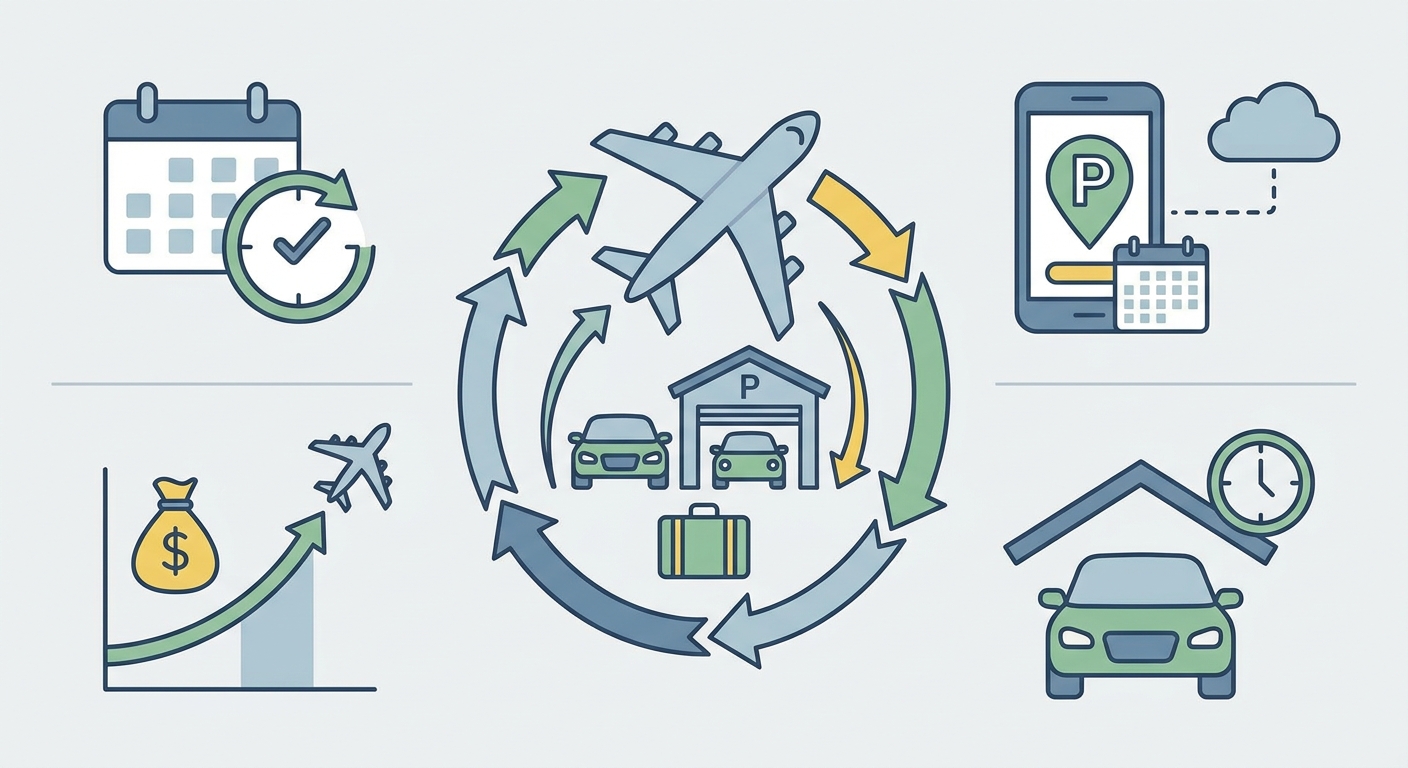
Pre-booking your parking at London Luton Airport is the single most effective strategy to save money, guarantee your space, and reduce travel-day stress. By booking in advance, you move from being a price-taker, subject to expensive on-the-day 'gate rates', to a price-setter, able to lock in significant discounts offered by parking providers to secure early revenue. This simple action can transform a potentially costly expense into a manageable part of your travel budget.
The primary driver behind the benefit of pre-booking is the pricing model used by airport parking operators. They operate on a dynamic pricing system, much like airlines and hotels. Prices are not fixed; they fluctuate based on supply and demand. When you book months in advance, demand is low, and operators are keen to fill their car parks. This early period is often the best time to book airport parking London Luton. To incentivise you, they offer their lowest prices. As the travel date approaches, availability shrinks and demand surges, causing prices to climb exponentially. The 'gate rate' - the price you pay if you simply turn up - is the highest possible price, designed to capture last-minute, unprepared travellers.
Consider a real-world scenario: The Miller family is planning a two-week trip to Portugal during the August school holidays. They need parking for 14 days. If they pre-book their Long Stay parking space at Luton in February, six months ahead, they might secure a rate of £80. However, if they wait until the week before their flight in August, the exact same spot could cost them £180 or more. By simply planning ahead, they save £100 - money that could be spent on family dinners or activities on their holiday. This isn't an unusual occurrence; it's the standard operating procedure for airport parking.
The alternative to pre-booking is relying on turning up on the day. This is a high-risk, high-cost strategy. During peak periods, such as Christmas, Easter, or the summer holidays, car parks can and do sell out completely. Arriving at the airport to find no available spaces can cause immense stress, potentially leading to missed flights and the added cost of expensive taxi fares. Pre-booking eliminates this risk entirely. Your space is reserved and guaranteed, giving you peace of mind. The small amount of time it takes to book online far outweighs the potential chaos and expense of leaving it to chance.
Actionable Insight
Always treat airport parking as a core part of your holiday booking process. As soon as your flights and accommodation are confirmed, make booking your airport parking the very next step. This simple habit shift will consistently yield the best prices and a smoother start to your journey.
What Is the Absolute Best Time to Book Luton Airport Parking?
The definitive best time to book parking at London Luton Airport is between three and six months before your departure date. This window consistently offers the lowest prices and the widest selection of parking options, allowing you to secure savings of up to 60%. Booking within this timeframe leverages the core principles of supply and demand in your favour, before the majority of travellers have even started planning their ancillary travel needs.
Parking providers at Luton, both official and third-party, release their inventory far in advance. During this early period, their primary goal is to build a baseline of occupancy. To achieve this, they offer highly attractive 'early bird' discounts. They know that as the travel date nears, demand will inevitably increase, allowing them to raise prices incrementally. By booking three to six months out, you are essentially capturing the lowest price point in this dynamic pricing curve. After the three-month mark, prices begin a steady upward climb, accelerating sharply in the final four weeks before departure.
Let's illustrate with a practical example. Imagine you are flying from Luton for a one-week holiday at the end of July. If you start looking for parking in January (seven months out), you might find prices are available but not at their absolute lowest, as some providers may not have finalised their peak season rates. However, checking again in February or March (five to six months out) will likely reveal the best deals. A space in the official Long Stay car park might be priced at £65. By May (two months out), the same space could be £95. In the first week of July (three weeks out), it might jump to £130. The week of travel, it could be £160 or more. This demonstrates how the early booking window provides a substantial financial advantage.
Compared to booking just one or two months in advance, the three-to-six-month window offers more than just better prices; it provides superior choice. Premium options like Meet & Greet or the closest Short Term car parks, which have limited capacity, are more likely to be available. If you wait, you may find these convenient services are fully booked, forcing you to choose a less ideal option. Booking early ensures you get the service you want at a price you're happy with.
Actionable Insight
Set a calendar reminder. As soon as you book your flights, create a reminder for exactly six months before your departure date with the note: "Book Luton Airport Parking." This proactive step ensures you hit the optimal booking window every time you travel.
How Do School Holidays and Peak Seasons Affect Parking Prices?
School holidays and peak travel seasons have the single most significant impact on London Luton Airport parking prices, often causing rates to double or even triple compared to off-peak periods. The dramatic surge in demand during these times means that booking well in advance is not just advisable; it's absolutely essential to avoid exorbitant costs. The standard booking window advice becomes even more critical during these high-demand periods.
The reason for this price inflation is simple: demand far outstrips the fixed supply of parking spaces. London Luton is a major hub for family holidays, with airlines offering numerous routes to popular European destinations. When schools break for Summer, Easter, Christmas, or half-term, millions of families look to travel. This concentrated demand for flights translates directly into a concentrated demand for parking. Parking operators respond by implementing peak-season pricing, where the dynamic pricing algorithm is set to be far more aggressive. The price floor is higher, and the rate of increase as the date approaches is much steeper.
Consider the difference between travelling in mid-June versus mid-August. A family booking parking for a week in June (term time) might find a great deal for £50 if they book two months in advance. Another family booking for a week in mid-August (peak school holidays) looking at the same two-month booking window might find the cheapest available option is £120. If that second family waits until two weeks before their August flight, the price could easily escalate to over £200. The product is identical - a parking space for seven days - but the price is dictated entirely by the calendar date.
Comparing Peak vs. Off-Peak Booking Windows
The strategy for booking must adapt to the season. During off-peak months like November or February (excluding half-term), you have more flexibility. Booking one to two months in advance will still likely yield a good price. However, for peak season, the 'three to six months in advance' rule becomes a hard necessity. Waiting until two months before a summer holiday flight is already leaving significant money on the table. For the absolute best prices for July or August, you should be finalising your parking booking in January or February.
Let's look at a mini case study. Two colleagues are planning identical one-week trips to Spain from Luton. Colleague A is travelling in early May (off-peak). Colleague B is travelling in early August (peak). Both book their parking three months in advance. Colleague A pays £60. Colleague B pays £95. Now, imagine they both forgot and booked two weeks in advance. Colleague A's price might rise to £85 (a £25 increase). Colleague B's price could rocket to £180 (an £85 increase). This shows how the financial penalty for late booking is disproportionately higher during peak season.
Actionable Insight
If your travel dates are fixed within school holidays, you must be hyper-vigilant. Book your parking as early as humanly possible, ideally the moment you book your flights. Do not wait. This is the period where early planning delivers the most significant financial rewards and truly defines the best time to book airport parking London Luton.

Does Booking Last-Minute Ever Make Sense for Luton Parking?
Booking airport parking at London Luton at the last minute - within a week of your flight - almost never makes financial sense and is a high-risk strategy. The belief that you might find a 'last-minute deal' is a common misconception borrowed from the hotel or package holiday industry. For airport parking, the pricing model works in the opposite direction: prices are at their absolute peak in the final days leading up to departure.
The logic behind this is rooted in the operator's business model. Unlike a hotel with an empty room, which generates zero revenue, a parking space doesn't have the same perishable value. Operators know that travellers in the last week have very few alternatives. Their flight is booked, and they need to get to the airport. This captive audience has less price sensitivity and is more likely to pay a premium for the necessity of a parking space. Therefore, there is no commercial incentive for operators to discount their remaining inventory; instead, they maximise revenue from these late bookers. Any 'deals' you see advertised for last-minute bookings are typically just slightly lower than the astronomical 'gate rate', but still significantly higher than any pre-booked price from weeks or months prior.
Let's consider a scenario. Mr. Evans has a business trip and only gets confirmation four days before he is due to fly from Luton. He goes online to book parking. The official Long Stay car park, which would have cost him £70 if booked a month ago, is now priced at £150. The more convenient Mid Stay option is completely sold out. A third-party Park & Ride service, usually a budget-friendly choice, is now £130. He is left with no choice but to pay an inflated price, a cost that could have been easily halved with advance planning. This is the reality of last-minute airport parking booking.
The only, extremely rare, exception where a last-minute booking isn't catastrophic is during the absolute depths of the off-peak season for a very short trip. For example, a two-day trip on a Tuesday in late January. In this low-demand scenario, the price difference between booking a week out and two days out might be minimal, though still higher than booking months in advance. However, this is not a reliable strategy and should never be counted on, especially for trips longer than a couple of days or during any remotely popular travel period.
Actionable Insight
Avoid last-minute booking at all costs. If you are a frequent business traveller with an unpredictable schedule, consider booking a flexible parking option. These allow you to amend or cancel your booking for a small premium. This is a far more cost-effective strategy than repeatedly paying exorbitant last-minute or gate rates.

What Role Do Mid-Week vs. Weekend Bookings Play in Cost?
The specific days of the week you travel can influence the cost of your Luton airport parking, although the effect is generally less pronounced than seasonality or the booking window. Typically, parking that spans a weekend, especially a bank holiday weekend, will be more expensive than an equivalent duration mid-week. This is driven by the leisure travel market, which is concentrated around weekends.
Airlines and, by extension, parking operators at Luton see a surge in demand from Thursday evening through to Monday morning. Many people plan short city breaks or long weekend getaways, leading to higher occupancy rates in the car parks during this period. A booking from Monday to Thursday is for a period of lower demand compared to a booking from Thursday to Sunday. The pricing algorithms reflect this, and you may find that a four-day booking starting on a Thursday is marginally more expensive than a four-day booking starting on a Monday, even when booked at the same time and well in advance.
Let's examine a tangible example. A traveller needs to park for three days. Let's call her Jane. Jane first checks prices for a trip from Monday to Wednesday. The system quotes her £45 for a spot in the Mid Stay car park. She then checks the price for the same car park for a trip from Friday to Sunday of the same week. The price is now quoted at £55. This £10 difference is a direct result of the higher demand for weekend parking. While not as dramatic as the £100+ savings from booking early, these smaller efficiencies can add up, especially for frequent travellers.
This effect is amplified when a bank holiday is involved. A three-day booking over a bank holiday weekend (e.g., Friday to Monday) will be priced at a significant premium compared to a standard weekend. This is because it combines the high demand of a weekend with the peak demand of a holiday period. In these instances, the importance of booking several months in advance is magnified even further. The price difference between an early booking and a late booking for a bank holiday weekend can be just as stark as for a week in the summer holidays.
Actionable Insight
If you have flexibility in your travel dates, even by a day or two, it's worth experimenting with a price comparison tool. Check the cost of parking if you leave on a Wednesday versus a Friday, or return on a Tuesday versus a Monday. Shifting your travel days to avoid the Thursday-to-Sunday peak demand window can sometimes unlock additional savings on top of your early booking discount.
How Far in Advance Can You Actually Book, and Is It Worth It?
Most parking providers at London Luton Airport, including the official airport car parks and major third-party operators, allow you to book your space up to a year, and sometimes even 18 months, in advance. While booking this far out guarantees your space, it may not always secure the absolute lowest price. The financial 'sweet spot', as we've established, is typically the three-to-six-month window.
The reason booking a full year in advance isn't always the cheapest option is that operators may not have finalised their pricing strategies or released their best 'early bird' promotional rates yet. When you look at prices 12 months out, you are often seeing a standard, non-discounted rate. This rate will almost certainly be cheaper than booking last-minute, but it might be slightly higher than the heavily discounted rates released around six to eight months before the travel date, when marketing campaigns for the upcoming season begin in earnest.
Let's consider a scenario for a family planning a major summer holiday for August 2026. They are very organised and look to book their parking in August 2025 (12 months out). They are quoted a price of £110 for a two-week stay. This seems reasonable, so they consider booking it. However, if they were to wait and check again in February 2026 (6 months out), they might find a special offer has been released, bringing the price for the exact same stay down to £90. In this case, waiting a few months resulted in a £20 saving. The risk of waiting, of course, is that a major event could be announced or demand could be unexpectedly high, but generally, the 3-6 month window remains optimal.
So, when is it worth booking more than six months in advance? The primary reason is for peace of mind during exceptionally busy, fixed-date global events. For example, if a major sporting event like the Olympics or the World Cup final is taking place, and you know Luton will be exceptionally busy, securing your spot a year in advance makes sense. In these unique situations, the demand is so predictable and high that prices are unlikely to drop, and the risk of car parks selling out completely is very real. For regular holiday travel, however, sticking to the three-to-six-month rule is a more reliable financial strategy.
Actionable Insight
If you are planning more than six months ahead, it's wise to track prices rather than booking immediately. Use a comparison website to check the price at 12 months, 9 months, and then 6 months. This allows you to observe the pricing trend and book when the rates hit their lowest point, which is most likely to be within that six-month window.
Are There Price Differences Between On-Airport and Off-Airport Parking?
Yes, there are significant price and service differences between on-airport and off-airport parking at Luton, and your booking strategy should account for these. On-airport options (like Short Term, Mid Stay, Long Stay, and Terminal Car Park 1 & 2) are managed by the airport itself and offer convenience due to their proximity. Off-airport options are run by independent companies located near the airport and typically offer lower prices in exchange for a slightly longer transfer time via a shuttle bus.
On-airport parking, particularly the Short Term and Terminal car parks, is priced at a premium due to the convenience of being just a short walk from the check-in desks. The Long Stay car park, while still on-airport, is further away and requires a shuttle bus, making its pricing more competitive. Off-airport Park & Ride services are usually the most budget-friendly choice. They operate from secure car parks located a few miles from the airport and run frequent, free shuttle buses to the terminal. The trade-off for the lower price is the additional transfer time, which can add 15-30 minutes to your journey.
The optimal booking time affects both types of parking, but often in slightly different ways. On-airport car parks, with their fixed, large capacities, tend to follow the dynamic pricing model very strictly. Their prices will reliably be lowest when booked far in advance. Off-airport providers also use dynamic pricing but sometimes engage in more aggressive competition. You might find one off-airport company runs a special flash sale to fill its spaces, creating more price volatility. However, the overarching rule remains the same: booking any option early is cheaper than booking it late.
Comparison Table: On-Airport vs. Off-Airport Booking
Let's compare the potential costs for a one-week stay during the Easter holidays, booked at different times:
| Parking Type | Booked 6 Months Out | Booked 1 Month Out | Booked 1 Week Out |
|---|---|---|---|
| On-Airport (Long Stay) | £75 | £120 | £170 |
| Off-Airport (Park & Ride) | £60 | £95 | £140 |
| On-Airport (Meet & Greet) | £110 | £175 | Often Sold Out |
This table clearly shows that while off-airport is consistently cheaper, the financial penalty for booking late is severe across all categories. The premium Meet & Greet service, which offers the ultimate convenience, is often the first to sell out during peak times, making early booking the only way to secure it.
Actionable Insight
Decide on your priority: convenience or cost. If you want the lowest possible price, focus on off-airport Park & Ride services and book them 3-6 months in advance. If you value convenience and a shorter transfer, choose an on-airport option like the Long Stay or Mid Stay car park, but apply the exact same early booking discipline to maximise your savings.
How Can Using Comparison Websites Affect Your Booking Strategy?
Using airport parking comparison websites is a crucial tactic that should be central to your booking strategy. These platforms act as powerful aggregators, allowing you to compare prices from dozens of providers - including official on-airport and various off-airport options - in a single search. This not only saves you time but also ensures you have a transparent view of the entire market, empowering you to make the most informed and cost-effective decision.
Comparison sites work by pulling live pricing data directly from the parking providers. When you enter your travel dates, they present you with a list of available options, which you can then sort by price, transfer time, customer rating, or distance from the terminal. This makes them an invaluable tool for finding the best time to book airport parking London Luton. This is far more efficient than visiting each individual parking provider's website one by one. Furthermore, these sites often negotiate exclusive discounts with the providers, meaning the prices they display can sometimes be even lower than booking direct. They also feature genuine customer reviews, which can be invaluable for assessing the reliability and service quality of lesser-known off-airport operators.
Let's imagine a traveller, Maria, is looking for parking for a 10-day trip. If she goes directly to the official Luton Airport website, she will only see the prices for their on-site car parks. She might book the Long Stay for £100, thinking it's a reasonable deal. However, if she had used a comparison site, she would have seen the official Long Stay for £100, but also a highly-rated off-airport Park & Ride service for £80 and another with a slightly longer transfer for £75. The comparison site immediately reveals an extra £25 in potential savings that she would have otherwise missed. It gives her the power of choice and full market visibility.
Integrating these tools into your strategy is simple. Don't just book the first option you see. Start your search on a reputable comparison website 3-6 months before your trip. Use the filters to narrow down the options based on your preferences (e.g., you only want car parks with the 'Park Mark' security award). Read a few recent reviews for your top choices. This process adds perhaps ten minutes to your booking journey but can save you a significant amount of money and help you avoid unreliable providers. It's an essential due diligence step.
Actionable Insight
Make comparison websites your first port of call, not your last. Use them as your primary search tool in the early stages of planning. Once you've identified the best option, you can choose to book through the comparison site or visit the provider's site directly to see if there's any difference in price, though this is rare. This ensures you are always starting from a position of knowledge.
What Are the Risks of Not Booking Your Luton Parking in Advance?
Failing to book your London Luton airport parking in advance exposes you to a combination of significant financial and logistical risks that can severely disrupt the start of your journey. The consequences range from paying excessively high prices to the catastrophic scenario of finding no available parking at all, potentially causing you to miss your flight. These risks are entirely avoidable with a small amount of forward planning.
The most immediate and certain risk is financial. As we've detailed, airport parking operates on a dynamic pricing model where costs escalate dramatically as the travel date approaches. Turning up on the day and paying the 'gate rate' is the most expensive way to park your car. This rate can be two, three, or even four times higher than a price you could have secured by booking a few months earlier. This isn't a small premium; for a two-week holiday, the difference can amount to over £150 - a substantial and unnecessary blow to any travel budget.
Beyond the financial penalty, there is a very real risk of limited or no availability. London Luton Airport is extremely busy, especially during peak travel seasons. The official car parks and popular off-airport providers regularly sell out completely during school holidays, bank weekends, and major events. Imagine the stress of arriving at the airport two hours before your flight, driving to the Long Stay car park only to be met with a 'Car Park Full' sign. The ensuing panic involves a frantic search for any alternative, wasting precious time and causing immense anxiety. This could lead to a desperate, expensive taxi ride and abandoning your car at home, or worse, missing your flight altogether.
Let's consider a worst-case but plausible scenario. The Jones family is flying to Greece for the summer holidays. They didn't pre-book parking. They arrive at Luton and find the Long and Mid Stay car parks are full. They try a nearby off-airport provider, who also has no space. With the clock ticking, they are forced to use the expensive Short Term car park, costing them over £400 for their two-week trip. This single oversight costs them a huge portion of their spending money and starts their holiday with extreme stress and frustration. This entire situation is a direct consequence of not pre-booking.
Actionable Insight
View pre-booking not as an optional extra, but as a mandatory part of your flight booking process. It is your insurance policy against price gouging, stress, and the potential for a disastrous start to your trip. The small time investment required to book online guarantees your space, locks in a fair price, and ensures a smooth, predictable arrival at the airport.
Booking your airport parking for London Luton is a critical step in prudent travel planning. The evidence is overwhelmingly clear: the earlier you book, the more you save. The golden window of three to six months in advance provides the perfect balance of peak availability and rock-bottom prices, especially for those travelling during the high-demand school holidays. By adopting this simple principle, you can consistently cut your parking costs by more than half compared to those who wait until the last minute.
We've explored the intricate dance of dynamic pricing, where demand dictates cost, and seen how seasonality acts as a powerful multiplier on this effect. Waiting until the final month, or worse, the final week, is a surefire way to pay a premium. The myth of the 'last-minute deal' simply does not apply to the world of airport parking; here, procrastination is penalised, and foresight is rewarded. Remember the stark contrast in cost for a summer holiday spot booked in February versus one booked in July - the saving is not just a few pounds, but often a significant sum that can be better spent on your actual holiday.
To make the best decision, you must combine this timing strategy with the right tools. Leverage the power of comparison websites to gain a full overview of the market, comparing on-airport convenience with off-airport value. Assess your personal priorities - is it worth paying a little more for a shorter walk to the terminal, or are you happy with a shuttle ride to secure the absolute lowest price? By answering these questions well in advance, you can select the perfect product for your needs at the best possible price. Don't let an easily avoidable expense cast a shadow over your trip. Plan ahead, book early, and travel with the peace of mind that comes from knowing you found the best time to book airport parking London Luton and made a smart, informed choice.
Frequently Asked Questions
It is always significantly cheaper to book your Luton airport parking online in advance. Paying on the day, known as the 'gate rate', is the most expensive option available and can cost up to 60-70% more than a pre-booked price. Parking operators use discounted online rates to incentivise early bookings and manage capacity. By booking online, even just 24 hours ahead, you will save money. For the best possible price, you should book several months in advance to take advantage of early bird discounts before demand drives prices up closer to your travel date.
Yes, you can turn up and park without a booking, but it is a very risky and expensive strategy. You will be charged the highest possible 'gate rate'. More importantly, during busy periods like school holidays, bank holiday weekends, or the summer season, the car parks can be completely full. Arriving without a booking risks finding no available spaces, which can cause significant stress and could even lead to you missing your flight. Pre-booking online guarantees your space is reserved for you and locks in a much lower price, providing both financial savings and peace of mind.
For Christmas, which is one of the busiest travel periods, you should book your Luton airport parking as early as possible. The ideal time would be in the late summer or early autumn, around September or October. This is four to five months in advance. Prices for the festive period start to rise sharply from November onwards as demand surges. Booking early not only secures a much better price but also ensures you have a choice of parking options, as premium services like Meet & Greet and the most convenient car parks sell out quickly for Christmas and New Year travel.
If your flight is delayed and you exceed your pre-booked parking period, you will be required to pay for the extra time upon your exit. The additional charges are calculated at the car park's standard daily rate, which is typically much higher than the discounted pre-booked rate. You can pay for the overstay at the exit barrier or at a payment kiosk in the car park. It's always a good idea to check the specific operator's terms and conditions, as some may have a short grace period, but you should generally expect to pay for any significant overstay.
Non-flexible or 'saver' deals can offer the absolute lowest price, but they come with significant risk as they are non-refundable and cannot be amended. These deals are only worth considering if your travel plans are 100% confirmed and you are certain they will not change. If there is any chance your flight times might shift, or you might have to cancel your trip, it is far safer to pay a small premium for a flexible booking. A flexible option allows you to change dates or cancel for a refund, providing valuable insurance against unforeseen circumstances.