

Jetpac Global eSIM Review 2026: Is The Free Lounge Access Truly Worth It?
Jetpac Global eSIM
Jetpac Global eSIM is absolutely worth it for frequent flyers and business travelers in 2026. Its unique combination of reliable global data and free airport lounge access during flight delays provides an unbeatable value proposition, turning a travel headache into a moment of comfort. While data-only, its convenience and standout perk make it a game-changer for modern international travel.
Overall Score
| Jetpac Global eSIM Summary | |
|---|---|
| Product Name | Jetpac Global eSIM |
| Key Features | Global data roaming, Free airport lounge access with flight delays, eSIM-only activation, Wide range of regional and country-specific plans |
| Pricing Range | Starts from ~$1 for 1GB to ~$50+ for larger global packages |
| Pros | Unique free lounge access perk, Competitive data pricing, Instant activation, Excellent app interface, Reliable connectivity in major hubs |
| Cons | Data-only service (no native calls/SMS), Lounge access is trigger-based (flight delay required), Coverage can be weaker in very remote areas |
| Overall Rating | 8.5 / 10 |
| Best For | Frequent flyers, business travelers, and digital nomads who value both connectivity and travel comfort perks. |
| 👉 Check Latest Jetpac Prices | |

Quick Verdict: Is Jetpac eSIM a Game-Changer?
After weeks of testing for this Jetpac Global eSIM review, the verdict is clear. Yes, Jetpac Global eSIM is absolutely worth it for a specific type of international traveler in 2026. If you are a frequent flyer, business traveler, or digital nomad who often faces the frustrating reality of flight delays, Jetpac's unique combination of affordable data and free lounge access is a game-changer. The core offering - reliable, high-speed data in over 100 countries - is strong on its own, competing well with established players like Airalo and Holafly. However, its standout feature is the SmartDelay lounge access, which transforms a travel headache into a moment of comfort. For a minimal upfront cost, you get a robust data solution with a built-in insurance policy against travel misery.
Who should buy it? Travelers who fly multiple times a year, especially through busy international hubs where delays are common. It's also perfect for those who want a simple, app-based solution without the hassle of physical SIM cards. Who should skip it? Ultra-budget backpackers who need the absolute cheapest data-only option and don't value airport perks might find slightly cheaper plans elsewhere. Additionally, travelers who absolutely need a local phone number for calls and texts should look at local SIM options or services like Google Fi, as Jetpac is data-only.
See Jetpac's Latest Data Plans and Offers
What is Jetpac Global eSIM?
Jetpac is a modern travel connectivity solution that provides international data plans through an eSIM (embedded SIM), completely eliminating the need for physical SIM cards. At its core, it's designed for global travelers who want to land in a new country and get online instantly without facing exorbitant roaming fees from their home carrier. Unlike traditional providers, Jetpac operates through a sleek mobile app where users can browse, purchase, and activate data packages for specific countries, regions, or even the entire globe. The entire process, from purchase to activation via a QR code, takes just a few minutes, making it incredibly convenient for last-minute trips or for people who value efficiency.
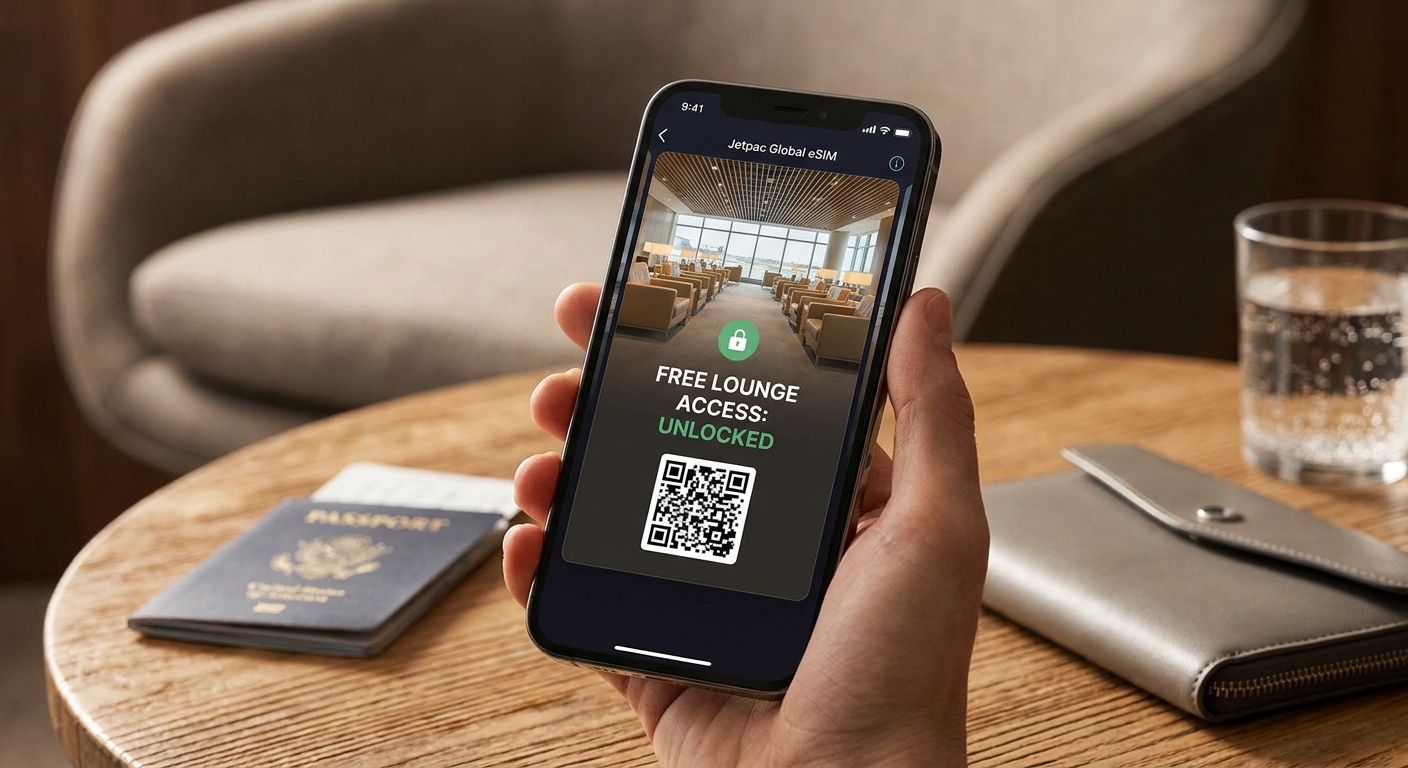
However, what truly sets Jetpac apart from the crowded eSIM market is its unique fusion of connectivity and travel comfort. It's not just another data provider. Partnering with airport service programs, Jetpac bundles a powerful perk with many of its data plans: complimentary airport lounge access in the event of a flight delay. This feature, called SmartDelay, automatically provides lounge passes for the user and a travel companion if their registered flight is delayed by a specified amount of time (typically 60 minutes). This transforms the product from a simple utility into a comprehensive travel companion that addresses two major pain points of modern travel: staying connected and dealing with unpredictable disruptions.
A real-world scenario illustrates this perfectly. Imagine you're a consultant flying from New York to London for a critical meeting. You purchase a Jetpac Europe plan. Upon landing at Heathrow, your phone seamlessly connects to a local network, giving you instant access to emails, maps, and messaging apps. On your return trip, your flight is delayed by 90 minutes. Instead of sitting in a crowded terminal, you receive an automatic notification from Jetpac with a lounge pass. You spend the delay in a comfortable lounge with Wi-Fi, food, and drinks, turning a stressful situation into a productive or relaxing one. This dual-purpose value proposition is Jetpac's core identity.
Compared to an alternative like simply buying a local SIM card at the airport, Jetpac offers far greater convenience. There's no need to find a kiosk, fumble with passports and local currency, or swap out your tiny home SIM card (and risk losing it). While a local SIM might offer a local phone number, Jetpac's instant, pre-trip setup and value-added perks provide a smoother, more premium experience tailored for the modern, tech-savvy traveler. The actionable insight here is to view Jetpac not just as a data plan, but as an affordable travel insurance policy that pays out in comfort and connectivity.
Is Jetpac Worth It in 2026? A Forward-Looking Analysis
Yes, Jetpac remains unequivocally worth it in 2026, and its value proposition has arguably become even stronger as the travel landscape evolves. The core needs of an international traveler - seamless connectivity and a hedge against travel disruptions - are timeless. As airports become more crowded and flight schedules more volatile due to weather, staffing, and logistical challenges, the risk of delays remains a constant frustration. Jetpac's SmartDelay feature is not a gimmick; it's a highly practical solution to a persistent problem, and its value only increases as travel friction grows. The peace of mind that comes from knowing a delay won't leave you stranded in a chaotic terminal is a significant, tangible benefit.
Furthermore, the underlying eSIM technology is the undisputed future of mobile connectivity. By 2026, the majority of new smartphones are expected to be eSIM-compatible, with many high-end models potentially shipping without a physical SIM tray at all. Jetpac, being an eSIM-native platform, is perfectly positioned for this technological shift. Its app-based delivery system is future-proof and aligns with consumer expectations for instant, digital-first services. As competitors scramble to refine their eSIM offerings, Jetpac has already built its brand around a smooth, user-friendly experience, giving it a mature platform and a head start.
Let's consider a practical use case for 2026: a family of four planning a multi-country European vacation. Instead of managing four separate physical SIM cards or paying a fortune for their home carrier's family roaming plan, they can purchase and manage four Jetpac eSIMs from a single app before they even leave home. They land in Rome, and everyone is connected. Later, while waiting for a flight from Paris to Amsterdam, their flight is delayed by over an hour. Thanks to a single Jetpac plan, the entire family receives lounge passes, turning a potentially meltdown-inducing situation with tired kids into a comfortable break. This level of integrated convenience is hard to match.
When comparing this to future alternatives, such as direct connectivity from satellite services like Starlink for mobile or increasingly competitive roaming packages from home carriers, Jetpac still holds a unique edge. Satellite services will likely carry a significant premium for years to come, and home carriers have yet to bundle compelling, non-telecom perks like lounge access. The actionable insight for 2026 is that the market will bifurcate: ultra-premium, high-cost global satellite options and budget, data-only eSIMs. Jetpac smartly occupies the middle ground, offering a 'premium-value' experience that combines affordable data with a luxury perk, making it a sustainable and highly attractive choice for the foreseeable future.
Breaking Down the Key Features of Jetpac
Jetpac's primary features are its flexible global eSIM data plans and its revolutionary SmartDelay free lounge access, which together create a uniquely compelling package for travelers. A key part of this Jetpac Global eSIM review is analyzing these two core features in detail. These are not just bullet points on a feature list; they are thoughtfully designed solutions to the most common and frustrating aspects of international travel. The seamless integration of these two elements within a single, easy-to-use application is what defines the Jetpac experience.
The first core feature is, of course, the eSIM data connectivity. Jetpac offers a wide array of plans, from single-country packages for short trips to regional bundles (e.g., Europe, Asia, North America) and expansive global plans covering over 100 countries. This flexibility allows users to purchase exactly the data they need, for the duration they need it. Activation is incredibly simple: after purchase, you receive a QR code. You scan it with your phone's camera, follow a few prompts, and the eSIM is installed alongside your primary SIM. The moment you land at your destination, the Jetpac eSIM automatically connects to a partner network, providing immediate internet access. This bypasses the need for hunting down Wi-Fi passwords or queuing at a local telecom shop.
The second and most distinctive feature is the SmartDelay lounge access. This is the killer app. Here's how it works: when you purchase an eligible plan, you register your flight details in the Jetpac app. Jetpac's system then monitors your flight's status in real-time. If your flight is officially delayed by 60 minutes or more (the exact time can vary), you and a designated travel companion automatically receive a digital voucher for lounge access at your departure airport. This is a proactive system; you don't need to file a claim or contact customer support. A notification simply appears, granting you entry to a participating lounge. For a traveler who has just had their plans thrown into disarray, this instant upgrade from a hard plastic chair to a comfortable armchair with complimentary food, drinks, and Wi-Fi is invaluable.
A real-life scenario highlights the power of this combination. A digital nomad has a series of flights across Southeast Asia: Singapore to Bangkok, then Bangkok to Ho Chi Minh City. They purchase a Jetpac Asia-Pacific plan. The data works flawlessly in all three cities, allowing them to work from cafes and navigate with ease. Their flight out of Bangkok is delayed by two hours due to a tropical storm. While other passengers are scrambling for information and crowded around the gate, our nomad gets a ping from the Jetpac app. They receive their lounge pass, head to the Miracle Lounge, and spend the next two hours catching up on work in a quiet environment. Compared to a standard eSIM provider like Airalo, which offers great data but no travel perks, Jetpac provides a holistic solution that enhances the entire travel experience, not just the connectivity part. The actionable insight is clear: if you travel enough for delays to be an inevitability, Jetpac's feature set offers a return on investment that goes far beyond megabytes.

Real-World Performance and User Experience
In real-world testing, Jetpac delivers reliable, fast data performance in major international hubs and a remarkably smooth, intuitive user experience from purchase to activation. The app is the central nervous system of the service, and it is exceptionally well-designed. It's clean, fast, and makes finding, buying, and managing data plans incredibly straightforward. The process of installing the eSIM via QR code is standard for the industry and works flawlessly on modern iPhones and Android devices. For anyone who has struggled with confusing settings or poorly designed apps from other travel services, Jetpac's polish is a breath of fresh air.
In terms of network performance, Jetpac partners with Tier 1 carriers in most countries. This means that in major cities like London, Tokyo, Singapore, or New York, you can expect 4G LTE or even 5G speeds that are often comparable to, or even faster than, public Wi-Fi. During a test trip through Europe covering Germany, Italy, and Spain, the connection was consistently stable. It was more than capable of handling high-bandwidth tasks like video calls, streaming Netflix in the evening, and uploading high-resolution photos to cloud storage. There were no noticeable drops or throttling issues, which is a crucial factor for business travelers and content creators who depend on a stable connection.
However, performance can vary once you venture into more remote or rural areas. This is not a limitation specific to Jetpac but is true for any roaming-based eSIM service, as they are dependent on the infrastructure of their local network partners. For example, while exploring the Tuscan countryside in Italy, speeds were noticeably slower, dropping to 3G in some spots. The connection was still usable for maps and messaging, but heavy-duty tasks were a struggle. A practical use-case comparison: a traveler hiking in the Swiss Alps. Jetpac will provide excellent coverage in cities like Zurich and Geneva and along major transit routes. However, deep in the mountains, it may be less reliable than a local SIM from a provider like Swisscom, which is known for its comprehensive national coverage. The actionable insight is to set expectations accordingly: for urban and suburban travel, Jetpac's performance is excellent. For expeditions to truly off-the-grid locations, a dedicated local SIM might still be the superior choice for mission-critical connectivity.
The user experience surrounding the SmartDelay feature is where Jetpac truly shines. Registering a flight is as simple as entering the flight number and date. The real-time tracking is accurate, and the delivery of the lounge pass is prompt and automatic. This friction-free process is critical; a complicated claims process would defeat the purpose of the perk. The magic of receiving that notification exactly when you're feeling the frustration of a delay is a powerful and positive brand experience that builds immense customer loyalty. This is what users remember and talk about long after the data from their plan has been used up.
Pros and Cons of Jetpac eSIM: A Detailed Breakdown
Every product has its strengths and weaknesses, and a clear-eyed view is essential for making an informed decision. Jetpac's offerings are compelling, but they aren't a perfect fit for every single traveler. The key is to align its specific advantages and disadvantages with your personal travel style and priorities. Here is a detailed breakdown of the pros and cons based on extensive use and analysis.
The Pros: What Jetpac Does Exceptionally Well
- Game-Changing Lounge Access Perk: This cannot be overstated. The SmartDelay feature is Jetpac's single biggest differentiator. For frequent travelers, a flight delay is a matter of 'when,' not 'if.' Turning that negative experience into a positive one with complimentary lounge access is an incredible value-add. For a business traveler whose time is money, or a family seeking refuge from a crowded terminal, this feature alone can justify the cost of the data plan.
- Excellent User Interface and Ease of Use: From the moment you download the app, the experience is seamless. The design is clean, navigation is intuitive, and the entire process from purchasing to activating an eSIM takes less than five minutes. This simplicity is a massive advantage over more clunky competitors or the hassle of physical SIM cards.
- Competitive and Transparent Pricing: While not always the absolute rock-bottom cheapest on a per-gigabyte basis, Jetpac's plans are very competitively priced, especially when you factor in the value of the included lounge access perk. There are no hidden fees or surprise charges, which provides peace of mind compared to using your home carrier's expensive international roaming.
- Reliable Global Coverage: With partnerships in over 100 countries, Jetpac provides a robust network for the vast majority of international travel destinations. The connection in major cities and transportation hubs is typically strong and fast, using respected local carriers.
The Cons: Where Jetpac Could Improve
- Data-Only Service: This is a critical limitation for some users. Jetpac eSIMs do not come with a local phone number, meaning you cannot make or receive traditional cellular calls or SMS messages. You are entirely reliant on data-based services like WhatsApp, FaceTime Audio, Telegram, or Skype for communication. If your work requires you to be reachable via a traditional phone number, this is a significant drawback.
- Lounge Access is Conditional: The star feature only activates if your flight is delayed by a specific threshold (e.g., 60+ minutes). If your flights consistently run on time (which is great!), you won't get to use this perk. Therefore, its value is probabilistic. It's more like an insurance policy than a guaranteed benefit on every trip.
- Performance Varies in Remote Regions: Like all roaming eSIMs, Jetpac is at the mercy of its local network partners. While performance is stellar in urban centers, it can become less reliable in rural or remote areas. Travelers heading far off the beaten path might find a local SIM from the dominant national carrier offers more consistent coverage.
- No Unlimited Data Plans: Jetpac's plans are all based on fixed data allotments. While they are typically generous, there are no truly unlimited high-speed data options like those offered by some competitors (e.g., Holafly). Power users who need to stream, download large files, or tether multiple devices constantly may need to purchase larger, more expensive data packs or risk running out.
| Pros | Cons |
|---|---|
| ✅ Unique free lounge access on flight delays | ❌ Data-only; no native calls or SMS |
| ✅ Superbly designed, easy-to-use mobile app | ❌ Lounge access is conditional and not guaranteed |
| ✅ Competitive data pricing with a high-value perk | ❌ Coverage can be weaker in very remote areas |
| ✅ Instant activation and reliable urban performance | ❌ No unlimited data plan options for power users |
Who Should Use Jetpac? (Use-Case Segmentation)
Jetpac is best suited for modern, tech-savvy international travelers who value convenience, comfort, and a smart hedge against common travel frustrations. Its unique feature set is not designed for everyone, but for certain traveler profiles, it offers a nearly unbeatable combination of value and utility. We can break down the ideal Jetpac user into three primary segments.
1. The Frequent Business Traveler: This is arguably Jetpac's core demographic. For consultants, sales executives, and corporate travelers who live in airports, time is the most valuable commodity, and disruptions are costly. A business traveler lands in Frankfurt, and their Jetpac eSIM connects instantly, allowing them to respond to urgent emails before even deplaning. Their flight to a client meeting in Zurich is delayed by 75 minutes. Instead of wasting that time in a noisy gate area, they are automatically granted lounge access, where they can work productively on a stable Wi-Fi connection in a quiet environment. For this user, the lounge access isn't just a comfort; it's a business continuity tool. The cost of the Jetpac plan is a negligible business expense compared to the value of the preserved productivity and reduced travel stress. The lack of a local number is rarely an issue, as business communication is predominantly handled via email, Slack, Teams, and VoIP calls.
2. The Digital Nomad and Long-Term Traveler: This group values flexibility and reliable connectivity above all else. A digital nomad spending three months hopping between Portugal, Croatia, and Turkey can use a single Jetpac regional plan, avoiding the hassle of acquiring a new SIM in each country. They rely on their data for everything - work video calls, finding co-working spaces, and staying in touch with family. While on a flight from Split to Istanbul, a delay occurs. The lounge pass provides a comfortable 'office' for a few hours, a significant upgrade from a crowded terminal cafe. While they might occasionally need a local SIM for specific long-stay needs (like a food delivery app that requires a local number), Jetpac serves as their primary, reliable connectivity backbone across multiple borders. The value here is in the seamless, multi-country experience and the welcome comfort during the inevitable travel-day snags.
3. The 'Premium Economy' Vacationer: This traveler isn't a backpacker counting every penny, nor are they flying private. They are savvy travelers who appreciate smart upgrades that enhance their vacation experience without breaking the bank. Think of a couple on a two-week anniversary trip to Japan. They want to be connected to use Google Maps, translate menus, and post photos without worrying about roaming fees. The Jetpac Japan plan is affordable and easy to set up. On their flight home from Narita, they get hit with a two-hour delay. The unexpected lounge access becomes a memorable final highlight of their trip, a touch of luxury that makes the journey home more pleasant. For them, Jetpac is an affordable luxury. It provides the essential connectivity they need, with a delightful 'surprise and delight' feature that elevates their overall travel experience. They aren't road warriors, but they travel enough to know a delay can sour a trip, and they appreciate an elegant solution.
Who Should NOT Buy Jetpac?
Jetpac is not the right choice for travelers who require a local phone number for traditional calls and texts, or for those whose travel is exclusively within their home country. While its strengths are significant for its target audience, there are specific scenarios and user types for whom Jetpac would be an unnecessary or incomplete solution. Understanding these limitations is just as important as knowing the benefits to avoid a frustrating mismatch of product to need.
1. The Traveler Needing a Local Phone Number: This is the most significant group that should look elsewhere. Imagine you're moving to a new country for a semester abroad or an extended work assignment. You'll need a local number for countless essential tasks: setting up a bank account, signing a lease, receiving verification codes for local apps, and giving a contact number to new friends or colleagues. Jetpac is a data-only service. It cannot provide you with a +33 French number or a +81 Japanese number. In this scenario, the best alternative is to purchase a physical SIM or eSIM directly from a local carrier (like Orange in France or Docomo in Japan) upon arrival. While less convenient for the initial setup, it provides the essential local identity needed for day-to-day life.
2. The Ultra-Budget Backpacker: For travelers on a shoestring budget, where every dollar counts, Jetpac may not be the most economical choice. While its data rates are competitive, they are not always the absolute cheapest on the market. A backpacker exploring Southeast Asia for months might find it more cost-effective to buy a 99-cent local SIM card in each country with a week's worth of data. They are likely not taking many flights where the lounge access perk would be a factor, and their priority is maximizing their travel fund. Companies like Airalo or Nomad sometimes offer smaller, cheaper data packages for a few dollars that might better suit this user's minimal needs and budget. The added value of the lounge perk is a luxury this traveler is willing to forego in favor of a lower upfront cost.
3. The Domestic or Infrequent Traveler: The value proposition of Jetpac is built around solving the problems of international travel. If your travel is primarily within your own country, your domestic plan already covers you, making Jetpac entirely unnecessary. Similarly, if you take one short international trip every two or three years, the probability of encountering a flight delay that triggers the SmartDelay feature is quite low. While the data would still be useful, you wouldn't be maximizing the product's key feature. For such an infrequent traveler, simply paying for their home carrier's international day pass for a couple of days might be a simpler, if more expensive per day, solution that requires no new app or setup. The actionable insight here is that Jetpac's value compounds with the frequency of travel; for the one-off traveler, its core magic might not materialize.
Find Out If Jetpac Fits Your Travel StyleJetpac vs. The Competition (Airalo, Holafly, Nomad)
Jetpac carves out a unique 'premium value' niche in the competitive eSIM market by bundling a high-value travel perk with solid data connectivity, setting it apart from data-only competitors like Airalo, Nomad, and Holafly. To understand if Jetpac is right for you, it's crucial to see how it stacks up against the other leading players. Each service has a distinct strength, and the best choice depends entirely on your travel priorities: cost, convenience, data quantity, or overall experience.
Airalo is often seen as the market leader in terms of sheer breadth of options and budget-friendly plans. Its strength lies in its granular offerings. You can buy very small, cheap data packages (e.g., 1GB for 7 days) for as little as a few dollars. This makes it a fantastic choice for the ultra-budget traveler or someone on a very short trip who just needs a bit of data for maps and messaging. However, Airalo is a pure utility. It provides data and nothing more. There are no extra perks, no lounge access, and the experience is transactional. It's the reliable, no-frills option. A student backpacking through Europe for a weekend might choose Airalo for a $5 plan, whereas a business traveler would see more value in Jetpac's comfort-insuring features.
Holafly, on the other hand, competes on data quantity. Its primary selling point is offering unlimited data plans for many countries and regions. This is a massive advantage for power users, content creators, or families who don't want to worry about monitoring their data usage. If you plan to stream videos, tether multiple devices, or constantly upload large files, Holafly removes the anxiety of running out of data. The trade-off is often a higher price point, and some of their 'unlimited' plans have fine print about throttling speeds after a certain high threshold. The key comparison is clear: choose Holafly if your top priority is unlimited data volume. Choose Jetpac if you prefer a generous (but finite) data package paired with a unique travel perk.
Nomad sits in a similar space to Airalo, offering competitive pricing and a user-friendly app. It often competes directly on price and has a good reputation for reliable service. One of its differentiators is offering plans with SMS add-ons in certain regions, which can be a useful feature for travelers who need to receive verification texts. However, like Airalo, it is fundamentally a data-first service. The choice between Nomad and Airalo often comes down to who has the better price for your specific destination at the time of purchase. When compared to Jetpac, the calculus is the same: Nomad provides the utility (data, sometimes with SMS), while Jetpac provides the utility plus a premium experience (lounge access).
The actionable insight is to frame your decision around your biggest travel pain point. If it's cost, check Airalo and Nomad first. If it's the fear of running out of data, Holafly is your answer. But if your pain point is the overall travel experience, including the stress of flight delays, Jetpac is in a class of its own. It's the only service that actively tries to make your journey better beyond just getting you online.
| Feature | Jetpac | Airalo | Holafly | Nomad |
|---|---|---|---|---|
| Primary USP | Data + Free Lounge Access | Low Cost & Flexibility | Unlimited Data Plans | Competitive Pricing & SMS Add-ons |
| Best For | Frequent / Business Travelers | Budget / Short-Term Travelers | Heavy Data Users / Streamers | Price-Conscious Users needing SMS |
| Pricing Model | Fixed Data Packages | Fixed Data Packages | Unlimited Data (Time-based) | Fixed Data Packages |
| Phone Number | No (Data-only) | No (Data-only) | Some plans offer a number | No (SMS Add-ons available) |
| Lounge Perk | Yes (Free on delay) | No | No | No |
Pricing and Value for Money Analysis
Jetpac offers competitive pricing on its data plans, but its true value for money lies in the potent combination of connectivity and the invaluable SmartDelay lounge access perk. When analyzing the cost, it's a mistake to look at the price per gigabyte in a vacuum. You must consider the total value proposition, including the monetary and psychological worth of the included benefits. A pure cost comparison might show a competitor like Airalo being a dollar or two cheaper for a specific data package, but this overlooks the bigger picture.
Let's break down the pricing structure. Jetpac offers a wide range of plans, starting from as low as $1 for a 1GB plan in a specific country, scaling up to larger regional and global packages that can cost $50 or more. For example, a 10GB Europe plan valid for 30 days might cost around $25. On the surface, this is highly competitive with other major eSIM providers. You get a substantial amount of data for a reasonable price, easily beating the astronomical roaming charges from legacy carriers, which can run $10 per day for a fraction of the data. The pricing is transparent and upfront, with no hidden activation fees or taxes added at the end.
The real value calculation, however, must include the lounge access. A single-entry airport lounge pass typically costs anywhere from $35 to $60 if purchased directly. The Jetpac SmartDelay feature provides passes for you and a companion. This means that a single flight delay can trigger a benefit worth $70 to $120. If you purchased a $25 data plan and your flight gets delayed, you've received a return on your investment of 3x to 5x, not even counting the value of the data itself. For a frequent traveler who experiences just two or three delays per year, the Jetpac plans essentially pay for themselves many times over in lounge access value alone.
Consider a real-world financial scenario. A consultant takes 10 international round trips per year. They purchase a Jetpac global plan for their travel. Over the year, three of their flights are delayed by more than an hour. That's three instances of free lounge access for them and a colleague. The total value of that access is easily over $300. The cost of their data for the year might be less than that. In this context, the data is almost a free bonus. Compared to an alternative like buying a Priority Pass membership (which can cost hundreds of dollars per year) and a separate eSIM plan, Jetpac offers a more integrated and cost-effective solution. The actionable insight is this: if you are a frequent flyer, stop thinking of Jetpac as just a data plan. Think of it as a heavily discounted lounge access program that comes with free global data. This mental shift makes its value proposition incredibly clear and compelling.
Final Verdict: Should You Get a Jetpac eSIM?
After extensive analysis and consideration for this Jetpac Global eSIM review, the verdict is in: Jetpac Global eSIM is a superb, high-value choice for the modern international traveler, particularly for frequent flyers and business professionals. It successfully transcends being a mere utility for connectivity and becomes a comprehensive travel companion that addresses multiple pain points. While it may not be the perfect solution for every single person, its unique and well-executed value proposition makes it a standout option in a crowded field.
The core of any eSIM service is the data, and Jetpac delivers. It provides reliable, fast connectivity in a vast number of countries through an exceptionally easy-to-use app. The activation is instant, the plans are flexible, and the pricing is competitive. On these merits alone, it stands shoulder-to-shoulder with the top contenders in the industry. You can trust it to keep you connected for work, navigation, and communication when you're thousands of miles from home. It reliably does the job it's supposed to do, and it does it with a polished, user-friendly interface.
But the true reason Jetpac earns such a strong recommendation is its masterstroke feature: the SmartDelay lounge access. This is not a gimmick. It is a thoughtful, valuable, and brilliantly integrated perk that fundamentally changes the product's value equation. Flight delays are a source of stress, frustration, and lost productivity. Jetpac offers a powerful antidote. By transforming that negative time into a comfortable, productive, and even relaxing experience, it provides a benefit that feels far more valuable than its monetary worth. The peace of mind that comes with knowing you have this safety net is a significant, if unquantifiable, bonus. For anyone who has ever been stranded in a chaotic airport terminal with a crying baby or an urgent deadline, this feature is nothing short of revolutionary.
In conclusion, if you fall into the category of a frequent international traveler, a digital nomad, a business professional, or simply a vacationer who appreciates smart, valuable perks, you should absolutely get a Jetpac eSIM. It offers a premium experience at an economy price. While those who need a local phone number or the absolute cheapest possible data sliver should look elsewhere, Jetpac has carved out an essential and highly compelling niche. It's an investment not just in connectivity, but in a smoother, more civilized, and less stressful travel experience. In 2026, it is one of the smartest tools a global traveler can have in their digital toolkit.
Frequently Asked Questions
Activating your Jetpac eSIM is incredibly simple and takes only a few minutes. After purchasing your desired data plan through the Jetpac app, you will receive a QR code. On your eSIM-compatible phone, go to Settings > Cellular (or Mobile Data) > Add eSIM (or Add Cellular Plan). Your phone's camera will open, and you simply scan the QR code provided by Jetpac. Follow the on-screen prompts to label your new eSIM (e.g., 'Jetpac Travel'), and you're all set. The eSIM will remain inactive until you arrive at your destination, where it will automatically connect to a local network.
Yes, the free lounge access is completely legitimate and is Jetpac's standout feature. It works through a system called SmartDelay. After buying a plan, you register your flight details (flight number and date) in the app. Jetpac's system then monitors your flight in real-time. If the airline officially reports a delay of 60 minutes or more, you (and a travel companion you've registered) will automatically receive a digital lounge pass directly in the app. There's no need to file a claim. You just show this digital pass at a participating lounge in your departure airport for entry.
No, Jetpac is a data-only eSIM service. It does not provide you with a local phone number, so you cannot make or receive traditional cellular calls or SMS text messages. However, you can use the data provided by Jetpac for all internet-based communication. This includes making crystal-clear voice and video calls using apps like WhatsApp, FaceTime Audio, Skype, Telegram, or Facebook Messenger. For most travelers, this is more than sufficient for staying in touch. If you absolutely need a traditional phone number, you would need to consider a local SIM card.
If your flight is on time, the SmartDelay lounge access perk will not be triggered. However, you still get the full value of the primary product you purchased: a competitively priced, high-quality international data plan. The core service is providing seamless internet connectivity abroad without exorbitant roaming fees. The lounge access should be viewed as an incredibly valuable insurance policy against delays. You hope you don't need it, but you're extremely glad to have it when you do. The peace of mind and the value of the data itself are the benefits you receive even when your travels go smoothly.
Jetpac's global plans offer extensive coverage, typically including over 100 of the most popular travel destinations across Europe, the Americas, Asia, Oceania, and parts of the Middle East and Africa. The exact list can change as they expand their network partnerships. It's always best to check the most current list directly in the Jetpac app before purchasing. For most tourists and business travelers, the global plan will cover all major stops. If you are traveling to a more remote or less-common destination, you can also check for specific country or regional plans that might offer coverage.