
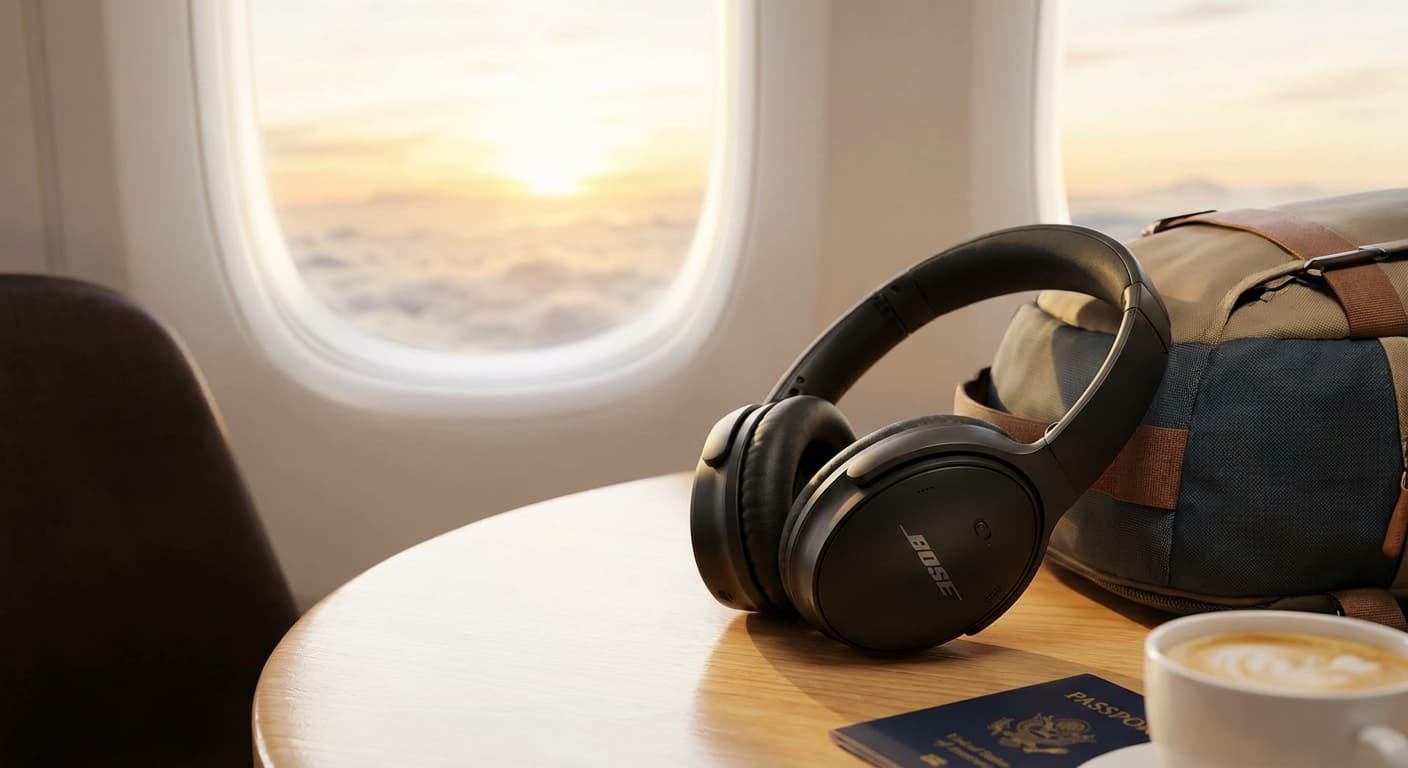
Bose QuietComfort 45 Headphones Review: Are They Worth the Investment for Travel?
Bose QuietComfort 45 Wireless Noise Cancelling Headphones
Yes, the Bose QuietComfort 45 headphones are absolutely worth the investment for travel in 2026, provided your priorities are elite noise cancellation and unrivaled comfort. They are the undisputed champions for long-haul flights where you need to wear headphones for 8, 12, or even 16 hours straight. Their ability to erase the low, monotonous drone of an airplane engine is simply world-class, creating a tranquil bubble that significantly reduces travel fatigue.
Overall Score
| Bose QuietComfort 45 Headphones Review Summary | |
|---|---|
| Product Name | Bose QuietComfort 45 Wireless Noise Cancelling Headphones |
| Key Features | Elite Active Noise Cancellation (ANC), Aware Mode, Legendary Comfort, 24-Hour Battery Life, USB-C Charging, Physical Buttons |
| Pricing Range | $279 - $329 (Varies with promotions) |
| Pros |
|
| Cons |
|
| Overall Rating | 8.5 / 10 |
| Best For | Frequent flyers, long-haul travelers, and anyone prioritizing all-day comfort and powerful noise cancellation over the latest tech features. |
| 👉 Check Latest Price on Amazon | |
Quick Verdict: The Traveler's Workhorse
Yes, the Bose QuietComfort 45 headphones are absolutely worth the investment for travel in 2026, provided your priorities are elite noise cancellation and unrivaled comfort. They are the undisputed champions for long-haul flights where you need to wear headphones for 8, 12, or even 16 hours straight. Their ability to erase the low, monotonous drone of an airplane engine is simply world-class, creating a tranquil bubble that significantly reduces travel fatigue. The physical buttons are a godsend when you're fumbling in a dark cabin, and the 24-hour battery life ensures they'll outlast any journey.
Who should buy them? The frequent flyer, the business traveler who lives in airports, and anyone who gets overwhelmed by loud environments. If you want a no-fuss, supremely comfortable tool to make travel more peaceful, this is it.
Who should skip them? The tech enthusiast who wants the absolute latest features like spatial audio, wear detection, and customizable ANC will be better served by the pricier Bose QC Ultra or Sony WH-1000XM5. Similarly, audiophiles seeking the most dynamic and detailed sound profile might find the QC45's audio tuning a bit too safe.
What Are the Bose QuietComfort 45 Headphones?
The Bose QuietComfort 45 (often called QC45) are over-ear, wireless, noise-cancelling headphones that represent the evolution of a legendary product line. They are the direct successors to the iconic QuietComfort 35 II, a pair of headphones that for years defined the gold standard for travel-focused audio. In essence, Bose's QuietComfort series is to noise cancellation what the Ford Model T was to automobiles - it brought a transformative technology to the masses and became synonymous with the category itself. The QC45 aims to continue that legacy by focusing on three core pillars: phenomenal noise cancellation, exceptional comfort, and straightforward usability.
Unlike competitors who are locked in an arms race of adding complex features, Bose took a more refined approach with the QC45. They identified what made their previous models so beloved by travelers - the feeling of putting them on and the world simply melting away - and doubled down on it. They improved the Active Noise Cancellation (ANC) to better handle mid-range frequencies (like voices in a busy terminal), added an 'Aware Mode' to let you hear your surroundings without taking them off, modernized the charging to USB-C, and boosted the battery life to a robust 24 hours. They purposefully kept the design familiar and the controls as simple, tactile buttons, resisting the trend of sometimes-finicky touch controls.
In the current market, the QC45 sits in a compelling position. It's no longer the brand's flagship - that title belongs to the newer Bose QuietComfort Ultra Headphones. However, this positions the QC45 as a high-performance, premium product that is often available at a more accessible price point. It's not a budget option, but rather a proven, reliable workhorse. For a real-world traveler, this often translates to getting 95% of the performance of the top-tier models for a fraction of the cost, making it a smart, pragmatic choice.
Think of them less as a cutting-edge gadget and more as a piece of essential travel gear, like a comfortable neck pillow or a reliable carry-on bag. Their purpose isn't to wow you with bells and whistles, but to consistently and reliably perform their primary function: making the stress and noise of travel disappear. This focus on the core experience is what has kept the QuietComfort line relevant for decades and is central to the QC45's enduring appeal for anyone who spends significant time in transit.
Are the Bose QuietComfort 45 Worth It in 2026 for Travel?
Yes, the Bose QuietComfort 45 headphones remain one of the most worthwhile investments a traveler can make in 2026. While newer, more feature-rich models exist, the QC45 excels at the two things that matter most during a long journey: silencing the environment and remaining comfortable for hours on end. Their value proposition has actually strengthened over time. As flagship prices from competitors like Sony and even Bose's own Ultra line have crept upwards, the QC45 offers a near-flagship noise-cancelling experience at a distinctly mid-to-upper-tier price, especially during sales periods.
The core reason for their continued relevance is their specialization. The ANC technology within the QC45 is exceptionally tuned to combat the low-frequency drone of jet engines, train tracks, and bus motors. This isn't just a minor feature; it's a game-changer for reducing travel fatigue. A traveler arriving after a 10-hour flight using QC45s will feel demonstrably more rested and less frazzled than one who endured the constant engine noise. This specific, powerful application of technology is what newer models struggle to improve upon in a meaningful way for the average traveler. While the Sony WH-1000XM5 might be slightly better at cancelling inconsistent chatter, the QC45's mastery over constant drone remains elite.
Consider this real-world scenario: you're on a red-eye flight from Los Angeles to New York. You need to sleep to be functional for a morning meeting. The QC45's lightweight design and minimal clamping force mean you can rest your head against the window or a pillow without a painful pressure point developing. The ANC will reduce the engine roar to a faint hum, and you can drift off without needing to blast audio. In this situation, features like spatial audio or high-fidelity LDAC codec support are irrelevant. What matters is comfort and silence, and that is where the QC45 delivers in spades.
Compared to the budget-friendly Anker Soundcore headphones, which also offer ANC, the difference is stark. While Anker provides good value, the Bose QC45's noise cancellation is in a different league, offering a more profound sense of quiet and superior comfort over extended periods. Against its primary rivals like the Sony XM5, the QC45 makes its case on comfort and simplicity. The Sonys have more features and better audio fidelity, but many users find the QC45 lighter and more comfortable for marathon sessions. In 2026, the QC45 is the pragmatic choice for the travel purist. It's an investment in tranquility and comfort, and on that front, it still delivers an outstanding return.
Find the Best Price for Your Next Trip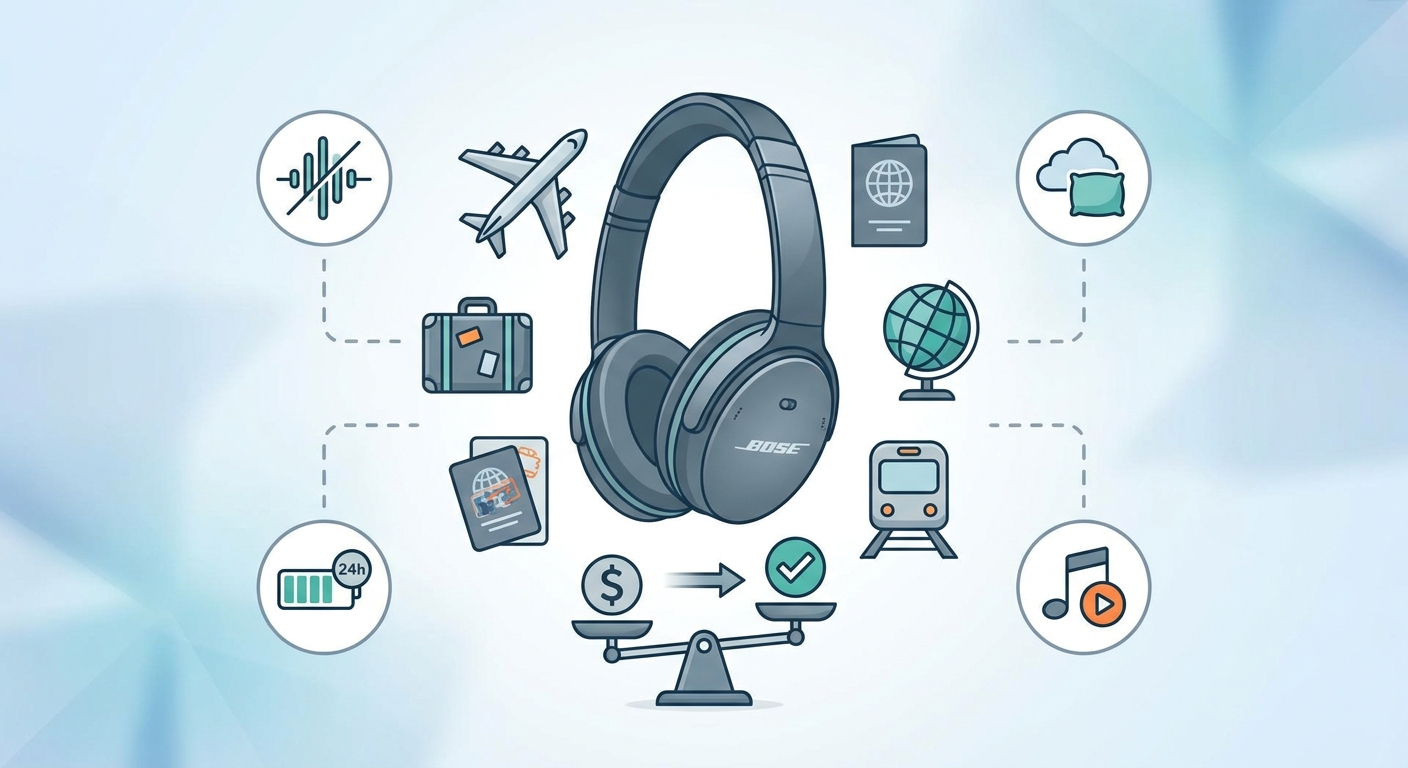
Key Features Deep Dive: What Makes Them a Travel Icon?
The Bose QuietComfort 45's reputation as a travel icon is built on a foundation of meticulously engineered features that directly address the pain points of travel. It's not about having the longest spec sheet, but about perfecting the features that matter most when you're 30,000 feet in the air or navigating a chaotic train station. The three pillars of its success are its legendary noise cancellation, its supreme comfort, and its no-nonsense operational simplicity.
World-Class Active Noise Cancellation (ANC)
At the heart of the QC45 is Bose's proprietary ANC technology. It works by using microphones on the outside and inside of the earcups to measure ambient sound and then generating an opposite signal in milliseconds to cancel it out. Where the QC45 truly shines is in its handling of low-frequency, constant noises. For a traveler, this means the deep, pervasive roar of a jet engine is virtually eliminated. It doesn't just muffle the sound; it creates a bubble of profound quiet. A real-world example is sitting in a window seat on a Boeing 777. The engine noise is a constant, fatiguing rumble. With the QC45 on, that rumble transforms into a barely-there, distant whoosh. This allows you to listen to a podcast at 30% volume instead of 70%, protecting your hearing and enhancing clarity. While competitors like the Sony XM5 might offer more granular control over ANC levels, the QC45's single, powerful 'Quiet Mode' is arguably more effective and simpler for its intended purpose - total immersion and escape.
Aware Mode: Your Connection to the World
The flip side of powerful ANC is the need to hear your surroundings. Bose's 'Aware Mode' is the solution. With a press of a button, the external microphones pass through ambient sound, so you can hear boarding announcements, the flight attendant asking for your drink order, or traffic while walking through a city, all without removing your headphones. The implementation is impressively natural, avoiding the artificial, digitized sound some other transparency modes produce. Imagine you're at the airport gate, enjoying your music. The gate agent begins boarding announcements. Instead of yanking your headphones off, you simply tap the button, hear the announcement clearly, and then tap it again to return to your sanctuary. This seamless transition between isolation and awareness is a crucial travel feature that reduces the friction of constantly taking your gear on and off.
Unrivaled Comfort and Timeless Design
If ANC is the soul of the QC45, comfort is its body. Bose has refined this design over generations. The headphones are incredibly lightweight, and the clamping force is perfectly calibrated - secure enough to stay on your head, but gentle enough to prevent pressure headaches. The earcups are made from plush, synthetic leather, and the memory foam inside is soft and deep, ensuring your ears have ample room and don't touch the internal drivers. This is the feature that truly distinguishes them on a long-haul flight. After wearing the QC45 for six straight hours on a flight from Chicago to London, you can take them off and feel no soreness or 'hot spots' on your ears or scalp. This is a feat many more feature-packed but heavier or tighter competitors cannot match. The physical buttons for volume, playback, and ANC control are another deliberate design choice that enhances the travel experience, as they are far more reliable and easier to locate by touch than the gesture-based touchpads found on rivals.
Reliable Battery Life and Connectivity
The Bose QC45 provides up to 24 hours of playback on a single charge, a significant metric for travelers. This covers even the longest commercial flights in the world, like Singapore to New York, with hours to spare. The move to USB-C charging means you can likely use the same cable that charges your phone or laptop, reducing clutter in your travel bag. Furthermore, a quick-charge feature provides up to 3 hours of playback from just a 15-minute charge - a lifesaver for those moments you realize you forgot to charge them before leaving for the airport. The Bluetooth 5.1 connection is stable and features multipoint pairing, allowing you to be connected to your laptop and phone simultaneously. You can be watching a movie on your tablet, and if a call comes in on your phone, the headphones will seamlessly switch the audio, a feature that is invaluable for the modern business traveler.
Real-World Performance: The Ultimate Travel Companion Test
In controlled lab environments, the Bose QuietComfort 45 performs exceptionally well. But its true value is only revealed in the chaotic, unpredictable, and noisy reality of travel. We put the QC45 through a series of common travel scenarios to see how it holds up when it matters most. The results confirm its status as a top-tier travel tool, excelling in some areas and showing its pragmatic trade-offs in others.
Scenario 1: The Bustling Airport Terminal
An airport terminal is an auditory assault: a mix of rolling luggage, overlapping announcements, distant conversations, and crying children. Here, the QC45's ANC immediately proves its worth. Putting them on in 'Quiet Mode' is like stepping into a soundproofed room. The constant, low-level hum of the building's HVAC and the rumble of bags on tile floors disappear completely. It significantly dampens the cacophony of human chatter, turning it into a distant murmur. While it won't entirely eliminate a sudden, sharp sound like a nearby shout, it reduces the overall sonic 'clutter' by about 80-90%, lowering stress levels palpably. When it was time to listen for a gate change announcement, a quick press to activate 'Aware Mode' brought the environment back in with crystal clarity, proving its utility. The headphones made a two-hour delay feel far more manageable and peaceful.
Scenario 2: The 12-Hour Transatlantic Flight
This is the QC45's home turf. Onboard an Airbus A350, the moment you enable 'Quiet Mode', the powerful, monotonous drone of the engines is erased. It is a genuinely startling effect for first-time users. The noise floor drops so low that you can enjoy a movie or podcast at a comfortable, low volume. More importantly, this is where the legendary comfort shines. Over a 12-hour period, from takeoff to landing, there was no ear fatigue, no painful pressure on the crown of the head, and no overheating thanks to the breathable earcups. Many competitor headphones, like some heavier models from Sony or Sennheiser, can start to feel like a burden after the 6-hour mark. The QC45 feels like an extension of your body. We were able to sleep for several hours with them on, something that's simply not possible with less comfortable headphones. The battery indicator still showed over 50% upon landing, confirming its ultra-long-haul credentials.
Scenario 3: A Noisy Commuter Train
On a commuter train, the sound profile is different: the rhythmic clatter of the wheels on the track, the screech of brakes, and the loud conversations of fellow passengers. The QC45 handled the constant track noise with the same efficacy as the jet engine, smoothing it out into a non-issue. It was less effective against the sharp, unpredictable sounds of loud talkers sitting nearby. The ANC dulled their voices, but you could still make out words if they were close enough. This highlights a key characteristic: the QC45 is an engine-noise killer, first and foremost. It's excellent for voices, but not a total 'people eliminator' like some newer, more advanced systems claim to be. However, for listening to a podcast or an audiobook during a daily commute, it provides more than enough noise reduction to make the experience enjoyable and immersive.
Scenario 4: Making Calls from a Hotel Lobby
A frequent traveler often needs to take calls in less-than-ideal environments. The QC45's microphone system features noise-rejection technology designed to isolate your voice. In a moderately busy hotel lobby with background music and conversations, the person on the other end of the call reported that my voice was clear and easily understandable. They noted they could hear some background noise, but it was suppressed enough not to be distracting. This is a significant improvement over the older QC35 II. While it may not match the beamforming microphone arrays of the absolute latest models like the Bose QC Ultra, it is more than capable for professional calls on the go. It's a reliable communication tool, reinforcing its status as an all-around travel workhorse.
A Detailed Look at the Pros and Cons
No product is perfect, and the Bose QuietComfort 45 is a study in focused excellence and deliberate trade-offs. Understanding its specific strengths and weaknesses is key to determining if it's the right travel companion for you. Instead of a simple list, let's break down the most significant pros and cons in detail.
| Pros | Cons |
|---|---|
| S-Tier Comfort for Marathon Wear | Sound Profile is Safe, Not Spectacular |
| Elite Noise Cancellation for Travel | Non-Adjustable ANC |
| Intuitive and Reliable Physical Controls | Lacks Modern Smart Features |
| Excellent Battery Life with Quick Charge | Classic Design Can Feel Dated |
The Pros (What Makes It a Traveler's Dream)
1. S-Tier Comfort for Marathon Wear: This cannot be overstated. The QC45's combination of low weight (240g), minimal clamping force, and deep, plush earcups makes it the industry leader for long-duration comfort. While other headphones might feel fine for an hour or two, the QC45 is one of the very few that remains unnoticeable after an eight-hour flight. For travelers battling jet lag and fatigue, avoiding the additional discomfort of sore ears or a pressure headache is a massive, tangible benefit that outweighs almost any other feature.
2. Elite Noise Cancellation for Travel: Bose's ANC is specifically tuned to decimate low-frequency hums and drones. This makes it exceptionally effective against the primary sources of noise during travel - airplane engines, train rumble, and bus motors. The sense of serene quiet it creates is profound and directly contributes to a more relaxing journey. While some rivals may handle sharp, intermittent sounds slightly better, the QC45's performance against the most fatiguing travel noises is arguably best-in-class.
3. Intuitive and Reliable Physical Controls: In a world obsessed with sleek, minimalist touch controls, the QC45's physical buttons are a breath of fresh air for travelers. They are easy to find by feel, provide satisfying tactile feedback, and work flawlessly with gloves on. There are no accidental track skips when you adjust the headphone on your head or rest against a pillow - a common frustration with touch-based competitors. This practical, no-nonsense approach is perfect for the often-fumbling reality of being cramped in an airline seat.
The Cons (Where It Shows Its Age)
1. Sound Profile is Safe, Not Spectacular: The audio quality of the QC45 is clear, balanced, and pleasant. However, it lacks the dynamism and detail that audiophiles crave. The bass is present but not punchy, and the treble can lack a bit of sparkle. Bose tunes for easy, non-fatiguing listening over long periods, which is a sensible choice for a travel headphone. But compared to the more vibrant sound of the Sony WH-1000XM5 or the Sennheiser Momentum 4, which support higher-fidelity codecs like LDAC and aptX Adaptive, the QC45's sound can feel a bit plain. It's good, but not great.
2. Non-Adjustable ANC: The QC45 offers two modes: 'Quiet' (full ANC) and 'Aware' (full transparency). There is no in-between. You cannot dial the ANC down to a lower level, a feature offered by virtually all of its main competitors. While the 'Quiet' mode is fantastic, some users might find it creates a slight sensation of pressure or disorientation in an already quiet room. The inability to set a custom, intermediate level of noise cancellation is a notable omission in the current market.
3. Lacks Modern Smart Features: This is a key area of compromise. The QC45 does not have wear detection, meaning music won't automatically pause when you take them off. It lacks features like 'Speak-to-Chat' found in Sony headphones, which automatically pauses music when you start talking. It also doesn't support advanced audio formats like spatial audio or 360 Reality Audio. For the user who just wants silence and music, these are non-issues. But for the tech-savvy traveler who wants all the latest conveniences, the QC45 feels a generation behind.
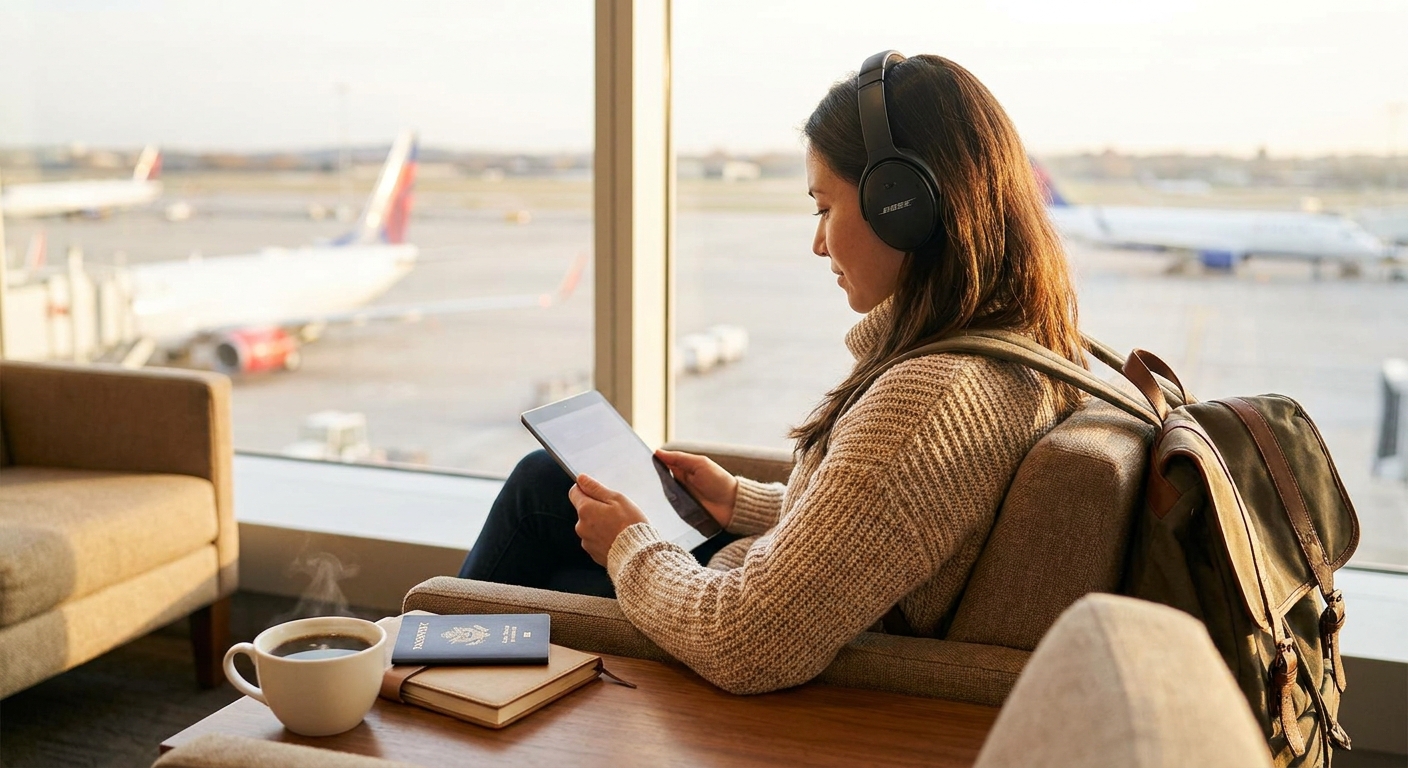
Who Should Buy the Bose QC45 for Their Travels?
The Bose QuietComfort 45 is not a one-size-fits-all headphone; it's a specialized tool designed for a specific type of user. You should buy the QC45 if your travel style and priorities align with its core strengths of comfort, powerful ANC, and simplicity. It's for the traveler who views headphones as essential gear for survival and serenity, rather than as a statement piece of cutting-edge technology. We can break down the ideal user into several key personas.
The Frequent Business Traveler
This individual spends countless hours in airports and on planes. For them, reliability and performance are paramount. The Business Traveler needs headphones that can block out the terminal chaos to allow for focused work, take a clear conference call from a hotel lobby, and provide a peaceful sanctuary on a red-eye flight. The QC45's multipoint connectivity is a killer feature here, allowing a seamless switch between a laptop for a presentation and a phone for a call. The supreme comfort means they can be worn from gate to gate without a second thought, and the robust battery ensures they're always ready. For this user, the lack of fancy features is a plus; they prefer the dependability of physical buttons over gimmicks.
The Nervous or Sensory-Sensitive Flyer
For many, flying is a stressful experience, and the constant, loud drone of the engines can be a major source of anxiety. The QC45 is a therapeutic device for this traveler. Its ability to almost completely eliminate that engine noise can have a genuinely calming effect, making the entire experience more tolerable. By creating a personal bubble of quiet, it allows the user to disconnect from the overwhelming sensory input of the cabin and retreat into their own world of music, podcasts, or simple silence. For someone with sensitivity to loud noises, the investment in a QC45 isn't about luxury; it's about accessibility and well-being.
The Long-Haul Globetrotter and Backpacker
Whether you're on a 16-hour flight to Australia or a 12-hour bus ride in South America, comfort is king. The Globetrotter needs gear that can withstand the rigors of long journeys without becoming a nuisance. The QC45's lightweight build and legendary comfort make it the perfect companion for these marathon trips. The included hard-shell case is durable and protects the headphones when shoved into a packed backpack. The long battery life means they won't need to hunt for a power outlet in a remote hostel. This traveler values practicality over everything, and the QC45 is the epitome of a practical, high-performing travel tool.
The 'Set It and Forget It' User
This user wants technology that just works, without fuss. They don't want to spend time fiddling with companion apps, customizing EQ settings, or learning complex touch gestures. They want to put on their headphones, press a button, and have the noise disappear. The QC45 is the champion for this demographic. Its operation is incredibly straightforward: a power switch, volume buttons, a multi-function button for playback, and a button to toggle between Quiet and Aware modes. It's an appliance-like experience in the best possible way - dependable, predictable, and highly effective at its job.
Who Should AVOID the Bose QC45?
While the Bose QuietComfort 45 is an exceptional travel headphone for many, it is definitively not the right choice for everyone. You should avoid the QC45 if your needs extend beyond the core travel experience and into the realms of critical audio listening, cutting-edge technology, or strict budget constraints. Recognizing that another product might be a better fit for your specific use case is just as important as understanding the QC45's strengths. Here are the users who should probably look elsewhere.
The Audiophile Seeking Peak Sound Quality
If your primary reason for buying premium headphones is to experience music with the highest possible fidelity, the QC45 will likely leave you wanting more. Its sound signature is pleasant and balanced but lacks the excitement, detail, and expansive soundstage that audiophiles cherish. It only supports the standard SBC and AAC Bluetooth codecs, which are perfectly fine for streaming but fall short of the high-resolution audio offered by competitors' support for LDAC (Sony) or aptX HD/Adaptive (Sennheiser, Bowers & Wilkins). An audiophile would be much better served by the Focal Bathys for a premium wireless experience or the Sennheiser Momentum 4 Wireless, which offers a more engaging and customizable sound profile for a similar price.
The Tech Enthusiast and Early Adopter
This user thrives on having the latest and greatest features. They want wear-detection for auto-play/pause, customizable ANC levels, speak-to-chat functionality, spatial audio for immersive movie watching, and extensive EQ controls in the companion app. The QC45 has none of these. Its feature set is deliberately minimalist and focused. For the tech enthusiast, this simplicity can feel dated and restrictive. This person should be looking directly at the flagship models like the Bose QuietComfort Ultra Headphones, which add immersive audio, or the feature-packed Sony WH-1000XM5. The QC45 is a pragmatic tool, not a technological showcase.
The Budget-Conscious Traveler
While the QC45 offers better value than current flagships, it is still a premium-priced product. For the traveler on a tight budget, there are far more cost-effective options that deliver a significant portion of the noise-cancelling experience. The Anker Soundcore Space Q45 or Life Q30 headphones, for example, offer surprisingly effective ANC, good battery life, and decent comfort for less than half the price of the Bose. While they can't match the QC45's elite performance or supreme comfort, the value proposition is undeniable. If your goal is simply to make a flight more tolerable without breaking the bank, these budget alternatives are the smarter financial choice.
The Style-Focused User
The design of the Bose QuietComfort 45 is classic, functional, and instantly recognizable. However, it's a design that has seen only minor tweaks for nearly a decade. Compared to the sleek, modern aesthetic of the Sony WH-1000XM5, the premium materials of the Bang & Olufsen Beoplay HX, or the unique look of the Apple AirPods Max, the QC45's plastic build can feel less luxurious. If you view headphones as a fashion accessory as much as a utility, the QC45's utilitarian design might not meet your aesthetic standards. It prioritizes function over form, and for those who want both, other options may be more appealing.
Bose QC45 vs. The Competition: A Traveler's Showdown
In the competitive world of noise-cancelling headphones, the Bose QC45 doesn't exist in a vacuum. Its primary rivals are the Sony WH-1000XM5 and Bose's own newer flagship, the QuietComfort Ultra Headphones. Understanding how the QC45 stacks up against these titans is crucial for making an informed travel-focused decision. The choice often comes down to a trade-off between comfort, features, and price.
The battle for supremacy in this space is fierce, with each brand bringing a different philosophy to the table. Bose has always prioritized the purity of its noise cancellation and the lightness of its design. Sony, on the other hand, has consistently pushed the envelope on features and audio technology. This fundamental difference is key to understanding the comparison. The QC45 is the seasoned veteran, reliable and perfected for its core mission. The others are the ambitious newcomers, loaded with the latest tech but sometimes at the cost of simplicity or proven comfort.
Let's break down the key differences in a head-to-head comparison table to make the distinctions clear for a traveling consumer. This isn't just about which is 'best' overall, but which is best for the specific demands of being on the move, from the departure lounge to the arrival hall.
| Feature | Bose QuietComfort 45 | Sony WH-1000XM5 | Bose QuietComfort Ultra |
|---|---|---|---|
| Primary Strength | All-Day Comfort & Simplicity | Features & Audio Fidelity | Best Overall Performance |
| Noise Cancellation | Elite (especially for engine drone) | Elite (better with voices/variable noise) | Best-in-class (slight edge over others) |
| Comfort & Weight | Winner (240g, low clamping force) | Very Good (250g, slightly more pressure) | Excellent (253g, similar to XM5) |
| Battery Life | 24 hours | 30 hours (with ANC) | 24 hours (18 with Immersive Audio) |
| Controls | Physical Buttons | Touch Controls | Buttons & Volume Strip |
| Key Features | Multipoint Pairing, Aware Mode | Wear Detection, Speak-to-Chat, LDAC, DSEE Extreme | Immersive Audio (Spatial), Snapdragon Sound, aptX Adaptive |
| Price Point (MSRP) | $$ | $$$ | $$$$ |
Analysis for the Traveler
Bose QC45 vs. Sony WH-1000XM5: This is the classic showdown. The Sony XM5 is objectively the more advanced headphone. Its ANC is slightly more adaptive to changing environments, its sound quality is richer thanks to LDAC support, and its smart features like Speak-to-Chat are genuinely useful. However, for the travel purist, the QC45 wins on two critical fronts: comfort and controls. Many users find the QC45's lighter weight and gentler fit noticeably more comfortable after the 5-hour mark. The physical buttons on the QC45 are also more reliable and less prone to accidental touches than the XM5's touchpad, which can be a significant advantage in a cramped airplane seat. Decision Framework: If you want the best all-around tech and audio quality and don't mind touch controls, get the Sony XM5. If your number one priority is wearing headphones for 10+ hours without discomfort, choose the Bose QC45.
Bose QC45 vs. Bose QuietComfort Ultra: Here, the comparison is within the family. The QC Ultra is the true successor to Bose's flagship throne. It takes the QC45's foundation and improves upon it in nearly every way: the ANC is a step above, the microphone quality is better, and it adds Bose Immersive Audio for a spatial sound experience. It also supports higher-quality audio with Snapdragon Sound and aptX Adaptive. However, these upgrades come at a significant price premium. The core experience of silencing an airplane engine is remarkably similar between the two. Decision Framework: If you want the absolute best noise cancellation Bose has to offer and are excited by features like spatial audio, the QC Ultra is worth the splurge. If you want 95% of that core ANC performance and legendary comfort for a much lower price, the QC45 offers far better value for money.
See How the QC45 Price Compares TodayPricing & Value Analysis
In 2026, the Bose QuietComfort 45's greatest strength might just be its exceptional value proposition. With an original MSRP of $329, it is now frequently available for under $300, and often dips closer to $250 during major sales events. This pricing positions it in a sweet spot, significantly cheaper than current flagships while offering performance that is far superior to budget-tier alternatives. This isn't about being the cheapest; it's about providing the most 'travel comfort and silence' per dollar spent.
To put this in perspective, new flagship models like the Bose QuietComfort Ultra and Sony WH-1000XM5 typically launch and hover around the $400-$430 mark. This means you can often acquire the QC45 for a saving of $100-$150. The crucial question for a traveler is: what are you giving up for that saving, and is it worth it? As we've detailed, the main sacrifices are advanced smart features (wear detection, spatial audio) and the highest-fidelity audio codecs. For someone whose primary goal is to silence a jet engine and sleep on a plane, these features are arguably non-essential. The core performance - ANC and comfort - is so close to the flagships that the price difference becomes very compelling.
Let's consider a real-world value calculation. A round-trip international flight can easily cost over $1000. The difference between arriving exhausted and frazzled versus arriving rested and ready to go can be priceless. If purchasing the QC45 for ~$280 makes just two or three long-haul flights significantly more comfortable and less fatiguing, the headphones have effectively paid for themselves in terms of well-being and productivity. It's an investment in your travel experience. Compared to spending an extra $150 on the QC Ultra, you have to ask if the slightly better ANC and spatial audio will make your flight $150 more comfortable. For most people, the answer is likely no; the point of diminishing returns is hit hard.
Furthermore, the value of the QC45 shines when compared to budget options. A $100 Anker Soundcore headphone might seem like a bargain, but its ANC, while good for the price, is noticeably less effective on a plane. Its comfort, while decent, is not on the same level for multi-hour wear. For a frequent traveler, the upgrade to the QC45's superior performance is a justifiable leap. You are paying for a premium, reliable, and durable piece of travel equipment that will last for years. In 2026, the Bose QuietComfort 45 represents the peak of performance for the price, making it arguably the smartest buy in the premium noise-cancelling category for any traveler focused on core functionality.
Final Verdict: The Definitive Answer for Travelers
After extensive analysis and consideration of real-world travel scenarios, the Bose QuietComfort 45 headphones earn a definitive and strong recommendation as one of the best investments a traveler can make in 2026. They are not the newest or the most feature-packed headphones on the market, but they are masters of their specific craft: creating a comfortable, quiet sanctuary in the midst of travel chaos. Their value lies not in what has been added, but in what has been perfected over generations of the QuietComfort lineage.
The core mission of a travel headphone is to combat the two biggest enemies of a pleasant journey: noise and discomfort. The QC45 attacks these problems with unparalleled focus. Its Active Noise Cancellation remains in the absolute top tier for erasing the low-frequency drone of engines, providing an immediate and tangible reduction in travel fatigue. More importantly, its lightweight design and perfectly tuned ergonomics deliver a level of long-wear comfort that its competitors still struggle to match. The ability to wear them for an entire transatlantic flight without a hint of soreness is their killer feature, and it's one that doesn't show up on a spec sheet.
Yes, you will be forgoing the latest technological advancements. The sound quality is good, not audiophile-grade. The feature set is basic compared to the smorgasbord offered by Sony. But the QC45's simplicity is also a strength. The reliable physical buttons, the straightforward operation, and the robust build quality make for a friction-free user experience that just works, every single time. It's a dependable workhorse, not a finicky show pony.
Ultimately, the decision comes down to your personal priorities. If you are a traveler who values peace, quiet, and comfort above all else, the Bose QuietComfort 45 is more than just 'worth it'; it is the benchmark. It is the pragmatic, intelligent choice for those who understand that the best technology is the one that seamlessly solves a real-world problem. For silencing the skies and making the world your quiet oyster, the QC45 remains a champion, offering elite performance at a price that makes more sense than ever.
Frequently Asked Questions
The Bose QC45's noise cancellation is exceptionally effective on an airplane. Its ANC technology is specifically engineered to target and eliminate low-frequency, constant sounds, which is the exact profile of a jet engine's drone. When you activate the 'Quiet Mode', the overwhelming roar of the engines is reduced to a faint, barely noticeable hum. This creates a serene environment that makes it easier to sleep, listen to audio at a low volume, and significantly reduces travel fatigue. While no headphone can eliminate 100% of all noise, the QC45 comes incredibly close with the sounds that matter most during air travel, making them a top-tier choice for flyers.
Yes, absolutely. The ability to be worn for a full 10-hour flight without discomfort is arguably the Bose QC45's single greatest strength. They are renowned for their ergonomic design, which includes a lightweight build (240g), soft, plush earcup cushions that don't press on your ears, and a gentle clamping force that keeps them secure without creating pressure points. Many competitors, while feature-rich, are heavier or have a tighter fit that can lead to soreness after a few hours. The QC45 was designed for these marathon sessions, making them the industry leader for long-haul comfort and the go-to choice for frequent flyers.
The Bose QC45 microphone is quite good for calls in a noisy airport. It features a noise-rejecting microphone array that does a commendable job of isolating your voice from background chaos. While it won't create a perfectly silent studio environment for the person on the other end, it effectively suppresses ambient noise like crowd chatter and distant announcements, making your voice the primary focus. Callers will be able to understand you clearly without being overly distracted. While newer models like the Bose QC Ultra offer even more advanced voice isolation, the QC45 is more than reliable enough for professional and personal calls on the go.
The main differences between the Bose QC45 and the newer Bose QuietComfort Headphones (2023 model) are subtle but important. The newer model offers adjustable noise cancellation via the Bose Music app, allowing you to choose levels between full Quiet and Aware modes, which the QC45 lacks. The QuietComfort Headphones also feature a 'Wind Block' setting and slightly improved audio tuning. However, the core ANC performance, legendary comfort, 24-hour battery life, and overall physical design remain extremely similar. The QC45 often represents better value, while the newer model provides a bit more flexibility and refinement for a higher price.
Yes, you can. The Bose QC45 comes with a 2.5mm to 3.5mm audio cable in the box, allowing you to use them as traditional wired headphones if the battery dies. This is a crucial feature for travelers, as it provides a reliable backup for in-flight entertainment systems or if you simply forget to charge them. When used with the cable and powered on, you still get the benefit of active noise cancellation. If the battery is completely dead, they will function as passive, wired headphones, though the sound quality and noise isolation will be reduced without the internal electronics active.