

NordVPN vs. ExpressVPN (2026): The Ultimate VPN for Secure Travel
NordVPN
NordVPN is the top choice for travelers, offering unmatched speed, a vast server network, and a suite of advanced security features at a highly competitive price.
Overall Score
Top Picks
NordVPN
NordVPN dominates in performance and value, making it the best choice for travelers who want top-tier speed and security without the premium price tag. Its advanced features provide comprehensive protection on any network.
ExpressVPN
ExpressVPN is the champion of simplicity and reliability. It's the perfect option for beginners or anyone who prioritizes a seamless, user-friendly experience and is willing to pay more for it.
Comparison
Design
Performance
Value for Money
Ease of Use
Durability
Features
Choosing a Virtual Private Network (VPN) for travel is no longer a luxury; it's a necessity. From protecting your sensitive data on unsecured airport Wi-Fi to accessing your favorite streaming services from your hotel room, the right VPN is a traveler's best friend. Two names dominate the industry: NordVPN and ExpressVPN. Both promise Fort Knox-level security, blazing-fast speeds, and unparalleled access to global content. But when you're thousands of miles from home, which one truly delivers? This in-depth comparison dives deep into every critical feature to determine the definitive winner for secure travel browsing in 2026.
| Feature | NordVPN | ExpressVPN |
|---|---|---|
| Overall Winner For Travel | Winner | Runner-Up |
| Best For | Speed-conscious travelers, tech-savvy users, and those on a budget. | Simplicity, ease of use, and consistent performance across a wide server network. |
| Average Speed Loss | 10-20% (using NordLynx) | 15-25% (using Lightway) |
| Server Network | 6,300+ servers in 111 countries | 3,000+ servers in 105 countries |
| Security Audits | Regular independent audits (PwC, Deloitte) | Regular independent audits (PwC, Cure53) |
| Encryption | AES-256-GCM | AES-256-GCM |
| Proprietary Protocol | NordLynx (based on WireGuard) | Lightway |
| RAM-Only Servers | Yes (all servers) | Yes (TrustedServer technology) |
| Simultaneous Connections | 10 devices | 8 devices |
| Money-Back Guarantee | 30 days | 30 days |
| Starting Price (2-year plan) | ~ $3.09/month | ~ $6.67/month |
| Pros |
|
|
| Cons |
|
|
| Action | Check Price - NordVPN | Check Price - ExpressVPN |
Quick Verdict: Which is Better for Travelers?
For the majority of travelers in 2026, NordVPN is the superior choice. It offers a powerful combination of industry-leading speeds through its NordLynx protocol, a more extensive server network, and a suite of advanced security features like Threat Protection, all at a significantly more competitive price point on its long-term plans. The value proposition is simply undeniable for anyone planning to use a VPN regularly during their travels.
However, this doesn't mean ExpressVPN is without its merits. ExpressVPN is the ideal option for travelers who prioritize simplicity and absolute ease of use above all else. Its apps are exceptionally intuitive, and its Lightway protocol delivers remarkably consistent and reliable performance across its entire global network, even in less common locations. If you are a less tech-savvy user or someone who just wants a 'connect and forget' experience that works flawlessly every time, the premium price for ExpressVPN can be justified.
Choose NordVPN if: You are a digital nomad, a business traveler, or a vacationer who wants the fastest speeds for streaming and downloads, advanced security features, and the best possible value for your money.
Choose ExpressVPN if: You prioritize a simple, clean user interface, need consistent performance in a wide variety of countries, and are willing to pay a premium for a seamless, hassle-free experience.
NordVPN Rating
- Overall Rating: 9.2/10
- Design: 8.5/10
- Performance: 9.5/10
- Value for Money: 9.5/10
- Ease of Use: 8.5/10
- Reliability: 9.5/10
- Features: 9.5/10
Where NordVPN wins: NordVPN dominates in performance, thanks to its NordLynx protocol which consistently provides some of the lowest speed loss in the industry. It also offers unbeatable value for money with its feature-packed long-term plans and a higher number of simultaneous connections (10 vs. ExpressVPN's 8).
ExpressVPN Rating
- Overall Rating: 8.8/10
- Design: 9.5/10
- Performance: 9.0/10
- Value for Money: 8.0/10
- Ease of Use: 9.5/10
- Reliability: 9.5/10
- Features: 8.5/10
Where ExpressVPN wins: ExpressVPN is the undisputed champion of design and ease of use. Its applications across all platforms are clean, minimalist, and incredibly straightforward. While slightly slower on paper than NordVPN, its performance is exceptionally consistent, making it a highly reliable choice for travelers who need a connection that just works.
Which is Better for Travel: NordVPN or ExpressVPN?
Direct Answer: NordVPN is the better overall VPN for travel due to its superior speed, larger server network, advanced security features, and more affordable pricing. While ExpressVPN offers a more streamlined user experience, NordVPN's comprehensive feature set provides more utility and protection for the modern traveler.
When evaluating a VPN for travel, we must look beyond simple specifications and consider real-world scenarios. A traveler's needs are unique: they require robust security for untrusted networks, speed for streaming and video calls, and the ability to bypass geographic restrictions to access home services. In these key areas, NordVPN consistently pulls ahead. Its NordLynx protocol, a custom implementation of WireGuard, is engineered for speed, minimizing the frustrating slowdowns that can plague VPN connections, especially when connecting to servers far from your physical location. This is a tangible benefit when you're trying to stream a 4K movie in your hotel or join a high-stakes video conference from a co-working space abroad.
Furthermore, NordVPN's security suite is more comprehensive. Beyond the standard kill switch and AES-256 encryption that both services offer, NordVPN includes Threat Protection. This feature actively blocks malware, trackers, and intrusive ads, providing an essential layer of security when navigating unfamiliar websites or connecting to questionable public Wi-Fi networks in cafes, airports, and hotels. For a traveler, this isn't just a convenience; it's a critical defense mechanism against cyber threats that are often more prevalent when you're on the move and potentially less cautious.
ExpressVPN's strength lies in its simplicity and reliability. Its proprietary Lightway protocol is also incredibly efficient and secure, and its TrustedServer technology (RAM-only servers) is a gold standard for privacy. The user experience is flawless, making it an excellent choice for beginners. However, when you compare the complete packages side-by-side, NordVPN offers more features, more servers, faster peak performance, and more simultaneous connections for a lower price. For the traveler who wants the most powerful and versatile tool in their digital toolkit, NordVPN presents a more compelling and data-driven case.
What Are the Key Differences?
Direct Answer: The key differences between NordVPN and ExpressVPN for travelers are their proprietary protocols (NordVPN's speed-focused NordLynx vs. ExpressVPN's consistency-focused Lightway), their server network size (NordVPN's 6,300+ vs. ExpressVPN's 3,000+), their additional features (NordVPN's Threat Protection and Meshnet), and their pricing models (NordVPN is significantly cheaper on multi-year plans).
While both services excel at core VPN functionality, their philosophies and strengths diverge in areas critical to travelers. First and foremost is their approach to performance. NordVPN has adopted and built upon the WireGuard protocol to create NordLynx, which prioritizes raw connection speed and throughput. This often results in higher download and upload speeds in benchmark tests. ExpressVPN developed its Lightway protocol from the ground up, focusing on lightweight code, rapid connection times, and seamless switching between networks (e.g., from Wi-Fi to cellular), which translates to incredible reliability and consistency. For a traveler, this means NordVPN might be faster for a large download, but ExpressVPN might feel more stable when your connection is spotty.
The server network is another major differentiator. With over double the number of servers, NordVPN offers more options to avoid congestion and potentially find a faster connection in popular regions. While ExpressVPN's network in 105 countries is nothing to scoff at, NordVPN's presence in 111 countries, combined with its sheer server volume, gives it an edge in flexibility. This can be crucial when trying to find a server in a specific city to access local content or services.
Perhaps the most significant difference for security-conscious travelers lies in the bonus features. NordVPN has evolved into a comprehensive cybersecurity suite. Its Threat Protection feature is a built-in ad, tracker, and malware blocker that works even when the VPN is not connected to a server. Meshnet allows you to create a secure, private network between your devices, which is perfect for securely accessing files on your home computer from your travel laptop. ExpressVPN, by contrast, maintains a laser focus on being an excellent core VPN service. It offers fewer bells and whistles, preferring to perfect the primary functions of security, privacy, and unblocking. This leads to a cleaner, less complex app, but one with less raw utility than NordVPN's offering.
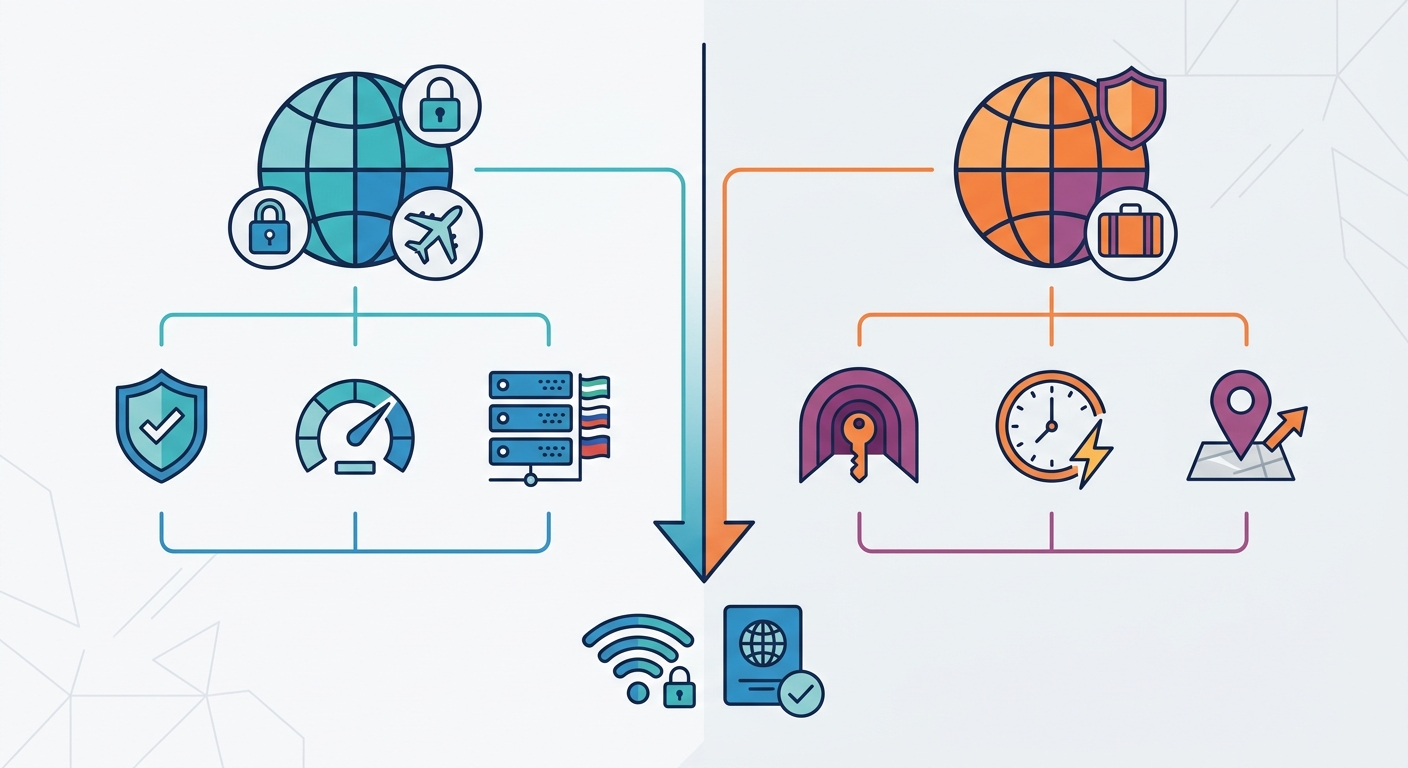
Design & User Experience Comparison
Direct Answer: ExpressVPN offers a superior design and user experience with its minimalist, intuitive apps that are perfect for beginners. NordVPN's apps are feature-rich and highly functional but can feel more complex due to their map-based interface and numerous settings.
For a weary traveler, simplicity is golden. After a long flight, the last thing you want is to grapple with a complicated app just to secure your connection. This is where ExpressVPN shines brightest. Its interface across all platforms - Windows, macOS, iOS, and Android - is a model of clarity. It features a large, unambiguous 'On/Off' button, a clearly displayed selected server location, and a simple list to choose a new one. There are no complex maps or overwhelming menus. Everything is designed to get you connected securely in a single click. This streamlined approach makes it exceptionally welcoming for users who are not tech-savvy and value a 'set it and forget it' experience.
Let's consider a real-world travel scenario. You've just landed, you're trying to book a ride-share service, and you need to connect to the airport's public Wi-Fi. With ExpressVPN, you open the app, tap the big button, and you're protected. The process is virtually frictionless. The 'Smart Location' feature automatically suggests the optimal server for speed, removing any guesswork. This focus on an effortless user journey is ExpressVPN's core design philosophy and a major selling point.
NordVPN, on the other hand, opts for a more detailed, data-rich interface. Its desktop apps are dominated by a world map dotted with server locations. While visually appealing and useful for getting a sense of the network's scale, it can be less practical than a simple list for quick connections. Clicking on a country pin and then selecting a specific server takes more steps than ExpressVPN's streamlined list approach. The mobile app defaults to a similar map, although a server list is readily available. Furthermore, NordVPN's settings menu is packed with options: a choice of protocols, an app-specific kill switch, split tunneling, and toggles for Threat Protection and Meshnet. For a power user, this level of control is fantastic. For a casual traveler, it can feel intimidating. While NordVPN is by no means difficult to use, it presents a steeper learning curve compared to ExpressVPN's elegant simplicity.
In conclusion, the 'better' design depends entirely on the user. If your priority is a clean, foolproof, one-click connection with zero clutter, ExpressVPN is the clear winner. If you are a user who enjoys tinkering with settings, wants access to advanced features directly from the main interface, and appreciates a visual representation of the server network, NordVPN's design is more powerful and flexible, albeit less approachable.
Secure Your Travels with NordVPNPerformance Comparison: Speed & Reliability
Direct Answer: NordVPN is generally faster than ExpressVPN, thanks to its NordLynx protocol which delivers higher download and upload speeds with minimal latency. However, ExpressVPN's Lightway protocol provides exceptionally consistent and reliable performance across its global network, making it a very close competitor.
For a traveler, VPN performance is a make-or-break factor. It determines whether you can smoothly stream your favorite show after a long day of sightseeing, have a lag-free video call with family back home, or quickly upload large photo backups to the cloud. Both NordVPN and ExpressVPN have invested heavily in creating next-generation proprietary protocols to address this, and the results are impressive. NordVPN's NordLynx, an adaptation of the lightweight and modern WireGuard protocol, is built for raw speed. In numerous independent tests, when connecting to nearby servers (e.g., from the US to the UK), NordVPN consistently retains a higher percentage of the base internet speed, often with speed drops of only 10-15%. This is a remarkable achievement and makes it feel almost as if you're not using a VPN at all.
Imagine you're a digital nomad staying in an Airbnb in Lisbon. Your base internet speed is 100 Mbps. Connecting to a New York server with NordVPN to access US-based work platforms might result in speeds around 85-90 Mbps. This is more than enough for any task. ExpressVPN's Lightway protocol, while also incredibly fast and efficient, might deliver speeds closer to 75-80 Mbps in the same scenario. While this difference is negligible for web browsing, it can become noticeable during large file transfers or when streaming 4K video content, giving NordVPN a clear edge for speed-intensive tasks.
However, the story doesn't end with peak speed. Reliability and consistency are just as important, especially when traveling to more remote destinations. This is where ExpressVPN often shines. Its Lightway protocol was engineered for stability and fast connection hand-offs. If you're on a train and your phone switches from Wi-Fi to cellular data, ExpressVPN is more likely to maintain a stable VPN connection without dropping. Furthermore, users often report that ExpressVPN's performance is incredibly uniform across its entire network. Whether you're connecting to a server in South Korea, Brazil, or South Africa, you can expect a predictably solid and usable connection. NordVPN, while faster on average, can sometimes have greater performance variability on its more distant servers.
Therefore, the choice comes down to your travel patterns and priorities. If you are a power user who demands the absolute highest speeds for gaming, streaming, or large downloads, and your travels are mostly within well-connected regions like North America, Europe, and East Asia, NordVPN is the performance king. If you are a globetrotter heading to diverse and sometimes less-connected locations, and you value a consistently reliable connection that works predictably everywhere, ExpressVPN's stability and uniform performance make it an exceptionally strong and trustworthy contender. Both are elite performers, but they cater to slightly different definitions of 'high performance'.
Security & Privacy Features Comparison
Direct Answer: Both NordVPN and ExpressVPN offer exceptional, top-tier security and privacy, but NordVPN takes a slight lead with its more extensive suite of built-in protective features like Threat Protection.
When you're connecting to a hotel's open Wi-Fi network, security is paramount. This is the core function of a VPN, and both NordVPN and ExpressVPN are industry leaders. They share a foundation of essential security features that should be non-negotiable for any traveler. Both utilize AES-256 encryption, the same standard used by governments and security agencies worldwide, making your data virtually uncrackable. Both have strict, independently audited no-logs policies, meaning they do not collect or store any information about your online activity. Critically for travelers, both services run their entire networks on RAM-only servers (ExpressVPN's 'TrustedServer' technology). This is a game-changer for privacy: since data is never written to a traditional hard drive, every bit of information is wiped clean the moment a server is rebooted, ensuring no residual data can ever be seized or compromised.
Both services also provide a reliable kill switch, a crucial safety net. Imagine you're in a cafe checking your bank account, and your VPN connection momentarily drops. A kill switch instantly cuts your internet access, preventing any of your unencrypted data from leaking onto the public network. Both also offer robust DNS leak protection, ensuring that your browsing requests are always routed through the secure VPN tunnel and not your local ISP. From a core privacy and encryption standpoint, you are in incredibly safe hands with either provider.
The distinction appears when you look at the additional, integrated security tools. NordVPN has bundled a comprehensive security suite into its service under the name Threat Protection. This feature goes beyond typical VPN functions. It actively scans downloads for malware, blocks malicious websites before they can load, and strips away intrusive third-party trackers and ads. For a traveler, this is immensely valuable. You're often navigating unfamiliar booking sites, clicking on links in emails, or visiting local tourist websites that may not have robust security. Threat Protection acts as a proactive guard, sanitizing your browsing experience and protecting you from threats that a standard VPN connection alone wouldn't stop. It's like having an antivirus and ad-blocker built directly into your VPN.
ExpressVPN, true to its philosophy, keeps things more focused. It offers a basic tracker blocker and a new ad-blocker feature, but it lacks the malware scanning and more advanced protection found in NordVPN's suite. It also has a 'Threat Manager' feature that blocks apps from communicating with known malicious trackers. While effective, it's less comprehensive than NordVPN's all-in-one solution. Therefore, while both providers offer an A+ grade on core VPN security, NordVPN's added layers of protection give it a distinct advantage for the security-conscious traveler who wants maximum protection with minimal effort.
Feature Breakdown Table
| Feature | NordVPN | ExpressVPN |
|---|---|---|
| Kill Switch | System-wide and App-specific | System-wide (Network Lock) |
| Split Tunneling | Yes (Windows, Android, Android TV) | Yes (Windows, Android, Mac, Routers) |
| Ad & Tracker Blocker | Yes (Threat Protection - Advanced) | Yes (Threat Manager - Basic) |
| Malware Protection | Yes (File scanning via Threat Protection) | No |
| Obfuscated Servers | Yes (Automatic) | Yes (Automatic) |
| Double VPN / Multi-Hop | Yes | No |
| Dedicated IP | Yes (Paid Add-on) | No |
| Smart DNS | Yes (SmartPlay) | Yes (MediaStreamer) |

Server Network & Global Coverage
Direct Answer: NordVPN has a significantly larger server network with over 6,300 servers in 111 countries, compared to ExpressVPN's 3,000+ servers in 105 countries. This gives NordVPN an advantage in avoiding server congestion and offering more connection options.
The size and distribution of a VPN's server network are critically important for travelers. A larger network generally means two things: first, you're more likely to find a server close to your physical location, which can improve speed and reduce latency. Second, you have more options to choose from within a single country, which helps to avoid overloaded servers and provides more IP addresses to bypass stubborn geo-blocks. On paper, NordVPN is the decisive winner here. With more than double the number of servers, the chances of finding a fast, uncongested connection in popular locations like the US, UK, or Germany are much higher. This raw server count is a significant advantage during peak usage times.
Let's take a practical example. You're traveling in Europe and want to stream the latest season of a show only available on US Netflix. With NordVPN, you have access to servers in 16 different US cities. If the New York server is slow or blocked by Netflix, you can easily switch to Chicago, Los Angeles, or Miami to find one that works. ExpressVPN also offers servers in multiple US cities, but the sheer number of options provided by NordVPN gives users more flexibility to troubleshoot and find the optimal connection. This can save a lot of frustration when you just want to relax and watch your show.
However, server count isn't the only metric that matters; country distribution is equally important for the intrepid globetrotter. Here, the race is much closer. ExpressVPN boasts servers in 105 countries, while NordVPN covers 111. Both providers offer excellent coverage across North America and Europe. Where they differ slightly is in more remote regions. ExpressVPN has historically been praised for its strong presence in South America, Asia, and Africa, offering reliable servers in countries where many other providers have no footprint. This makes it a fantastic choice for journalists, researchers, or adventurous travelers heading off the beaten path.
For instance, if your travels take you to Bhutan or Brunei, ExpressVPN has you covered. NordVPN has also been expanding its network aggressively and now has an impressive global reach, including locations like the United Arab Emirates and Vietnam, which are crucial for travelers in those regions. Ultimately, the best choice depends on your specific travel itinerary. It's wise to check both providers' server lists for the specific countries you plan to visit. While NordVPN's massive server count gives it the overall edge for performance and flexibility, ExpressVPN's thoughtful global distribution makes it a powerful and reliable ally for those venturing to the far corners of the world.
Pricing & Value for Money
Direct Answer: NordVPN offers significantly better value for money, with its two-year plan costing less than half of ExpressVPN's cheapest long-term option. For budget-conscious travelers, NordVPN is the clear winner.
While security and performance are paramount, the cost is a major factor for any traveler. In this category, the difference between NordVPN and ExpressVPN is stark. Both services offer premium features and command premium prices on their month-to-month plans, which are generally not recommended due to their high cost (typically around $12-$13 per month). The real value is found in their long-term subscriptions, and this is where NordVPN establishes a commanding lead. NordVPN's two-year plan is frequently available for around $3 per month, making it one of the most affordable top-tier VPNs on the market. This aggressive pricing makes it an incredibly attractive option for anyone, from a student backpacker to a family on vacation, looking to secure their devices without breaking the bank.
In contrast, ExpressVPN positions itself as a premium brand, and its pricing reflects that. Its best-value plan is typically a one-year subscription that costs around $6.67 per month (billed annually). While it sometimes includes a few extra months for free, the per-month cost is still more than double that of NordVPN's standard long-term deal. Over the course of a two-year period, a traveler could save over $80 by choosing NordVPN over ExpressVPN, money that could be better spent on flights, accommodation, or experiences.
Let's break down what you get for that money. With NordVPN's lower price, you get a faster service (on average), a larger server network, more simultaneous connections (10 vs. 8), and a more comprehensive security suite including Threat Protection and Meshnet. From a pure feature-per-dollar perspective, the value is heavily skewed in NordVPN's favor. ExpressVPN justifies its higher price with its exceptional ease of use, rock-solid reliability, and a brand reputation built over many years. For some users, particularly those who are less price-sensitive and value a completely frictionless experience, this premium may be worthwhile. They are paying for peace of mind and simplicity.
However, for the vast majority of travelers who are looking for the most capable and feature-rich service at the best possible price, NordVPN is the logical and financially sound choice. Both services offer a 30-day money-back guarantee, allowing you to try them risk-free. But when it comes to long-term commitment and overall value, NordVPN's pricing strategy makes it far more accessible and appealing.
Get the Best Deal on ExpressVPNPros and Cons (Detailed Breakdown)
Direct Answer: NordVPN's main pros are its industry-leading speed, vast server network, and affordable price, while its main con is a slightly more complex user interface. ExpressVPN's key pros are its unmatched simplicity and consistent reliability, while its primary con is its high price point.
NordVPN: A Deep Dive
Pros:
- Blazing-Fast Speeds: The NordLynx protocol is a game-changer. For travelers who need to stream 4K content, engage in video conferencing, or download large files, the minimal speed loss provided by NordVPN is a significant, tangible benefit that enhances the user experience.
- Unbeatable Value for Money: The affordability of its two-year plan is a major draw. It allows travelers to access a top-tier cybersecurity tool for the price of a cup of coffee per month, making premium security accessible to everyone.
- Advanced Security Suite: Features like Threat Protection and Meshnet go beyond basic VPN functionality. Threat Protection provides active defense against malware and trackers, crucial for navigating the web in unfamiliar territories. Meshnet is a unique tool for digital nomads or business travelers who need to securely access remote devices.
- Massive Server Selection: With over 6,300 servers, the ability to find a fast, uncongested server is unparalleled. This density is especially useful in popular regions like the US and Europe, ensuring reliable access to geo-restricted content.
Cons:
- Interface Can Be Busy: The map-based interface on desktop, while visually impressive, can be less efficient for quick connections than a simple server list. The sheer number of settings and features can also be overwhelming for a first-time VPN user.
- Connection Times Can Vary: While exceptionally fast once connected, some users report that establishing the initial connection can occasionally take a few seconds longer than with ExpressVPN's Lightway.
ExpressVPN: A Deep Dive
Pros:
- Supreme Ease of Use: This cannot be overstated. From installation to daily use, ExpressVPN is the epitome of user-friendly design. Its one-click connection and minimalist interface make it the perfect choice for non-technical users or anyone who wants zero hassle.
- Rock-Solid Reliability: ExpressVPN's performance is incredibly consistent. Whether connecting to a server next door or one halfway around the world, you get a stable and predictable connection. This reliability is invaluable for a traveler who needs a VPN that simply works, every single time.
- Excellent for Unblocking Content: ExpressVPN has a well-earned reputation for being one of the best VPNs for bypassing geo-restrictions on streaming platforms like Netflix, BBC iPlayer, and others. Its large pool of regularly refreshed IP addresses is highly effective.
- Wide Device and Router Support: ExpressVPN offers dedicated, easy-to-use apps for a vast range of devices, and its router applet is considered the best in the industry, making it easy to protect every device on your travel network.
Cons:
- Premium Price Tag: The most significant drawback is the cost. It is one of the most expensive VPNs on the market, and its price can be a major deterrent for budget-conscious travelers, especially when a competitor like NordVPN offers more features for less money.
- Fewer Advanced Features: In its pursuit of simplicity, ExpressVPN omits some of the advanced features found in NordVPN, such as Multi-Hop connections and a built-in malware scanner.
Which is Best for Beginners on the Go?
Direct Answer: ExpressVPN is unequivocally the best choice for beginners traveling. Its incredibly simple interface, one-click connectivity, and 'just works' philosophy removes all complexity from using a VPN.
For a beginner, the concept of a VPN can be intimidating. Talk of protocols, encryption standards, and server locations can sound like a foreign language. A first-time user traveling abroad needs a tool that provides security without demanding technical knowledge. This is precisely the user ExpressVPN is designed for. The entire user experience is built around removing friction. The installation process is straightforward on every device. Once installed, the app presents a clean, welcoming screen with a single, prominent button to connect. There's no need to navigate complex settings or understand what a 'kill switch' is to be protected; the essential security features work automatically in the background.
Consider the scenario of a family on vacation. The parents want to ensure their kids' tablets are secure on the hotel Wi-Fi and be able to access their home country's streaming services for cartoons. They don't have the time or inclination to configure settings. With ExpressVPN, they can install the app on each device, open it, and tap 'Connect'. The Smart Location feature will automatically choose the best server, and they are instantly protected and ready to stream. This level of simplicity is what makes it the ideal choice for non-technical users, families, and anyone who values their time and wants to avoid a learning curve.
While NordVPN is not a difficult application to use by any means, it presents more initial choices to the user. The map interface, the specialty servers (like Double VPN, P2P, Onion Over VPN), and the extensive settings menu in NordVPN can create a sense of 'analysis paralysis' for a beginner. They might wonder, "Which protocol should I use?" or "Do I need to turn on Threat Protection?" These are valuable options for an experienced user, but they represent potential points of confusion for a novice. NordVPN requires a little more exploration to understand and utilize its full potential. ExpressVPN, in contrast, makes the expert decisions for you, delivering an optimized experience right out of the box. For a traveler who is a VPN beginner, this guided, foolproof approach is worth its weight in gold and makes ExpressVPN the hands-down winner in this category.
Use-Case Segmentation: Who Should Choose What?
Direct Answer: Digital nomads and business travelers should choose NordVPN for its speed and advanced features, while casual vacationers and those in restrictive countries may prefer ExpressVPN for its simplicity and reliability in unblocking content.
Not all travelers are created equal. Your profession, travel style, and technical comfort level will dictate which VPN is a better fit. Let's break it down into specific traveler profiles.
For the Digital Nomad and Remote Worker: NordVPN
This user needs speed, security, and versatility. They are constantly using untrusted Wi-Fi in cafes and co-working spaces, uploading/downloading large files, and participating in video calls. NordVPN is the clear winner here. Its superior speeds with NordLynx ensure that productivity is never hampered by a slow connection. The Threat Protection feature provides an essential layer of security against malware and trackers on unfamiliar networks. The 10 simultaneous connections are a huge plus, allowing them to protect their laptop, phone, tablet, and other gadgets at the same time. Finally, the lower long-term price is a significant advantage for someone managing their own business expenses.
For the Casual Vacationer and Family: ExpressVPN
This group prioritizes ease of use and reliable streaming access. They want to protect their family's devices on hotel Wi-Fi and watch their favorite Netflix shows from back home. ExpressVPN is the better choice. Its dead-simple interface means anyone in the family can use it without confusion. Its stellar reputation for unblocking streaming services means less time troubleshooting and more time relaxing. While more expensive, the hassle-free experience is often worth the premium for a traveler who wants technology to disappear into the background during their holiday.
For the Business Traveler: NordVPN
The business traveler needs robust security for sensitive corporate data, reliability for important meetings, and the ability to bypass firewalls. NordVPN has the edge. Its security features, including the audited no-logs policy and RAM-based servers, provide peace of mind. The Meshnet feature can be a powerful tool for securely accessing files on an office server. The fast speeds ensure that VoIP calls and video conferences are crystal clear. The option for a Dedicated IP (as a paid add-on) is also a significant benefit for business users who need a static IP to access corporate networks securely.
For the Adventurer in Restrictive Countries: A Tie, Leaning ExpressVPN
Travelers heading to countries with heavy internet censorship (like China, Turkey, or the UAE) need a VPN that excels at obfuscation - disguising VPN traffic as regular internet traffic to avoid being blocked. Both NordVPN and ExpressVPN have excellent obfuscation technology that activates automatically when needed. Both have a strong track record of working in these difficult environments. However, ExpressVPN often gets a slight nod from users on the ground for its consistency and reliability in these specific situations. Its reputation is built on being a tool that just works, even under the most challenging network conditions. It's recommended to check recent reports before traveling, as the situation can change rapidly, but ExpressVPN is a very safe bet.
Use-Case Comparison Table
| Traveler Profile | NordVPN | ExpressVPN | Winner |
|---|---|---|---|
| Digital Nomad | Best (Speed, Features, Value) | Good (Reliable) | NordVPN |
| Casual Vacationer | Good (Great Value) | Best (Simplicity, Streaming) | ExpressVPN |
| Business Traveler | Best (Security Suite, Speed) | Good (Reliable, Easy) | NordVPN |
| Traveler in Restrictive Countries | Excellent (Strong Obfuscation) | Excellent (Proven Reliability) | Tie (Slight edge to ExpressVPN) |
Final Verdict: The Definitive Choice for Travelers in 2026
After a comprehensive, feature-by-feature battle, the conclusion is clear. While both NordVPN and ExpressVPN are elite services that will serve any traveler well, NordVPN emerges as the overall winner and the best choice for the majority of travelers in 2026.
NordVPN's victory is built on a foundation of superior value and a more powerful, forward-thinking feature set. It delivers industry-leading speeds that make a real-world difference when streaming, downloading, or working on the road. Its larger server network provides more options and better performance in high-traffic regions. Its integrated Threat Protection offers a level of cybersecurity that goes beyond what a traditional VPN provides, acting as a vital shield against the heightened risks of using public networks while traveling. When you combine these technical advantages with a price point that is significantly more affordable on its long-term plans, the case for NordVPN becomes overwhelmingly compelling. It is the power user's choice, the budget-conscious traveler's choice, and the security enthusiast's choice, all rolled into one.
This does not diminish ExpressVPN's quality. ExpressVPN remains a superb service and the undisputed champion of user experience. Its commitment to simplicity, reliability, and seamless performance is commendable. For the traveler who is intimidated by technology, values a pristine and intuitive interface above all else, and is willing to pay a premium for a guaranteed, hassle-free experience, ExpressVPN is an excellent and justifiable investment. It is the epitome of a 'connect and forget' tool that provides ironclad security without ever getting in your way.
Ultimately, your decision should be guided by a simple framework:
- Choose NordVPN if your priority is getting the maximum performance, the most advanced security features, and the best possible value for your money. It's the more powerful, versatile, and cost-effective tool for the modern traveler.
- Choose ExpressVPN if your priority is absolute simplicity, flawless ease of use, and rock-solid, consistent performance across the globe, and you are willing to pay a premium for that polished experience.
For our final recommendation, the data points towards NordVPN. It offers more, performs faster, and costs less, making it the smarter and more powerful choice for protecting your digital life on your next journey.