
Kiwi vs Skiplagged: Which Travel Hack Site Is Less Risky?
Kiwi
Kiwi excels at finding complex, multi-carrier itineraries through virtual interlining, offering a broader range of 'travel hacks.' Its optional Kiwi Guarantee provides a valuable safety net against self-transfer disruptions, making it a more managed-risk option for adventurous travelers.
View DealOverall Score
Top Picks
Kiwi
Kiwi excels at finding complex, multi-carrier itineraries through virtual interlining, offering a broader range of 'travel hacks.' Its optional Kiwi Guarantee provides a valuable safety net against self-transfer disruptions, making it a more managed-risk option for adventurous travelers.
Skiplagged
Skiplagged specializes in discovering incredibly cheap hidden city fares. While offering extreme savings, it comes with very high risks of airline penalties, no checked baggage, and minimal support for disruptions, suitable only for the most risk-tolerant, light travelers.
Comparison
Price & Value
Transparency & Fees
Flexibility, Changes & Cancellation
Refunds & Disruption Support
Customer Support & Reliability
Travel Risk Fit
Introduction: Navigating the High-Stakes World of Travel Hacking in 2026
In the dynamic landscape of online travel in 2026, budget-conscious travelers are constantly seeking innovative ways to reduce flight costs. Two platforms, Kiwi and Skiplagged, have emerged as prominent players in the realm of 'travel hacking,' promising significant savings by unearthing unconventional flight itineraries. While both aim to find the cheapest possible airfares, their methodologies, inherent risks, and traveler support mechanisms differ considerably. This comparison delves into the core offerings of Kiwi and Skiplagged, specifically scrutinizing which platform provides a less risky proposition for travelers eager to maximize savings without inadvertently jeopardizing their trip.
For many, the allure of dramatically cheaper flights outweighs the potential complexities. Kiwi is renowned for its 'virtual interlining' technology, which stitches together flights from non-partner airlines, often requiring self-transfers. Skiplagged, on the other hand, specializes in 'hidden city' ticketing - a controversial method where travelers book a flight with a layover at their desired destination, then simply exit the airport there, skipping the final leg. Both strategies can lead to substantial savings, but they also introduce unique challenges related to baggage, missed connections, airline policies, and customer support.
This article is tailored for travelers who are considering these platforms for their 2026 journeys, especially those weighing the financial benefits against the potential for trip disruptions. We will explore the mechanisms behind their pricing, the transparency of their fees, their approach to flexibility and cancellations, and critically, the level of support offered when things inevitably go awry. By examining their strengths, weaknesses, and ideal use cases, we aim to provide a clear understanding of which travel hack site is less risky, helping you make an informed decision for your next booking.
Main Comparison Table: Kiwi vs Skiplagged 2026
| Feature | Kiwi | Skiplagged |
|---|---|---|
| Best For | Complex self-transfer itineraries with optional guarantees, broad route discovery. | Extreme savings via hidden city ticketing, one-way flights, light travelers. |
| Price Range | Often finds competitive prices for multi-carrier routes. | Can find significantly lower prices for specific hidden city routes. |
| Key Strength | Extensive route combinations, Kiwi Guarantee for disruptions. | Unearths hidden city fares traditional sites miss, significant savings potential. |
| Key Weakness | Self-transfer risk, potential for long layovers, complex refund process. | High risk of airline penalties (banned, points lost), no checked bags, limited support for disruptions. |
| Travel Risk Fit | Medium to High (mitigated by optional Kiwi Guarantee). | High to Very High (due to hidden city ticketing and airline policy violations). |
| Refunds & Disruption Support | Kiwi Guarantee offers rebooking/refunds for covered disruptions; otherwise depends on airline. | Minimal direct support; relies on airline policy, which may penalize hidden city use. |
| Customer Support | Available via chat/phone, but resolution can be slow for complex issues. | Primarily email/chat; limited scope for hidden city specific issues. |
| Overall Rating | 7.2/10 | 6.5/10 |
| CTA | Compare flights on Kiwi | Find deals on Skiplagged |
Quick Verdict: Kiwi Edges Out Skiplagged for Risk-Aware Travel Hacking
For travelers in 2026 seeking to leverage travel hacking for savings, Kiwi generally presents a less risky, albeit still complex, option compared to Skiplagged. Kiwi's primary method of 'virtual interlining' involves booking separate tickets on different airlines to create unique, often cheaper, routes. While this inherently carries risks like missed connections during self-transfers, Kiwi attempts to mitigate this through its optional 'Kiwi Guarantee,' which offers rebooking or refunds in case of covered disruptions. This provides a crucial layer of protection that is largely absent from Skiplagged's core offerings.
Choose Kiwi if: You are comfortable with self-transfer itineraries, understand the need to recheck bags, and value the potential safety net of a disruption guarantee. Kiwi is better for those who want extensive route combinations and are willing to navigate slightly more complex booking conditions for broader savings across various destinations.
Choose Skiplagged if: Your absolute priority is finding the lowest possible fare, and you are willing to embrace the significant risks associated with 'hidden city' ticketing. This means traveling with only carry-on luggage, understanding that airlines may penalize this practice, and accepting minimal support if your itinerary is disrupted or flagged. It is for the truly adventurous and risk-tolerant budget traveler.
Choose neither if: You prioritize simplicity, direct airline support, guaranteed connections, and minimal risk above all else. For such travelers, booking directly with airlines or through traditional online travel agencies (OTAs) that offer protected connections remains the safest approach. Both Kiwi and Skiplagged introduce complexities that are not suitable for every traveler, particularly those new to independent travel or those with strict schedules.
Overall, Kiwi's broader inventory and the existence of its guarantee make it the slightly safer choice for most people interested in travel hacking. Skiplagged, while offering potentially deeper discounts, operates in a much higher-risk domain due to its reliance on hidden city fares, a practice often frowned upon or even prohibited by airlines. Kiwi's model is more transparent about the separate nature of tickets, allowing travelers to make a more informed decision about the trade-offs involved.
Short Answer: Kiwi vs Skiplagged 2026 - Which is Less Risky?
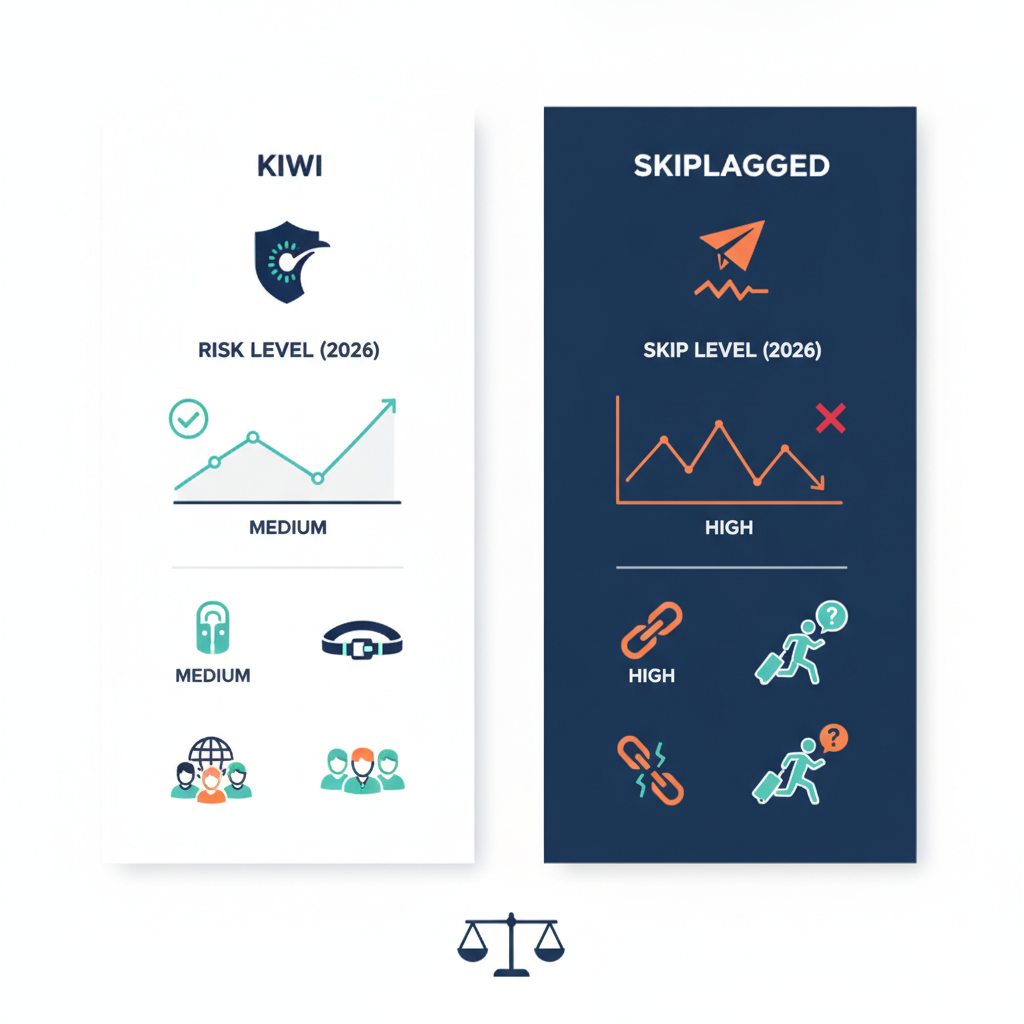
For travel hacking in 2026, Kiwi is generally the less risky option compared to Skiplagged. Kiwi specializes in virtual interlining, combining flights from non-partner airlines, and offers an optional Kiwi Guarantee to protect against self-transfer disruptions. Skiplagged, while often finding cheaper hidden city fares, relies on a controversial method that airlines can penalize, offers no baggage protection, and provides minimal support for issues arising from this high-risk strategy. Your choice depends on your risk tolerance: Kiwi for managed complexity, Skiplagged for extreme savings with extreme risk.
Rating Summary
Understanding the nuances of travel hacking sites like Kiwi and Skiplagged requires a breakdown of their performance across critical dimensions. Our 2026 evaluation focuses on factors that directly impact savings, transparency, flexibility, and crucially, risk.
Kiwi Rating Breakdown
| Dimension | Score | Notes |
|---|---|---|
| Price & Value | 8.0/10 | Competitive for complex routes, especially with multi-carrier combinations, but final price needs careful checking. |
| Transparency & Fees | 7.5/10 | Service fees are generally clear, but baggage and self-transfer implications require traveler diligence. |
| Flexibility, Changes & Cancellation | 7.0/10 | Options exist, but depend on fare rules and the Kiwi Guarantee; changes can be complex and costly. |
| Refunds & Disruption Support | 7.5/10 | Kiwi Guarantee provides a safety net for covered disruptions, but standard refunds are tied to airline policies. |
| Customer Support & Reliability | 6.8/10 | Support channels are available, but response times and resolution for complex, multi-carrier issues can be challenging. |
| Travel Risk Fit | 6.5/10 | Medium risk due to self-transfers, but the optional Kiwi Guarantee significantly mitigates this for cautious travelers. |
| Overall Rating | 7.2/10 | Best for: adventurous travelers who understand self-transfer risks and value route discovery with a layer of optional protection. |
Skiplagged Rating Breakdown
| Dimension | Score | Notes |
|---|---|---|
| Price & Value | 8.5/10 | Often finds exceptionally low prices for hidden city routes, offering high value for specific, high-risk scenarios. |
| Transparency & Fees | 6.0/10 | Base fares are clear, but the inherent risks of hidden city are not always front-and-center; baggage fees are a major hidden cost due to policy. |
| Flexibility, Changes & Cancellation | 5.0/10 | Extremely limited; hidden city tickets are typically non-changeable/non-refundable, and any changes can expose the hidden city practice. |
| Refunds & Disruption Support | 4.5/10 | Minimal to non-existent for issues related to hidden city travel; travelers are largely on their own. |
| Customer Support & Reliability | 5.5/10 | Basic support for booking issues, but cannot effectively assist with problems arising from airline opposition to hidden city ticketing. |
| Travel Risk Fit | 4.0/10 | Very high risk due to hidden city ticketing, potential for airline penalties, and complete lack of protection for missed final legs. |
| Overall Rating | 6.5/10 | Best for: extreme budget travelers who are fully aware of hidden city risks, travel light, and prioritize savings above all else. |
Where Kiwi Wins, Where Skiplagged Wins, and Where it Depends
Kiwi clearly wins in areas related to Travel Risk Fit and Refunds & Disruption Support, primarily due to its Kiwi Guarantee. This optional add-on, while not foolproof, provides a structured response to disruptions that is simply not available with Skiplagged's hidden city model. Kiwi also offers a more transparent booking process regarding the separate nature of tickets, allowing travelers to anticipate self-transfer requirements.
Skiplagged, conversely, excels primarily in Price & Value for those specific hidden city routes it uncovers. When a hidden city fare aligns perfectly with a traveler's desired destination, the savings can be truly unparalleled, often beating even Kiwi's lowest fares. However, this comes at a significant cost to Transparency & Fees (especially concerning baggage) and severely limits Flexibility, Changes & Cancellation.
The decision often depends heavily on the traveler's risk tolerance and travel style. If mitigating unexpected disruptions is a priority, even with complex itineraries, Kiwi is the better choice. If securing the absolute lowest price for a one-way trip, with minimal luggage, and a full understanding of the associated airline policy risks is paramount, then Skiplagged might appeal. The most important scoring category for this niche is undeniably Travel Risk Fit, as the very nature of these platforms involves unconventional booking methods that deviate from standard airline practices.
Which Is Better: Kiwi or Skiplagged for Travel Hacking in 2026?
When evaluating Kiwi vs Skiplagged in 2026, the question of which is "better" is deeply nuanced, hinging entirely on a traveler's risk appetite, specific travel needs, and understanding of unconventional ticketing methods. For the majority of travelers seeking cost-effective flights through non-traditional means, Kiwi generally stands out as the more versatile and comparatively less risky option. Its strength lies in aggregating flights from disparate airlines to form unique, cheaper itineraries, often involving self-transfers. While this still requires traveler diligence, Kiwi's optional guarantee offers a form of protection against common disruptions like missed connections, a crucial benefit that Skiplagged simply cannot match.
Skiplagged, on the other hand, is the undisputed champion for discovering hidden city fares, which can sometimes offer truly astonishing price reductions. However, this comes with a heightened level of risk, as hidden city ticketing often violates airline terms and conditions. Airlines may cancel subsequent legs of a journey, void frequent flyer miles, or even ban passengers if the practice is discovered. Therefore, while Skiplagged can be better for extreme budget buyers looking for the absolute rock-bottom price on a one-way flight with carry-on luggage, it is a choice reserved for those fully prepared to accept these significant potential consequences.
For advanced users who thoroughly understand the intricacies of flight segments, layovers, and airline policies, Kiwi's extensive route permutations provide a powerful tool for global exploration. Its broad coverage allows for creative multi-city and international itineraries that traditional OTAs often miss. For the budget-conscious, both offer savings, but Kiwi's approach is generally more sustainable and less confrontational with airlines. In terms of long-term ownership, Kiwi's model is arguably more robust as it operates within a more accepted, albeit complex, framework of separate tickets, compared to Skiplagged's reliance on a practice that airlines actively try to prevent. Ultimately, the decision revolves around whether you prioritize a slightly more managed risk with broader options (Kiwi) or extreme savings with extreme risk (Skiplagged).
Key Differences Between Kiwi and Skiplagged
The fundamental distinctions between Kiwi and Skiplagged lie in their core flight-finding methodologies, the types of risks they introduce, and their approach to traveler support. Understanding these differences is crucial for any traveler considering either platform in 2026.
Kiwi's primary innovation is 'virtual interlining.' This technology allows it to combine flights from airlines that do not typically codeshare or have interline agreements. For instance, it might pair a budget airline flight with a legacy carrier flight, or two separate budget airline flights, to reach a final destination cheaper than booking a single ticket through a traditional carrier. The catch is that these are often booked as separate tickets, meaning travelers are responsible for rechecking their baggage, passing through immigration (if applicable), and re-clearing security during layovers. Kiwi offers a 'Kiwi Guarantee' as an optional add-on, which promises rebooking or refunds if a disruption (like a delay or cancellation) on one leg causes a traveler to miss a subsequent, separate leg. This is a significant differentiator in terms of risk mitigation.
Skiplagged, conversely, specializes in 'hidden city' ticketing. This involves booking a flight where your actual desired destination is a layover city, not the final destination on the ticket. For example, if you want to fly from City A to City B, Skiplagged might find a cheaper flight from City A to City C that has a layover in City B. You book the A-C flight, get off at City B, and simply skip the final B-C leg. This strategy is highly effective for finding rock-bottom prices, especially for one-way trips, but it comes with severe limitations: you cannot check bags (as they would go to the final destination, C), and airlines explicitly prohibit this practice in their terms and conditions. Discovery by the airline can lead to penalties, including the cancellation of future tickets, loss of frequent flyer miles, or even being banned from the airline. Skiplagged offers no protection or support if an airline detects or penalizes this behavior.
In essence, Kiwi focuses on complex but legitimate itinerary construction that requires traveler awareness, while Skiplagged focuses on controversial but deeply discounted itinerary exploitation that carries significant airline-related risks. Kiwi's model is designed for broader, multi-stop international travel, whereas Skiplagged is hyper-focused on single-direction, domestic (or short-haul international) hidden city opportunities.
Feature Breakdown: Kiwi vs Skiplagged
| Feature | Kiwi | Skiplagged |
|---|---|---|
| Core Strategy | Virtual Interlining (combining separate tickets from non-partner airlines). | Hidden City Ticketing (booking beyond desired destination to use layover). |
| Primary Savings Method | Unconventional route combinations, leveraging low-cost carriers. | Exploiting pricing inefficiencies on multi-leg routes. |
| Risk Disclosure | Explicit warnings for self-transfers, optional Kiwi Guarantee available. | Generally highlights savings; inherent hidden city risks are less emphasized upfront. |
| Self-Transfer Focus | Central to its model; travelers must be aware of rechecking bags, visas, etc. | Not a core focus, but some standard itineraries may involve transfers. |
| Hidden City Focus | Not a primary feature; may show some, but not its core selling point. | The primary offering; excels at finding these specific fares. |
| Baggage Implications | Checked bags require rechecking during self-transfers. | Strictly carry-on only for hidden city flights. |
| Support for Disruptions | Kiwi Guarantee (optional) provides rebooking/refunds for covered issues. | Minimal direct support for hidden city-related issues; traveler is on their own. |
| Airline Relationship | Books separate tickets, generally within airline terms for each segment. | Facilitates bookings that often violate airline terms and conditions. |
| App Functionality | Robust app for search, booking, itinerary management, and alerts. | Good app for search and booking, less focused on in-trip disruption management for complex issues. |
| Where to Buy | View Deal |
Search and Booking Experience: Navigating Complexity
The search and booking experience on both Kiwi and Skiplagged is designed to surface complex itineraries, but they do so with differing levels of transparency and user guidance. In 2026, both platforms offer relatively intuitive interfaces for initial searches, but the subsequent steps reveal their distinct philosophies regarding traveler education and risk management.
Kiwi's search experience is highly flexible and powerful. Users can input broad search criteria, such as "anywhere" for a destination, or flexible dates, making it excellent for destination discovery based on budget. Its strength lies in its ability to combine flights from numerous carriers, including low-cost airlines, to construct unique routes. When a self-transfer itinerary is found, Kiwi is generally explicit about it. It clearly marks segments as "self-transfer," often highlights the required time between flights, and provides warnings about baggage implications and potential visa requirements. The checkout flow, while involving multiple steps due to the separate nature of tickets, is designed to guide users through the process. Upsells for the Kiwi Guarantee, travel insurance, and other extras are prominent but optional. The mobile app mirrors the desktop experience, offering robust search filters, price alerts, and itinerary management, which is crucial for monitoring complex multi-leg journeys.
Skiplagged's search experience is streamlined for identifying hidden city fares. When you search for a route, it displays both direct flights (often more expensive) and "Skiplagged Fares" which are the hidden city options. These fares are presented with a clear price advantage, and the platform usually provides a brief explanation of how hidden city ticketing works. However, the inherent risks - such as the inability to check bags, the potential for airline penalties, or what happens if the airline changes the schedule or reroutes the flight - are not always as prominently displayed during the booking flow as the self-transfer risks are on Kiwi. The booking process itself is straightforward once a hidden city fare is selected, often redirecting to an OTA or airline for the actual purchase. The mobile app is efficient for finding deals but offers less in the way of comprehensive itinerary management for managing complex disruptions, especially those stemming from airline policy violations. The simplicity of Skiplagged's booking flow for hidden city fares can be deceptive, as it masks a higher underlying risk profile that requires significant traveler understanding outside of the platform's immediate guidance.
For travelers prioritizing clarity around operational complexities like self-transfers, Kiwi's interface provides more upfront information. For those solely focused on the lowest price and already deeply familiar with hidden city caveats, Skiplagged's direct presentation of those fares is effective. The key difference lies in what kind of complexity each platform chooses to emphasize or provide solutions for.

Pricing and Value for Money: Unpacking the Real Cost
When comparing Kiwi and Skiplagged in 2026, the perceived "cheapness" of flights is often the primary draw, but understanding the true pricing and value for money requires a deep dive into base fares, service fees, and the hidden costs associated with their unique booking models. The cheapest upfront price doesn't always translate to the best total value, especially when factoring in risk.
Kiwi's pricing model: Kiwi often displays highly competitive fares by leveraging its virtual interlining technology. This means it can combine budget carriers and traditional airlines in ways that traditional search engines might not. The base prices can be significantly lower, especially for complex international itineraries. However, travelers must be vigilant about the final price. Kiwi charges a service fee, which is added at checkout. More importantly, the value proposition includes an optional 'Kiwi Guarantee' which, while adding to the cost, provides a safety net for self-transfer disruptions. For travelers with checked baggage, the cost of rechecking bags between separate tickets needs to be factored in, as does the potential for unexpected visa costs if an international layover requires entering a country. The value for money with Kiwi is high for those who can navigate the complexities of self-transfers and appreciate the optional disruption protection.
Skiplagged's pricing model: Skiplagged excels at finding exceptionally low 'hidden city' fares. These prices can be dramatically cheaper than direct flights or even standard multi-leg flights, sometimes offering savings of 30-50% or more on specific routes. This makes its base price competitiveness very strong for its niche. Skiplagged's service fees are typically minimal or absorbed into the fare, making the initial price appear incredibly attractive. However, the hidden costs are substantial and often indirect. The biggest "cost" is the absolute inability to check baggage on a hidden city flight, as it would go to the ticketed final destination, not your intended layover. This forces travelers into carry-on only, which might not be practical for everyone. Furthermore, the value equation must account for the high risk of airline penalties - potential bans, loss of frequent flyer miles, or even cancellation of future bookings - which are intangible but very real costs if the practice is detected. For a very specific, light-traveling, risk-tolerant segment, Skiplagged offers unparalleled price value, but for others, the hidden costs and risks far outweigh the savings.
In summary, while Skiplagged can offer lower absolute prices for specific hidden city routes, Kiwi's overall value proposition is often stronger when considering the total trip cost, including baggage, and the crucial aspect of disruption protection. The pricing table below illustrates these considerations:
Pricing and Value Comparison
| Cost Factor | Kiwi | Skiplagged |
|---|---|---|
| Base Price Competitiveness | Very good for multi-carrier, complex routes. | Excellent for specific hidden city routes. |
| Service Fees | Typically visible at checkout, can add to total. | Often minimal or integrated, less impact on displayed price. |
| Baggage Handling | Checked bags require rechecking during self-transfers; fees apply per airline. | Strictly carry-on only for hidden city; checked bags impossible. |
| Hidden Costs Risk | Potential for unexpected visa costs on international self-transfers. | High risk of airline penalties (bans, lost miles) for policy violation. |
| Value for Complex Routes | High, especially with Kiwi Guarantee for peace of mind. | Limited, as its strength is primarily one-way hidden city. |
| Value for Extreme Discounts | Good, but rarely as extreme as Skiplagged's hidden city finds. | Exceptional, but only for those willing to accept significant risk. |
| Where to Buy | View Deal |
Always remember to check the final price at checkout, including all fees, and consider the real implications of baggage and potential airline penalties before committing to either platform.
Compare current deals on Kiwi.
Pros and Cons: Weighing the Trade-offs
Choosing between Kiwi and Skiplagged involves a careful assessment of their respective advantages and disadvantages. Both platforms offer unique benefits for budget travel in 2026, but they also come with significant trade-offs that every traveler must consider.
Kiwi: Pros and Cons
Pros:
- Extensive Route Combinations: Kiwi excels at finding unique, often cheaper, routes by combining flights from numerous non-partner airlines, opening up destinations that might otherwise be unaffordable.
- Kiwi Guarantee: This optional protection offers rebooking or refunds for covered disruptions on self-transfer itineraries, providing a crucial safety net that is rare in this segment.
- Flexible Search Tools: Its "anywhere" search and flexible date options make it excellent for inspiring travel and finding deals without a fixed destination.
- Transparent Self-Transfer Warnings: Kiwi is generally clear about segments requiring self-transfers, baggage recheck, and potential visa implications, allowing for informed decisions.
- Broader Travel Options: Beyond virtual interlining, Kiwi also offers standard flights, hotels, and car rentals, making it a more comprehensive booking platform.
- App Itinerary Management: The app is useful for tracking complex itineraries and receiving alerts for changes.
- Legitimate Booking Model: While complex, virtual interlining is generally within the bounds of airline terms, reducing the risk of outright airline penalties for the booking method itself.
Cons:
- Self-Transfer Risks: Despite the guarantee, self-transfers inherently carry risks like tight connection times, unexpected delays, and the hassle of rechecking bags and clearing security/immigration. This can be a deal-breaker for travelers with mobility issues or tight schedules.
- Complex Refund Process (without Guarantee): If not covered by the Kiwi Guarantee, refunds are subject to individual airline policies for each separate ticket, which can be a lengthy and frustrating process.
- Customer Support Challenges: While available, resolving issues for multi-carrier, separate-ticket itineraries can be more time-consuming and complex than with single-airline bookings.
- Potential for Long Layovers: To achieve lower prices, some itineraries may involve very long or inconvenient layovers.
- Service Fees: Kiwi charges a service fee on top of the base fare, which can sometimes diminish the savings.
- Baggage Recheck Hassle: For international self-transfers, travelers with checked bags must collect, recheck, and often pay additional baggage fees for each separate airline. This is a minor trade-off for light travelers but a significant one for others.
Skiplagged: Pros and Cons
Pros:
- Unbeatable Hidden City Fares: Skiplagged often finds the absolute lowest prices for specific routes by leveraging hidden city ticketing, offering significant savings that no other platform can match.
- Simple Interface for Hidden City Deals: It clearly presents "Skiplagged Fares" alongside standard options, making it easy to identify potential hidden city savings.
- One-Way Focus: Particularly strong for one-way hidden city flights, which is a common use case for this type of travel hack.
- Quick Price Comparison: Excellent for a rapid check to see if a hidden city option exists for a desired route.
- Minimal Service Fees: Often has very low or no additional service fees, making the displayed price very close to the final cost.
Cons:
- High Airline Penalty Risk: The biggest deal-breaker is the risk of violating airline terms and conditions, which can lead to canceled flights, lost frequent flyer miles, or even being banned by the airline.
- No Checked Baggage: For hidden city flights, checking a bag is impossible as it will be routed to the final destination on the ticket, not your layover city. This is a major limitation for many travelers.
- No Disruption Protection: Skiplagged offers no guarantee or support if a flight is delayed, canceled, or rerouted, potentially stranding travelers or exposing their hidden city practice.
- Limited Flexibility: Hidden city tickets are typically non-changeable and non-refundable. Any attempt to change can flag the booking or incur significant costs.
- No Round Trips: Generally not viable for round trips, as skipping a leg will often result in the cancellation of all subsequent flights in the itinerary.
- Ethical Concerns: Some travelers may feel uncomfortable with a practice that actively circumvents airline pricing structures, potentially impacting future fare structures.
- Minimal Customer Support for Issues: Skiplagged's support cannot effectively assist with problems arising from airline opposition to hidden city ticketing. This is a major trade-off for urgent travel problems.
Search and Booking Experience: User Interface and Complexity Management
The user experience on travel booking sites in 2026 is critical, especially for platforms that deal with complex itineraries. Both Kiwi and Skiplagged offer distinct search and booking experiences tailored to their respective travel hacking strategies, impacting how easily users can find, understand, and book their unconventional flights.
Kiwi's interface is designed for comprehensive route discovery. Upon landing on Kiwi's website or app, users are greeted with a clean search interface that encourages flexibility. Its standout features include the "Everywhere" search option, allowing users to find the cheapest destinations from a given origin, and a flexible date calendar that highlights the lowest fares across a month or even a year. These tools are invaluable for budget travelers without fixed plans. When results are displayed, Kiwi effectively uses color-coding and clear labels to indicate self-transfer segments, virtual interlining, and the minimum recommended connection times. This visual guidance helps users understand the operational complexities upfront. The checkout process, while more involved than a single-airline booking, provides detailed breakdowns of each flight segment, baggage rules, and the cost of the optional Kiwi Guarantee. This level of transparency, coupled with a relatively smooth payment experience, makes navigating complex itineraries manageable for informed users. The mobile app is robust, offering real-time updates and an organized itinerary view, which is essential for tracking multi-leg journeys on the go.
Skiplagged's interface prioritizes showcasing hidden city deals. Its search page is straightforward, allowing users to quickly input origin and destination. The results page prominently features "Skiplagged Fares" alongside traditional flights, making the unique savings immediately apparent. The platform provides a brief, clear explanation of hidden city ticketing when these fares are selected, advising users about the carry-on-only rule. This directness is appealing to users who are already familiar with the concept and are solely focused on the price advantage. However, beyond this initial explanation, the interface offers less in the way of detailed risk management or contingency planning. The booking handoff is typically smooth, often directing users to a third-party OTA or the airline itself to complete the purchase. While the mobile app is efficient for searching and booking, it doesn't offer the same depth of in-trip management or disruption support as Kiwi, particularly for issues arising from the hidden city practice. For instance, if a flight is canceled or rerouted, the app won't provide guidance on how to avoid exposing your hidden city intent, leaving the traveler to manage the situation independently.
In essence, Kiwi's user experience is about managing the inherent complexity of virtual interlining with tools and information, while Skiplagged's experience is about efficiently surfacing a high-risk deal with minimal on-platform guidance for the unique challenges it creates. Travelers who prefer more hand-holding and informational transparency will lean towards Kiwi, whereas those who prefer raw price discovery and self-reliance will find Skiplagged's directness appealing.
Flexibility, Changes, and Cancellations: A High-Stakes Game
Flexibility and the ability to change or cancel a booking are paramount for modern travelers in 2026, especially when dealing with the unconventional itineraries offered by Kiwi and Skiplagged. However, the nature of their respective booking models makes these processes significantly more complex and often less forgiving than traditional bookings.
Kiwi's approach to flexibility and cancellations: With Kiwi, flexibility is a mixed bag. Since virtual interlining involves separate tickets, each segment is subject to its individual airline's fare rules. This means a non-refundable budget airline ticket remains non-refundable, regardless of other segments. Kiwi does offer various fare types, some of which may allow changes or cancellations for a fee, but these are often more expensive. The crucial element here is the Kiwi Guarantee. If you purchase this optional add-on, and a delay or cancellation on one leg causes you to miss a subsequent, separate leg, Kiwi will rebook you on the next available flight or provide a refund. This provides a significant layer of flexibility for unforeseen disruptions, essentially making the separate tickets behave more like a protected connection. Without the guarantee, if you miss a self-transfer flight due to a delay on the first leg, you're generally on your own, and the subsequent ticket is forfeited. Initiating a cancellation through Kiwi typically involves their support team, who then liaise with the individual airlines, which can be a time-consuming process with outcomes dependent on each airline's policy.
Skiplagged's approach to flexibility and cancellations: Flexibility and cancellations are almost non-existent for hidden city bookings on Skiplagged. Because hidden city ticketing often involves booking a flight with the intent to skip the final leg, any attempt to change or cancel can expose this practice to the airline. Airlines typically have strict rules against this and may cancel the entire itinerary or refuse refunds. Hidden city fares are almost always non-refundable and non-changeable to begin with, offering zero flexibility. If a traveler needs to change plans or cancel, they usually forfeit the entire ticket value. Furthermore, if an airline changes the flight schedule or reroutes the flight, it can completely undermine the hidden city strategy, and Skiplagged offers no recourse or support in such scenarios. This extreme lack of flexibility is a core component of the hidden city risk profile, making it suitable only for travelers with highly stable plans and a high tolerance for potential loss.
In summary, while neither platform offers the inherent flexibility of a fully refundable direct booking, Kiwi's optional guarantee provides a valuable, albeit paid, layer of protection for disruptions that significantly improves its flexibility for complex itineraries. Skiplagged, by contrast, offers virtually no flexibility or protection for its hidden city fares, making it a high-risk choice for any traveler whose plans might change or whose flights might be disrupted.
Customer Support and Disruption Handling: When Things Go Wrong
The true test of any travel booking platform's reliability comes when things inevitably go wrong. For sites specializing in travel hacking like Kiwi and Skiplagged, understanding their customer support mechanisms and how they handle disruptions in 2026 is paramount, as these situations often involve multiple carriers and complex policies.
Kiwi's customer support and disruption handling: Kiwi offers customer support through various channels, including live chat, email, and phone, though access to immediate human support can sometimes vary. For standard bookings, their support team acts as an intermediary with the airlines. However, for their signature virtual interlining itineraries, the Kiwi Guarantee is the cornerstone of their disruption handling. If a delay, cancellation, or schedule change on one flight causes a traveler to miss a connecting flight (booked separately), and the guarantee was purchased, Kiwi promises to either rebook the traveler on the next available flight to their destination or provide a refund for the unused portion of the trip. This is a significant advantage, as it shifts the burden of rebooking and compensation from the traveler to Kiwi. However, the process still requires contacting Kiwi's support, and resolution times can vary depending on the complexity of the issue and the availability of alternative flights. Travelers report that while the guarantee is valuable, the process of claiming it and getting rebooked can still be stressful and time-consuming during active travel disruptions.
Skiplagged's customer support and disruption handling: Skiplagged's customer support is primarily geared towards assisting with the initial booking process and general inquiries. They offer support via email and sometimes live chat. However, when it comes to handling disruptions, especially those related to hidden city ticketing, their support is minimal to non-existent. Because hidden city flights violate airline terms, Skiplagged cannot (and will not) intervene if an airline detects the practice, cancels a flight, or penalizes the traveler. If an airline changes a flight schedule or cancels a segment, and this ruins the hidden city strategy, the traveler is entirely on their own to find alternative transportation, often at significant personal cost. Skiplagged does not offer any form of disruption protection or guarantee comparable to Kiwi's. Travelers using Skiplagged for hidden city fares must assume full responsibility for any and all potential disruptions and be prepared to handle them independently, often requiring booking new flights out-of-pocket. This makes Skiplagged a high-risk option for anyone who values robust support during travel emergencies.
In essence, Kiwi's support, particularly with its guarantee, aims to provide a solution for complex itinerary disruptions, albeit sometimes with delays. Skiplagged's support, for its core hidden city product, offers almost no safety net, placing the entire burden of risk and resolution squarely on the traveler. For critical travel scenarios, this difference in support can be a deal-breaker, making Kiwi the significantly less risky choice from a disruption handling perspective.
Trust, Safety, and Traveler Risk: The Core Dilemma
The question of trust, safety, and traveler risk is at the heart of the Kiwi vs Skiplagged comparison in 2026. Both platforms operate outside the traditional booking paradigm, introducing varying degrees of risk that demand careful consideration from travelers.
Kiwi's trust and safety profile: Kiwi operates as a legitimate online travel agency that specializes in virtual interlining. While the concept of separate tickets and self-transfers carries inherent operational risks (like missing a connection if the first flight is delayed), Kiwi's business model itself is generally not in direct violation of airline terms and conditions. The individual flights are booked as separate contracts with each airline. Payment security is standard, using secure payment gateways. The primary risks with Kiwi revolve around the practicalities of self-transfer: ensuring enough layover time, rechecking baggage, and potentially needing visas for transit countries. However, the presence of the optional Kiwi Guarantee significantly enhances traveler confidence and safety. This guarantee acts as an insurance policy, promising rebooking or refunds in case of covered disruptions, effectively mitigating much of the financial risk associated with missed self-transfers. While customer support resolution can be slow, the existence of a formal process for disruption handling builds a level of trust. Kiwi also provides clear warnings about the nature of self-transfers, empowering travelers to make informed decisions about their itinerary's complexity.
Skiplagged's trust and safety profile: Skiplagged's hidden city ticketing model introduces a much higher level of traveler risk and raises significant trust issues with airlines. While booking through Skiplagged is technically possible and often results in very cheap fares, the practice of hidden city ticketing is explicitly prohibited by most airlines in their Conditions of Carriage. Airlines view this as a breach of contract and revenue manipulation. If an airline detects that a traveler has intentionally skipped a flight segment (especially if it's a pattern, or if they try to check baggage), they can impose severe penalties. These include:
- Cancellation of all subsequent flights in the itinerary (if it's not a one-way).
- Voiding of frequent flyer miles or status.
- Charging the difference between the hidden city fare and the direct fare.
- Banning the traveler from future flights with that airline.
Skiplagged itself states that it "discloses hidden-city flights to you, which are not usually sold by other travel sites." However, it offers no protection against airline retaliation. Payment security is generally handled by the underlying booking provider (airline or OTA), but the risk to the traveler comes from the booking strategy itself, not the payment process. This fundamental conflict with airline policies means that using Skiplagged for hidden city fares carries a very high level of travel risk, primarily from the airline, not from Skiplagged as a platform. Travelers must fully understand that they are engaging in a practice that could have serious consequences beyond just a missed flight.
In terms of overall safety and risk, Kiwi, while requiring careful planning for self-transfers, operates within a more accepted framework and offers a tangible safety net. Skiplagged, by facilitating a practice that violates airline rules, places travelers at a much higher, unmitigated risk of airline penalties and lack of support during disruptions. For most travelers, Kiwi represents a significantly safer option for travel hacking in 2026.
App and In-Trip Experience: Managing Your Journey on the Go
In 2026, a seamless mobile experience is critical for managing travel, especially for complex itineraries. Both Kiwi and Skiplagged offer dedicated apps, but their utility during the actual trip, particularly when disruptions occur, differs significantly based on their core business models.
Kiwi's app and in-trip experience: Kiwi's mobile app is a robust tool designed to support travelers throughout their journey, particularly those on virtual interlining itineraries. Once a booking is confirmed, the app serves as a centralized hub for all flight details, boarding passes, and booking confirmations across multiple carriers. Key features include real-time flight status updates, gate change notifications, and push alerts for potential delays or cancellations. This is invaluable for self-transfer scenarios, where even a small delay on one leg can have cascading effects. For travelers who have purchased the Kiwi Guarantee, the app is also the primary point of contact for initiating support requests in case of a missed connection. While resolution might still require human interaction, the ability to quickly access information and start the support process from your phone is a significant advantage. The app also offers offline access to itineraries, which is incredibly useful when international roaming is unavailable or unreliable. For managing the inherent complexities of multi-segment, multi-carrier travel, Kiwi's app is a strong performer, actively attempting to mitigate in-trip stress.
Skiplagged's app and in-trip experience: Skiplagged's mobile app is primarily focused on its strength: finding cheap hidden city fares. The search and booking functionality within the app is efficient and user-friendly, allowing travelers to quickly identify and book deals. However, its utility for in-trip management, especially concerning potential disruptions or the unique challenges of hidden city ticketing, is far more limited. The app will provide basic flight details, but it offers little in the way of real-time alerts or proactive support for hidden city bookings. If a flight is delayed, canceled, or rerouted, which could expose or ruin the hidden city strategy, the app does not provide specific guidance or mechanisms for support. Travelers are expected to manage these situations independently, relying on the operating airline's app or website, and being careful not to reveal their hidden city intent. There's no equivalent to Kiwi's disruption handling within the Skiplagged app for its core product. While useful for initial booking, the Skiplagged app essentially leaves the traveler to their own devices once the journey begins, particularly for the high-risk hidden city itineraries.
For travelers embarking on complex journeys, the in-trip support and information provided by Kiwi's app offer a much-needed layer of confidence and practical assistance. Skiplagged's app, while excellent for finding deals, falls short in providing the necessary tools and support for managing the heightened risks of hidden city travel once the trip is underway. This makes Kiwi the superior choice for overall app and in-trip experience, particularly for managing potential disruptions.
Use-Case Segmentation: Who Should Choose Which?
Deciding between Kiwi and Skiplagged in 2026 boils down to matching their unique offerings and risk profiles with your specific travel needs and preferences. Both serve distinct segments of the budget travel market.
Traveler Type Comparison
| Traveler Type | Choose Kiwi If... | Choose Skiplagged If... |
|---|---|---|
| Budget Traveler | You want to find the cheapest overall route for complex, multi-carrier itineraries, and are okay with self-transfers (especially with the Kiwi Guarantee). | You need the absolute lowest price for a one-way trip, understand hidden city risks, and travel with only carry-on luggage. |
| Families | You are comfortable with self-transfers but prioritize the optional Kiwi Guarantee for peace of mind against disruptions. | Avoid. Hidden city ticketing is too risky for families due to baggage limitations, potential for being stranded, and airline penalties. |
| Business Traveler | You need to optimize costs for complex international routes and are willing to manage self-transfers, especially if your company allows the Kiwi Guarantee. | Avoid. Business travel requires reliability, checked bags, and adherence to airline policies, all of which hidden city ticketing compromises. |
| Flexible Traveler | You have flexible dates and destinations, want to explore the cheapest routes globally, and are open to longer layovers for savings. | You have extremely flexible plans and can easily adapt to potential disruptions or rebook on short notice without recourse. |
| Low-Risk Traveler | Avoid. Even with the Kiwi Guarantee, self-transfers introduce more risk than traditional bookings. Consider booking direct or with a full-service OTA. | Absolutely Avoid. Hidden city ticketing is inherently high-risk and not suitable for travelers prioritizing safety and certainty. |
| International Traveler | You're looking for complex international routes, often combining different airlines, and are diligent about visa requirements and baggage recheck. | You're traveling one-way internationally to a specific layover city, with only carry-on, fully aware of potential immigration and airline issues. |
| Last-Minute Traveler | You need to find the quickest and cheapest available route, even if it involves complex transfers. | You're trying to snag a last-minute deal for a one-way flight, accepting the high risks involved. |
| Solo Traveler | You're independent, comfortable navigating airports, and value cost savings for extensive solo adventures. | You're an experienced solo traveler who is highly self-reliant and prioritizes extreme savings above all else. |
Real-World Scenarios: Choosing the Right Travel Hack Site
Let's consider a few practical scenarios in 2026 to illustrate when a traveler might choose Kiwi over Skiplagged, or vice versa, focusing on the "less risky" aspect.
Scenario 1: The Budget-Conscious Solo Traveler - Milan to Tokyo
Imagine Alex, a solo traveler in Milan, wants to fly to Tokyo as cheaply as possible for a three-week backpacking trip. He has only a large backpack (carry-on size) and is flexible on layovers. He's heard about both Kiwi and Skiplagged.
- Kiwi Approach: Alex searches Milan to Tokyo on Kiwi with flexible dates. Kiwi might find an itinerary like Milan to Istanbul on a budget carrier, followed by a separate ticket from Istanbul to Tokyo on a different airline. The total cost is significantly less than a direct flight. Kiwi clearly highlights the self-transfer in Istanbul, advising him to allow ample time and recheck his bag (if he had one, which he doesn't). He opts for the Kiwi Guarantee for a small extra fee, giving him peace of mind that if the first flight is delayed, Kiwi will help him rebook to Tokyo. This is a complex but manageable itinerary.
- Skiplagged Approach: Alex searches Milan to Tokyo on Skiplagged. Skiplagged might find a hidden city fare, perhaps Milan to Seoul with a layover in Tokyo, which is cheaper than a direct Milan-Tokyo flight. The savings are enticing. However, Alex must be acutely aware that he cannot check his large backpack (it would go to Seoul), and skipping the Tokyo-Seoul leg could lead to airline penalties. If the flight is rerouted due to weather or an operational issue and no longer stops in Tokyo, his plan is ruined, and he has no recourse.
- Decision: Alex, valuing some level of protection and the ability to combine various airlines for a global journey, chooses Kiwi with the Kiwi Guarantee. While the self-transfer is a hassle, the guarantee mitigates the highest risk, and his carry-on only status makes it easier. Skiplagged's hidden city risk is too high for an international trip where he needs to ensure arrival in Tokyo.
Scenario 2: The Urgent Business Trip - New York to Chicago (one-way)
Sarah needs to fly from New York to Chicago next week for an urgent business meeting. Her company has a strict travel budget, but she absolutely cannot miss the meeting. She travels with a small carry-on bag and needs reliability.
- Kiwi Approach: Kiwi might find a slightly cheaper, multi-segment route involving a self-transfer through a regional airport, combining two different low-cost carriers. While cheaper, the self-transfer introduces a risk of missing the connection, even with the Kiwi Guarantee, which might involve rebooking on a later flight. For an urgent business meeting, any delay is unacceptable.
- Skiplagged Approach: Skiplagged might find a hidden city fare, e.g., New York to Denver with a layover in Chicago, significantly cheaper than a direct New York-Chicago flight. Sarah could use this, but the risk of airline detection, or worse, a last-minute schedule change that bypasses Chicago, is too high for a critical meeting. Her company also wouldn't approve of violating airline terms.
- Decision: Sarah, prioritizing reliability and adherence to company policy over extreme savings for a critical business trip, chooses neither. She opts for a traditional booking directly with a reputable airline or a full-service OTA, even if it's slightly more expensive. The risk introduced by both Kiwi's self-transfers and Skiplagged's hidden city is incompatible with her need for certainty.
Scenario 3: The Adventure Seeker - Exploring Southeast Asia (multi-city)
Maria wants to travel from Bangkok to multiple cities in Southeast Asia over a month, with no fixed itinerary, seeking the cheapest way to hop between destinations. She travels very light.
- Kiwi Approach: Maria uses Kiwi's multi-city and "Everywhere" search functions. Kiwi excels at piecing together flights from various budget airlines across Southeast Asia, often finding incredibly cheap connections between smaller airports. Each leg is a separate ticket, but she's used to self-transfers and values the broad route discovery. She might purchase the Kiwi Guarantee for longer or more critical transfers.
- Skiplagged Approach: Skiplagged might find some cheap hidden city options for individual legs, e.g., Bangkok to Hanoi via Kuala Lumpur. However, using hidden city for multiple legs is extremely risky, as skipping one leg could cancel subsequent flights if they are on the same airline. The constant need to book one-way hidden city flights for each segment would be cumbersome and prone to error.
- Decision: Maria chooses Kiwi. Its ability to create complex, multi-city itineraries using virtual interlining is perfectly suited for her adventure. While self-transfers are part of the deal, the overall flexibility and the ability to add the Kiwi Guarantee for peace of mind make it the far less risky and more practical choice for a month-long, multi-destination trip.
Final Verdict: Navigating Risk and Reward in 2026 Travel Hacking
In the evolving landscape of online travel in 2026, both Kiwi and Skiplagged offer compelling propositions for travelers seeking to drastically cut flight costs. However, their methods and the associated risks are fundamentally different, making the choice between them a critical decision based on individual risk tolerance and travel priorities. After a comprehensive review, the verdict is clear: Kiwi is generally the less risky travel hack site compared to Skiplagged.
Kiwi's strength lies in its innovative 'virtual interlining' technology, which constructs complex itineraries by combining flights from non-partner airlines. While this inherently involves self-transfers and requires traveler diligence, Kiwi mitigates much of the associated financial risk through its optional 'Kiwi Guarantee.' This guarantee provides a crucial safety net, offering rebooking or refunds in the event of covered disruptions. Kiwi's broader search capabilities, transparent warnings about self-transfers, and more robust in-app itinerary management make it a more versatile and manageable platform for adventurous budget travelers who are prepared for some complexity but still value a layer of protection.
Skiplagged, on the other hand, is the go-to for 'hidden city' ticketing, a strategy that can yield truly extraordinary savings on specific one-way routes. However, this comes at a significantly higher, unmitigated risk. Hidden city ticketing often violates airline terms and conditions, potentially leading to severe penalties, including flight cancellations, loss of frequent flyer miles, or even airline bans. The absolute inability to check baggage and the complete lack of disruption support for these high-risk bookings make Skiplagged suitable only for the most extreme budget travelers who are fully aware of and willing to accept these substantial consequences. It is not a platform for the faint of heart, families, or business travelers who prioritize reliability and adherence to airline policies.
Choose Kiwi if: You want to explore a vast array of unique, cost-effective flight combinations, are comfortable with the logistical challenges of self-transfers, and value the peace of mind offered by an optional disruption guarantee. It's the better choice for complex international itineraries and for those who appreciate a more transparent approach to unconventional bookings.
Choose Skiplagged if: Your sole objective is to find the absolute lowest possible price for a one-way flight, you travel exclusively with carry-on luggage, and you are fully prepared to accept the significant, unmitigated risks associated with violating airline terms and conditions. It's the platform for the ultimate risk-taker in pursuit of maximum savings on specific, limited routes.
For the majority of travelers in 2026, Kiwi offers a more balanced approach to travel hacking, providing substantial savings with a more managed risk profile. Always remember to scrutinize the final price, understand all terms and conditions, and consider travel insurance, regardless of which platform you choose. Your journey's success depends not just on the price, but on the preparedness for the unexpected.
Still comparing? Check the latest pricing on both platforms before deciding.
Frequently Asked Questions
Yes, Kiwi is a legitimate online travel agency that finds real flights. While its 'virtual interlining' model involves booking separate tickets, which introduces operational complexity and self-transfer risks, Kiwi itself is not violating airline terms. It also offers an optional 'Kiwi Guarantee' to provide protection against disruptions, making it a safer option for those willing to pay a little extra for peace of mind. Payment security is standard.
Skiplagged is a legitimate search engine that finds real flights, including highly discounted 'hidden city' fares. However, the practice of hidden city ticketing is often against airline terms and conditions, making it inherently high-risk. While Skiplagged itself is not illegal, using its hidden city feature can lead to penalties from airlines, such as canceled flights, lost miles, or even being banned. It offers no protection against these risks.
Skiplagged often finds the absolute cheapest fares for specific one-way routes through its hidden city ticketing method, potentially offering greater savings on those niche bookings. Kiwi, however, generally provides competitive prices for a broader range of complex, multi-carrier itineraries. For most travelers, especially those needing flexibility or checked bags, Kiwi's overall value might be better when factoring in the total trip cost and risk mitigation options.
With Kiwi, if you purchased the optional Kiwi Guarantee, they will rebook you or offer a refund if a covered disruption causes you to miss a self-transfer connection. Without the guarantee, you're subject to individual airline policies for each separate ticket. With Skiplagged, especially for hidden city fares, if a flight is canceled or rerouted, you are typically on your own to find alternative travel, with no support or refund from Skiplagged, and potential complications with the airline.
With Kiwi, you can check bags, but for self-transfer itineraries, you'll need to collect them, clear customs (if international), and recheck them for your next separate flight, potentially incurring additional fees. With Skiplagged's hidden city fares, you absolutely cannot check bags, as they will be routed to the ticketed final destination, not your intended layover city. Hidden city travel is strictly for carry-on only.
Kiwi generally offers better customer support for urgent travel issues, particularly if you have the Kiwi Guarantee. Their team can assist with rebooking or refunds for covered disruptions on complex itineraries. Skiplagged's support is more limited, especially for problems arising from hidden city ticketing, where they cannot intervene with airlines. For critical in-trip problems, Kiwi provides a more structured, albeit sometimes slow, support system.
Travelers who prioritize simplicity, direct airline support, guaranteed connections, and minimal risk should avoid both platforms and book directly with airlines or traditional OTAs. Families, business travelers, and those with checked luggage should particularly avoid Skiplagged due to its high hidden city risks. Even with Kiwi, those uncomfortable with self-transfers or potential complex customer service interactions might prefer simpler booking methods.
The risks of hidden city ticketing include: violating airline terms and conditions, potential cancellation of subsequent flights, loss of frequent flyer miles, being charged the difference in fare, or even being banned by the airline. You cannot check bags, as they will go to the final ticketed destination. If a flight is delayed, canceled, or rerouted, your entire hidden city strategy is compromised with no recourse or support.