
Kiwi vs Hopper: Which App Is Better for Cheap Flights?
Kiwi
Kiwi is best for experienced, adventurous budget travelers who are willing to navigate complex, self-transfer itineraries to secure the absolute lowest possible fares. Its strength lies in uncovering unique flight combinations by piecing together non-partner airlines.
View DealOverall Score
Top Picks
Kiwi
Kiwi is best for experienced, adventurous budget travelers who are willing to navigate complex, self-transfer itineraries to secure the absolute lowest possible fares. Its strength lies in uncovering unique flight combinations by piecing together non-partner airlines.
Hopper
Hopper is best for mainstream travelers who value predictability, ease of use, and optional flexibility, especially for straightforward flight and hotel bookings. Its intuitive app and price prediction tools make booking confident and stress-free.
Comparison
Price & Value
Transparency & Fees
Search Experience
Flexibility, Changes & Cancellation
Refunds & Disruption Support
App & Mobile Experience
In the competitive world of online travel in 2026, finding the absolute cheapest flights often comes down to leveraging the right booking platform. For budget-conscious travelers and digital nomads alike, Kiwi and Hopper stand out as two prominent contenders, each promising to unlock savings on airfare. This in-depth comparison dives into their unique strengths, potential pitfalls, and overall value proposition to help you decide which app is better suited for securing cheap flights for your upcoming journeys.
Whether you prioritize rock-bottom prices found through unconventional routes, or prefer the predictability of price forecasts and flexible booking options, Kiwi and Hopper cater to distinct travel philosophies. While both aim to save you money, their underlying mechanisms, user experience, and approach to customer support differ significantly. This article will dissect these differences, providing a data-driven analysis to inform your booking decisions in 2026, ensuring you make a confident choice that aligns with your travel style and risk tolerance. We'll explore everything from their search capabilities and pricing transparency to their handling of cancellations and in-trip support, arming you with the knowledge to navigate the complexities of modern flight booking.
Understanding the nuances between these two platforms is crucial. One might excel at uncovering deeply discounted, multi-carrier itineraries, while the other shines with its intuitive interface and innovative price prediction tools. Our goal is to cut through the marketing claims and provide a clear, actionable guide on whether Kiwi or Hopper offers the superior experience for securing cheap flights, considering the ever-evolving landscape of travel in 2026. By the end of this comparison, you'll have a comprehensive understanding of which app truly delivers on its promise of affordable air travel, and which might come with unforeseen trade-offs.
Ready to discover which app will be your go-to for scoring the best flight deals this year? Let's dive into the details and see how Kiwi and Hopper stack up against each other.
Compare current deals on both platforms to find your next cheap flight!
Quick Verdict
Choosing between Kiwi and Hopper in 2026 largely depends on your travel priorities and tolerance for complexity. Choose Kiwi if you are an adventurous, budget-first traveler willing to navigate complex, self-transfer itineraries for the absolute lowest possible price. Kiwi excels at finding unconventional flight combinations, including 'virtual interlining' routes that stitch together different airlines, often resulting in significant savings. Its strength lies in uncovering routes you might not find elsewhere, making it ideal for those with flexible schedules and a keen eye for maximizing savings.
Choose Hopper if you value predictability, a user-friendly experience, and innovative tools like price prediction and 'Price Freeze' options. Hopper is excellent for travelers who want to monitor flight prices, receive timely alerts, and book with confidence, knowing they've likely secured a good deal based on data-driven forecasts. It's particularly strong for straightforward bookings and offers robust add-ons for increased flexibility, making it a safer and more convenient choice for many, especially families or less experienced international travelers.
Choose neither if you prioritize direct airline support, guaranteed seamless connections without self-transfer risks, or wish to accumulate airline loyalty points. In such cases, booking directly with the airline or using a traditional, full-service online travel agency (OTA) that acts as the merchant of record for connected flights might be a more suitable, albeit potentially more expensive, option. For most travelers seeking a balance of savings and convenience without venturing into highly complex itineraries, Hopper often presents a more straightforward and less risky proposition in 2026.
Which is better overall?
For the average traveler seeking a balance of good deals, ease of use, and reasonable flexibility, Hopper edges out Kiwi as the better overall choice in 2026. Its intuitive interface, reliable price prediction, and clear add-on options for flexibility make the booking process less daunting and more predictable. While Kiwi can find lower base prices, the inherent risks and complexities of its self-transfer itineraries often outweigh the savings for many, especially when considering potential disruption handling.
Which is better for beginners?
Hopper is unequivocally better for beginners. Its gamified interface, clear alerts, and straightforward booking flow reduce friction and decision paralysis. The price prediction feature empowers new travelers to feel confident about booking, while optional add-ons like 'Cancel for Any Reason' provide an accessible safety net. Kiwi's complex search results and the implications of virtual interlining can be overwhelming for those new to independent travel booking.
Which is better for demanding users?
Kiwi is generally better for demanding users who are seasoned travelers, adept at navigating complex itineraries, and prioritize absolute price over convenience or simplicity. These users understand the risks of self-transfer and are prepared to manage potential disruptions independently. Kiwi's powerful search engine and ability to combine carriers in unique ways provide a level of control and discovery that more conventional platforms cannot match, appealing to those who meticulously plan every aspect of their journey.
Which gives better value?
The app that offers better value depends heavily on the traveler's definition of 'value'. Kiwi often delivers better price savings on the initial ticket cost, especially for complex routes, making it high value for extreme budget travelers. However, Hopper provides better overall value by reducing booking anxiety through price prediction, offering optional flexibility at a transparent cost, and generally providing a smoother, less risky experience. For many, avoiding the potential headaches of self-transfers is worth a slightly higher base fare.
Which is safer for most buyers?
Hopper is the safer choice for most buyers. Its focus on more conventional flight bookings and transparent add-ons for flexibility significantly reduces the risk profile compared to Kiwi's virtual interlining model. While both platforms offer customer support, the inherent complexity of multi-ticket itineraries on Kiwi means that disruption handling can be far more challenging, placing a greater burden on the traveler. Hopper's straightforward approach makes it a lower-risk option for securing flights.
Which has the stronger long-term case?
Both platforms have strong long-term cases within their respective niches. Hopper's innovative use of AI for price prediction and its expansion into hotels and car rentals position it as a robust, all-in-one travel planning tool with broad appeal. Its continuous focus on user experience and flexible booking options aligns with evolving traveler preferences. Kiwi, while specialized, maintains a strong long-term case for the niche of extreme budget and adventurous travelers who will always seek the absolute lowest fare, regardless of complexity. Its unique virtual interlining technology ensures it will always capture a segment of the market no other OTA can fully serve.
Short Answer
For finding cheap flights in 2026, Hopper is generally better for most travelers due to its intuitive interface, reliable price prediction, and optional flexibility features, offering a more predictable and user-friendly booking experience. However, Kiwi excels for extreme budget travelers willing to navigate complex, self-transfer itineraries to secure the absolute lowest fares, uncovering unique route combinations others miss. The choice hinges on whether you prioritize predictability and ease (Hopper) or maximum savings with potential added complexity and risk (Kiwi).
Rating Summary
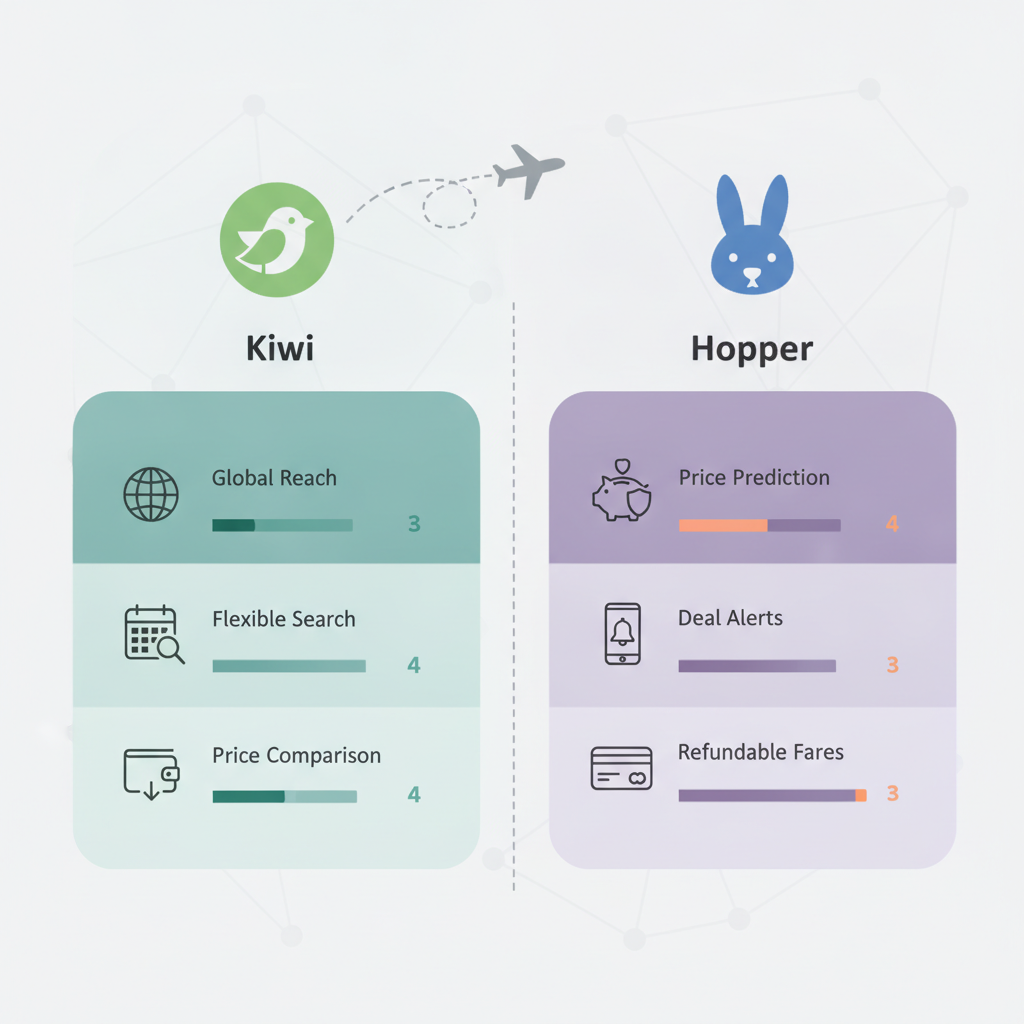
Here's how Kiwi and Hopper stack up across key dimensions for flight booking in 2026:
Kiwi Ratings:
Hopper Ratings:
Where Kiwi Wins
Kiwi predominantly wins in its ability to uncover exceptionally low base fares, often by piecing together flights from different airlines that do not typically codeshare. This 'virtual interlining' technology is its core strength, making it the go-to for travelers whose primary goal is to spend as little as possible on airfare. Its search engine is incredibly powerful for exploring flexible dates, multi-city itineraries, and even 'anywhere' destinations, making it a dream for spontaneous or complex trip planning where price is paramount. For those who enjoy the challenge of finding obscure routes and are comfortable with the logistics of self-transfer, Kiwi offers unmatched discovery and potential savings.
Where Hopper Wins
Hopper shines with its superior user experience, innovative price prediction technology, and robust flexibility add-ons. Its app is a masterclass in intuitive design, making flight search and booking a seamless, almost gamified experience. The 'Watch a Trip' feature, combined with its highly accurate price forecasts, empowers users to book at the optimal time, significantly reducing anxiety about overpaying. Furthermore, Hopper's 'Price Freeze' and 'Cancel for Any Reason' options, while costing extra, provide a level of control and peace of mind that Kiwi's standard offerings lack, making it a stronger contender for travelers who prioritize convenience and risk mitigation.
Where the Decision Depends on User Preference
The choice between Kiwi and Hopper often boils down to a fundamental trade-off: price vs. predictability and ease of use. If you are an experienced, independent traveler who thrives on finding the absolute cheapest fare, even if it means managing separate tickets and potential self-transfer risks, Kiwi is likely your preferred tool. However, if you're a mainstream traveler, a family, or someone who values a smooth booking process, transparent flexibility options, and data-driven confidence in your purchase, Hopper will be the more appealing choice. Your personal travel style, risk tolerance, and the complexity of your itinerary will be the ultimate determinants.
Which Scoring Category Matters Most for This Niche?
For the niche of finding cheap flights, 'Price & Value' is arguably the most critical scoring category, as it directly addresses the core user intent. However, 'Transparency & Fees' and 'Flexibility, Changes & Cancellation' are also profoundly important, as a low base price can quickly become expensive or problematic if hidden fees, strict cancellation policies, or lack of disruption support come into play. The true 'value' of a cheap flight isn't just its initial cost, but the total cost and peace of mind it offers throughout the travel journey.
Which Is Better: Kiwi or Hopper?
When evaluating Kiwi versus Hopper for securing cheap flights in 2026, the question of which is "better" isn't a simple one-size-fits-all answer. Each platform has carved out a distinct niche, catering to different segments of the travel market. The ultimate winner for you will depend on your specific travel style, risk tolerance, and what you prioritize in a booking experience. Both apps are formidable tools in the quest for affordable airfare, but they achieve this through fundamentally different approaches.
Overall, for the vast majority of travelers seeking a reliable, user-friendly, and reasonably flexible way to book flights, Hopper stands out as the stronger contender. Its commitment to clear price predictions, a seamless mobile experience, and transparent options for enhancing flexibility significantly reduces the stress associated with flight booking. Hopper's expansion into hotels and car rentals also makes it a more versatile, all-in-one travel planning ecosystem for many users.
However, for advanced users and extreme budget buyers, Kiwi remains unparalleled in its ability to unearth the absolute lowest fares, particularly through its innovative virtual interlining technology. If your primary goal is to minimize expenditure, and you are prepared to manage the inherent complexities and potential risks of self-transfer itineraries, Kiwi offers a powerful set of tools that other platforms simply cannot replicate. These users are often seasoned travelers who understand the trade-offs involved and are willing to invest extra effort for maximum savings.
For beginners, Hopper is the clear choice. Its gamified interface, straightforward alerts, and accessible flexibility add-ons create a welcoming environment for those new to independent travel planning. Kiwi, with its dense search results and the implications of managing separate tickets, can be overwhelming for novice travelers. Long-term, both platforms continue to innovate within their respective domains. Hopper's data-driven approach to pricing and its comprehensive travel offerings suggest a strong future for broad market appeal, while Kiwi's specialized focus on price hacking ensures its relevance for a dedicated segment of cost-conscious travelers. Ultimately, the "better" app is the one that best aligns with your personal travel philosophy and practical needs for 2026.
Before making your final decision, consider your comfort level with managing potential travel disruptions. Hopper's add-ons provide a clearer pathway for changes and cancellations, albeit at an extra cost. Kiwi's "Guarantee" for self-transfers offers some protection, but the process can be more arduous due to the involvement of multiple, often uncooperative, airlines. Therefore, while Kiwi might present a lower initial price, Hopper often delivers greater peace of mind and a more streamlined experience, which for many, represents superior overall value.
Ready to compare? Check Kiwi's deals or explore Hopper's predictions today!
Key Differences Between Kiwi and Hopper
The fundamental differences between Kiwi and Hopper stem from their core philosophies and technological approaches to finding cheap flights. While both aim to be your go-to app for travel deals, their underlying mechanisms create distinct user experiences and cater to different types of travelers.
Core Philosophy and Technology
- Kiwi: Virtual Interlining and Price Hacking. Kiwi's standout feature is its proprietary "virtual interlining" technology. This allows the platform to combine flights from airlines that don't have codesharing agreements, essentially creating unique, multi-carrier itineraries that often result in significantly lower fares. It specializes in finding complex routes, including self-transfer flights where you book separate tickets and are responsible for re-checking baggage and making connections. This approach is about maximizing price arbitrage across the entire global flight network.
- Hopper: Price Prediction and Flexible Add-ons. Hopper's strength lies in its data science and AI-driven price prediction algorithm. It analyzes billions of flight and hotel prices daily to predict with 95% accuracy whether prices will rise or fall. This allows users to "Watch a Trip" and book at the optimal time. Hopper also heavily features flexible add-ons like "Price Freeze," "Cancel for Any Reason," and "Change for Any Reason," which provide peace of mind and control at a transparent, additional cost.
Inventory Sources and Route Combinations
- Kiwi: Maximized Combinations. Kiwi aggregates flights from a vast number of airlines, including major carriers and numerous low-cost carriers globally. Its virtual interlining means it can display routes that involve multiple airlines, even if they operate independently, offering a wider array of unique, often cheaper, connection possibilities.
- Hopper: Curated Deals and Direct Partnerships. Hopper focuses on direct partnerships with airlines and hotels to offer competitive pricing. While it also searches broadly, its emphasis is more on conventional, airline-supported routes and package deals, rather than creating complex, self-transfer itineraries.
User Experience and Interface
- Kiwi: Powerful but Complex. Kiwi's interface, especially on desktop, is packed with filters and options, allowing for highly customized and flexible date searches. However, the sheer volume of information and the complexity of understanding self-transfer risks can be overwhelming for casual users.
- Hopper: Intuitive and Gamified. Hopper boasts a highly intuitive, visually appealing, and gamified mobile-first experience. Its notifications are engaging, and the process of watching a trip or freezing a price is designed to be simple and enjoyable, catering to a broader audience.
Approach to Disruption and Customer Support
- Kiwi: Kiwi.com Guarantee. For self-transfer itineraries, Kiwi offers its "Kiwi.com Guarantee," which aims to cover costs in case of missed connections due to delays or cancellations. However, navigating this guarantee and dealing with support for complex, multi-airline issues can be a lengthy and challenging process.
- Hopper: Add-on Protection. Hopper offers specific paid add-ons like "Flight Protection" or "Cancel for Any Reason" that provide clear terms for rebooking or refunds in case of disruptions. Its standard customer support for issues not covered by these add-ons is generally more straightforward than Kiwi's.
These key differences illustrate that while both platforms aim to save you money, they do so through divergent strategies, each with its own set of advantages and inherent risks.
| Feature | Kiwi | Hopper |
|---|---|---|
| Core Technology | Virtual Interlining (combining non-partner airlines) | AI Price Prediction & Flexible Add-ons |
| Primary Goal | Absolute lowest price, unique route combinations | Optimal booking time, price certainty, flexibility |
| Itinerary Complexity | High (often self-transfer, multi-carrier) | Moderate (standard airline connections) |
| Price Protection | Kiwi.com Guarantee for self-transfers | Price Freeze, Cancel/Change for Any Reason (add-ons) |
| User Interface | Powerful, data-rich, can be complex | Intuitive, gamified, mobile-first |
| Travel Services | Flights, some hotels, cars, packages | Flights, Hotels, Car Rentals, Vacation Homes |
| Typical Savings | Deep discounts on complex routes | Savings from optimal booking time & deals |
| Risk Level for Disruptions | Higher (especially for self-transfers) | Lower (especially with add-ons) |
| Where to Buy | View Deal |
Design, Interface, and User Experience
The design, interface, and overall user experience are crucial factors when choosing a travel booking app, particularly for something as intricate as finding cheap flights. In 2026, both Kiwi and Hopper offer distinct user journeys that reflect their core business models and target audiences. Understanding these differences can significantly impact your satisfaction and efficiency when planning your next trip.
Kiwi's interface is built for power users and those who thrive on detailed information and extensive customization. On both its website and mobile app, Kiwi presents a dense array of filters, flexible date options, and multi-city search capabilities. The sheer volume of route combinations, often involving multiple airlines, is displayed in a way that prioritizes comprehensive data. While this empowers experienced travelers to fine-tune their searches and uncover obscure, highly specific itineraries, it can also feel overwhelming for beginners. The visual presentation of complex self-transfer routes, complete with layover times and airport changes, requires a certain level of engagement and understanding from the user. For those who enjoy deep-diving into options and meticulously planning every leg of a journey, Kiwi offers an unparalleled level of control. However, for a quick, straightforward search, the interface can sometimes feel less immediate and more analytical.
Hopper, in contrast, offers a highly intuitive, visually engaging, and mobile-first experience that prioritizes simplicity and guidance. Its design is clean, colorful, and incorporates gamified elements that make the process of searching and booking flights enjoyable. The app's core feature, price prediction, is seamlessly integrated, with clear color-coded calendars indicating when prices are expected to rise or fall. This predictive guidance is a significant advantage for users who want to book with confidence without having to constantly monitor prices themselves. Hopper's interface nudges users towards optimal booking times and presents add-on options like "Price Freeze" or "Cancel for Any Reason" in a clear, easy-to-understand manner. The focus is on reducing decision fatigue and making the booking process as frictionless as possible, often through personalized alerts and simplified choices. This approach makes Hopper exceptionally beginner-friendly and appealing to a broad audience who value convenience and peace of mind.
The difference extends to how each app handles notifications and in-trip management. Hopper excels with its proactive, real-time alerts for price drops, flight status changes, and personalized recommendations, all delivered through a well-designed notification system. Kiwi's notifications are more transactional, focusing on booking confirmations and itinerary updates, which can feel less engaging. Ultimately, if you prefer a robust, data-heavy platform for intricate searches, Kiwi's design will appeal. If you value a guided, user-friendly, and predictive experience that simplifies decision-making, Hopper's interface is superior.

Pricing and Value for Money
When it comes to pricing and value for money in 2026, both Kiwi and Hopper aim to deliver savings, but they do so through distinct pricing models and value propositions. Understanding these differences is crucial for determining which platform truly offers the best deal for your specific travel needs.
Kiwi's primary value proposition is its ability to uncover the absolute lowest base fares, often by leveraging its unique virtual interlining technology. This means it can combine flights from different airlines, including budget carriers, that don't typically partner. The result is frequently a significantly cheaper ticket price than what you might find on traditional OTAs or even directly with airlines. However, this comes with important caveats regarding transparency and potential hidden costs. While Kiwi is generally transparent about its own service fees, travelers must be acutely aware of baggage policies for each individual airline in a multi-carrier itinerary. Baggage fees can quickly add up, potentially negating initial savings. Furthermore, the inherent risk of self-transfer - where a missed connection on one ticket means you might forfeit the next - represents a significant "hidden cost" in terms of potential financial loss and stress, even with the Kiwi.com Guarantee.
Hopper's value for money is derived less from finding the absolute rock-bottom base fare and more from its intelligent price prediction and flexible add-ons. Its algorithm helps users identify the optimal time to book, often saving them money by advising when to buy or wait. The core value here is confidence in booking a good deal, rather than just the cheapest. Hopper's "Price Freeze" feature allows users to lock in a fare for a fee, protecting against price increases - a valuable service for those who need time to decide. Similarly, its "Cancel for Any Reason" or "Change for Any Reason" add-ons, while costing extra, offer unparalleled flexibility and peace of mind, essentially insuring your booking against unforeseen circumstances. These add-ons are transparently priced and can provide immense value by mitigating risk and allowing for last-minute changes that would otherwise be costly or impossible. Hopper's base prices are competitive, but its true value often lies in these optional layers of protection and its guidance on booking timing.
When comparing total trip cost, it's essential to look beyond the advertised base fare. Kiwi's seemingly cheaper flights might require additional budgeting for separate baggage fees, potential visa requirements for layovers, and the psychological cost of managing complex connections. Hopper's initial price might be slightly higher, but its transparent add-ons and predictable nature can lead to a more stable and less stressful total travel budget. For a traveler prioritizing the lowest possible number on the ticket, Kiwi often wins. For a traveler prioritizing overall peace of mind, flexibility, and a guided booking experience, Hopper delivers superior value.
| Pricing Aspect | Kiwi | Hopper |
|---|---|---|
| Base Price Competitiveness | Often finds the absolute lowest fares (virtual interlining) | Highly competitive, good deals from direct partnerships |
| Service Fees | Transparent service fees, generally low | Transparent service fees, generally low |
| Baggage Fee Transparency | Requires careful checking per airline in multi-carrier routes | Generally clearer, follows airline policy |
| Price Protection Feature | Kiwi.com Guarantee (for self-transfer disruptions) | Price Freeze (paid add-on to lock in price) |
| Flexibility Add-ons | Limited to Kiwi.com Guarantee | Cancel for Any Reason, Change for Any Reason (paid add-ons) |
| Currency Conversion | Standard rates, option to pay in various currencies | Standard rates, clear display of local currency |
| Overall Value | High for extreme budget, risk-tolerant travelers | High for predictability, flexibility, and ease of use |
| Where to Buy | View Deal |
Flexibility, Cancellations and Refunds
Flexibility, cancellation policies, and the refund process are critical considerations for travelers in 2026, especially given the unpredictable nature of global travel. Kiwi and Hopper approach these aspects from fundamentally different angles, directly impacting a traveler's peace of mind and financial risk.
Kiwi's standard flexibility is generally limited, reflecting the often non-refundable and non-changeable nature of the budget fares it unearths. When you book a flight through Kiwi, especially a virtual interlining itinerary, you are often dealing with separate tickets for each leg of your journey. This means that changing or canceling one leg does not automatically affect the others, and each segment is subject to its individual airline's strict policies. Standard refunds for cancellations initiated by the traveler are typically subject to the original airline's fare rules, which for budget tickets, often means no refund or a credit with significant fees. Kiwi does offer its "Kiwi.com Guarantee" for self-transfer bookings, which aims to protect travelers in case of missed connections due to airline delays or cancellations. This guarantee covers rebooking or a refund for the unused portion of the itinerary. However, activating and navigating this guarantee during a live travel disruption can be a complex and time-consuming process, often requiring direct communication with Kiwi's support team while coordinating multiple independent airlines. The refund speed, even under the guarantee, can be slow, as it involves Kiwi recouping funds from various carriers.
Hopper, on the other hand, places a significant emphasis on offering enhanced flexibility through its innovative, paid add-ons. While standard bookings on Hopper are also subject to airline policies, the platform actively markets "Cancel for Any Reason" and "Change for Any Reason" options. These add-ons, purchased at checkout, provide travelers with unparalleled control. For a transparent fee, you can cancel your flight for any reason up to a specified time before departure and receive a significant portion (often 80-100%) of your money back, typically as a credit or even cash, depending on the specific add-on chosen. Similarly, the "Change for Any Reason" option allows you to alter your dates or destination without incurring hefty airline change fees. This approach offers a clear, predictable path to flexibility, which is a major advantage for travelers with uncertain plans or those seeking extra peace of mind. The refund process for these add-ons is generally more straightforward and faster, as it is handled directly by Hopper according to the terms of the purchased protection.
When comparing the two, Kiwi's flexibility relies on its guarantee for disruptions, which is reactive and can be complex to utilize. Hopper's flexibility is proactive, allowing travelers to purchase options that give them control over their own decisions, regardless of airline rules. For travelers who value predictable options for changes and cancellations, even at an additional cost, Hopper provides a far superior and less stressful experience. For those who prioritize the lowest initial price and are willing to accept the rigidness of budget fares, Kiwi remains an option, but with higher inherent risk and less straightforward refund processes.
Customer Support and Disruption Handling
The true test of any travel booking platform emerges when things go wrong. In 2026, robust customer support and efficient disruption handling are paramount, especially for complex international itineraries. Kiwi and Hopper have distinctly different approaches, largely influenced by their business models and the types of bookings they facilitate.
Kiwi's customer support and disruption handling are often cited as a significant area of concern for many travelers, particularly when dealing with complex, multi-carrier, self-transfer itineraries. The very nature of virtual interlining - combining flights from non-partner airlines - means that when one leg of a journey is delayed or canceled, it can have a cascading effect on subsequent, independently booked flights. While Kiwi offers its "Kiwi.com Guarantee" to assist in rebooking or refunding in such scenarios, the process of activating this guarantee and receiving timely assistance can be challenging. Users often report long wait times for phone support, reliance on email or app-based chat, and a potentially arduous process of providing documentation and coordinating with multiple airlines through Kiwi. Emergency support during urgent travel disruptions can be particularly stressful, as the traveler becomes an intermediary between Kiwi and several distinct airlines. This setup requires a high degree of patience and self-reliance from the traveler, making it less ideal for those who expect seamless, immediate assistance.
Hopper generally maintains a better reputation for customer support and disruption handling, especially for issues related to its own add-ons like "Price Freeze" or "Cancel for Any Reason." When a traveler purchases one of these protections, Hopper typically takes more direct responsibility for facilitating rebooking or refunds according to the terms of the add-on. Its in-app chat support is often praised for being responsive, and while phone support might also have wait times, the overall process is usually more streamlined for standard bookings. For airline-initiated changes or cancellations on conventional routes, Hopper's support will help navigate airline policies, similar to other OTAs. However, the clarity and directness of its add-on protections often mean a more predictable and less stressful experience when a change or cancellation is needed. This makes Hopper a more reassuring choice for travelers who prioritize accessible and effective support during unforeseen events.
Ultimately, the level of support you receive from either platform is highly dependent on the complexity of your booking and whether you've purchased additional protections. For simple, direct flights, both can likely handle minor issues. However, for the intricate, often high-risk itineraries that Kiwi specializes in, the burden on the traveler to manage disruptions is significantly higher, even with their guarantee. Hopper's model, with its emphasis on optional, transparent protections, offers a more predictable and generally less stressful support experience, making it a more appealing option for those who value peace of mind over the absolute lowest fare.

Trust, Safety, and Traveler Risk
Trust, safety, and the inherent traveler risk associated with online booking platforms are paramount concerns for anyone planning a trip in 2026. While both Kiwi and Hopper are legitimate companies, their operational models introduce varying levels of risk that travelers must understand before committing to a booking.
Kiwi, while a legitimate and established brand, carries a higher inherent risk profile for travelers, primarily due to its reliance on virtual interlining. The practice of combining separate tickets from non-partner airlines means that if one flight is delayed or cancelled, the subsequent, independently booked flight is not protected by standard airline interline agreements. This "self-transfer risk" can lead to missed connections, forfeited tickets, and additional costs for rebooking, especially if you need to re-check baggage or clear customs and immigration during a layover. While Kiwi offers its "Kiwi.com Guarantee" to mitigate some of these risks, it's important to understand its limitations and the process for claiming. Payment security on Kiwi is standard, utilizing secure encryption for transactions. However, the greater risk stems from the complexity of the itinerary itself, which can introduce visa requirements for layovers in certain countries, even if you don't intend to leave the airport. For cautious or inexperienced travelers, the complexity and potential for disruption on Kiwi's unique itineraries represent a significant suitability risk.
Hopper generally presents a lower risk profile for travelers, especially for standard flight bookings. Its focus on conventional airline routes and direct partnerships means that bookings are typically more straightforward, and standard airline policies for delays and cancellations apply. Hopper's use of AI for price prediction is generally accurate, but it's important to remember that predictions are not guarantees; prices can still fluctuate. Payment security on Hopper is robust, adhering to industry standards for protecting sensitive financial data. The optional "Price Freeze" and "Cancel for Any Reason" add-ons, while costing extra, actually enhance traveler safety by providing clear, contractual protections against price changes or the need to cancel. These features offer a transparent way for travelers to mitigate financial risk. While no online booking is entirely risk-free, Hopper's model minimizes the inherent complexities that can lead to unforeseen issues, making it a safer choice for most travelers.
In summary, both platforms employ standard payment security measures. However, the distinction in traveler risk comes down to the nature of the itineraries they offer. Kiwi's innovative but complex virtual interlining introduces a higher level of operational risk for the traveler, requiring greater vigilance and preparedness for potential disruptions. Hopper, by sticking to more conventional booking structures and offering explicit risk-mitigating add-ons, provides a generally safer and more predictable experience. When deciding, always consider your comfort level with managing potential self-transfer challenges and whether the initial price savings are worth the elevated risk exposure.
App and In-Trip Experience
In 2026, a travel app's utility extends far beyond the initial booking. The in-trip experience - from itinerary management and real-time alerts to mobile document access and customer support integration - is crucial for a seamless journey. Kiwi and Hopper, both mobile-first platforms, offer distinct app experiences that cater to their respective user bases.
Kiwi's app provides essential functionality for managing your itinerary, but its strength lies more in its powerful search capabilities than in its in-trip guidance. Once a booking is confirmed, the app clearly displays flight details, booking references, and e-tickets. It allows for easy access to your documents, which can be useful at check-in or security. Notifications are primarily focused on changes to your flight schedule or gate information. However, for complex multi-carrier, self-transfer itineraries, the app's ability to provide proactive, integrated support during disruptions can feel less robust. While it will show the separate tickets, the onus is often on the traveler to understand the implications of a delay on one leg for subsequent, independently booked flights. Offline access to itineraries is a standard feature, ensuring you have your details even without an internet connection. Despite its powerful search filters, the in-trip management aspects can sometimes feel less intuitive or proactive compared to platforms designed for simpler, connected itineraries. For travelers who are highly self-reliant and prefer to manage potential issues independently, the app serves its purpose, but it doesn't hold your hand through complex disruptions.
Hopper's app excels in its intuitive design, proactive in-trip features, and seamless integration of customer support, offering a superior overall mobile experience. The app's interface is celebrated for its user-friendliness, with clear visuals and easy navigation. Crucially, Hopper's app provides real-time flight status updates, gate changes, and delay notifications directly to your phone, often before the airlines officially announce them. This proactive communication is invaluable during travel. For those who purchase "Flight Protection" or similar add-ons, the app makes it incredibly easy to access support, initiate rebookings, or claim refunds directly within the interface, providing a single point of contact during stressful situations. Offline access to itineraries and booking details is also standard, ensuring vital information is always at hand. The gamified elements and personalized recommendations continue even during the trip, offering suggestions for nearby hotels or activities. Hopper's app feels like a true travel companion, designed to anticipate and address traveler needs both before and during the journey, making it particularly strong for those who value convenience and proactive assistance.
In essence, while Kiwi's app is a functional tool for booking and accessing itinerary details, Hopper's app provides a more holistic, proactive, and user-friendly in-trip experience. For travelers who want a digital assistant guiding them through their journey and offering immediate solutions during disruptions, Hopper's app is the clear winner. For those who use the app primarily for its powerful search and are comfortable managing their own complex itineraries, Kiwi's app is sufficient.
Use-Case Recommendations
Matching the right travel app to your specific use case is critical for a successful and stress-free booking experience in 2026. Kiwi and Hopper cater to distinct traveler profiles, and understanding these segments will help you make the best choice.
| Traveler Type / Use Case | Choose Kiwi If... | Choose Hopper If... |
|---|---|---|
| Extreme Budget Traveler | Your absolute priority is the lowest possible fare, and you're willing to manage complex, self-transfer itineraries. | You want competitive prices but also value price prediction and optional flexibility to avoid overpaying or last-minute changes. |
| Flexible Dates / Multi-City | You need to explore a vast array of flexible date combinations and complex, multi-leg journeys across different airlines. | You want a user-friendly interface to quickly find the best dates and receive alerts for price drops on more straightforward multi-city routes. |
| Complex Itineraries / Self-Transfer | You are an experienced traveler comfortable with booking separate tickets, re-checking baggage, and navigating multiple airline policies. | You prefer simpler, connected itineraries and want to avoid the risks and complexities associated with self-transfer bookings. |
| Price Prediction / Optimal Booking Time | You are less concerned with predicting optimal booking times and more focused on finding current, immediate low prices. | You want to leverage AI-driven insights to know when to buy or wait, ensuring you book at a favorable price. |
| Peace of Mind / Flexibility Add-ons | You rely on the Kiwi.com Guarantee for self-transfer protection and are comfortable with its terms and potential complexities. | You want transparent, paid options like "Cancel for Any Reason" or "Price Freeze" to secure your booking and mitigate risk. |
| Beginner / User-Friendly Experience | You are an experienced online booker who thrives on detailed data and advanced search filters. | You are new to independent flight booking and prefer a guided, intuitive, and gamified app experience. |
| International Travel (High Risk) | You are aware of and prepared to manage potential visa requirements and immigration procedures for self-transfer layovers. | You prefer lower-risk international routes with established airline connections and clear support options. |
| Family Travel | You are willing to manage the complexities of multiple individual tickets and potential disruptions for significant savings. | You prioritize ease of booking, predictable pricing, and flexibility add-ons to minimize stress for family trips. |
Real-World Scenarios
To truly understand the practical implications of choosing between Kiwi and Hopper in 2026, let's consider a few real-world traveler scenarios:
Scenario 1: The Solo Backpacker on a Multi-Country European Tour
Imagine Alex, a solo backpacker planning a three-month, multi-country tour across Europe. Alex's budget is extremely tight, and they are highly flexible with dates, airports, and even destinations. They are comfortable with long layovers, carrying minimal luggage, and are adept at navigating airports and public transport. Alex's primary goal is to spend the absolute least amount of money on flights, even if it means flying with different low-cost carriers and making self-transfers.
Recommendation: Kiwi. For Alex, Kiwi is the undisputed champion. Its virtual interlining technology will unearth flight combinations that no other platform can match, piecing together budget airlines for significant savings across multiple legs. Alex can use Kiwi's "Nomad" search feature to find the cheapest routes between various cities over flexible periods. While the inherent risks of self-transfer are present, Alex's experience and willingness to manage potential disruptions make Kiwi the ideal tool for achieving maximum savings on a complex itinerary.
Scenario 2: The Family Planning a Beach Vacation
Meet the Chen family - two adults and two young children - planning a one-week beach vacation to a popular resort destination. Their travel dates are somewhat flexible within a two-week window, but they need a direct or single-connection flight. Their main priorities are a smooth, stress-free journey, predictable costs, and the ability to make changes if one of the kids gets sick. They want to ensure they get a good deal but aren't looking for the absolute cheapest flight if it means added complexity or risk.
Recommendation: Hopper. Hopper is the clear choice for the Chen family. Its intuitive interface and price prediction feature will help them identify the best time to book their flights, giving them confidence in their purchase. Crucially, they can opt for Hopper's "Cancel for Any Reason" add-on, providing invaluable peace of mind should unforeseen circumstances arise with the children. The straightforward booking process, clear communication, and generally more responsive customer support (especially with add-ons) make Hopper a far less stressful option for family travel, even if the base fare is slightly higher than Kiwi's lowest possible options.
Scenario 3: The Business Traveler Monitoring a Specific Route
Sarah is a business traveler who frequently flies between two major cities for work. Her travel dates are often fixed, but she has some flexibility on booking lead time. She needs a specific route, often with a preferred airline for loyalty points, but wants to ensure she books when prices are at their lowest. She also needs reliable service and easy access to her itinerary on the go.
Recommendation: Hopper (with a caveat). For Sarah, Hopper's price prediction capabilities are invaluable. She can "Watch" her specific route and receive alerts when prices are expected to drop, allowing her to book at the optimal moment. The "Price Freeze" option is also highly beneficial if she needs to secure a specific fare while awaiting final approvals. The caveat is that if loyalty points are paramount, she might use Hopper for price monitoring but ultimately book directly with her preferred airline if the price difference is negligible. However, for sheer price optimization and predictability on a specific route, Hopper offers superior tools compared to Kiwi's broader, more complex search.
Final Verdict
After an extensive comparison in 2026, the verdict on whether Kiwi or Hopper is better for cheap flights ultimately hinges on your personal travel philosophy and priorities. Both platforms offer significant advantages, but they cater to fundamentally different needs and risk tolerances. There isn't a single "best" app for everyone; rather, it's about finding the one that aligns with your specific journey.
For the majority of mainstream travelers, particularly those who prioritize ease of use, predictable booking, and optional flexibility, Hopper emerges as the more compelling choice. Its intuitive app, data-driven price predictions, and transparent add-ons like "Price Freeze" and "Cancel for Any Reason" provide a comfortable and confident booking experience. Hopper reduces anxiety by guiding you to optimal booking times and offering clear pathways for changes or cancellations, making it ideal for families, less experienced international travelers, or anyone seeking a smoother, lower-stress trip planning process. It delivers excellent value by combining competitive prices with powerful tools for managing your booking risks.
Conversely, Kiwi remains the unparalleled champion for the extreme budget traveler, the adventurous backpacker, and the seasoned itinerary hacker. If your sole mission is to find the absolute lowest possible fare, and you are prepared to embrace the complexities, potential risks, and logistical challenges of multi-carrier, self-transfer itineraries - even without the direct support of interline agreements - Kiwi's virtual interlining technology is unmatched. It will uncover flight combinations and price arbitrage opportunities that no other platform can, offering exceptional upfront savings for those willing to navigate its intricacies and manage potential disruptions independently.
In 2026, the travel landscape continues to evolve, but the core distinction between these two platforms remains clear. Kiwi is for the intrepid, cost-obsessed explorer who views travel planning as a puzzle to be solved for maximum savings. Hopper is for the modern traveler who values convenience, predictability, and peace of mind, leveraging smart technology to make confident booking decisions. Choose wisely, and happy travels!
Choose Kiwi if: You are an experienced, budget-first traveler who prioritizes the absolute lowest fare, is comfortable with self-transfer risks, and enjoys finding complex, unique flight combinations.
Choose Hopper if: You value an intuitive, user-friendly booking experience, reliable price predictions, and optional, transparent flexibility features for a less stressful and more predictable journey.
Still comparing? Check the latest pricing on Kiwi or explore Hopper's predictions before finalizing your decision!
Frequently Asked Questions
Yes, Kiwi is a legitimate online travel agency (OTA) that has been operating for many years. It is well-known for its innovative virtual interlining technology, which allows it to combine flights from non-partner airlines to create unique and often cheaper itineraries. While legitimate, its complex booking model and reliance on self-transfers introduce specific risks that travelers must be aware of, especially concerning missed connections or changes to separate tickets. Always review its terms and the Kiwi.com Guarantee carefully.
Hopper is generally considered a safe and reliable platform for booking flights and other travel services. It uses secure payment processing and offers transparent add-ons like 'Price Freeze' and 'Cancel for Any Reason' that can enhance booking safety and flexibility. While no online booking is entirely risk-free, Hopper's focus on more conventional flight connections and its robust app features contribute to a secure and trustworthy user experience. Its price prediction accuracy is also a key safety feature for budget-conscious travelers.
For finding the absolute lowest base fares, especially on complex, multi-carrier itineraries involving self-transfers, Kiwi often has the edge in 2026 due to its virtual interlining technology. It excels at uncovering unique route combinations. However, Hopper is better for finding competitively priced flights at optimal booking times, leveraging its price prediction algorithm to help you book before prices rise. If 'cheapest' means the lowest number on the ticket, Kiwi wins; if it means the best value with less risk, Hopper is often superior.
Hopper generally has better-regarded customer service, especially for issues related to its own add-ons. Its in-app chat is often responsive, and the process for changes or refunds with purchased flexibility is usually more straightforward. Kiwi's customer service, particularly for complex multi-carrier, self-transfer disruptions, can be challenging and time-consuming to navigate, even with its Kiwi.com Guarantee. Travelers seeking more predictable and accessible support during urgent travel problems may find Hopper's offerings more reassuring.
The primary risks of using Kiwi for self-transfer flights include missed connections due to delays or cancellations on one independently booked flight, which can lead to forfeiting subsequent tickets. You are also responsible for re-checking baggage, passing through immigration, and potentially obtaining transit visas during layovers. While the Kiwi.com Guarantee offers some protection, activating it and resolving issues can be complex and stressful. These risks are inherent to the virtual interlining model and require a high degree of traveler preparedness.
Hopper's price prediction algorithm boasts a 95% accuracy rate, but it cannot guarantee price drops. It provides data-driven forecasts to advise whether you should buy or wait. For a guarantee, Hopper offers a 'Price Freeze' add-on, which allows you to lock in a specific fare for a fee. If the price goes up after you've frozen it, Hopper covers the difference up to a certain amount. This feature effectively guarantees your price against increases, but the prediction itself is a strong indicator, not a certainty.
You should book directly with the airline or hotel if you prioritize maximum control, direct communication for changes or disruptions, airline loyalty benefits, or if the price difference is negligible. Use Kiwi if you are an extreme budget traveler willing to manage complex, self-transfer risks for the absolute lowest fares. Choose Hopper if you value price prediction, optional flexibility add-ons, and a user-friendly experience that simplifies booking and provides peace of mind, even if it's not always the absolute cheapest option.
Travelers who should avoid Kiwi include those who need maximum refund flexibility, guaranteed seamless connections without self-transfer risks, or who expect immediate and straightforward customer support during urgent disruptions. Beginners, families with young children, and travelers with strict schedules or limited tolerance for unexpected logistical challenges should also consider alternatives, as Kiwi's complex itineraries can introduce significant stress and potential financial risk.
Travelers who should avoid Hopper are those whose sole priority is finding the absolute lowest possible fare, even if it means navigating highly complex, multi-carrier, self-transfer itineraries. While Hopper offers competitive prices and valuable add-ons, it may not uncover the extreme 'price hacking' deals that Kiwi's virtual interlining can. Additionally, if you prefer to avoid any additional fees for flexibility and are comfortable with strict airline policies, Hopper's add-on heavy model might not appeal to you.