

Agoda vs Airbnb: Which Is Better for Apartments and Vacation Rentals?
Agoda
Agoda, known for its extensive network of hotels, has significantly expanded its offerings into apartments and vacation rentals, presenting a strong alternative for travelers in 2026. It often provides competitive pricing and a robust loyalty program, making it a valuable platform for diverse accommodation needs.
View DealOverall Score
Top Picks
Agoda
Agoda is ideal for travelers seeking competitive prices on a wide range of accommodation types, including a growing selection of apartments and vacation rentals. Its loyalty program can offer significant savings for frequent users, especially when booking flexibly.
Airbnb
Airbnb excels for those prioritizing unique, localized stays and direct host interaction, offering an unparalleled inventory of homes and apartments globally. It's best suited for travelers who value authentic experiences and are comfortable with varied host policies.
Comparison
Price & Value
Transparency & Fees
Booking Experience
Coverage & Inventory
Flexibility & Cancellation
Customer Support & Protection
As travelers increasingly seek more authentic, spacious, and localized accommodation experiences, the competition between online booking giants for apartments and vacation rentals has intensified. In 2026, two major players, Agoda and Airbnb, stand out as primary choices for securing everything from city-center flats to sprawling holiday homes. But when it comes to finding the perfect apartment or vacation rental, which platform truly offers the better experience, value, and reliability?
This comprehensive comparison delves into Agoda and Airbnb's strengths and weaknesses for short-term and long-term rental bookings in 2026. We'll examine their inventory, pricing structures, user experience, flexibility, customer support, and overall value proposition. Whether you're a budget-conscious backpacker, a family planning an extended holiday, a business traveler seeking a comfortable workspace, or a digital nomad looking for a month-long stay, understanding the nuances of each platform is crucial to making a confident booking decision. Our goal is to equip you with the insights needed to determine which platform aligns best with your travel style and specific rental needs, ensuring a smoother, more enjoyable trip experience.
Choosing between Agoda and Airbnb isn't just about finding the lowest nightly rate; it's about understanding the total cost, the transparency of fees, the ease of booking, and the peace of mind that comes with reliable support should your plans change. This article will guide you through these critical considerations, helping you navigate the complexities of vacation rental bookings in 2026.
Comparison Table: Agoda vs Airbnb for Vacation Rentals (2026)
| Feature | Agoda | Airbnb | Verdict |
|---|---|---|---|
| Best For | Budget-conscious travelers, those valuing loyalty programs, mixed hotel/rental search. | Unique local experiences, diverse home inventory, direct host interaction. | Depends on travel priority: deals vs. experience. |
| Price Range | Often competitive base rates; loyalty discounts. | Varied, but cleaning & service fees can increase total. | Agoda often better for base price, Airbnb for unique value. |
| Key Strength | Extensive global inventory (hotels + growing rentals), AgodaCash rewards. | Unmatched variety of unique homes, strong community reviews. | Inventory breadth vs. depth & uniqueness. |
| Key Weakness | Rental inventory can be less curated; UI still hotel-centric. | High cleaning & service fees, inconsistent host quality. | Transparency of fees is a concern for Airbnb. |
| Transparency & Fees | Generally clear, but check carefully for all property types. | Cleaning fees & service fees often significant and upfront. | Agoda typically more straightforward on fees. |
| Flexibility & Cancellation | Varies by property; look for "Free Cancellation" filters. | Host-set policies (Flexible, Moderate, Strict). | Both require careful policy review. |
| Customer Support & Protection | Standard OTA support; acts as intermediary. | Mediation model between guest & host; resolution center. | Agoda for direct support, Airbnb for dispute resolution. |
| Overall Rating | 8.0/10 | 7.8/10 | Agoda edges out for value, Airbnb for unique inventory. |
| CTA | Compare Deals on Agoda | Explore Rentals on Airbnb |
Quick Verdict
Choose Agoda if you are a budget-conscious traveler prioritizing competitive pricing, especially for a wider range of accommodation types including apartments and serviced residences, and value a loyalty program that offers future savings. Agoda often provides good deals and its platform is strong for comparing various options side-by-side, making it a solid choice for those who appreciate a more traditional online travel agency (OTA) approach with a growing rental inventory.
Choose Airbnb if your priority is finding unique, local, and authentic vacation rentals, from quirky treehouses to spacious family homes, and you value direct communication with hosts. Airbnb's strength lies in its diverse, user-generated inventory and community-driven review system, making it ideal for travelers seeking a personalized experience and are comfortable with varying host-set policies.
Choose neither if you prefer booking directly with property owners for maximum control and direct communication, or if you require an extremely high level of standardized service and amenities typically found only in hotels. For those seeking absolute consistency or avoiding intermediary fees entirely, direct booking might be a better fit, though it often comes with less price comparison capability.
Overall, Agoda is better for most people seeking a blend of value and variety, particularly if they are already familiar with OTA booking processes. Airbnb is better for demanding users who prioritize unique experiences and are willing to navigate varied host interactions. Agoda gives better value in terms of transparent base pricing and loyalty rewards, while Airbnb's value comes from its often unparalleled inventory of distinctive homes. For most buyers, Agoda presents a safer choice due to its more standardized booking process and direct customer support, even for rentals. Airbnb, however, has a stronger long-term case for unique, community-driven stays, continuing to innovate in personalized travel experiences in 2026.
Short Answer
For apartments and vacation rentals in 2026, Agoda generally offers better overall value and a more streamlined booking process for a wider range of property types, making it ideal for budget-conscious travelers seeking competitive prices and loyalty rewards. Airbnb, conversely, is superior for finding truly unique and authentic local stays directly from hosts, catering to travelers who prioritize distinctive experiences and are comfortable with varied host policies and service fee structures. The choice ultimately hinges on whether you prioritize cost-effectiveness and a broad selection (Agoda) or unparalleled uniqueness and direct host interaction (Airbnb).
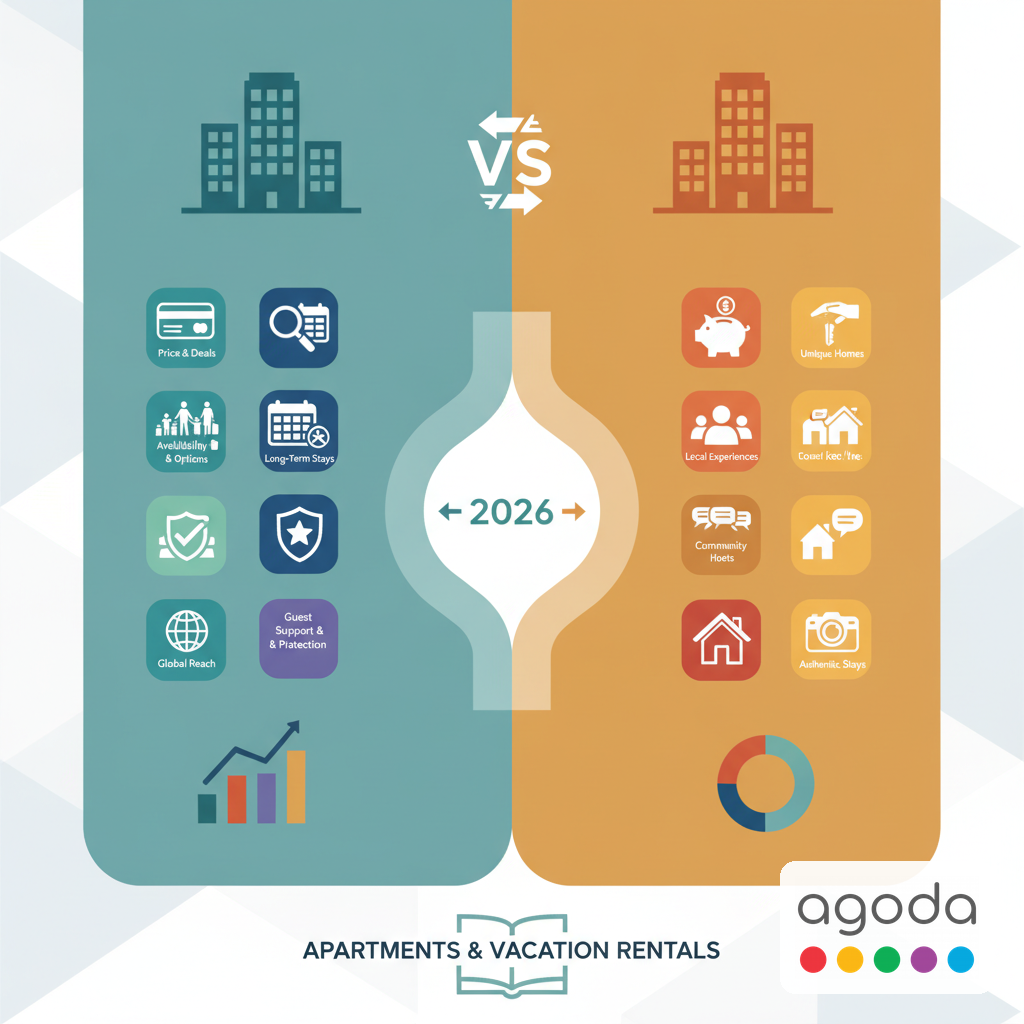
Rating Summary
Agoda Rating Summary
| Dimension | Score | Notes |
|---|---|---|
| Price & Value | 8.8/10 | Often competitive base rates, enhanced by AgodaCash loyalty program. |
| Transparency & Fees | 7.5/10 | Generally clear, but always check final price for all property types. |
| Booking Experience | 8.2/10 | Efficient search with good filters, though UI can feel busy for rentals. |
| Coverage & Inventory | 8.5/10 | Strong global presence in hotels, with rapidly expanding and diverse rental options. |
| Flexibility & Cancellation | 7.8/10 | Policies vary significantly by property; "Free Cancellation" filter is crucial. |
| Customer Support & Protection | 7.0/10 | Standard OTA support, but can be an extra layer in host disputes. |
| Overall Rating | 8.0/10 | Best for: value-driven travelers seeking a broad selection of accommodation types with loyalty benefits. |
Airbnb Rating Summary
| Dimension | Score | Notes |
|---|---|---|
| Price & Value | 7.5/10 | Base rates can be good, but cleaning and service fees often significantly increase total cost. |
| Transparency & Fees | 6.8/10 | Cleaning fees are frequently high and non-negotiable, impacting overall price clarity. |
| Booking Experience | 8.5/10 | Intuitive, visually rich interface with excellent map search and instant booking options. |
| Coverage & Inventory | 9.0/10 | Unrivaled selection of unique homes, apartments, and distinctive stays globally. |
| Flexibility & Cancellation | 8.0/10 | Host-set policies are clear, offering various levels of flexibility. |
| Customer Support & Protection | 7.5/10 | Guest/host mediation model, with a resolution center for disputes, can be slow. |
| Overall Rating | 7.8/10 | Best for: travelers prioritizing unique, localized experiences and direct host interaction over strict cost savings. |
Where Agoda wins: Agoda generally wins on upfront price competitiveness and the potential for additional savings through its AgodaCash loyalty program. Its integration of hotels and a growing rental inventory means you can often find a wider range of options in one search, appealing to travelers who might also consider a hotel. The transparency of its base pricing, while still requiring careful final checkout review, tends to be more straightforward than Airbnb's often-surprising cleaning fees.
Where Airbnb wins: Airbnb clearly wins in terms of unique inventory and the authentic local experience it provides. Its platform is specifically designed for home-sharing, leading to an unparalleled selection of homes, apartments, and unusual stays. The ability to communicate directly with hosts and access local insights is a significant advantage for travelers seeking more than just a place to sleep. Its community-driven review system also offers a deep dive into previous guest experiences.
Where the decision depends on user preference: The choice largely depends on whether you prioritize cost and variety (Agoda) or uniqueness and direct host interaction (Airbnb). For travelers who value loyalty programs and potentially lower final costs, Agoda might be better. For those who seek a specific type of unique accommodation or want to immerse themselves in a local neighborhood, Airbnb is the clear frontrunner. The importance of "Transparency & Fees" will heavily influence budget-conscious travelers, while "Coverage & Inventory" will sway those looking for niche experiences.
Which scoring category matters most for this niche: For apartments and vacation rentals, Transparency & Fees is arguably the most critical scoring category. The prevalence of cleaning fees, service fees, and other charges can drastically alter the perceived value of a booking. A seemingly cheap nightly rate can quickly inflate on either platform, but Airbnb's model, in particular, has faced consistent criticism for opaque or disproportionately high cleaning fees. Therefore, understanding the true final cost before committing is paramount.
Which Is Better: Agoda or Airbnb?
When deciding between Agoda and Airbnb for apartments and vacation rentals in 2026, the "better" platform is highly dependent on your specific travel priorities and preferences. There isn't a single universal winner, but rather a platform that excels in particular areas that might align more closely with your needs. This decision often comes down to a trade-off between traditional OTA efficiencies and a peer-to-peer marketplace's unique offerings.
For most people, especially those balancing budget with a desire for diverse options, Agoda often presents a compelling case. As a seasoned online travel agency, Agoda has significantly invested in expanding its non-hotel inventory, now featuring a robust selection of apartments, serviced residences, and vacation homes globally. Its strength lies in its ability to aggregate various property types, often presenting competitive base prices and allowing users to accumulate AgodaCash rewards for future bookings. This makes it a strong contender for travelers who appreciate a more standardized booking experience and prefer to compare a broader spectrum of accommodations, from traditional hotels to private rentals, all within one platform.
However, for advanced users or those with a specific vision for their trip - perhaps a desire for a truly unique stay, a culturally immersive experience, or direct interaction with a local host - Airbnb remains the unrivaled leader. Airbnb's vast, user-generated inventory offers an unparalleled array of distinctive properties, from converted barns to luxury villas, that are often not available on other platforms. Its community-driven platform fosters direct communication, which can lead to personalized recommendations and a deeper connection to the destination. While its fee structure can be less transparent due to variable cleaning and service fees, the unique value derived from its distinctive offerings often justifies the cost for many travelers.
For budget buyers, Agoda typically offers better opportunities for cost savings. Its frequent promotions, "secret deals," and the aforementioned AgodaCash program can lead to genuinely lower final prices. While Airbnb can have budget-friendly options, the cumulative effect of cleaning and service fees can push the total cost above expectations, especially for shorter stays. For long-term ownership of your travel choices, meaning consistent value and reliable support over multiple trips, Agoda's established OTA model and loyalty program often provide a more predictable experience.
The most important niche dimensions, such as "Transparency & Fees" and "Coverage & Inventory," heavily influence this overall decision. Agoda generally performs better on fee transparency for its diverse inventory, whereas Airbnb shines in the sheer breadth and uniqueness of its vacation rental coverage. Ultimately, if a blend of cost-effectiveness, broad selection, and a familiar booking process is your priority, Agoda is likely the better choice. If unique experiences, direct host interaction, and an unparalleled variety of home-like accommodations are paramount, Airbnb will serve you better in 2026.
Key Differences Between Agoda and Airbnb
The fundamental differences between Agoda and Airbnb stem from their core business models and their historical focus. Understanding these distinctions is crucial for travelers booking apartments and vacation rentals in 2026, as they directly impact inventory, pricing, user experience, and support. While both platforms now offer similar property types, their underlying philosophies create distinct user journeys and outcomes.
Feature Breakdown Table: Agoda vs Airbnb
| Feature Category | Agoda (Product A) | Airbnb (Product B) |
|---|---|---|
| Core Business Model | Online Travel Agency (OTA) with direct contracts & aggregations. | Peer-to-peer marketplace; hosts list directly. |
| Primary Inventory Focus | Hotels, resorts, then apartments, serviced residences, villas. | Private homes, apartments, unique stays, rooms. |
| Service Fees | Booking fees integrated into price or clearly displayed; often lower. | Guest service fees (typically 5-14.2%) + host cleaning fees. |
| Cleaning Fees | Less common for apartment-style properties; usually bundled. | Very common and often significant, added at checkout. |
| Loyalty Program | AgodaCash rewards, member-only prices, VIP status. | Limited direct guest loyalty program; focus on community. |
| Host/Guest Interaction | Primarily through Agoda support; limited direct pre-booking chat. | Direct messaging, host profiles, community guidelines. |
| Booking Confirmation | Instant confirmation common; voucher-based. | Instant Book or host approval; detailed itinerary. |
| Cancellation Policies | Varies by property & supplier; clearly stated. | Host-set (Flexible, Moderate, Strict, Long-Term). |
| Dispute Resolution | Agoda acts as intermediary with property. | Resolution Center for guest-host mediation. |
| Mobile App Focus | Comprehensive booking & itinerary management. | Seamless communication, check-in, local guides. |
| Where to Buy | View Deal |
Product Philosophy and Target Users: Agoda, originally a hotel-centric OTA, has expanded to include a vast array of apartments and vacation rentals. Its philosophy is about providing choice and value across a broad spectrum of accommodation types, appealing to travelers who might switch between a hotel and a rental depending on the trip. Airbnb, conversely, was built on the premise of home-sharing, targeting travelers who seek authentic local experiences, personalized stays, and direct engagement with property owners or managers. This means Agoda's rental listings often feel more like professionally managed units, while Airbnb's can range from a spare room in someone's home to a professionally managed luxury villa.
Feature Differences: Agoda's search filters are comprehensive, allowing users to narrow down by property type, amenities, price, and cancellation policies. Its platform is designed for efficient comparison. Airbnb's filters are also robust, with a strong emphasis on unique features (e.g., "unique homes," "treehouses," "cabins") and experiences, catering to niche interests. Agoda's loyalty program, AgodaCash, is a significant differentiator, offering tangible rewards for repeat bookings. Airbnb has focused more on the "host community" and less on a direct guest loyalty program, though it does offer some referral bonuses and discounts.
Pricing Differences: While both platforms offer competitive base prices, the final checkout price can differ significantly. Agoda's pricing, while sometimes including local taxes and service charges, tends to be more consolidated or clearly itemized. Airbnb's model, however, frequently features a base nightly rate, a guest service fee (taken by Airbnb), and a host-set cleaning fee. The cleaning fee, in particular, can be substantial and disproportionately high for shorter stays, leading to less transparency in the initial advertised price. This often makes Airbnb's "total cost" higher than initially perceived.
Performance Differences: In terms of booking performance, Agoda often provides instant confirmation for most of its properties, streamlining the booking flow. Airbnb also offers "Instant Book" options, but many listings still require host approval, which can introduce a delay. For speed and direct confirmation, Agoda often has an edge. However, for sheer variety and the ability to find truly unique, non-standard accommodations, Airbnb's performance in listing depth is unparalleled.
Long-Term Fit: For travelers who value consistency and a loyalty program that rewards frequent bookings across hotels and rentals, Agoda offers a stronger long-term fit. For those who prioritize unique, personalized experiences and are comfortable with the peer-to-peer nature of the platform, Airbnb provides a long-term solution for distinct travel styles. Both platforms continuously evolve, but their core identity remains rooted in these foundational differences.

Search, Booking, and User Experience
The user experience, from initial search to final booking confirmation, plays a pivotal role in a traveler's decision-making process. In 2026, both Agoda and Airbnb have refined their platforms significantly, yet their inherent design philosophies lead to distinct user journeys when searching for apartments and vacation rentals. The interface, filters, and overall flow reflect their core strengths and target audiences.
Agoda, traditionally a hotel booking platform, has adapted its user interface (UI) to accommodate its growing inventory of apartments and vacation rentals. Its search experience is robust, offering comprehensive filters that allow users to narrow down options by price, star rating, property type (including "apartment," "villa," "residence"), amenities, and crucial booking conditions like "free cancellation." The map search functionality is effective, allowing travelers to visualize property locations relative to points of interest or specific neighborhoods. However, because Agoda still caters to a broad range of accommodation types, its UI can sometimes feel a bit busy or less specialized for rentals compared to Airbnb. The information presented, while thorough, often mirrors a hotel listing, which might require extra scrutiny to discern specific rental nuances like cleaning fees or host interaction details, although these are improving.
Airbnb's user experience, conversely, is purpose-built for home-sharing and unique stays, making its interface inherently more intuitive for vacation rental searches. The visual presentation is often richer, with large, inviting images and a strong emphasis on the "home" aspect of each listing. Its map search is a cornerstone feature, allowing users to effortlessly browse properties by geographic area, with prices updating dynamically as you pan and zoom. Airbnb's filters are highly granular and cater specifically to rental needs, including options for number of bedrooms, specific amenities like "dedicated workspace" or "pet-friendly," and even "unique stays" categories. The platform's "Instant Book" feature streamlines the booking process, allowing immediate confirmation without host approval, though many listings still require manual review, which can introduce delays.
The checkout clarity on both platforms requires careful attention. Agoda generally presents a clearer breakdown of the nightly rate, taxes, and any service fees before the final payment step. While it's essential to review the "Total Price" carefully, surprises are less frequent. Airbnb, however, has a more complex fee structure due to its reliance on host-set cleaning fees and its own guest service fees. These can significantly inflate the initial nightly rate, especially for short stays, making the final price a notable jump from the advertised per-night cost. This lack of upfront transparency for the all-in price has been a consistent point of feedback for Airbnb users.
Upsells are present on both platforms but manifest differently. Agoda might suggest travel insurance, airport transfers, or activity bookings, typical of an OTA. Airbnb's upsells are more subtle, sometimes promoting "Experiences" or encouraging longer stays with discounted rates. Both platforms generally have a smooth booking flow once selections are made, requiring standard traveler information and payment details. Confirmation speed is typically instant on Agoda for most properties, while Airbnb's "Instant Book" listings are immediate, but others depend on host response times. Overall, if you prioritize a specialized, visually driven search for unique homes, Airbnb excels. If you prefer a comprehensive, efficient comparison tool for a wider range of properties with a more traditional booking feel, Agoda's user experience is highly effective.
Pricing, Fees, and Total Cost
One of the most critical factors when booking apartments and vacation rentals is the total cost, which encompasses not just the nightly rate but also various fees and taxes. In 2026, both Agoda and Airbnb present different approaches to pricing and fee structures, making a direct "apples-to-apples" comparison challenging but essential for budget-conscious travelers. The perceived upfront price can often be misleading, especially on platforms with complex fee breakdowns.
Pricing & Value Table: Agoda vs Airbnb
| Cost Component | Agoda | Airbnb | Impact on Total Cost |
|---|---|---|---|
| Base Nightly Rate | Often highly competitive, especially with member discounts. | Varies greatly by host, property, and demand. | Agoda often starts lower, but always compare final price. |
| Taxes & Local Charges | Usually included in the displayed price or clearly added at checkout. | Can be added at checkout; varies by location. | Standard on both; check local regulations. |
| Service Fees (Platform) | Integrated into the price or a minor, transparent booking fee. | Guest service fee (typically 5-14.2%) added to subtotal. | Airbnb's service fee is a guaranteed addition. |
| Cleaning Fees | Less common or often bundled for apartment-style properties. | Very common, can be significant, and non-negotiable. | Major impact on Airbnb, especially for short stays. |
| Security/Damage Deposit | Less common for Agoda rentals, if present, usually pre-authorized. | Common, either pre-authorized or collected by host. | Generally temporary hold, but can be a financial concern. |
| Extra Guest Fees | Clearly stated per person if applicable. | Often applies after a certain number of guests; host-set. | Check policy if traveling with more than 2-3 people. |
| Currency Conversion | Supports multiple currencies; check bank's foreign transaction fees. | Supports multiple currencies; check bank's foreign transaction fees. | Both platforms are similar; bank fees are the variable. |
| Loyalty Benefits | AgodaCash rewards, VIP member discounts. | Limited direct guest loyalty. | Agoda offers tangible long-term savings. |
| Where to Buy | View Deal |
Prices change frequently, so check the latest price before buying.
Agoda's base prices for apartments and vacation rentals are often highly competitive, benefiting from its extensive network and ability to offer "member-only deals" or "secret prices." For travelers who frequently book through Agoda, the AgodaCash loyalty program can provide significant additional value, accumulating points that can be redeemed for future bookings. When it comes to taxes and service fees, Agoda generally integrates these into the displayed price or clearly itemizes them during the checkout process, making the final cost more predictable. Cleaning fees, while present for some properties, are typically less prevalent or less disproportionate than on Airbnb, especially for shorter stays. This often results in a total trip cost that is closer to the initially advertised nightly rate.
Airbnb's pricing model, however, can be more complex and, at times, less transparent. While the nightly rates can appear attractive, the final total price often includes a guest service fee (charged by Airbnb) and a host-set cleaning fee. The cleaning fee, in particular, has been a frequent point of contention among users. It can range from a nominal amount to a sum equivalent to one or more nightly rates, significantly increasing the overall cost, especially for stays of only one or two nights. This means a seemingly cheap Airbnb listing can quickly become more expensive than a comparable Agoda apartment or even a hotel once all fees are factored in. Security deposits are also more common on Airbnb, though they are usually pre-authorized holds rather than upfront charges.
For long-term stays, both platforms may offer monthly discounts, which can mitigate the impact of cleaning fees on Airbnb. However, Agoda's loyalty program provides a more consistent mechanism for saving money across various booking durations. When evaluating value for money, Agoda often delivers a clearer proposition due to its more straightforward fee structure and loyalty benefits. Airbnb's value is derived more from the uniqueness and personalized nature of its properties, where the higher total cost might be justified by an unparalleled experience. Therefore, rigorous comparison of the final checkout price, including all taxes and fees, is absolutely essential on both platforms before committing to a booking in 2026. Always confirm the exact amount you will be charged before payment to avoid any surprises.
Flexibility, Cancellations, and Refunds
In the dynamic world of travel, flexibility in booking, ease of making changes, and clarity around cancellation and refund policies are paramount. For apartments and vacation rentals in 2026, both Agoda and Airbnb offer varying degrees of flexibility, but their approaches and the underlying responsibilities differ significantly, impacting the traveler's peace of mind and financial risk.
Agoda's Flexibility and Cancellation: Agoda, operating as an OTA, aggregates properties from various suppliers, meaning its cancellation policies are largely dictated by the individual property or host. However, Agoda makes it relatively easy to filter for "Free Cancellation" options during the search process, which is a crucial feature for uncertain travel plans. These free cancellation windows typically allow changes or cancellations up to a certain date or time before check-in without penalty. Beyond this window, or for non-refundable rates (which are often cheaper), cancellations may incur charges or result in no refund. Date changes are also subject to the property's policy and availability, and may involve a fee or a rate difference. If a property or host cancels, Agoda's customer support typically steps in to help find alternative accommodation or process a full refund, acting as the intermediary to resolve the issue directly with the supplier. The refund process generally follows the property's stated policy, with Agoda facilitating the transaction.
Airbnb's Flexibility and Cancellation: Airbnb's cancellation policies are set by individual hosts, and they fall into several categories: Flexible, Moderate, Strict, and Long-Term. These policies are clearly displayed on each listing, allowing guests to choose based on their comfort level with commitment. A "Flexible" policy might allow a full refund if canceled 24 hours before check-in, while "Strict" might only offer a 50% refund for cancellations made seven days before check-in. Long-term stay cancellations have specific rules that often require 30 days' notice. Changes to bookings are also at the host's discretion and policy. If a host cancels a confirmed booking, Airbnb has a "Host Cancellation Policy" that protects guests, often providing a full refund and assistance in finding alternative accommodation, sometimes with a rebooking credit. The refund process for Airbnb is typically handled through their platform, adhering to the host's policy and Airbnb's guest protection terms. However, disputes over refunds, especially concerning cleaning fees or partial stays, can sometimes require significant interaction with Airbnb's Resolution Center.
Refunds and Disruption Support: Both platforms aim to provide support in case of disruptions. For Agoda, if a booking is disrupted (e.g., property overbooked or becomes unavailable), their customer service team is the primary point of contact for rebooking or refund assistance. Their role as an intermediary can sometimes add a layer of communication, but they are directly responsible for ensuring the booking terms are met. For Airbnb, if a guest arrives and the property is not as described, or if there's a significant issue, the guest is encouraged to contact the host first. If unresolved, Airbnb's Guest Guarantee and Resolution Center provide a mechanism for mediation and potential refunds or rebooking assistance. This peer-to-peer resolution can be empowering but also more time-consuming if the host is unresponsive or uncooperative.
In summary, Agoda offers a more standardized approach to cancellation and changes, with clear filters to find flexible options, and its customer service takes a direct role in resolving supplier-side issues. Airbnb provides granular, host-set policies that offer varied flexibility, with a more community-driven approach to dispute resolution. Travelers prioritizing ease of finding flexible options and direct intermediary support might lean towards Agoda, while those comfortable with host-specific policies and peer-to-peer interactions might prefer Airbnb.

Customer Support and Host/Guest Protection
The quality and accessibility of customer support, alongside robust protection policies, are paramount for travelers booking apartments and vacation rentals, especially when plans go awry. In 2026, both Agoda and Airbnb offer support channels and guest protection mechanisms, but their underlying models dictate how these services are delivered and how effectively they resolve issues between guests and property providers.
Agoda's Customer Support: As a traditional Online Travel Agency (OTA), Agoda provides direct customer support channels including a help center, live chat, phone support, and email. This means that if you encounter an issue with your apartment or vacation rental booking - such as a problem with check-in, a discrepancy with the listing, or a host cancellation - your primary point of contact is Agoda's support team. They act as an intermediary, communicating directly with the property owner or manager on your behalf to resolve the issue. This can be a double-edged sword: while it offers a single point of contact, it can sometimes add a layer of communication, potentially slowing down urgent resolutions. However, for many travelers, having a large, established company directly handle disputes and rebooking is a significant comfort. Agoda's support is generally available 24/7, with multilingual options, aiming to provide assistance before, during, and after a trip. Complaint patterns often revolve around the speed of resolution rather than a lack of access to support.
Airbnb's Customer Support and Protection: Airbnb's model is inherently peer-to-peer, which influences its support structure. Guests are generally encouraged to communicate directly with their host for most issues. If a problem cannot be resolved with the host, Airbnb's customer support steps in, often through its Resolution Center. This system is designed for mediation between guests and hosts, handling issues like property damage, unexpected charges, or significant discrepancies with the listing. While Airbnb offers 24/7 support via phone and chat, the resolution process for complex issues can sometimes be more prolonged as it often involves gathering evidence from both parties. Airbnb's "Guest Guarantee" and "Rebooking Assistance" are key protection features, offering support if a host cancels last minute or if the property is uninhabitable upon arrival. This can include assistance with finding a new place and issuing a refund or credit. While the direct host interaction can be a positive, the reliance on a mediation model for disputes can be frustrating for guests seeking immediate, decisive action.
Disruption Handling: For both platforms, disruption handling is a critical test. If an Agoda property becomes unavailable, Agoda's team will typically work to find a comparable alternative or process a full refund. For Airbnb, if a host cancels, the platform provides support to find another booking, often with a partial credit. However, the onus is often on the guest to identify alternatives, with Airbnb's support facilitating the rebooking. In cases of significant issues upon arrival, Airbnb's "rebooking assistance" is designed to help, but guests often need to document the problem thoroughly. For urgent, in-trip problems, Agoda's direct support line might feel more reassuring to some, whereas Airbnb's system relies more on the guest's ability to communicate and document with both the host and the platform.
Ultimately, travelers who prefer a centralized, direct support system where the platform takes primary responsibility for dispute resolution might find Agoda more comforting. Those who are comfortable with direct host communication and a more mediated approach to problem-solving, leveraging a community-driven platform, might prefer Airbnb. Both platforms are continuously refining their support systems, but their fundamental differences in how problems are addressed remain a key differentiator in 2026.
Trust, Safety, and Traveler Risk
Booking apartments and vacation rentals involves a significant degree of trust and an assessment of various safety and traveler risks. In 2026, both Agoda and Airbnb have implemented measures to protect users, but their different operational models lead to distinct risk profiles that travelers should consider before committing to a booking. Understanding these nuances is key to a secure and worry-free trip.
Agoda's Trust and Safety: Agoda, as a large OTA, leverages its established reputation in the travel industry. Its payment security is robust, utilizing standard encryption and secure payment gateways, ensuring sensitive financial data is protected. Listings on Agoda, especially for apartments and serviced residences, are often provided by professional property managers or established hotel chains that also offer apartment-style accommodations. This can lead to a more standardized experience, with properties typically having commercial licenses and adhering to certain safety standards. While Agoda also lists individual vacation rentals, the vetting process for these is generally managed by the platform or its partners. Traveler verification is mostly tied to the booking process. The primary risks with Agoda often relate to the accuracy of third-party listings or occasional miscommunications between Agoda's support and the property, but outright scams are relatively rare due to the corporate intermediary model.
Airbnb's Trust and Safety: Airbnb operates on a peer-to-peer model, which inherently introduces a different set of trust and safety considerations. While Airbnb has invested heavily in security features, including secure payment processing and identity verification for hosts and guests, the quality and safety of individual listings can vary more widely. The platform relies heavily on its community review system, which is a powerful tool for assessing host reliability and listing accuracy. However, issues like misrepresented properties, last-minute cancellations by hosts, or disputes over damage deposits can arise. Airbnb has implemented various initiatives over the years, such as "Host Protection Insurance" and "Guest Guarantee," to mitigate risks. They also offer a 24/7 safety line for urgent issues. Scams, though rare, can sometimes occur through attempts to move communication or payment off-platform, which Airbnb actively warns against. The platform's emphasis on direct host-guest interaction means travelers should feel comfortable communicating and, if necessary, escalating issues through the Resolution Center.
Listing Accuracy and Host Reliability: For Agoda, listing accuracy is generally high, especially for properties managed by professional entities. Host reliability is essentially property reliability, backed by Agoda's customer service. For Airbnb, listing accuracy is dependent on the host, though extensive photos and guest reviews help. Host reliability is directly assessed through their response rate, cancellation history, and overall rating. Guests should always scrutinize reviews and host profiles on Airbnb.
Platform Protection and Dispute Resolution: Agoda's platform protection primarily comes from its role as the merchant of record and its customer service team stepping in to mediate or resolve issues with properties. Airbnb's platform protection includes its Guest Guarantee, AirCover, and a structured Resolution Center for guest-host disputes. While this can be effective, it often requires active participation from both guest and host. Payment safety is strong on both platforms, with secure transactions. The main traveler risk on Airbnb often stems from the variability of host quality and the potential for disputes that require mediation, whereas on Agoda, risks are more tied to standard booking errors or property-specific issues that are typically handled by the OTA.
In conclusion, Agoda generally offers a more standardized and institutionally backed layer of trust and safety, particularly for professionally managed rentals. Airbnb provides a robust, community-driven safety framework, but the inherent peer-to-peer nature means guests must be more proactive in vetting listings and hosts through reviews and direct communication. For travelers prioritizing clear corporate accountability, Agoda is a strong choice. For those comfortable with a community-based system and direct host interaction, Airbnb offers effective protection within its unique ecosystem.
App and In-Trip Experience
In 2026, a seamless mobile experience is no longer a luxury but a necessity for travelers managing their bookings on the go. Both Agoda and Airbnb offer comprehensive mobile applications designed to enhance the in-trip experience for apartment and vacation rental bookings, but they excel in different areas, reflecting their core service philosophies. The utility of these apps extends beyond booking to include itinerary management, communication, and real-time support, making them indispensable travel companions.
Agoda's App Experience: Agoda's mobile application is a powerful extension of its desktop platform, offering a highly functional and efficient booking experience. Its strength lies in its ability to manage a diverse range of accommodation types, including apartments and serviced residences, alongside hotels. The app's search functionality is robust, with intuitive filters that allow users to quickly find suitable rentals, often displaying "mobile-exclusive deals." Once a booking is confirmed, the app becomes a central hub for itinerary management, providing instant access to booking confirmations, vouchers, and property contact details. Push notifications are effectively used for important updates, such as check-in reminders or changes to a booking. While it facilitates communication with customer support directly, direct messaging with property managers is less common than on Airbnb, aligning with Agoda's intermediary role. The app often includes useful features like currency converters and destination guides, enhancing its utility for international travelers. For travelers who appreciate a comprehensive, all-in-one booking and management tool, Agoda's app is highly effective, offering a more traditional, streamlined approach to travel organization.
Airbnb's App Experience: Airbnb's mobile app is renowned for its user-friendly design and its focus on fostering direct communication and a personalized in-trip experience. The app's visual layout is clean and engaging, making it a pleasure to browse unique vacation rentals. Its map functionality is particularly strong, allowing for dynamic property discovery based on location. Once a booking is made, the Airbnb app truly shines as a communication tool. Guests can easily message their hosts directly within the app, which is crucial for coordinating check-in, asking questions about the property, or resolving minor issues during the stay. This direct communication channel is a cornerstone of the Airbnb experience, providing a personalized touch that Agoda's app, by its nature, cannot fully replicate. The app also provides detailed check-in instructions, local recommendations from hosts, and access to Airbnb Experiences. Notifications are well-integrated for host messages and booking updates. For travelers who value direct, real-time communication with their host and a more community-centric approach to their stay, Airbnb's app delivers an outstanding, highly personalized in-trip experience.
Itinerary Management and Offline Access: Both apps offer good itinerary management. Agoda clearly displays booking details and allows easy access to vouchers. Airbnb provides a detailed itinerary with all booking information and host contacts. For offline access, both apps generally allow users to view their confirmed bookings and essential details even without an internet connection, which is invaluable during international travel. However, real-time communication features will naturally require connectivity.
In essence, Agoda's app is a highly efficient, feature-rich tool for managing diverse travel bookings with a strong focus on deals and centralized support. Airbnb's app excels in facilitating direct, personal communication with hosts and enhancing the local, unique experience of a rental. The choice between the two apps for an in-trip experience largely depends on whether you prioritize streamlined booking management and centralized support (Agoda) or direct host interaction and a personalized local connection (Airbnb).
Pros and Cons: Agoda vs Airbnb
Understanding the strengths and weaknesses of Agoda and Airbnb is crucial for making an informed decision about your next apartment or vacation rental booking in 2026. Each platform offers distinct advantages and disadvantages that cater to different traveler profiles and priorities.
Agoda: Pros and Cons
Pros:
- Competitive Pricing: Agoda often offers very attractive base rates, especially with its "member-only deals" and dynamic pricing.
- AgodaCash Loyalty Program: Earn points (AgodaCash) on bookings that can be redeemed for future savings, providing long-term value for frequent users.
- Diverse Inventory: Beyond hotels, Agoda has a rapidly expanding selection of apartments, serviced residences, and villas, offering a wide range of options in one search.
- Clearer Fee Structure: Generally, taxes and service fees are more integrated or clearly itemized, leading to fewer surprises at checkout compared to some Airbnb listings.
- Standardized Booking Process: As an OTA, Agoda provides a more familiar and standardized booking experience, with clear confirmation processes and direct customer support.
- "Pay at Property" Option: Many Agoda listings offer the flexibility to pay upon arrival, which can be advantageous for managing cash flow or if plans are uncertain.
- Strong Filters: Comprehensive search filters allow precise narrowing down by property type, amenities, and cancellation policies.
- Centralized Support: Agoda's customer service acts as a direct intermediary between you and the property, simplifying dispute resolution.
Cons:
- Less Unique Inventory: While growing, Agoda's rental inventory might not offer the same level of unique or quirky properties as Airbnb.
- Hotel-Centric UI: The user interface, while functional, can sometimes feel geared more towards hotels, requiring extra effort to find rental-specific details.
- Limited Direct Host Interaction: Communication with property managers or hosts before booking is often indirect or through Agoda's support, lacking Airbnb's personal touch.
- Cancellation Policies Vary Widely: While "free cancellation" exists, other policies can be restrictive and require careful review.
- Potential for Intermediary Delays: In case of issues, Agoda's role as an intermediary can sometimes add a layer of communication, potentially slowing down urgent resolutions.
- Fewer Community Reviews for Rentals: While Agoda has reviews, the depth and volume of community-driven insights for unique rentals may be less extensive than on Airbnb.
- No Host Damage Protection: Unlike Airbnb's specific host guarantees, property damage claims would be handled via standard property contracts or Agoda's general terms.
- Less Focus on "Experiences": Agoda primarily focuses on accommodation, with less emphasis on local activities or experiences integrated into the booking process.
Airbnb: Pros and Cons
Pros:
- Unparalleled Unique Inventory: Airbnb offers an unmatched selection of distinctive homes, apartments, and unusual stays globally, catering to niche interests.
- Authentic Local Experiences: The platform is designed for immersive travel, allowing guests to live like a local and often gain insights from their hosts.
- Direct Host Communication: Easy in-app messaging with hosts before and during a stay fosters personalized interaction and quick answers to questions.
- Strong Community Reviews: Detailed guest reviews and host ratings provide deep insights into property accuracy and host reliability.
- Dedicated Workspace Filter: Excellent for remote workers and digital nomads seeking suitable long-term stays with specific amenities.
- "Experiences" Integration: Beyond accommodation, Airbnb offers local activities and tours, allowing for a comprehensive trip planning in one place.
- Host Protection: Programs like AirCover provide hosts with damage protection, which can indirectly benefit guests by ensuring well-maintained properties.
- User-Friendly App: Highly intuitive and visually appealing mobile app, especially for browsing unique properties and managing communication.
Cons:
- High Cleaning Fees: Often significant and non-negotiable, cleaning fees can drastically inflate the total cost, especially for shorter stays.
- Guest Service Fees: An additional fee charged by Airbnb itself, further increasing the total price above the advertised nightly rate.
- Inconsistent Host Quality: While reviews help, host responsiveness and property standards can vary widely, leading to unpredictable experiences.
- Reliance on Host Mediation: Dispute resolution often begins with direct host communication, and escalating to Airbnb support can be a slower process.
- Variable Cancellation Policies: Host-set policies (Flexible, Moderate, Strict) require careful review for each listing, making broad comparisons harder.
- Less Loyalty Program Focus: Airbnb lacks a direct, points-based guest loyalty program, offering fewer inherent savings for repeat bookings.
- Potential for Last-Minute Host Cancellations: While rare, host cancellations, though protected by Airbnb, can be highly disruptive.
- Less Suitable for Standardized Business Travel: The variability in properties and service might not suit business travelers requiring consistent amenities and invoicing.
Use-Case Segmentation: Who Should Choose Which?
The choice between Agoda and Airbnb for apartments and vacation rentals in 2026 is rarely one-size-fits-all. Instead, it's best viewed through the lens of specific traveler profiles and their unique needs. By segmenting use-cases, we can identify which platform provides superior value and a better experience for different types of journeys and travelers.
Use-Case Comparison Table: Agoda vs Airbnb
| Traveler Type / Need | Choose Agoda If... | Choose Airbnb If... |
|---|---|---|
| Budget Traveler | You want the absolute lowest base price and value loyalty rewards. | You're staying for an extended period where cleaning fees are less impactful. |
| Family Travel | You need a serviced apartment with hotel-like amenities and clear policies. | You need multiple bedrooms, a full kitchen, and a backyard for kids. |
| Business Traveler | You need consistent quality, clear invoicing, and often a serviced apartment. | You need a "dedicated workspace" and a quiet, home-like environment for extended work. |
| Luxury Traveler | You seek high-end serviced apartments with premium amenities and concierge service. | You desire unique, opulent villas, private estates, or designer homes with bespoke experiences. |
| Solo Traveler | You're looking for budget-friendly private rooms or compact apartments in safe areas. | You want to immerse yourself in a local culture, potentially renting a room in a shared home. |
| Backpacker / Digital Nomad | You prioritize cost-effective, long-term apartment rentals or hostels with private rooms. | You need a "dedicated workspace" and a stable, comfortable base for remote work, valuing local immersion. |
| Flexible Traveler | You prioritize "free cancellation" filters and a direct refund process via an OTA. | You understand and accept host-set cancellation policies, or prefer to communicate directly for changes. |
| Unique Experience Seeker | You want a professionally managed apartment in a convenient location. | You're looking for a treehouse, yurt, castle, or a truly one-of-a-kind stay. |
| Long-Term Stays (1+ month) | You value AgodaCash for extended bookings and prefer a more formal rental agreement. | You seek monthly discounts and a home-like environment with direct host communication. |
| Last-Minute Booking | You need instant confirmation and want to compare a broad range of available options quickly. | You need an "Instant Book" listing for immediate access, and are flexible on property type. |
If you want the absolute lowest base price and value loyalty rewards, choose Agoda. Agoda's aggressive pricing strategy and AgodaCash program make it a go-to for travelers prioritizing cost savings. This is particularly true for those who frequently book travel and can leverage the accumulated loyalty points across various accommodation types. For short stays where cleaning fees on Airbnb might disproportionately inflate the total, Agoda often provides a more economical final price.
If you need multiple bedrooms, a full kitchen, and a backyard for kids, choose Airbnb. Families often find Airbnb's selection of full homes and apartments more suitable, offering more space, dedicated sleeping areas, and amenities like private outdoor spaces that are less common in Agoda's serviced apartment inventory. The ability to cook meals in a full kitchen can also lead to significant savings for family groups.
If you need a "dedicated workspace" and a quiet, home-like environment for extended work, choose Airbnb. Digital nomads and business travelers seeking a comfortable, functional workspace for longer durations will benefit from Airbnb's specialized filters and the home-like atmosphere of many listings. The direct communication with hosts can also be helpful for specific work-related needs, like internet speed checks.
If you seek high-end serviced apartments with premium amenities and concierge service, choose Agoda. For luxury travelers who still desire the space and privacy of an apartment but with hotel-level services, Agoda's inventory of serviced residences and luxury apartments often fits the bill. These properties frequently offer amenities like daily cleaning, room service, and dedicated reception staff, blending the best of both worlds.
If you're looking for a treehouse, yurt, castle, or a truly one-of-a-kind stay, choose Airbnb. The platform's strength lies in its unique and often quirky accommodations that promise an unforgettable experience beyond a standard rental. For travelers whose primary goal is a distinctive stay, Airbnb's curated categories are unmatched. Ultimately, your ideal platform in 2026 will be the one that most closely matches your travel style, budget, and desired level of interaction with your accommodation provider.
Real-World Scenarios
To truly understand the practical implications of choosing between Agoda and Airbnb for apartments and vacation rentals in 2026, let's consider a few real-world scenarios. These examples highlight how different traveler needs and priorities can lead to a clear preference for one platform over the other, even when both offer similar property types.
Scenario 1: The Budget-Conscious Family Vacation
A family of four (two adults, two young children) is planning a 7-day trip to a popular European city. Their primary goal is to find an affordable apartment with a kitchen to save on dining out, and at least two separate sleeping areas. They are flexible on exact location but want to be near public transport. They are also keen on maximizing savings for future trips.
Decision: Agoda. For this family, Agoda would likely be the better choice. They would leverage Agoda's robust search filters to find "apartments" or "serviced residences" with a "kitchen" and "family room" options. Agoda's competitive base prices, often enhanced by member discounts, would help them stay within budget. Crucially, the AgodaCash loyalty program would allow them to earn rewards on this significant booking, providing tangible savings for their next family adventure. While Airbnb might offer more unique homes, the cumulative cleaning and service fees for a 7-day stay could easily push the total cost beyond their budget, making Agoda's more transparent fee structure and loyalty benefits more appealing.
Scenario 2: The Remote Worker Seeking a Unique Long-Term Stay
A solo digital nomad plans to spend a month in Southeast Asia, working remotely. They need a quiet, comfortable apartment with reliable high-speed internet, a dedicated workspace, and a strong sense of local immersion. They value direct communication with their host for local tips and potential extended stays.
Decision: Airbnb. Airbnb is the clear winner here. The platform's unparalleled inventory of unique homes means the nomad can find a truly distinctive apartment that feels like a local residence, not a generic rental. Airbnb's "dedicated workspace" filter is essential, and the ability to directly message hosts for internet speed checks or specific amenities provides peace of mind. For a month-long stay, the impact of Airbnb's cleaning fee is amortized over many nights, making the total cost more reasonable. Furthermore, the direct host communication and community reviews are invaluable for local insights and building a temporary sense of belonging, which is crucial for long-term travelers.
Scenario 3: The Last-Minute Business Trip
A business professional needs to book a 2-night stay in a major city for a conference, with only 48 hours' notice. They require a comfortable, centrally located apartment with reliable Wi-Fi, a workspace, and quick, guaranteed confirmation. Consistency and ease of booking are paramount.
Decision: Agoda. For a last-minute business trip, Agoda's traditional OTA model and broad inventory of serviced apartments would be more suitable. The professional could quickly filter for "apartments" or "aparthotels" in the city center, prioritizing "instant confirmation" and "free cancellation" (if applicable) for maximum flexibility. Agoda's streamlined booking flow and direct customer support would ensure a quick, no-fuss reservation. While Airbnb has "Instant Book" options, the variability in host quality and the potential for high cleaning fees for a very short stay make it less ideal for a quick, consistent business booking where efficiency and predictability are key.
Scenario 4: The Group Getaway with Friends
A group of six friends wants to book a large vacation rental for a weekend celebration in a popular resort town. They need ample space, multiple bathrooms, a common area for socializing, and a clear understanding of house rules regarding noise and parties. Budget is a consideration, but space and amenities for the group are prioritized.
Decision: Airbnb. Airbnb excels in providing large, group-friendly vacation rentals, often offering entire homes with multiple bedrooms and living spaces that are perfect for socializing. The platform's detailed listings and guest reviews provide crucial insights into the property's suitability for groups, including house rules and amenities like large kitchens or entertainment areas. While cleaning fees will be a factor, they are often shared among the group, making the per-person cost manageable. Direct communication with the host allows the group to clarify any rules about gatherings or noise levels beforehand, ensuring a smooth stay. Agoda's inventory might have large apartments, but Airbnb's focus on private homes often yields better results for this specific type of group travel.
Final Verdict
After a thorough comparison of Agoda and Airbnb for apartments and vacation rentals in 2026, it's clear that both platforms offer compelling advantages, but cater to distinct traveler needs. There is no single universal "better" choice; rather, the optimal platform depends entirely on your priorities for price, experience, and peace of mind.
Overall Winner: For the majority of travelers seeking a broad selection of apartments and vacation rentals with competitive pricing and a more standardized booking experience, Agoda generally edges out as the overall winner. Its blend of traditional OTA reliability, a growing and diverse rental inventory, and a rewarding loyalty program offers a robust and dependable booking solution for a wider audience. Agoda's more transparent fee structure, especially for shorter stays, often results in a more predictable total cost.
Best Value Pick: Agoda. If your primary concern is securing the best possible price and maximizing savings, Agoda consistently delivers. Its frequent promotions, member discounts, and the valuable AgodaCash program provide tangible financial benefits that are hard to beat, especially when booking across various accommodation types.
Best Premium Pick: Airbnb. For those with a more flexible budget who prioritize unique, high-end, or architecturally significant vacation rentals, Airbnb is the premium choice. Its curated selection of luxury homes, villas, and distinctive properties offers an unparalleled experience that goes beyond standard accommodation, delivering bespoke stays.
Best Beginner Pick: Agoda. For first-time bookers of apartments or vacation rentals, or those who prefer a straightforward, less complicated process, Agoda's established OTA framework is more approachable. Its clear support channels and familiar booking flow reduce potential anxieties associated with peer-to-peer interactions.
Best Long-Term Pick: Agoda. For travelers who plan to book accommodations frequently over time, Agoda's loyalty program provides a consistent and accumulating benefit. This long-term value, combined with its expanding global inventory, makes it a strong platform for repeat users.
Choose Agoda if: You prioritize competitive pricing, value a loyalty program, prefer a more standardized booking process, or need a wider selection that includes serviced apartments alongside traditional hotels. It's an excellent choice for budget-conscious families, business travelers, or anyone who appreciates a reliable, all-in-one booking platform.
Choose Airbnb if: You seek truly unique, authentic, and localized experiences, desire direct communication with hosts, or require specific amenities like a dedicated workspace in a home-like setting. It's ideal for digital nomads, groups of friends, or travelers who view their accommodation as an integral part of their cultural immersion.
Ultimately, both Agoda and Airbnb have carved out significant niches in the vacation rental market in 2026. Your decision should be guided by a clear understanding of your travel style, budget, and desired level of engagement with your accommodation. Always compare the final total cost, including all fees, and review cancellation policies carefully before making your booking.
Frequently Asked Questions
Yes, Agoda is a legitimate and well-established online travel agency that has significantly expanded its offerings to include apartments, serviced residences, and vacation rentals. While historically known for hotels, its rental inventory is growing rapidly in 2026, backed by its corporate structure and customer support. However, as with any booking platform, it's always advisable to review specific property details and cancellation policies carefully before booking.
Agoda can often be cheaper than Airbnb for vacation rentals, especially when considering the final total cost. Agoda frequently offers competitive base rates, member discounts, and a loyalty program (AgodaCash) that provides future savings. Airbnb's total price often includes significant host-set cleaning fees and guest service fees, which can make it more expensive, particularly for shorter stays. Always compare the final checkout price on both platforms to determine the true cost.
If your Agoda apartment booking is cancelled (either by you or the property), the outcome depends on the specific cancellation policy chosen at booking. Agoda's customer support acts as an intermediary to facilitate refunds or rebooking. On Airbnb, if a host cancels, the platform typically offers a full refund and rebooking assistance, sometimes with a credit. If you cancel, the refund depends on the host-set policy (Flexible, Moderate, Strict). Always review policies carefully before booking.
Booking direct with a property owner or manager offers maximum control and direct communication, often avoiding platform service fees. However, Agoda and Airbnb provide valuable benefits like price comparison, broader inventory, platform protection, and structured review systems. Book direct when you know the property and want a personal relationship. Use Agoda for competitive pricing, loyalty benefits, and a wide selection. Choose Airbnb for unique experiences and direct host interaction with peer reviews.
Agoda generally offers more direct, centralized customer service as an OTA. Their team acts as an intermediary to resolve issues with properties. Airbnb's support relies more on guest-host mediation through its Resolution Center, which can be effective but sometimes slower for complex disputes. Travelers preferring a single point of contact for problem-solving might find Agoda's approach more reassuring, while those comfortable with peer-to-peer communication might prefer Airbnb.
Yes, Agoda is a strong option for long-term apartment rentals in 2026, especially for serviced apartments or extended stays. Its growing inventory includes many properties suitable for longer durations, and its AgodaCash loyalty program can provide significant savings for extended bookings. While Airbnb is also popular for long-term stays with monthly discounts, Agoda's more traditional booking process and loyalty benefits can appeal to those seeking a consistent experience.
On Agoda, hidden costs are less common, but always check the final price for local taxes, incidental fees, or specific property charges that might be added at checkout. For Airbnb, the main hidden costs are often significant host-set cleaning fees and Airbnb's own guest service fees, which can substantially increase the total cost beyond the advertised nightly rate, especially for short stays. Security deposits are also more prevalent on Airbnb.
Airbnb is undeniably better for unique vacation rental experiences. Its peer-to-peer marketplace model fosters an unparalleled inventory of distinctive properties, from treehouses and yurts to castles and designer homes, that are often unavailable on other platforms. If your priority is a truly memorable and one-of-a-kind stay that offers more than just a place to sleep, Airbnb's selection and focus on 'Experiences' make it the superior choice in 2026.
Both platforms offer varying degrees of flexibility, but with different mechanisms. Agoda's flexibility depends on the specific property's policy, with clear filters for 'Free Cancellation' options. Changes are handled through Agoda's support. Airbnb's flexibility is determined by host-set policies (Flexible, Moderate, Strict) for each listing, and changes often require direct communication with the host. Always review the specific policy for your chosen rental on either platform.